Tag: Matthew

  • Salt of the Earth

    Salt of the Earth

    In studying the scriptures, it can be beneficial to have an understanding of the cultural background of those people and situations we read about. I recently read something that added a whole new perspective to the phrase “salt of the earth.”

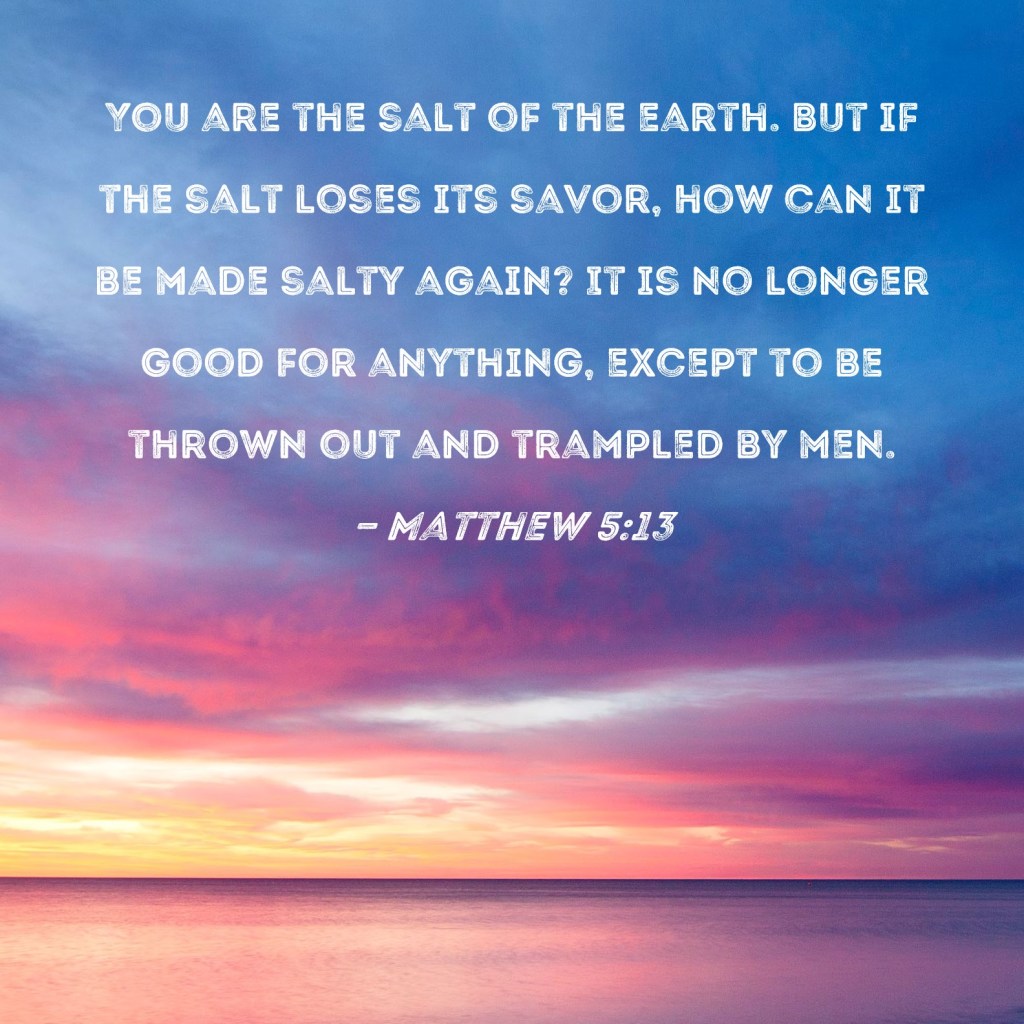
    Matthew 5:13 reads

    “Ye are the salt of the earth: but if the salt have lost his savour, wherewith shall it be salted? It is thenceforth good for nothing, but to be cast out, and to be trodden under foot of men.”

    3 Nephi 12:13 reads

    “Verily, verily, I say unto you, I give unto you to be the salt of the earth; but if the salt shall lose its savor wherewith shall the earth be salted? The salt shall be thenceforth good for nothing, but to be cast out and to be trodden under foot of men.”

    I don’t know about you, but when I think about salt the first thing I think about is taste. Especially when the word “savor” is used. But this is NOT what those hearing these words come from the source (Jesus Christ) would have thought about.

    In using the metaphor of us being “the salt of the earth”, with my understanding of taste, I would think about being a representative of the gospel to help it “taste” good to others. That by seeing the way I live, others can see that the Gospel is good. Another thought that comes to my mind about salt is its preservative properties. This metaphor could be looked at as those who are the salt of the earth conserve and preserve the Gospel, keeping it active and alive.

    How would the ancient Israelites and inhabitants of ancient America have viewed this metaphor? Turns out, the primary purpose of salt to these cultures would have been its ability to impact the smell of sacrifices.

    The commentary I read stated:

    “When sacrifices were offered upon the altars of ancient Israel, the Israelites did not give the Lord the flesh of the animal, the fruit of the ground, or the ashes or smoke of such sacrifices. The acceptable part of the offering presented to the Lord was the smell, ‘a sweet savour unto the Lord’ (Leviticus 1:17). (Many translations have the word “aroma” in the place of “savour”). In the Bible, the word savour most often refers to the pleasant smell of burning sacrifice in the temple. To ensure that the smell would be sweet, the Mosaic law required that the offering be liberally sprinkled with salt.

    “The scent of an unsalted burnt offering would be the stench of scorched flesh. But if the meat were generously salted, the odor would be quite different, ….. due to the reaction of the salt upon the cells that compose animal flesh. Under high-salt conditions, cellular fluid rapidly escapes the cells to dilute the salts outside cell membranes. ………When accentuated by heat, these fluids cause a sweet savour to emanate….

    “In this context the charge to be the ‘salt of the earth’ takes on marvelous significance. The Lord said, ‘I give unto you to be the salt of the earth; but if the salt shall lose its savour wherewith shall the earth be salted?’ (3 Nephi 12:13). The Savior’s audience no doubt understood the law of Moses and the close connection between salt and acceptable sacrifice (emphasis added).

    “It is clear that under the new covenant the followers of Christ, as “salt,” are responsible for extending gospel blessings to the whole earth. “When men are called unto mine everlasting covenant,” the Lord explains, “they are accounted as the salt of the earth and the savor of men” (D&C 101:39). It is our privilege and blessing to lovingly lead our brothers and sisters to Christ, helping them receive their covenant blessings. As we do so, we become the figurative salt that makes it possible for them to offer the acceptable sacrifice of a broken heart and a contrite spirit. In addition, our own covenant sacrifice of time, talents, and means is pleasing to the Lord.”

    The commentary concludes with this statement:

    “So how do we become the salt of the earth? The Apostle Paul points out that charity is a key to this process: “Be ye therefore followers of God, as dear children; And walk in love, as Christ also hath loved us, and hath given himself for us an offering and a sacrifice to God for a sweet smelling savour” (Ephesians 5:1-2).

    This gives the analogy of salt of the earth a whole new meaning.

    Without the gospel of Jesus Christ, and those keeping the covenants of God on earth, there is no acceptable sacrifice on the earth.

    I’ve written before about the One True Church and why it’s important. Our covenants are important.

    Malachi 4:5-6 reads

    Behold, I will send you Elijah the prophet before the coming of the great and dreadful day of the Lord:

    And he shall turn the heart of the fathers to the children, and the heart of the children to their fathers, lest I come and smite the earth with a curse.

    Modern revelation gives us more insight into this curse.

    D&C 128:18 reads

    the earth will be smitten with a curse unless there is a welding link of some kind or other between the fathers and the children, upon some subject or other—and behold what is that subject? It is the baptism for the dead. For we without them cannot be made perfect; neither can they without us be made perfect. Neither can they nor we be made perfect without those who have died in the gospel also; for it is necessary in the ushering in of the dispensation of the fulness of times, which dispensation is now beginning to usher in, that a whole and complete and perfect union, and welding together of dispensations, and keys, and powers, and glories should take place, and be revealed from the days of Adam even to the present time.

    We are the salt of the earth. We are the enabling welding link, through the power and priesthood of Jesus Christ Himself, that allows the sacrifices of this world to be of any worth, of a sweet savor, to God Almighty.

    What a beautiful and powerful responsibility. What a calling. Without the gospel our sacrifices are for naught. Our covenants are important.

    We must be the salt of the earth to save it from the curse, to make our sacrifices acceptable to God, to link ourselves to our past generations, and to one day come before God, having fulfilled our salt-like duties. To preserve, save, and help the earth on its eternal trajectory. What a sobering an humbling thought.

    As I always say, I am grateful for the Church of Jesus Christ of Latter-day Saints. I am grateful for the priesthood attached to it. I am grateful that we can help in God’s glorious plan.


  • Forgiveness, Doves, and The Chosen

    Forgiveness, Doves, and The Chosen

    Surprisingly I haven’t written about the Chosen yet.

    I’m about to finish season 3. I think this is an important TV show.

    In this season, there is a moment when Mary is talking to Tamar, a woman from Ethiopia.

    Mary voices jealousy towards Tamar for seemingly being able to push her way into the group without any hardships. Mary points out that she needed demons cast from her and to be pulled drunk from a tavern to get to her current place with Jesus. Mary seems to think Tamar is lacking humility due to her lack of trials.

    It was at this point that Tamar said something that jumped out at me while I watched:

    “Jesus forgave you, but you choose to hold on to it.”

    An episode later we get a look into Matthew’s past. Matthew is my favorite character.

    We see a flashback to when an old man came to Matthew during Matthew’s time as a tax collector. The man brazenly admits to legally accumulating tons of debt in an effort to help his children. The man will be sentenced to a prison camp because he’ll never be able to pay back the debt. He doesn’t care; he is an old man.

    The man then gives Matthew some prayer tassels. They are seemingly worthless, but the meaning of the old prayer tassels was significant to the old man. To him, those tattered tassels were priceless.

    The man gives them as a gift to Matthew telling him that one day he may regain his faith and need them. Matthew insists that he will never need those prayer tassels. The man insists.

    Matthew held onto those tassels and Mary found them.

    When Mary asked about them, Matthew told her the story. He didn’t understand why the man gave this sentimental item to him. Mary explained that the old man wasn’t giving some prayer tassels to Matthew, he was giving his faith to Matthew.

    Matthew’s response:

    “Why would he do that for someone like me?”

    Mary then told a story about a time she was going to kill herself. The only thing that stopped her was a dove. She saw it in the distance and took it as a sign that she shouldn’t do what she was considering.

    She told Matthew that man who gave away his prayer tassels was Matthew’s dove.

    These scenes from this powerful show gave me a lot to ponder.

    I often feel like Mary and Matthew.

    “Jesus forgave you, but you choose to hold onto it.”

    “Why would he do that for someone like me?”

    I pondered on whether I’m holding onto anything. Are you?

    The second question is a question I ask myself often. Why would God do this for someone like me? Why did Christ suffer, for me?

    Are we too hard on ourselves?

    I think back on some of my doves.

    Love is Powerful.

    The Inspiration.

    RIP Coach.

    Sometimes I think I’m like Mary, holding onto guilt that Christ no longer wants me to hold. That said, I have an interesting relationship with my guilt. I don’t dwell on it. I think a lot of it has left me. Still, sometimes I think I feel unworthy.

    We all hold onto things we should let go, becuase Christ already forgave us.

    We are surrounded by doves, those people that see our potential. We can always be the dove to someone else when they feel like they’re coming up short.

    We all feel unworthy sometimes, even though those around us see our potential. And God always sees our potential.

  • A Lesson on Prayer from Ivy

    A Lesson on Prayer from Ivy

    “Become as little children” (Matthew 18:3).

    I think about this a lot.

    Ivy and I pray together often. Most nights at dinner. Most nights before bed.

    I used to say the prayer almost every time. Then most nights we both would say a prayer. Then we started splitting it 50/50, sometimes I would say it, sometimes Ivy would say it. Now she says it almost every time.

    It’s really neat to see her try to replicate what I say. When we were both saying a prayer each night, she would usually ask me to go first. When it was her turn, it was clear she was trying to repeat as much of what I said as she could remember.

    When she started asking to go first then demanding I repeat things she said, I knew she was close to taking over this important responsibility. I was very happy.

    It’s fun watching her prayers evolve.

    Recently she’s started saying something profound and powerful every night.

    “Heavenly Father, thank you for everything we have, and thank you for everything we don’t have.”

    When is the last time you thanked God for everything you don’t have?

    The faith of a little child. What a thing.

    Now Ivy is teaching me how to pray.

    I couldn’t be happier.

  • A Kingdom Divided

    A Kingdom Divided

    The first step for Zion is to stop distinguishing ourselves from one another. We are first Children of God.

    President Russell M. Nelson has been clear about the three primary identities we should all focus on for ourselves. Those three identities are:

    First – children of God.

    The first identity is for every person on the face of the earth. Whether they realize it or not, every person is a child or God. The second and third identities are for members of the Church of Jesus Christ of Latter-day Saints. But this does not exclude anyone. The second and third identities are an invitation to the world.

    The second identity is child of the covenant.

    The third identity is disciple of Jesus Christ.

    President Nelson has stressed that anything we give precedence over these three identities distracts from our true potential. As children of God, children of the covenant, and disciples of Jesus Christ, we have a divine inheritance and royal home to return to. Any other worldly designation distracts from our ultimate goal of becoming everything we can be.

    Some of the other designations the world assigns include sexuality, status, race, and political affiliation. There are countless self-defined categories we assign ourselves. None of these things matter, they won’t matter at all when the veil is lifted, and we are reminded of what we always were.

    Zion are the pure in heart (D&C 97:21), Zion are one.

    All who believe in Christ are the children of Christ. But how is Zion established? How can there be unity in Christ given the divisive nature of the world and Christianity?

    A search for all the sects of Christianity brings up THOUSANDS of results. Thousands. How can one know the truth when there are so many claiming to be true? How can Christianity be united under Christ when there are thousands battling for attention, power, and patrons.

    How can God be a God of such confusion and disorder?

    In Luke 11:17 Jesus Christ says:

    Every kingdom divided against itself is brought to desolation; and a house divided against a house falleth.

    How would Jesus Christ feel about the state of the religion that espouses His name?

    I’ve heard it said that Christianity is united, despite its differences, in its faith in Christ. I think this is an admirable way to look at it. In fact, it’s how I try to look at it. It’s my opinion and belief that our faith in Jesus Christ is important and unites us. That said, what really unites us? What enduring principle is it that unites all Christians?

    Is it our belief in what Christ taught? There are a million different interpretations of what Christ taught.  

    Is it our belief in who Christ was? That couldn’t be a more divisive topic. Was He who He claimed to be? Was He the Son of God or wasn’t he?

    Is it our belief in the Atonement of Jesus Christ and what it accomplished? Again, there are different interpretations of Christ’s Atonement, why it was needed, and what it accomplished.

    Surely we can agree on Christ’s resurrection? Was Christ resurrected with His body or wasn’t He? Was there significance to Him eating fish with His disciples after His resurrection? Again, there is contention on this topic.

    What can Christianity be united on? It seems nothing.

    I believe the Church of Jesus Christ of Latter-day Saints provides the only solution to this problem. What Christianity can be united on is a connection to Jesus Christ. A real connection. Not a belief in Him, what He taught, or who He was. The connection must be real and tangible. The connection must be a welding link. The connection must have veracity on earth and in heaven (Matthew 18:18). That connection must be through a covenant.

    A covenant is a two-way promise.

    A covenant binds us to Him.

    When we get baptized, we promise to take upon us the name of Christ, and He becomes our shepherd. From that point on we are inseparably linked with Him.

    Latter-day Saints are a covenant people. The saints of God have always been covenant keepers.

    In the podcast Church History Matters, the hosts were speaking about the early history of temples in the Church of Jesus Christ. Something they said stood out to me as I’ve been working on writing this post.

    “…through the ordinances given to both men and women, living and dead, the human family is being knit or woven or let’s just use the word sealed together into one eternal holy order which we can call the family of God, we can call it the Kingdom of God, we can call it the Church of the Firstborn, we can call it the Celestial Kingdom, or simply the priesthood.”

    In the most recent General Conference of the Church of Jesus Christ of Latter-day Saints, Elder McCune of the Seventy said:

    Joy and eternal perspective come through being bound to the Savior by making and keeping covenants through Christlike discipleship.

    Adam, Abraham, Moses, and Peter; they made covenants with the great Jehovah and became His, and received of His power. Over time, they became more like Him. Over time they became one with Him. Enoch created Zion and was so connected to the Lord that he and his city were taken up to Him. This connection is made through covenants.

    What can unite Christianity? It is a covenant with Jesus Christ.

    Christ’s Church has temples where these covenants can be made.

    We must strive to be one with our brothers and sisters. We can only truly be one as we are united under one banner. The disjointed nature of Christianity is unacceptable. Covenants are needed. It is the banner of covenants with Jesus Christ that will unite Christianity, and nothing else. He died for us. In return, He asked us to believe in Him, follow Him, repent, and be baptized. That was His request of us. There is only one baptism that is acceptable to God the Father and that is the baptism with His authority in the name of His Son. No other baptism is acceptable to Him because it is a baptism not by His authority.

    I wish the Christian world could see that it is covenants that unite us to God. It is covenants that can re-unite us.

    I know as the Millenium approaches that one day all knees will bow and every tongue confess. At some future date the children of God will know and understand the covenants needed to unite the heavenly and eternal family.

    It is here for us now. But the world does not listen. Jesus was sent to this world, but He was not of it. This world struggles with the eternal nature of what God has in store for us. One day the world will have to understand what was always offered to us. What is offered to us is unity under Christ. Eternal families, eternal potential, eternal happiness, eternal inheritance. That is what will come when the world covenants to join with Jesus Christ and be Zion.

  • Wheat and Tares

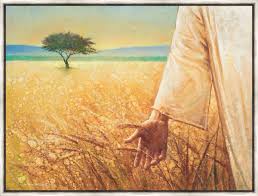
    Wheat and Tares

    Christ gives the parable of wheat and tares in Matthew 13:24-30:

    24 Another parable put he forth unto them, saying, The kingdom of heaven is likened unto a man which sowed good seed in his field:

    25 But while men slept, his enemy came and sowed tares among the wheat, and went his way.

    26 But when the blade was sprung up, and brought forth fruit, then appeared the tares also.

    27 So the servants of the householder came and said unto him, Sir, didst not thou sow good seed in thy field? from whence then hath it tares?

    28 He said unto them, An enemy hath done this. The servants said unto him, Wilt thou then that we go and gather them up?

    29 But he said, Nay; lest while ye gather up the tares, ye root up also the wheat with them.

    30 Let both grow together until the harvest: and in the time of harvest I will say to the reapers, Gather ye together first the tares, and bind them in bundles to burn them: but gather the wheat into my barn.

    In Doctrine and Covenants section 86 Christ gave an explanation of this parable. Here are His words:

    Verily, thus saith the Lord unto you my servants, concerning the parable of the wheat and of the tares:

    Behold, verily I say, the field was the world, and the apostles were the sowers of the seed;

    And after they have fallen asleep the great persecutor of the church, the apostate, the whore, even Babylon, that maketh all nations to drink of her cup, in whose hearts the enemy, even Satan, sitteth to reign—behold he soweth the tares; wherefore, the tares choke the wheat and drive the dchurch into the wilderness.

    But behold, in the last days, even now while the Lord is beginning to bring forth the word, and the blade is springing up and is yet tender—

    Behold, verily I say unto you, the angels are crying unto the Lord day and night, who are ready and waiting to be sent forth to reap down the fields;

    But the Lord saith unto them, pluck not up the tares while the blade is yet tender (for verily your faith is weak), lest you destroy the wheat also.

    Therefore, let the wheat and the tares grow together until the harvest is fully ripe; then ye shall first gather out the wheat from among the tares, and after the gathering of the wheat, behold and lo, the tares are bound in bundles, and the field remaineth to be burned.

    Quick rundown:

    Verses 1-3 explains the great apostasy that occurred to the church after the apostles “have fallen asleep” (aka were killed).

    Verse 4 reminds us that we’re now speaking of our day.

    Verse 5 tells us, “the angels are crying unto the Lord… to reap down the fields.” That can be interpreted different ways but basically the angels want to start with the harvest. The harvest can be considered the gathering of souls at the end of times. This leads to

    Verse 6 where the Lord tells the angels to hold off on the harvest because He doesn’t want to destroy the wheat. The wheat are the righteous, those followers of the Lord. The tares are those who oppose God.

    Verse 7 we learn that wheat will grow alongside tares until the end. Then the wheat will be separated from the tares, and the tares will be burned.

    I believe the most telling part of those verses is in verse 6 where it says, “for verily your faith is weak.”

    The Lord doesn’t want to pull up the tares because the wheat is still “tender” with weak faith.

    I’ve heard this parable many times but for the first time a thought occurred to me. What would it mean for the angels to reap the harvest and pull up the tares while the wheat is still weak? The tares being pulled up signifies the evil people of the world being taken away. The wheat would be too weak to handle this, the wheat is too intertwined with the tares. Wheat and tares, of course, represent people. What does it mean that the wheat is too tender for the tares to be taken? The thought that occurred to me was that the wheat, or faithful people, would have their faith shattered if the tares around them were taken. Could this represent the tares of some friends, family, and people we care about? What if God let loose the angels and took up the tares. How many faithful people would lose loved ones? 

    Are you a wheat or a tare?

    Is our faith weak or strong?

    In Matthew 13:38 Christ says

    “The good seed are the children of the kingdom; but the tares are the children of the wicked one”.

    Christ doesn’t detail the ok seed or the middle ground seed. We are good seeds or we are tares. We are working for Christ or working against Him. We are faithful or we lack faith.

    One day the wheat will be separated from the tares and the end will come. When that day comes, which side will we be on? The side of the wheat or the side of the tares? It’s not enough to be lukewarm as the adversary intensifies his attack. Wheat is nourishing, tares are not. There’s no middle ground. You are either a wheat or a tare.

    Which are you?