The other day I overheard someone talking about how they don’t believe in God. I didn’t talk to them. But later I daydreamed about what I could have said. I daydreamed about walking up to them and telling them I know God exists. I imagined this imaginary person asking ‘How do you know?’ I would then explain about the Book of Mormon, and that because of it, I can know that God exists. This imaginary person would then ask, ‘How do you know the Book of Mormon is true?’ At which point I could try to explain in less than 1000 words as even my imaginary friend starts to gloss over and not understand/comprehend/care about what I’m saying.
That’s what this short video made me think of. This video made me think of all the people I wish I could convince that the Book of Mormon is true. And along with that, all the people I wish I could convince that this matters, and it’s important.
A quick recap from the video and from myself because I can’t help myself –
Joseph Smith dictated the Book of Mormon without notes or source materials, nothing in front of him, in 65 working days. Today tens of thousands of people his same age stress and fret over 10-page term papers with sources included. The Book of Mormon is 531 pages.
So he was a literary genius? Quite the contrary, could hardly write an understandable letter.
So he faked for decades being an illiterate farm boy while dictating the greatest fictional literary work of all time? Uhm, okay. “This would require a beyond creative, theological genius to compile a book that radiates with the spirit.”
As this video says, it’s not about proving the Book of Mormon is true with facts.
It isn’t fiction. But I can’t prove that to anyone (as much as I think I actually can…). You have to read it then you have to ask God. And then if you get your answer, what next?
A reminder of what the Book of Mormon asks us to do – prove it. Then be baptized and remember Jesus Christ, the redeemer of this world.
3 Behold, I would exhort you that when ye shall read these things, if it be wisdom in God that ye should read them, that ye would remember how merciful the Lord hath been unto the children of men, from the creation of Adam even down until the time that ye shall receive these things, and ponder it in your hearts.
4 And when ye shall receive these things, I would exhort you that ye would ask God, the Eternal Father, in the name of Christ, if these things are not true; and if ye shall ask with a sincere heart, with real intent, having faith in Christ, he will manifest the truth of it unto you, by the power of the Holy Ghost.
5 And by the power of the Holy Ghost ye may know the truth of all things.
8 And it came to pass that he said unto them: Behold, here are the waters of Mormon (for thus were they called) and now, as ye are desirous to come into the fold of God, and to be called his people, and are willing to bear one another’s burdens, that they may be light;
9 Yea, and are willing to mourn with those that mourn; yea, and comfort those that stand in need of comfort, and to stand as witnesses of God at all times and in all things, and in all places that ye may be in, even until death, that ye may be redeemed of God, and be numbered with those of the first resurrection, that ye may have eternal life—
10 Now I say unto you, if this be the desire of your hearts, what have you against being baptized in the name of the Lord, as a witness before him that ye have entered into a covenant with him, that ye will serve him and keep his commandments, that he may pour out his Spirit more abundantly upon you?
If this book is true, what else matters!?!?
Family = eternity.
Jesus Christ = resurrection and eternal life.
Heavenly Father = our Father, we are sons and daughters of God.
If the Book of Mormon is true these things are true! Don’t day to day issues seem smaller when you realize you will live forever, with your family, as a divine being alongside THE divine beings?
I’ve been thinking recently. Why I care about this?
This being – the Gospel, the Church of Jesus Christ, the Church of Jesus Christ of Latter-day Saints, Jesus Christ in general.
Let’s start with Jesus Christ in general. I feel like I write about this constantly and it’s the constant conclusion to one of my posts, so I’ll be brief here. I care about Jesus Christ in general because He has given me everything. The least I can do in return is share Him, follow Him, try my best to be like Him.
Let’s go broader. Why do I care about the Gospel and the Church of Jesus Christ? That, I think goes in line with why I care about Jesus Christ Himself. If I care about Him, then I would care about His church, and I’d want to share His gospel. That lines up.
You’ll notice I distinguished the Church of Jesus Christ with the Church of Jesus Christ of Latter-day Saints. This is what I want to focus on and think about here.
Why do I care to share that I’m a member of the Church of Jesus Christ of Latter-day Saints? Why do I invite people to church? Why do I invite people to activities? Why do I share Book of Mormons? Why do I invite people to meet with the missionaries? Why do I share being a latter-day saint? Why do I talk about it? Why does it matter? Why do I care? Why do I keep doing it with such little success?
It’s something I think about relatively often. The why?
How do I stay motivated to write spiritually themed blog posts every week not very many read and fewer still are interested in?
Why do I keep having gospel discussions with people and trying to convince them that this is the restored Church of Jesus Christ – when everyone I talk to disagrees, or worse, doesn’t care?
Why do I keep inviting people to church and activities when they never come?
Why do I keep sharing scriptures and conference talks that no one reads or listens to?
Why is being a “Mormon” important?
Hmm.
Sounds depressing right? Sometimes it’s hard. Being a member missionary is hard. It’s discouraging. It seems like an endlessly fruitless effort.
And yet I’m not being persecuted or crucified so I have really nothing to complain about compared to saints from earlier times.
So, I’ve distinguished “The Church of Jesus Christ of Latter-day Saints” from “The Church of Jesus Christ” but that’s really the answer to the question of why. I do all these things, no matter how hard or discouraging, because I believe the Church of Jesus Christ of Latter-day Saints is the Church of Jesus Christ. I believe they are one and the same. I believe this is Christ’s restored church. I believe it is the way back to Him. I believe I was called and sent here to share it. That’s why I do it. That’s why I care.
I have a friend who converted to this church who once said something I found fascinating. He said, basically, “Whether it’s true or not, I don’t care. This church brings me happiness. It’s made my life better. It’s made me a better person. It’s made me feel closer to God. Is it true? Is it the One True Church? I don’t know. Really, I don’t care.”
He doesn’t care because for him it’s about his well-being. This church has helped his life and brought him joy. What does he care about the rest of it? While I think in a completely different way, I can appreciate this line of logic, this way of thinking. This person is an extreme pragmatist. So when he said this statement, it told me a lot about him.
Does what this individual said make him any less of a latter-day saint and disciple of Christ than me? I’ll say, I think it could, but it doesn’t. This person is still one of the most faithful, serving, selfless, Christ-like individuals I know. Ultimately his why doesn’t matter as much as who he is becoming, which is more like Jesus Christ.
I consider that person’s why somewhat temporal. ‘This church has been good to me and brought me joy, I’m for it.’
My why is different.
My question is, what if the church doesn’t bring you joy? What if it makes your life worse? This friend of mine might leave if that were the case. Right now he has no reason to leave.
Maybe this is why so many leave. They don’t see how the church is benefitting them.
This friend and I have a mutual friend. The mutual friend is very interested in religion and so we’ve had religious conversations together. After a few discussions, my friend said the mutual friend would never join the church. He said the mutual friend had too much to lose. His family would disown him, his wife would hate him, his whole life would change. It would be too hard. Should that person join the church?
My friend would say no.
Again, my why is different.
I look at that and say, “Is it true?”
Response from hypothetical person, “Well…”
“No well, is it true?”
If it’s true, if God sent a prophet, and that prophet established a church, and it’s Christ’s church – if it’s true – what else matters?
Is it true?
I believe it is.
That’s why it matters. That’s why I care. That’s why it’s so important to me.
I’ll write more on the temporal vs spiritual benefits of the church another time. But for now, I wanted to share that.
Is it true?
Yes.
Then it matters. It matters more than anything else on this entire earth.
Most of my blog posts are personal experiences with little research. They’re mostly just stream-of-thought writing. That’s what I prefer.
Every once in a while, I want to write about a topic I know nothing about, which results in some (or a lot) of research. My Adam-God Theory post is one that comes to mind.
I’ve long wanted to write a post about how the Trinity came to be. To prove this, years ago I gave my thoughts on the Trinity in this post.
And wrote about how I know the Godhead to be true in this post.
This has been a topic pretty consistently on my mind for a long time.
Quick definition so we can all follow along (because this isn’t going to be an advanced or complicated post), the Trinity refers to the belief that God the Father, Jesus Christ, and the Holy Ghost are all one being. Most of Christianity believes in the Trinity. The Church of Jesus Christ of Latter-day Saints, through the experience of the prophet Joseph Smith, believe in the Godhead. The Godhead is the belief that God the Father, Jesus Christ, and the Holy Ghost are three distinct beings who are one in purpose (John 17:21-23).
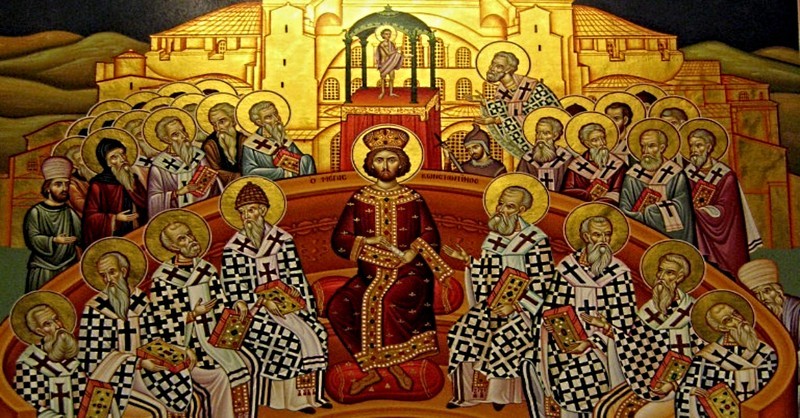
I’ve long wanted to learn more about how the Trinitarian belief came to be. I know it developed from the Nicene Creed. But if this is a falsehood perpetuated throughout history, how did it become so dominant? I’ve wanted to understand this history better. Part of the motivation to understand this better comes from the dominance of the Trinitarian viewpoint. When I’m trying to relate to other Christians, the Trinity vs Godhead question really becomes an issue.
To know God you must know who He is. When I talk to a Christian, we both believe in Jesus Christ, but who is Jesus Christ? It’s OK to say we both believe in God and go from there, but sometimes not understanding who God is keeps me and other Christians from really being able to progress and learn from each other.
Personally, I believe this is why this misunderstanding has been so perpetuated throughout history. Satan is cunning. He knows if we don’t know who our Father is, it becomes so much harder to worship Him.
Is that an unfair statement for me to make? I can hear all the Catholics and Protestants and Lutherans and Baptists in an uproar when I state that a core belief of theirs has been perpetuated by Satan to confuse them. I understand that this is inflammatory. When I’m told by those same groups of people that my belief that God the Father and Jesus Christ are separate and distinct beings is a lie that Satan has deceived me with, it hurts. So I get it.
This is why I want to understand where the belief in the Trinity comes from.
When I read the Bible, it’s so abundantly clear to me. It doesn’t make any sense to me that people can read the Bible and conclude that Heavenly Father and Jesus Christ are one person. And yet, I’m in the minority, so clearly, there’s more to it.
We all have our biases. I have always known Heavenly Father and Jesus Christ to be separate individuals. I have always known Christ to be my advocate with the Father. I have always known Heavenly Father to be my literal Heavenly Father. Seeing it any other way is hard. I get that others have always seen them as the same being. Others have read the scriptures with them being the same entity in mind. I get it.
Which leads me to my point.
As I studied this more, trying to understand it, the more confused I got. How this came to be is so confusing. I wanted to write a post simply explaining the history of the Nicene Creed and how the Trinitarian belief came to be and I’m realizing giving a “simple” explanation is going to take a lot more reading to understand.
Some things stood out as I’ve studied this topic. I have a 62,000+ word document of research, quotes, and other information from my study of this topic.
What stands out are the words I come across when reading how the Trinitarian belief came into existence.
“Argument” – 13 times in my notes.
“Debate” – 7 times in my notes.
“Power” – 18 times in my notes.
These are the words I kept coming across as I studied this topic.
One word stands out that I haven’t come across thus far in all my reading. That word is “revelation.” In all that I’ve read it’s always “debate” and “power” and “trial” and “gain” and “politics.” No revelation
I would love for a biblical and historical scholar to give me a crash course on the history of the creeds. For now, I continue to read, and study, and try to understand why the Christian world trusts a gospel principle that was handed down by power and politics, with little reference to the God they were trying to understand.
I conclude this post without a conclusion because I don’t yet have one. It will be the first of many posts about the Nicene Creed and the Trinitarian belief.
One of the great fallacies of Christian belief is what happens to people who die without being baptized, especially those who never, in mortal life, had an opportunity to be baptized.
The Church of Jesus Christ of Latter-day Saints is sometimes accused of diminishing God through the beliefs He has revealed to us. For example, the idea that we can become like Him. Other Christian sects look at this as some sort of disrespect towards God. Like us trying to be like our Father is an insult to Him. We’re similarly criticized for diminishing Christ’s Atonement in the faith and works discussion.
What of children who die without baptism? How many children have died without the opportunity to be baptized?
We’re criticized for diminishing Christ’s Atonement.
What’s more disrespectful to the price Christ paid for ALL of us than saying Christ’s Atonement doesn’t cover the billions of people – billions of babies and children, that have died without baptism? What a corrupt and sad view of the Atonement of Jesus Christ to say that it doesn’t protect innocent children who never could be baptized. He died for all of us.
So, I would like to share beautiful truths as revealed by God to his prophets in this dispensation that pertain to little children, salvation, the resurrection, and Christ’s Atonement.
The following are some frequently asked questions concerning the status of children who die before the age of accountability.
Are they automatically saved?
Elder Bruce R. McConkie wrote: “To this question the answer is a thunderous yes, which echoes and re-echoes from one end of heaven to the other. Jesus taught it to his disciples. Mormon said it over and over again. Many of the prophets have spoken about it, and it is implicit in the whole plan of salvation. If it were not so the redemption would not be infinite in its application. And so, as we would expect, Joseph Smith’s Vision of the Celestial Kingdom contains this statement: ‘And I also beheld that all children who die before they arrive at the years of accountability are saved in the celestial kingdom of heaven.’ [D&C 137:10.]
“It is sometimes asked if this applies to children of all races, and of course the answer is that when the revelation says all children it means all children. There is no restriction as to race, kindred, or tongue. Little children are little children and they are all alive in Christ, and all are saved by him, through and because of the atonement. …
“They are saved through the atonement and because they are free from sin. They come from God in purity; no sin or taint attaches to them in this life; and they return in purity to their Maker. Accountable persons must become pure through repentance and baptism and obedience. Those who are not accountable for sins never fall spiritually and need not be redeemed from a spiritual fall which they never experienced. Hence the expression that little children are alive in Christ.…
“Truly it is one of the sweetest and most soul-satisfying doctrines of the gospel! It is also one of the great evidences of the divine mission of the Prophet Joseph Smith. In his day the fiery evangelists of Christendom were thundering from their pulpits that the road to hell is paved with the skulls of infants not a span long because careless parents had neglected to have their offspring baptized. Joseph Smith’s statements, as recorded in the Book of Mormon and latter-day revelation, came as a refreshing breeze of pure truth: little children shall be saved. Thanks be to God for the revelations of his mind where these innocent and pure souls are concerned!” (“The Salvation of Little Children,” Ensign, Apr. 1977, pp. 4, 7.)
Even though little children will be saved, does that mean they will have eternal life?
Elder McConkie explained: “Eternal life is life in the highest heaven of the celestial world; it is exaltation; it is the name of the kind of life God lives. It consists of a continuation of the family unity in eternity. … children will be saved in the celestial kingdom. Salvation means eternal life; the two terms are synonymous; they mean exactly the same thing. Joseph Smith said, ‘Salvation consists in the glory, authority, majesty, power and dominion which Jehovah possesses and in nothing else.’ (Lectures on Faith, pp. 63–67.) We have come to speak of this salvation as exaltation—which it is—but all of the scriptures in all of the standard works call it salvation. I know of only three passages in all our scriptures which use salvation to mean something other and less than exaltation.” (“Salvation of Little Children,” p. 5.)
President Joseph Fielding Smith added:
“The Lord will grant unto these children the privilege of all the sealing blessings which pertain to the exaltation.
“We were all mature spirits before we were born, and the bodies of little children will grow after the resurrection to the full stature of the spirit, and all the blessings will be theirs through their obedience, the same as if they had lived to maturity and received them on the earth.
“The Lord is just and will not deprive any person of a blessing, simply because he dies before that blessing can be received. It would be manifestly unfair to deprive a little child of the privilege of receiving all the blessings of exaltation in the world to come simply because it died in infancy.…
“Children who die in childhood will not be deprived of any blessing. When they grow, after the resurrection, to the full maturity of the spirit, they will be entitled to all the blessings which they would have been entitled to had they been privileged to tarry here and receive them.” (Doctrines of Salvation, 2:54; see also Mosiah 15:25.)
Why do some children die and others live? Are those who die better off than those who remain in mortality?
Elder McConkie wrote:
“We may rest assured that all things are controlled and governed by Him whose spirit children we are. He knows the end from the beginning, and he provides for each of us the testings and trials which He knows we need. President Joseph Fielding Smith once told me that we must assume that the Lord knows and arranges beforehand who shall be taken in infancy and who shall remain on earth to undergo whatever tests are needed in their cases. This accords with Joseph Smith’s statement: ‘The Lord takes many away, even in infancy, that they may escape the envy of man, and the sorrows and evils of this present world; they were too pure, too lovely, to live on earth.’ (Teachings, pp. 196–97.) It is implicit in the whole scheme of things that those of us who have arrived at the years of accountability need the tests and trials to which we are subject and that our problem is to overcome the world and attain that spotless and pure state which little children already possess.” (“Salvation of Little Children,” p. 6.)
Will children who die before the years of accountability ever be tested in the way that other mortals are tested?
President Joseph Fielding Smith said: “Satan cannot tempt little children in this life, nor in the spirit world, nor after their resurrection. Little children who die before reaching the years of accountability will not be tempted.” (Doctrines of Salvation, 2:57; see also D&C 29:47; 45:58.)
What will happen to children in the Resurrection?
President Joseph F. Smith wrote: “Joseph Smith taught the doctrine that the infant child that was laid away in death would come up in the resurrection as a child; and, pointing to the mother of a lifeless child, he said to her: ‘You will have the joy, the pleasure, and satisfaction of nurturing this child, after its resurrection, until it reaches the full stature of its spirit.’ There is restitution, there is growth, there is development, after the resurrection from death. I love this truth. It speaks volumes of happiness, of joy and gratitude to my soul. Thank the Lord he has revealed these principles to us.” (Gospel Doctrine, pp. 455–56.)
Thank the Lord He has revealed these principles to us. Amen.
I’ve heard of the “Adam-God Theory” but never looked into it. Until recently, I really didn’t know what exactly it referred to. Here is my research into the Adam-God theory for those interested and especially for those who may have concerns about this theory and its history in the restored Church of Jesus Christ.
Before I begin, almost all my thoughts come from this link:
It was a great resource on this topic and I recommend it if you want to learn more.
If you want a quick, short video that sums up the whole history of the Adam-God theory, watch this video:
Now, my thoughts.
The Adam-God theory is the theory that Adam and God the Father are the same person. This theory was mentioned by Brigham Young.
First – Adam is not God the Father. Adam is not who we pray to. This does not fit the teachings of the scriptures, does not fit modern revelation, is not a doctrine of the restored gospel. So why are we talking about it, you ask?
Second – Yes, Brigham Young did make some bold statements about Adam being God. He also made countless statements contradicting that statement. Brigham Young was a convert and a prophet. Try to imagine the dichotomy of those positions. Try to imagine someone a few years into the faith trying to lead the entire church. Is it so shocking that there were erroneous statements made, especially when we consider and understand the personality and boldness of the prophet who led the saints across the rugged wilderness of the West?
Third – Because Brigham Young made incorrect statements does not mean he was a false prophet. It means he was learning line upon line, and he made false statements. He has made statements to try to help us, the people of the church, reconcile some of his more questionable comments. For example, when speaking generally about who Adam was and proposing some thoughts about Adam, Brigham started by saying, “I propose to speak upon a subject that does not immediately concern yours or my welfare….I do not pretend to say that the items of doctrine and ideas I shall advance are necessary for the people to know, or that they should give themselves any trouble about them whatever.. (Brigham Young, Oct 8, 1851). If it does not concern our welfare, don’t get too hung up on it. The church was young and growing when Brigham was prophet. God has always worked through us, mortals, to fulfill His works. This has always resulted in fallibility. Brigham Young was a prophet, even if he made mistakes in the thousands of public discourses he gave during his learning period as a prophet/convert.
Fourth – Because prophets are fallible does not mean we cannot trust and follow them. As The Church has grown out of its infancy, it has strengthened itself in countless ways. One of those strengths has become the checks and balances of the church organization. The First Presidency and Quorum of the Twelve Apostles must be unanimous in any declaration of doctrine. President Nelson speaks hundreds of times a year. Not every word from his mouth (in my opinion) is scripture. It is guidance and direction from God’s anointed prophet, yes, but not scripture. But when President Nelson, the First Presidency, and the Quorum of the Twelve sign their names to a declaration, it becomes binding guidance on doctrine, church policy, etc. Such was the case with “The Family: A Proclamation to the World” for example.
Now, the statement made by Brigham that when Adam and Eve came to the Garden of Eden they already had celestial, resurrected bodies is interesting. I more think they came with perfect bodies as they came directly from the Father and hadn’t yet been corrupted by the fall, not that they were necessarily resurrected bodies yet. Celestial, maybe, resurrected, I don’t think so. That’s all I will say on this matter, though, to support my point earlier that things that distract from our salvation should be discussed with caution. I haven’t done enough research, pondering, or praying to comment on this with much confidence and would hate for my children 150 years from now to claim I believed Adam was already resurrected when put in the Garden of Eden. See how these small comments can be blown out of proportion? Grateful I’m not a prophet.
Another thought – the eternal nature of the plan of happiness is not something we can begin to comprehend. If it ultimately distracts us from our current efforts towards salvation, we should tread with ultimate caution. Such is the thinking about if Adam lived on another planet before he came here and countless other thought experiments that might distract from what is important, which is, Jesus Christ performed the ultimate atoning sacrifice for my sins. He died so that I can live. He suffered so I can be forgiven and can live with God, my Father, again. All other questions, while interesting and can expand our minds and thinking, if they distract from the ultimate source of our salvation – the Plan of Salvation and Christ’s personal role in it for us – should be avoided.
Those are my thoughts on this from my research. Here are some final items to really, I hope, put this theory and any issues involved with it, to rest.
As mentioned, Brigham contradicted himself many times on the idea that Adam was God. While he mentioned the idea a couple times in public, there are many other instances of Brigham Young speaking where he clearly separated Adam and God the Father as two separate individuals.
BYU professor Stephen E. Robinson sums it up well:
“Yet another way in which anti-Mormon critics often misrepresent LDS doctrine is in the presentation of anomalies as though they were the doctrine of the Church. Anomalies occur in every field of human endeavor, even in science. An anomaly is something unexpected that cannot be explained by the existing laws or theories, but which does not constitute evidence for changing the laws and theories. An anomaly is a glitch…. A classic example of an anomaly in the LDS tradition is the so-called “Adam-God theory.” During the latter half of the nineteenth century Brigham Young made some remarks about the relationship between Adam and God that the Latter-day Saints have never been able to understand. The reported statements conflict with LDS teachings before and after Brigham Young, as well as with statements of President Young himself during the same period of time. So how do Latter-day Saints deal with the phenomenon? We don’t; we simply set it aside. It is an anomaly. On occasion my colleagues and I at Brigham Young University have tried to figure out what Brigham Young might have actually said and what it might have meant, but the attempts have always failed. The reported statements simply do not compute—we cannot make sense out of them. This is not a matter of believing it or disbelieving it; we simply don’t know what “it” is. If Brigham Young were here we could ask him what he actually said and what he meant by it, but he is not here…. For the Latter-day Saints, however, the point is moot, since whatever Brigham Young said, true or false, was never presented to the Church for a sustaining vote. It was not then and is not now a doctrine of the Church, and…the Church has merely set the phenomenon aside as an anomaly.”
“As far as can be determined, none of Brigham Young’s successors in the presidency of the Church continued this teaching in public, and by the presidency of Joseph F. Smith (1901–18) there were active moves to censure small groups that taught Adam-God.
One of the earliest statements from the Church rejecting Adam-God teachings was made by Charles W. Penrose in 1902:
‘The Church of Jesus Christ of Latter-day Saints has never formulated or adopted any theory concerning the subject treated upon by President Young as to Adam.‘
In October 1976 general conference, Spencer W. Kimball declared the Church’s official position on Adam-God:
‘We warn you against the dissemination of doctrines which are not according to the Scriptures and which are alleged to have been taught by some of the General Authorities of past generations. Such, for instance, is the Adam-God theory. We denounce that theory and hope that everyone will be cautioned against this and other kinds of false doctrine.‘”
Other statements by future general authorities refuting Brigham Young’s opinions:
Bruce R. McConkie – “What I am saying is that Brigham Young, contradicted Brigham Young, and the issue becomes one of which Brigham Young we will believe. The answer is we will believe the expressions that accord with the teachings of the Standard Works.”
And Brigham Young himself – “I am more afraid that this people have so much confidence in their leaders that they will not inquire for themselves of God whether they are led by Him. … Let every man and woman know, by the whisperings of the Spirit of God to themselves, whether their leaders are walking in the path the Lord dictates, or not.”
Finally, while some might consider everything said here to be a sign that the church changes and is “wrong,” I would completely refute that. The church is changing. The church is growing. The church is living.
Doctrine and Covenants 1:30 is Christ speaking and reads “And also those to whom these commandments were given, might have power to lay the foundation of this church, and to bring it forth out of obscurity and out of darkness, the only true and living church upon the face of the whole earth, with which I, the Lord, am well pleased, speaking unto the church collectively and not individually.”
While so many would criticize the Church of Jesus Christ of Latter-day Saints for changing, the Lord describes it as living. The only living church on the face of the earth. This is a power of Christ’s church- not a weakness.


 No Coincidences