Most of my blog posts are personal experiences with little research. They’re mostly just stream-of-thought writing. That’s what I prefer.
Every once in a while, I want to write about a topic I know nothing about, which results in some (or a lot) of research. My Adam-God Theory post is one that comes to mind.
I’ve long wanted to write a post about how the Trinity came to be. To prove this, years ago I gave my thoughts on the Trinity in this post.
And wrote about how I know the Godhead to be true in this post.
This has been a topic pretty consistently on my mind for a long time.
Quick definition so we can all follow along (because this isn’t going to be an advanced or complicated post), the Trinity refers to the belief that God the Father, Jesus Christ, and the Holy Ghost are all one being. Most of Christianity believes in the Trinity. The Church of Jesus Christ of Latter-day Saints, through the experience of the prophet Joseph Smith, believe in the Godhead. The Godhead is the belief that God the Father, Jesus Christ, and the Holy Ghost are three distinct beings who are one in purpose (John 17:21-23).
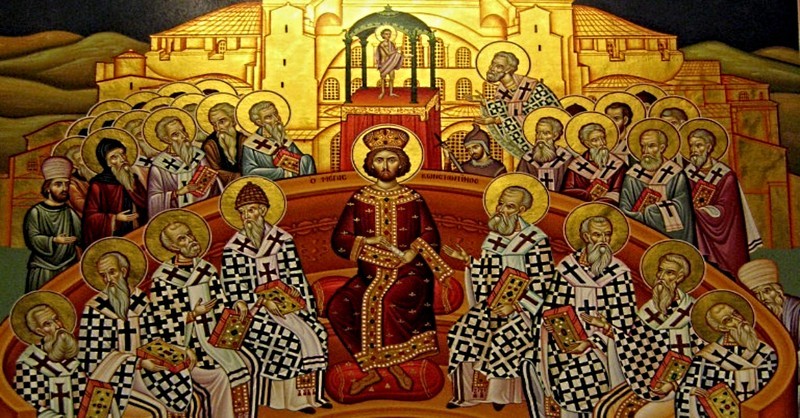
I’ve long wanted to learn more about how the Trinitarian belief came to be. I know it developed from the Nicene Creed. But if this is a falsehood perpetuated throughout history, how did it become so dominant? I’ve wanted to understand this history better. Part of the motivation to understand this better comes from the dominance of the Trinitarian viewpoint. When I’m trying to relate to other Christians, the Trinity vs Godhead question really becomes an issue.
To know God you must know who He is. When I talk to a Christian, we both believe in Jesus Christ, but who is Jesus Christ? It’s OK to say we both believe in God and go from there, but sometimes not understanding who God is keeps me and other Christians from really being able to progress and learn from each other.
Personally, I believe this is why this misunderstanding has been so perpetuated throughout history. Satan is cunning. He knows if we don’t know who our Father is, it becomes so much harder to worship Him.
Is that an unfair statement for me to make? I can hear all the Catholics and Protestants and Lutherans and Baptists in an uproar when I state that a core belief of theirs has been perpetuated by Satan to confuse them. I understand that this is inflammatory. When I’m told by those same groups of people that my belief that God the Father and Jesus Christ are separate and distinct beings is a lie that Satan has deceived me with, it hurts. So I get it.
This is why I want to understand where the belief in the Trinity comes from.
When I read the Bible, it’s so abundantly clear to me. It doesn’t make any sense to me that people can read the Bible and conclude that Heavenly Father and Jesus Christ are one person. And yet, I’m in the minority, so clearly, there’s more to it.
We all have our biases. I have always known Heavenly Father and Jesus Christ to be separate individuals. I have always known Christ to be my advocate with the Father. I have always known Heavenly Father to be my literal Heavenly Father. Seeing it any other way is hard. I get that others have always seen them as the same being. Others have read the scriptures with them being the same entity in mind. I get it.
Which leads me to my point.
As I studied this more, trying to understand it, the more confused I got. How this came to be is so confusing. I wanted to write a post simply explaining the history of the Nicene Creed and how the Trinitarian belief came to be and I’m realizing giving a “simple” explanation is going to take a lot more reading to understand.
Some things stood out as I’ve studied this topic. I have a 62,000+ word document of research, quotes, and other information from my study of this topic.
What stands out are the words I come across when reading how the Trinitarian belief came into existence.
“Argument” – 13 times in my notes.
“Debate” – 7 times in my notes.
“Power” – 18 times in my notes.
These are the words I kept coming across as I studied this topic.
One word stands out that I haven’t come across thus far in all my reading. That word is “revelation.” In all that I’ve read it’s always “debate” and “power” and “trial” and “gain” and “politics.” No revelation
I would love for a biblical and historical scholar to give me a crash course on the history of the creeds. For now, I continue to read, and study, and try to understand why the Christian world trusts a gospel principle that was handed down by power and politics, with little reference to the God they were trying to understand.
I conclude this post without a conclusion because I don’t yet have one. It will be the first of many posts about the Nicene Creed and the Trinitarian belief.
 No Coincidences
Leave a comment