Tag: Science

  • What the Theory of Evolution is Missing

    What the Theory of Evolution is Missing

    This is going to go a direction you won’t expect. I’m not going to argue against Darwin’s Theory of Evolution. I’m not nearly smart enough to discuss the theory of evolution in much detail.

    What I will do instead, is propose my own theory.

    Scientists who are proponents of the theory of evolution believe that life is constantly evolving. Over billions of years, a process called natural selection has taken place. Natural selection is basically the idea of survival of the fittest. If you’re the fittest, you survive. If you survive, you procreate. Survival of the fittest. Natural selection.

    The disconnect, for me personally, is when the theory of evolution brings scientists to the conclusion that God doesn’t exist. The omniscient, omnipresent, omnipotent God, creator of Heaven and Earth, couldn’t allow his creations to change?

    Here is where I will diverge from class Christian thinking. The theory of evolution doesn’t go far enough.

    “As man now is, God once was: As God now is, man may be.”

    What is it to attain the fulness of God? (Ephesians 3:19).

    You think fundamentalist Christians hate the theory of evolution already? Imagine their hate for us if we say it hasn’t gone far enough.

    Now, the theory evolution is more than just change. As I noted, it’s about natural selection. Darwin’s theory is that natural selection leads to change. Christ’s theory is He leads to change.

    I’m not saying that Christ is leading plants and animals to change. They have their own process to fulfill the measure of their creation.

    But Christ does lead us to change, or evolve, if you want to use that word.

    Many of both religious and scientific persuasions would scoff at this notion.

    Look again at the theory of evolution. Living creatures are evolving.

    Why would humans not aspire or evolve to something greater then? I’m not talking about from mushrooms or apes. We are God’s children and as His children we have a divine inheritance. Our evolution is much greater. It’s from what we are now, to what Christ is now. This is possible because our Heavenly Father wants to give us “all he hath.”

    What do I change into while here on earth, in a small amount of time? I turn into my parents. I become more and more like my dad every day. What do we evolve or change to eternally? God. He is my Father. It’s the natural order of things.

    Joseph Smith often talked about how scholars, intellectuals, and religionists ridiculed him. Yet all he ever taught was what made sense. What made sense were eternal truths.

    The boy, like to his father grown,

    Has but attained unto his own;

    To grow to sire from state of son,

    Is not ’gainst Nature’s course to run.

    A son of God, like God to be,

    Would not be robbing Deity.

    Lorenzo Snow

    Paul understood this (Philippians 2:5-6) –

    “Let this mind be in you, which was also in Christ Jesus:

    Who, being in the form of God, thought it not robbery to be equal with God”

    So, the scientific-minded, expand your thinking. Religious minded, expand your thinking. Embrace your inheritance and all that the Father has to offer you. Embrace change, embrace the Atonement of Jesus Christ that allows all change. Embrace your evolution. God wants you to aspire to be like Him. It isn’t robbery to Him. What greater joy is there than watching your children grow, develop, and become better? Maybe even become like you.  

    Where does the theory of evolution lead? Where are we headed, what do we become? What is our evolution?

    Our evolution is to become like God, our Father.

  • Speed of God

    Speed of God

    I recently read a book called ­Project Hail Mary. It’s by the same guy who wrote The Martian. This book has the space travel and physics concept of time dilation involved. I’m an ignoramus when it comes to the physics of this so I’m not going to say anything smart here. Time dilation is the idea that if you’re moving at a fast enough speed, you will age slower than someone moving at a normal or slower speed. See a movie like Interstellar for example. This is related to Einstein’s theory of relativity.

    To think about someone moving at a speed that makes them age slower than others – time dilation – is a beyond complext concept. The book had a comment like, “I’m glad the universe thought to have time slow down as you approached the speed of light.” That made me think, it’s amazing the universe is like this.

    Before I continue, I just wanted to share, this is the beginnings of a thought on how the physics of this complex phenomena might explain something about God, our relationship to Him, and our position to Him in the cosmos. In doing this, because I’m so ignorant on the topic and don’t fully understand it, I’m sure I’ll get something wrong that someone who better understands the science of this topic can point out. That’s fine. I take comfort in the fact that the people out there that adequately understand this concept are roughly 1 per 1 billion so probably unlikely to read my blog.

    This is more a mental exercise for myself.

    So… the faster you move, the slower you age. What is age for us? It is our mind and bodies degrading.

    God is the center of the universe. We all revolve around God. As we move closer to God, we move closer to the center.

    I’ve written about God and time before, here for example.

    Time is definitely different and potentially nonexistent for God. We talk about 1000 years for us being a day for God, in a way for us to try to understand God’s “time” (see Psalm 90:4 and 2 Peter 3:8, and especially D&C 130:4-11).

    God is light. God is in the center. So that would be why 1000 years for us is like a day for God. Time moves slower for Him because He’s at the center. Of course, God doesn’t age, He has a resurrected, perfected, and celestial body, but time moves slower for Him because He moves infinitely faster than the speed of light. He moves at the speed of everything – past, present, and future.

    So at a higher speed or revolution, less time is experienced. God’s mind, power, and faith move at a rate impossible for us to comprehend. Maybe that’s what makes Him in everything, alpha and omega, the beginning and the end. His higher speed puts Him on a higher plane. If we come closer to God, we would have to come closer to His speed and His plane, His level. If we do that, then time would slow down for us. We would be able to comprehend more. We would “age” slower. We would become like Him.

    By the way, this sent me down a wormhole (pun intended) of Youtube videos on time dilation, wormholes, the general theory of relativity, “nothing,” the twin paradox, space, and a plethora of other topics. This all led me to believe, while I can’t properly put into words my exact theory, that there is something to the above. There is something to God being the center. There is something to Christ being “light” which we know we can’t, in this life, move at the speed of. There is something to this physics and God thing. That makes sense given that God would be the master physicist as the Creator of the Universe.

    I’ll leave these musing at this point. Basically, long story short, there is something to God being on Kolob and us and our solar system revolving around Him. More on this as I explore this thought more.

  • Thomas Edison and the Unimaginable

    Thomas Edison and the Unimaginable

    How do you imagine something unimaginable?

    This thought is motivated by an awesome podcast called “How to Take Over the World.” I highly recommend it.

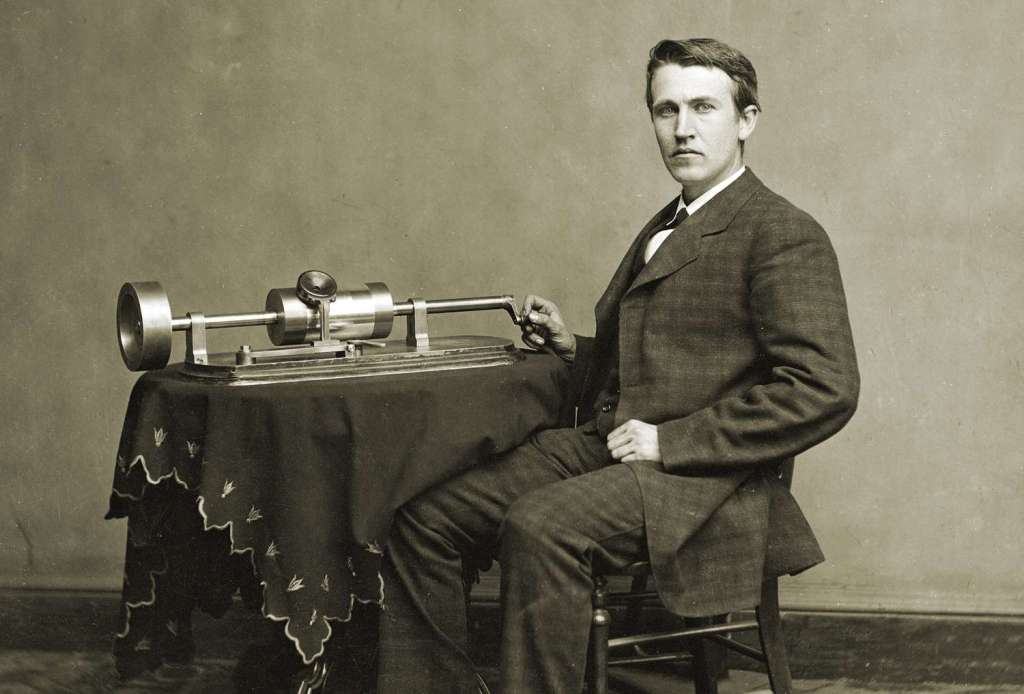
    When Thomas Edison discovered the ability to replay the voice using an invention that would become the phonograph, people couldn’t begin to fathom what they were hearing.

    When Edison started showing his new invention to individuals who had never seen anything like it before, this was a regular occurrence:

    A person would come in. Edison’s invention would be used to play back some recorded statement. The person would be asked what they just heard. The person would have no idea.

    The person would then be told that what they were about to hear was a human voice. The same recording would be replayed. The person would be able to repeat every word from the recorded statement.

    People who had never “seen” (heard) this before literally couldn’t fathom what was happening, so much so that their brains couldn’t even quantify it. How crazy is that? Makes you think how amazing it is that hearing the recorded voice has become so second nature to us. Up until 150 years ago, no human ears had ever heard the human voice from anything other than a human mouth.

    This new invention led to tons of confusion and misinformation about this device. People thought that dead spirits were speaking or the machine itself was talking. People just couldn’t wrap their minds or imaginations around the human voice being replayed.

    There is even a story of a scientist writing Edison after reading an article about the new invention/wonder in a magazine. The scientist asked Edison to issue a public statement refuting the absurdity, as it was not scientifically possible.

    This invention created a worldwide phenomenon. Thomas Edison became a celebrity overnight.

    This story leads to many interesting thoughts.

    The first interesting thing to consider is the idea of thinking about something that you can’t comprehend. When was the last time you were truly shocked by something? In the day and age we live in, nothing shocks us anymore. We’ve become numb to the fantastic world we live in. Moving stairs, cold boxes for food, flying tubes of steel, speeding metal squares: these things are amazing. We don’t even marvel at UFOs anymore, for crying out loud.

    I’m fascinated by inventors. I’m fascinated by people that can create something most of us never even dreamed possible. That was the phonograph, that was playing the human voice. Think how second nature the recorded voice has become to us. But back then, it was UNFATHOMABLE.

    The second thought that came to me from this story was, what do we really know about the world around us? We consider our society so intellectually mature and advanced, and yet, what do we really know about science? When we discover a fourth dimension, will we be shocked? When we learn there’s a spiritual realm all around us that we can’t see, how amazed will people be?

    This is also a lesson in trusting our senses. People back then couldn’t believe their eyes or ears. Today this has become a saying flippantly thrown about: “I couldn’t believe my eyes.” No, back then, they really couldn’t believe their eyes or ears. How much trust do we put in our senses? When it comes down to it, we can so quickly feel like our senses are deceiving us.

    Another noteworthy thing about this story is what the public latched onto when they heard of this invention. People got it into their heads that what was being played when the phonograph spoke were the voices of the dead. This kind of made sense. It was such a foreign concept to them, they just went to the most fantastical thing. Soothsayers and fortune tellers have existed for millennia. The natural assumption by people at that time was, if an unexplainable, miraculous, disembodied voice is speaking, it must be the dead talking.

    Not only did people jump to the conclusion that it was the dead speaking, they latched to the idea with an abundance of enthusiasm. Our fascination with the dead is endless, especially today. Why are we so enthralled by the idea? Why is it so important to us? Well, I believe, it’s because the hearts of the fathers are being turned to the children and the hearts of the children being turned to the fathers (Malachi 4:6, D&C 2, D&C 110:13-16, D&C 138:46-48, JSH 1:37-39).

    It’s our natural hope and desire to speak to our loved ones on the other side. We are drawn to them.

    There is an invention today, also from the 1800s, that is magnitudes more magnificent than the phonograph. This invention is equally as mystifying. In 1836 Joseph Smith, Jr. dedicated a temple to the Lord. This “invention” allowed the sealing of families for eternity. This miraculous invention, like the phonograph, is little understood by the world. Much of the world doesn’t realize this “invention” exists. Coincidentally, the phonograph was invented in 1877. The oldest standing Temple of God is the St. George temple which was dedicated in 1877.

    How amazing to see the temple work of this dispensation where so many of our hearts are turned to our progenitors who have already passed through the veil. When temple work is done for a family member, a real bond is created. We are all connected.

    This, I believe, is why people were hopeful the phonograph was a way for them to speak to their dead.

    The phonograph is an invention that has blessed the lives of so many with the ability to communicate here on Earth. Temples bless every person who has ever lived, does now live, or will ever live. The temple is eternal. I’m grateful to live in a time when we know of temples and of their eternal significance. I’m grateful to have temples nearby. I’m grateful to be sealed to my family for eternity. I’m grateful to know I will see all my loved ones again.

    How powerful is that? How amazing is that? We get to do work for our dead, be linked to them forever, and create a connection for eternity. Now that’s an amazing invention.

    Columbus, Ohio Temple
  • Bees Perceive Time….or do they

    Bees Perceive Time….or do they

    Can bees perceive time?

    Scientists put sugar water outside of a beehive every day at 4:00pm and found that the bees soon started coming out of their hives for the sugar water at 4:00pm every day. The bees did this even when there was no longer any sugar water left out for them.

    Therefore, bees perceive time.

    But some said, “Hold on, what if the bees are measuring the angle of the sun.”

    So they did the experiment in the dark. The bees still came out at 4:00pm.

    Therefore, bees perceive time.

    But…some said, “Hold on, what if the bees are measuring the heat from the sun?”

    These back and forths happened repeatedly until the experiment was eventually performed underground in a salt mine.

    But…some said, “What if the bees are measuring the rotation of the Earth?”

    How do we prove that bees perceive time?

    Then, a scientist did the exact same experiment, not in a salt mine, but in Paris. Then that scientist flew the bees to New York City. The bees left the hive at 10:00am because they had jetlag.

    This proved that bees perceive time… I think? (Maybe bees have an internal clock completely separate from our “time.” Do bees, in this case, perceive time “more” than I do because I don’t think I could be that precise…. But I digress). I’m not smart enough to think of another, “What if bees were doing this,” scenario, but what this did make me think about is how faulty our human logic is. Almost anything can be proven or disproven. What do we really know…about anything?

    With all our science, logic, and knowledge, we still basically know nothing. Our very own bodies are a mystery. We still don’t know how the pyramids were built. There are theories, of course, but we’ll never really know until it is revealed to us. I’m amazed at the pompous ignorance of our generation. Our generation believes that because we can Google something we’re the smartest generation to ever live on the earth, while most of us can’t begin to explain how “Google” even works.

    This story just made me think of the frailty of our own brilliance.  It’s hard to prove anything and we’re really not as smart as we all think. That’s all. 

  • The God Question: Intelligent Design, Evolution, and God

    The God Question: Intelligent Design, Evolution, and God

    This is a version of an essay I wrote for a science and religion course. That’s why it has such an “official” tone, and the headlines. I don’t share this because I think it’s an extraordinary essay. But I do think I made some decent points about the “God issue” in science. When you spend this much time writing an essay that fits the theme of your blog, it’s just gotta be shared. So here’s my essay on intelligent design, evolution, and God.

    Intelligent Design and Evolution

    God is the center of the debate between science and religion, and in particular the debate between the theories of evolution and intelligent design. To claim any other conflict ahead of the question of whether God exists is to distract from the root cause that separates these theories. If the question of God’s existence could be solved one way or another, then evolution and intelligent design could coexist and potentially benefit one another. Unfortunately, the existential question of God will never be solved by science. Therefore, with God being the center of the issue, exploring the “God issue” between evolution and intelligent design is the best way to help the two theories reconcile with one another, even if the true question, “does God exist?” is never answered.

    The God Question

    Believers of evolution and believers of intelligent design have more to agree upon than is often realized. However, there is one topic or question that creates a gulf between the two fields. That question is: Does God exist? When evolutionists and intelligent design proponents come to understand this as the main question that separates them, it may be possible to relate and coexist, and therefore grow as fields of knowledge alongside one another. It is the loud voices of ardent atheist evolutionists such as Richard Dawkins, Sam Harris, and Daniel Dennett who pronounce aggressive disbelief in God, and it is the loud and passionate voices of creationists who oppose belief in the undeniable evidence of evolution that create this void (Wolf, 2006). The milder, middle-of-the-road voices get drowned out by the louder minority. The believer in intelligent design who accepts the facts of evolution and the believer in evolution who can see the merits in intelligent design theory are the voices that bring these two fields to an agreement that benefits both. Intelligent design need not deny many aspects of the theory of evolution. Evolution need not devalue the merits of the theory of intelligent design. At the root of the conflict is the belief in God. Coming to understand God as the major issue and question can bring both sides into more agreement, or at the very least, a middle-ground of mutual understanding.

    Historical Belief in God

    The thinking of the world has transitioned aggressively from a belief in God. While there has been a movement away from God, especially in scientific communities, as can be illustrated in countless scholarly writings such as The God Delusion (Dawkins, 2006) and Why Intelligent Design Fails (Young & Edis, 2014), a large portion of the world still believes in some higher power, some creator that put humans on this earth. It is nearly impossible for a firm believer in God to remove that innate belief from their consciousness.

    In the book The 5000 Year Leap, Cleon Skousen (2011) discusses John Locke’s famous Essay Concerning Human Understanding. “In it Locke pointed out that it defies the most elementary aspects of reason and experience to presuppose that everything in existence developed as a result of fortuitous circumstance. The mind, for example, will not accept the proposition that the forces of nature, churning about among themselves, would ever produce a watch, or even a lead pencil, let alone the marvelous intricacies of the human eye, the ear, or even the simplest of the organisms found in nature. All of these are the product of intelligent design and high-precision engineering” (Skousen, 2011, pp. 95-96). Locke’s thinking agrees with the teleological argument of intelligent design put forth by William Paley in the 1700s (Crashcourse, 2016). Locke continues to expound on this topic by pointing out how a man can come to know God exists. Skousen concludes with Locke’s thinking, “And because any thoughtful person can gain an appreciation and conviction of these many attributes of the Creator, Locke felt that an atheist has failed to apply his divine capacity for reason and observation” (Skousen, 2011, p. 97).

    These examples from Locke are used to illustrate a point. It was not long ago that disbelief in God was deemed a ludicrous proposition. It wasn’t long ago that these theists were the louder voices. Historically, those with no belief in God have been discriminated against and ridiculed similarly to how science ridicules belief in God today. Ridicule of the belief of God is as counterproductive today as the ridicule of not believing in God has been throughout history.

    Attack on God

    An outspoken opponent of theism in the scientific community is Richard Dawkins. One of the basic attacks Dawkins uses against God is comparing belief in God to belief in any number of mythical creatures. Dawkins often refers to belief in God as being similar to believing in a Flying Spaghetti Monster (Dawkins, 2006). Dawkins says that because people believe in something ridiculous like the Flying Spaghetti Monster, doesn’t mean he has to accept it. This analogy is not close to comparable. There aren’t books handed down for centuries about belief in the Flying Spaghetti Monster. There isn’t a majority of the world population believing in Flying Spaghetti Monsters. We don’t have any support for the existence of Flying Spaghetti Monsters. This is just one example of an unfair attack from the “militant atheism” that Dawkins proposes (Dawkins, 2008).

    Scientists like Dawkins ignore the evidence that does exist out there because it doesn’t suit their needs or beliefs. This is the opposite of scientific progress and something Dawkins is “militantly” opposed to. There are many unexplained phenomena with adequate scientific evidence behind that scientists like Dawkins disregard simply because it’s phenomenal and they can’t understand it. Take, for example, near-death experiences. The catalogs and books being put together of people of different cultures, ages, demographics, and backgrounds all detailing a similar experience is dismissed out of hand. Science is based on observation. If any other phenomena like gravity or momentum had as much documented support as near death experiences that have been cataloged, scientists would explore further, not dismiss automatically.

    Another main critique of intelligent design is that the theory mentions design without defining who the designer would be. The reason intelligent design refuses to mention the designer is obvious. The mere mention of God is liable to get extreme backlash from the scientific community. Furthermore, it leaves the concept open to the many interpretations of the nature of God and who the creator may be across varying religions. This is an example of why the attack on God is counterproductive. It creates the dynamic where intelligent design theory talks about an ambiguous “designer” without simply stating that the designer is a theorized divine creator. God is the answer to the question of who the intelligent designer would be, and yet because of the aforementioned loud minority, God is not specifically mentioned. The issue is that while so many believe in this designer, in and out of the scientific community, no one can say the name for fear of being criticized.

    Intelligent Design within Evolution

    There is plausible proof of many elements of evolution. However, this does not remove the possibility of the influence of intelligent design. That is to say, it is conceivable that the world can evolve while also having the influence of an intelligent designer that planned for this evolution and progression. The two theories need not be at odds with one another. Intelligent design and evolution both have holes and flaws in their theories as Darwin himself admitted (Leddra, 2010). Neither theory is perfect. If either theory were perfect, there would be a definitive answer. That’s why they are still classified as theories. The conflict really comes down to one question: is there a God? This is where the entire conflict between intelligent design and evolution lies. That question will not be answered decisively by either science or religion.

    Science will not answer whether God exists. That will always be a matter of faith. If that question is answered it will mean that God has revealed Himself and His purpose, as science will never disprove God. This is obvious, for you cannot prove that something does not exist. If there is a God and He reveals Himself and His purposes, designs, and methods to humanity, then the conflict between intelligent design and evolution will instantly become a moot point. Humanity will know for a fact how living things came to be. The question of if they evolved, how they evolved, and God’s role in it, and these debates between intelligent design and evolution will become null and void. 

    Conclusion

    These examples showing the change in how God is perceived in both society and science, and how science has changed in the attack on God, go to show the underlying cause of all the controversy. It is ultimately about the existence of God. We can conclude, then, that it is extremely important for religion and science, and their respective theories, to consider how they can coexist with one another. By rejecting even the possibility of a God, science limits itself and its ability to explore the universe. By rejecting evolution, the theory of intelligent design limits its ability to coexist with science. Science will benefit by cooperation between the theories of intelligent design and evolution. This cooperation ultimately hinges on finding a way to reconcile the question of God, for the ability of all theories to progress to their fullest potential, and the furthering of knowledge for humanity.