Tag: scripture

  • Your True Identity

    Your True Identity

    *I originally wrote this in 2022.

    I’d like to discuss Grace and our Identity.

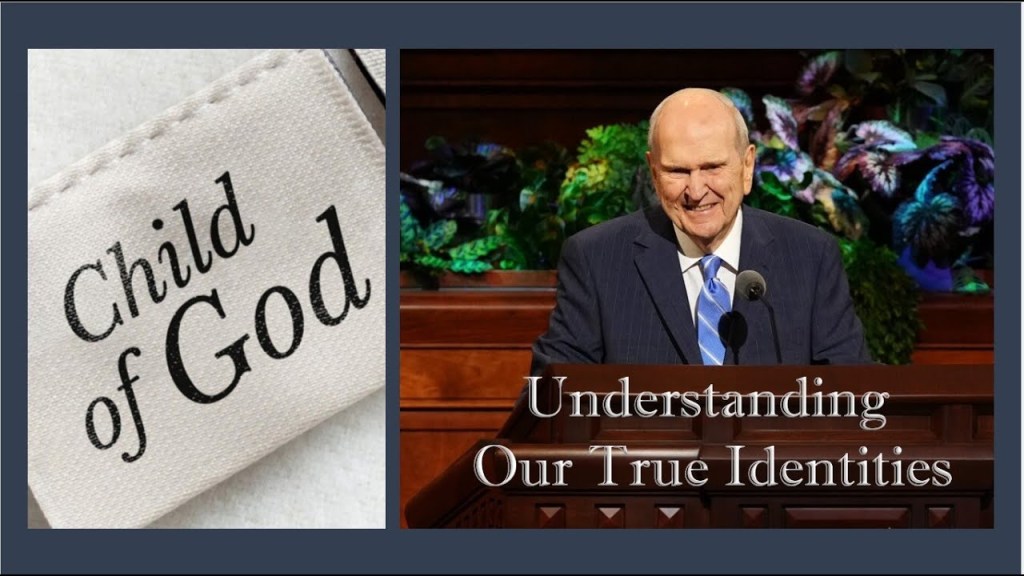
    In a recent address to young adults of the Church of Jesus Christ of Latter-day Saints, the prophet of the Lord, President Russell M. Nelson, talked about the three defining identities of a member of Christ’s church. Those identities were:

    1. Child of God
    2. Child of the covenant
    3. Disciple of Jesus Christ

    The grace portion of what I’d like to discuss, like President Nelson’s identities, will focus on members of Christ’s church. This doesn’t mean what I’m saying here doesn’t apply to all. I believe it does. Whether someone believes in God or not, the first identity of all God’s children is true. Every soul on this earth is a child of God, whether they believe it (or like it) or not. The other two identities are not excluded from anyone. Anyone can be a child of the covenant by aligning themselves with God. Anyone can be a disciple of Jesus Christ. These must be choices.

    Now that I’ve established that this is for everyone, let’s talk more about President Nelson’s message of identity. President Nelson emphasized that if the Lord spoke directly to us, the first thing He’d want us to understand is who we are; thus, the identities. It’s my testimony that the Lord was reminding us of this, through His mouthpiece, the prophet.

    President Nelson said:

    “Tonight, I plead with you not to replace these three paramount and unchanging identifiers with any others, because doing so could stymie your progress or pigeonhole you in a stereotype that could potentially thwart your eternal progression.

    There are various labels that may be very important to you, of course. Please do not misunderstand me. I am not saying that other designations and identifiers are not significant. I am simply saying that no identifier should displace, replace or take priority over these three enduring designations …”

    The world would so quickly have us forget who we truly are, and our true potential. The multitude of designations we can apply to ourselves pale in comparison to “Child of God.” Can you imagine being a prince of a nation, and calling yourself a peasant? Can you imagine being the president of a university and calling yourself a student? Can you imagine being the captain of the team, and calling yourself a bench warmer? That is what many of us do every day when we give ourselves any title but “Child of God.” Wear your title with pride. Your Father is God of the entire universe. He is King, He is Ruler, and you are His Child.

    “Make no mistake about it: Your potential is divine. With your diligent seeking, God will give you glimpses of who you may become. … As you embrace these truths, our Heavenly Father will help you reach your ultimate goal of living eternally in His holy presence.”

    -Russell M. Nelson

    Let’s transition into Grace. I can’t say anything better here than Brad Wilcox said in his talk His Grace is Sufficient, so please read the talk to remind yourself how patient and loving and kind our Savior is. I believe this may be the most powerful address ever given, especially for our day. I mean that literally. His Grace is Sufficient is so filled with eternal and significant truths, you could quote the whole thing. I will quote much of it here.

    I believe there is an epidemic in the Church of people not feeling good enough. I believe this aligns with President Nelson’s message of forgetting our identity. I think it also aligns with a misunderstanding that Satan has perpetuated, a misunderstanding of Grace and the Atonement of Jesus Christ.

    Brad Wilcox said, “Too many are giving up on the Church because they are tired of constantly feeling like they are falling short.”

    He then gave an example:

    “There are young women who know they are daughters of a Heavenly Father who loves them, and they love Him. Then they graduate from high school, and the values they memorized are put to the test. They slip up. They let things go too far, and suddenly they think it is all over. These young women don’t understand grace.”

    I would add – these young women don’t understand who they are. Slipping up doesn’t take away any of your three identities. Because you make a mistake, are you no longer God’s daughter? Because you slip up, are you no longer a daughter of the covenant? Because you’re not perfect, are you not a disciple of Jesus Christ? If that were the case, Christ would never have disciples! Be less hard on ourselves. And remember who we are.

    Few paragraphs in a talk have applied more perfectly to me:

    “There are young men who grow up their whole lives singing, “I hope they call me on a mission,” and then they do actually grow a foot or two and flake out completely. They get their Eagles, graduate from high school, and go away to college. Then suddenly these young men find out how easy it is to not be trustworthy, loyal, helpful, friendly, courteous, kind, obedient, cheerful, thrifty, brave, clean, or reverent. They mess up. They say, “I’ll never do it again,” and then they do it. They say, “I’ll never do it again,” and then they do it. They say, “This is stupid. I will never do it again.” And then they do it. The guilt is almost unbearable. They don’t dare talk to a bishop. Instead, they hide. They say, “I can’t do this Mormon thing. I’ve tried, and the expectations are just way too high.” So they quit. These young men don’t understand grace.”

    For me, it was a process of making mistakes, and then deciding I didn’t need to ask for forgiveness. The guilt of asking for forgiveness wasn’t worth it. I just moved on and stopped asking. But my soul was crying out. What saved me was my testimony of Jesus Christ and His Church, the Church of Jesus Christ of Latter-day Saints. Without that testimony of His restored Gospel, I would have never returned. It wasn’t worth feeling the guilt. But once I did return and reminded myself of the fruits of repentance and the pure joy of forgiveness, I could never go back. I continued to make mistakes and I continued to fall short. I continue to fall short. But that day when I cried tears of joy in a church parking lot, I felt Christ so palpably and so near, I knew I could never go back. I knew I had to keep trying. My soul had been starved for so long and once I felt the grace of Jesus Christ, which I only had to ask for, returning into my very being, I couldn’t go back.

    I plead for all of God’s children, all of you, my brothers and sisters, to not give up. Ask for that forgiveness, endure the guilt, and feel the overwhelming joy.

    Brother Wilcox in continuing to describe me, “…guilt is almost unbearable. They don’t dare talk to a bishop. Instead, they hide. They say, “I can’t do this Mormon thing. I’ve tried, and the expectations are just way too high.” So they quit. These young men don’t understand grace.”

    I definitely didn’t understand grace until I’d felt it’s full magnitude. Don’t give up on who you are. Don’t give up on who you can become. Don’t forget your true identity. “In all of these cases there should never be just two options: perfection or giving up. When learning the piano, are the only options performing at Carnegie Hall or quitting? No. Growth and development take time. Learning takes time. When we understand grace, we understand that God is long-suffering, that change is a process, and that repentance is a pattern in our lives. When we understand grace, we understand that the blessings of Christ’s Atonement are continuous and His strength is perfect in our weakness (see 2 Corinthians 12:9). When we understand grace, we can, as it says in the Doctrine and Covenants, “continue in patience until [we] are perfected” (D&C 67:13).”

    “Grace is not a booster engine that kicks in once our fuel supply is exhausted. Rather, it is our constant energy source.”

    Let Christ be your constant energy source. Don’t give up.

    “I testify that God’s grace is sufficient. Jesus’ grace is sufficient. It is enough. It is all we need. Oh, young people, don’t quit. Keep trying. Don’t look for escapes and excuses. Look for the Lord and His perfect strength. Don’t search for someone to blame. Search for someone to help you. Seek Christ, and, as you do, I promise you will feel the enabling power we call His amazing grace… I believe in you. I’m pulling for you… And Jesus is pulling with you.”

    -Brad Wilcox

    What has Christ done for us? What has God given us? President Nelson reminded us:

    “In short, They have offered you everything! Heavenly Father’s plan for His children allows us to live where and how He lives and ultimately to become more and more like Him. His plan literally makes the richest blessings of all eternity available to us, including the potential for us to become ‘joint-heirs with Christ’ (Romans 8:17).”

    “God will do “everything He can, short of violating your agency, to help you not miss out on the greatest blessings in all eternity.”

    Don’t give up. Don’t be discouraged. Never forget your divine heritage and what it affords you. You are a child of God! A joint heir with our Savior, the King, Jesus Christ. Don’t ever replace your identity with something temporary, that only this world gives. Satan abandoned his identity and now he wants nothing more but to deceive you into abandoning yours. Don’t do it!

    I bear my testimony that Christ’s Grace is Sufficient. He died for me, and He died for you. He did it all. There’s nothing we can do to screw it up if we just turn to Him. There’s nothing we can possibly do to make God abandon us. He loves us with a love we can’t comprehend.

    One day we’ll stand before Him, our Father, and we’ll remember. We’ll remember what love truly is, and we’ll remember who we are. Remember today and move towards that glorious light of living with Him, our Savior, and our families through eternity.

  • Reach Out

    Reach Out

    In Mark Chapter 5, Jesus of Nazareth performed a miracle that would foreshadow his great mission. It is in this chapter that the account of Jesus raising Jairus’s daughter from the dead occurs. It’s what happens in between Jairus coming to the Savior and Jesus performing that miracle that caught my attention.

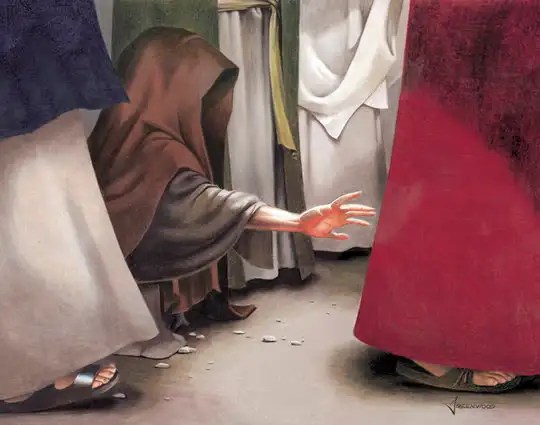
    On the way to raise a girl from the dead, Jesus was surrounded by people. A woman, who we’re told “had an issue of blood” (verse 25) reached out and touched Christ’s garment.

    Verse 30 reads:

    “And Jesus, immediately knowing in himself that virtue had gone out of him, turned him about in the press, and said, Who touched my clothes?”

    The thought occurred to me, is it a coincidence that this healing happened in this way at this moment? Christ performed many miracles. Here is a miracle, seemingly performed by someone else through Him. In verse 28 the woman said, “If I may touch but his clothes, I shall be whole.” Christ goes on to tell her that she is made whole by her faith.

    On the way to literally raising someone from the dead, why is this story even included? What is an issue of blood when compared to death?

    I wonder, and this is just me thinking, Christ was on His way to conquer death for that girl. At that moment, was there a power, a life giving force emanating from Christ’s very being that allowed this woman to be healed simply by reaching out to Him in faith?

    Now that Christ officially holds the power of the resurrection and has conquered death, is that life giving power emanating from Him constantly?

    Yes, it is.

    What do we learn from this account, then?

    All we need to do is reach out. Christ will heal us. 

  • A Lesson on Prayer from Ivy

    A Lesson on Prayer from Ivy

    “Become as little children” (Matthew 18:3).

    I think about this a lot.

    Ivy and I pray together often. Most nights at dinner. Most nights before bed.

    I used to say the prayer almost every time. Then most nights we both would say a prayer. Then we started splitting it 50/50, sometimes I would say it, sometimes Ivy would say it. Now she says it almost every time.

    It’s really neat to see her try to replicate what I say. When we were both saying a prayer each night, she would usually ask me to go first. When it was her turn, it was clear she was trying to repeat as much of what I said as she could remember.

    When she started asking to go first then demanding I repeat things she said, I knew she was close to taking over this important responsibility. I was very happy.

    It’s fun watching her prayers evolve.

    Recently she’s started saying something profound and powerful every night.

    “Heavenly Father, thank you for everything we have, and thank you for everything we don’t have.”

    When is the last time you thanked God for everything you don’t have?

    The faith of a little child. What a thing.

    Now Ivy is teaching me how to pray.

    I couldn’t be happier.

  • What Really Happened with Noah’s Curse of Ham/Canaan?

    What Really Happened with Noah’s Curse of Ham/Canaan?

    There’s a story from the Bible that’s never sat right with me. The Bible tells of Noah and his three sons after the flood. As the story goes, Noah planted a vineyard after the flood waters receded. He then drank of the fruit of the vine, got drunk, and passed out naked.

    Ham, finding his father naked, brought his brothers Shem and Japheth in, presumably to mock and make fun of their father.

    This disrespect to Noah is undeniable. What Ham did in this story was wrong.

    But did it warrant this?

    (Genesis 9:24-27 my additions in parentheses):

    24 And Noah awoke from his wine, and knew what his younger son (Ham) had done unto him.

    25 And he said, Cursed be Canaan (Ham’s son, Noah’s grandson); a servant of servants shall he be unto his brethren.

    26 And he said, Blessed be the Lord God of Shem (Noah’s other son); and Canaan shall be his servant.

    27 God shall enlarge Japheth (Noah’s other son), and he shall dwell in the tents of Shem; and Canaan shall be his servant.

    Was Ham’s sin so egregious that his son and their descendants deserved to be “servant of servants” to his brothers?

    Ham did something wrong, but this seems extreme.

    Bible scholars will say Ham violated the edict to honor his father. True. But all his descendants cursed for the rest of time? This is the part I’ve never understood. Seems too harsh a punishment for something that borders on immature and insensitive at worst.

    Which leads to something I read from Hugh Nibley. I read this in a lecture Hugh Nibley gave and he was citing some information he read. (Reference to this story is also in the Book of Jasher).

    “A very early Christian writing tells how Noah’s descendants waged bitter war among themselves after his death, to see who should possess his kingship; finally one of the blood of Ham prevailed, and from this the Egyptians, Babylonians, and Persians derive their priesthood and kingship. “From the race of Ham,” says the text, “came one through the magical (as opposed to the holy) succession named Nimrod, who was a giant against the Lord.”

    First of all, note the vague “before the Lord” of the King James Version (Genesis 10:9) conceals the true meaning, rendered “against the Lord” by the Rabbinical and early Christian writers).”

    Hugh Nibley continues (my emphasis bolded):

    “Nimrod claimed his kingship on the ground of victory over his enemies. His priesthood, however, he claimed by virtue of possessing “the garment of Adam.” The legends of the Jews assure us that it was by virtue of owning this garment that Nimrod was able to claim power to rule over the whole earth, and that he sat in his tower while men came and worshiped him.”

    Doesn’t this give Lord of the Rings vibes? A man in a tower making the peoples of the earth come to worship him. I had to say that, anyways…

    Let’s recap quickly the genealogy of Nimrod:

    Noah begot Ham. Ham had four sons – Canaan, Cush, Mizraim, and Phut. Nimrod was a son of Cush. Remember that Canaan is the one specifically mentioned in the curse of Noah in Genesis 9.

    But let’s continue with Hugh Nibley (emphasis bolded again):

    “The Apocryphal writers, Jewish and Christian, have a good deal to say about this garment. (“the garment of Adam” mentioned above). To quote one of them: “the garments of skin which God made for Adam and his wife, when they went out of the garden, were given . . . after the death of Adam . . . to Enoch”; hence they passed to Methuselah, and then to Noah, from whom Ham stole them as the people were leaving the ark. Ham’s grandson Nimrod obtained them from his father Cush. As for the legitimate inheritance of this clothing, a very old fragment recently discovered says that Michael (AKA Adam, the original owner of the garment) “disrobed Enoch of his earthly garments, and put on him his angelic clothing,” taking him into the presence of God.

    This idea is interesting. When Enoch and his city were taken up to God (Genesis 5:24), he apparently received new “angelic” clothing. This clothing must have been Terrestrial while the garment of Adam given to him from God was Tellestial, as that was the world he was entering. This would mean the garment of Adam, which was handed down to Enoch, would have been held until…

    “This garment of Enoch was supposed to be the very garment of skins that John the Baptist wore, called by the early Christians “the garment of Elias.” An Arabic “Life of John the Baptist” says that Gabriel (AKA Noah, which makes sense, it was stolen from him originally) brought it to John from heaven as “the garment of Elijah”. “It went back,” says John Chrysostom, “to the beginning of the world, to the times before which Adam required covering. Thus it was the symbol of repentance. . . .”

    So let’s recap. The garment belonged to Adam and was handed down to Enoch until it was taken from him when he went to Heaven. It was then given to Noah who may have had it stolen by his son Ham. It was lost to time until the angel Gabriel (Noah) returned to give it to John the Baptist. The part I want to focus on, if you haven’t guessed, is Ham stealing the garment from his father Noah.

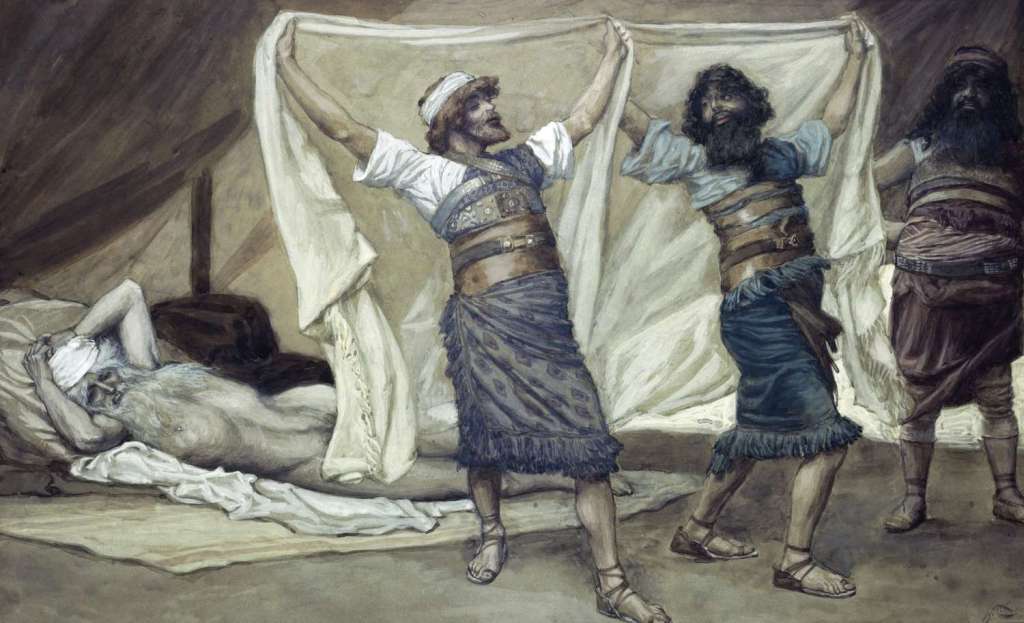
    “Incidentally, the story of the stolen garment as told by the old rabbis, including the great Eleazer, calls for an entirely different rendering of the strange story in Genesis 9 from the version in our King James Bible. They seemed to think that the erwath of Genesis 9:22 did not mean “nakedness” at all, but should be given its primary root meaning of “skin covering.” Read thus, we are to understand that Ham took the garment of his father while he was sleeping and showed it to his brethren, Shem and Japheth, who took a pattern or copy of it (salmah) or else a woven garment like it (simlah) which they put upon their own shoulders, returning the skin garment to their father. Upon awaking, Noah recognized the priesthood of two sons but cursed the son who tried to rob him of his garment.”

    Does Ham’s taking of the garment of his father, trying to strip him of it, remind you of anyone?

    “Behold, here am I, send me, I will be thy son, and I will redeem all mankind, that one soul shall not be lost, and surely I will do it; wherefore give me thine honor”.

    Moses 4:1

    -Satan

    Now read Genesis 9:22-23 considering this rabbinical story:

    22 And Ham, the father of Canaan, saw the nakedness of his father, and told his two brethren without.

    23 And Shem and Japheth took a garment, and laid it upon both their shoulders, and went backward, and covered the nakedness of their father; and their faces were backward, and they saw not their father’s nakedness.

    It seems plausible that what Ham did wasn’t simple mockery. It seems he might have stolen something from his father. Shem and Japheth, wanting to be like their father, try to replicate the garment Ham stole. But unlike Ham, they return it to Noah.

    Of course there are some unanswered questions with this theory – how did Ham get it back and hand it down to his sons if it was returned to Noah? Why was it Caanan cursed and not Cush or Ham himself? Still, there is something here that seems to add to this story of why Ham and all his descendants were cursed.

    Let’s continue to theorize..

    If this garment that Ham stole was the original garment of Adam, and signified the power, priesthood, and patriarchy of Noah, doesn’t that make more sense why he would have cursed Ham and his descendants? Noah might have sensed what Heavenly Father sensed (knew) when Satan demanded his honor. Ham might have desired power over those around him. This adds some new potential context to Noah’s great-grandson Nimrod’s story:

    “Nimrod claimed his kingship on the ground of victory over his enemies. His priesthood, however, he claimed by virtue of possessing “the garment of Adam.” The legends of the Jews assure us that it was by virtue of owning this garment that Nimrod was able to claim power to rule over the whole earth, and that he sat in his tower while men came and worshiped him.”

    The parallels to Satan continue.

    The rabbis (through Hugh Nibley) continue:

    “By an extremely common type of substitution, the simlah of Genesis 9:23 could very easily stand for an original tsimlah, a copy, imitation, pattern, or by an equally common type of transposition for Salmah, a garment or mantle, as in Micah 2:8. Even as it stands simlah means only a woven garment and can hardly refer to the original skin article. This is, apparently, the source of the widespread legend that Ham stole the garment of Noah and claimed to possess the priesthood by virtue of his illegal insignia. Ham’s descendants, Cush and Nimrod–both Africans, though Nimrod in his wandering moved to Asia–made the same claim. It is interesting that according to certain ancient scriptures which the Latter-day Saints claim have been restored by revelation in our own age, Pharaoh (who represents the Afro-Asian line of Cush-Nimrod) was blessed as to the kingship but cursed as to the priesthood, and he offered Abraham the privilege of wearing his own royal insignia in hope that Abraham would return the compliment by allowing Pharaoh to wear his priestly ones” (Abraham 1:26-27).

    I would suggest the possibility that Pharaoh wasn’t just trying to get Abraham to return the favor by letting him where his royal insignia. Maybe Pharaoh was trying to get Abraham to worship him in his counterfeit insignia of the priesthood. Abraham ultimately sought after the true priesthood, not the counterfeit.

    It continues…

    “According to a very old tradition, Pharaoh coveted the priesthood of Moses exactly as his ancestor Nimrod did that of Abraham, and it was said that the Pharaohs of Egypt dressed in a skin garment “to show that their origin was older than time itself. (Note, Abraham’s refusal to make the exchange was the real reason for his being expelled from Egypt, according to apocryphal writers.)

    Whatever the details, the priests and kings of antiquity certainly wore such garments, and the skin garment was often imitated in woven materials (see footnote below), in fact, the skin garment was itself held to be a substitute for a still older garment made of the leaves of the ficus religiosus.”

    Footnote (pertinent sentences to this discussion bolded):

    In later times the Egyptian priest wore “no real leopard-skin but a close-fitting coat of fine linen in the form of a leopard-skin,” H.R. Hall, “The Bronze Statuette of Khonserdaisu in the British Museum,” JEA 16 (1930): 1, cf. T.J.C. Baly, “Notes on the Ritual of Opening the Mouth,” 178. The Syrian Christians said that the garment given to Adam was of cotton, the “skin” of the tree, Eisler, Iesous Basileus, 2;34; this doctrine, they say, was known only to Moses, “who called cotton ‘skin’ because among trees it takes the place of skin”‘ hence the idea that John the Baptist took his clothes from trees. The Jews retained traces of the older garment in their phylacteries and in the Sisith, the four strings that every Jew once had on the edge of his garment, Ferris J. Stephens, “The Ancient Significance of Sisith,” JBL 50 (1931):59-70. Compare the Irham of the Moslems in John L. Burckhardt, Travels in Arabia, 2 vols. (London: Colburn & Bently, 1831), 1:104-05; 163-64.

    I provided this extra information from the mentioned footnote because I found it interesting and it added more context. But back to the point –

    It seems there is more to this story in Genesis 9.

    What actually happened with Ham and Noah?

    Was Noah’s nakedness symbolic?

    Was there a cloak or some sort of clothing that held significance that was stolen?

    We currently don’t know the answers to these questions but I find the questions fascinating.

    For now I hope anyone reading enjoyed where these thoughts took them, as I enjoyed the exercise. Possibly there’s more to know and understand about this story of Noah and his sons. There might be a great significance to the priesthood power that the ancients so desired, a significance we’re only scratching the surface of.

    One day we’ll know the answers to these questions.

  • A Kingdom Divided

    A Kingdom Divided

    The first step for Zion is to stop distinguishing ourselves from one another. We are first Children of God.

    President Russell M. Nelson has been clear about the three primary identities we should all focus on for ourselves. Those three identities are:

    First – children of God.

    The first identity is for every person on the face of the earth. Whether they realize it or not, every person is a child or God. The second and third identities are for members of the Church of Jesus Christ of Latter-day Saints. But this does not exclude anyone. The second and third identities are an invitation to the world.

    The second identity is child of the covenant.

    The third identity is disciple of Jesus Christ.

    President Nelson has stressed that anything we give precedence over these three identities distracts from our true potential. As children of God, children of the covenant, and disciples of Jesus Christ, we have a divine inheritance and royal home to return to. Any other worldly designation distracts from our ultimate goal of becoming everything we can be.

    Some of the other designations the world assigns include sexuality, status, race, and political affiliation. There are countless self-defined categories we assign ourselves. None of these things matter, they won’t matter at all when the veil is lifted, and we are reminded of what we always were.

    Zion are the pure in heart (D&C 97:21), Zion are one.

    All who believe in Christ are the children of Christ. But how is Zion established? How can there be unity in Christ given the divisive nature of the world and Christianity?

    A search for all the sects of Christianity brings up THOUSANDS of results. Thousands. How can one know the truth when there are so many claiming to be true? How can Christianity be united under Christ when there are thousands battling for attention, power, and patrons.

    How can God be a God of such confusion and disorder?

    In Luke 11:17 Jesus Christ says:

    Every kingdom divided against itself is brought to desolation; and a house divided against a house falleth.

    How would Jesus Christ feel about the state of the religion that espouses His name?

    I’ve heard it said that Christianity is united, despite its differences, in its faith in Christ. I think this is an admirable way to look at it. In fact, it’s how I try to look at it. It’s my opinion and belief that our faith in Jesus Christ is important and unites us. That said, what really unites us? What enduring principle is it that unites all Christians?

    Is it our belief in what Christ taught? There are a million different interpretations of what Christ taught.  

    Is it our belief in who Christ was? That couldn’t be a more divisive topic. Was He who He claimed to be? Was He the Son of God or wasn’t he?

    Is it our belief in the Atonement of Jesus Christ and what it accomplished? Again, there are different interpretations of Christ’s Atonement, why it was needed, and what it accomplished.

    Surely we can agree on Christ’s resurrection? Was Christ resurrected with His body or wasn’t He? Was there significance to Him eating fish with His disciples after His resurrection? Again, there is contention on this topic.

    What can Christianity be united on? It seems nothing.

    I believe the Church of Jesus Christ of Latter-day Saints provides the only solution to this problem. What Christianity can be united on is a connection to Jesus Christ. A real connection. Not a belief in Him, what He taught, or who He was. The connection must be real and tangible. The connection must be a welding link. The connection must have veracity on earth and in heaven (Matthew 18:18). That connection must be through a covenant.

    A covenant is a two-way promise.

    A covenant binds us to Him.

    When we get baptized, we promise to take upon us the name of Christ, and He becomes our shepherd. From that point on we are inseparably linked with Him.

    Latter-day Saints are a covenant people. The saints of God have always been covenant keepers.

    In the podcast Church History Matters, the hosts were speaking about the early history of temples in the Church of Jesus Christ. Something they said stood out to me as I’ve been working on writing this post.

    “…through the ordinances given to both men and women, living and dead, the human family is being knit or woven or let’s just use the word sealed together into one eternal holy order which we can call the family of God, we can call it the Kingdom of God, we can call it the Church of the Firstborn, we can call it the Celestial Kingdom, or simply the priesthood.”

    In the most recent General Conference of the Church of Jesus Christ of Latter-day Saints, Elder McCune of the Seventy said:

    Joy and eternal perspective come through being bound to the Savior by making and keeping covenants through Christlike discipleship.

    Adam, Abraham, Moses, and Peter; they made covenants with the great Jehovah and became His, and received of His power. Over time, they became more like Him. Over time they became one with Him. Enoch created Zion and was so connected to the Lord that he and his city were taken up to Him. This connection is made through covenants.

    What can unite Christianity? It is a covenant with Jesus Christ.

    Christ’s Church has temples where these covenants can be made.

    We must strive to be one with our brothers and sisters. We can only truly be one as we are united under one banner. The disjointed nature of Christianity is unacceptable. Covenants are needed. It is the banner of covenants with Jesus Christ that will unite Christianity, and nothing else. He died for us. In return, He asked us to believe in Him, follow Him, repent, and be baptized. That was His request of us. There is only one baptism that is acceptable to God the Father and that is the baptism with His authority in the name of His Son. No other baptism is acceptable to Him because it is a baptism not by His authority.

    I wish the Christian world could see that it is covenants that unite us to God. It is covenants that can re-unite us.

    I know as the Millenium approaches that one day all knees will bow and every tongue confess. At some future date the children of God will know and understand the covenants needed to unite the heavenly and eternal family.

    It is here for us now. But the world does not listen. Jesus was sent to this world, but He was not of it. This world struggles with the eternal nature of what God has in store for us. One day the world will have to understand what was always offered to us. What is offered to us is unity under Christ. Eternal families, eternal potential, eternal happiness, eternal inheritance. That is what will come when the world covenants to join with Jesus Christ and be Zion.