Tag: spiritual

  • Suns Experience

    Suns Experience

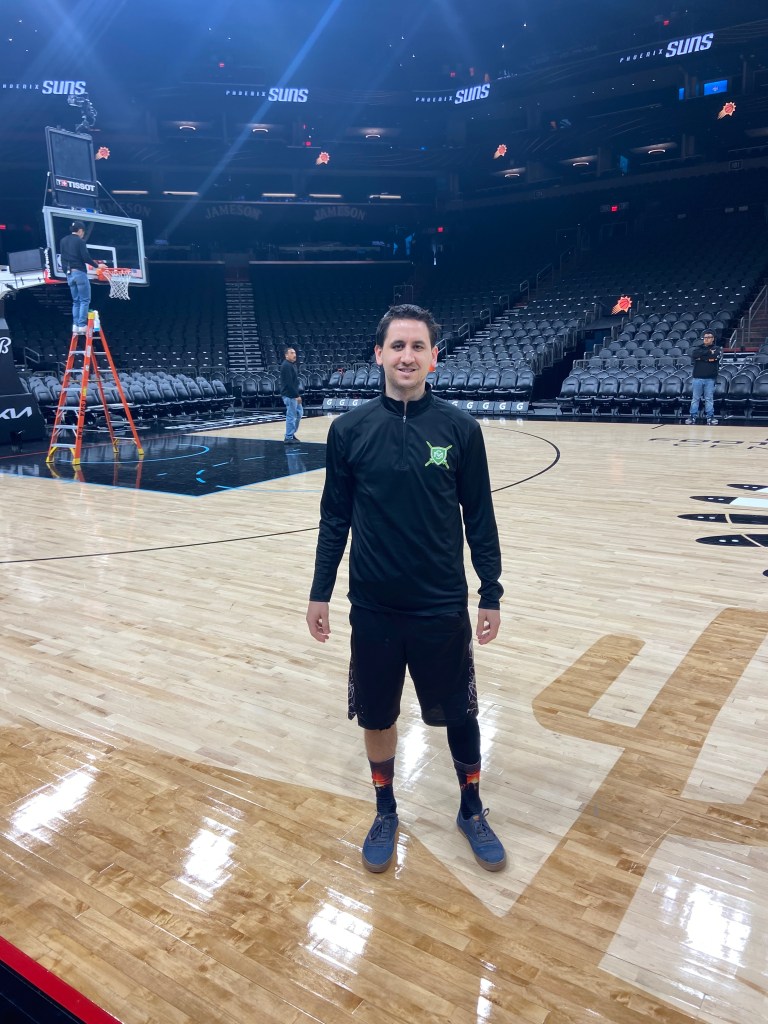
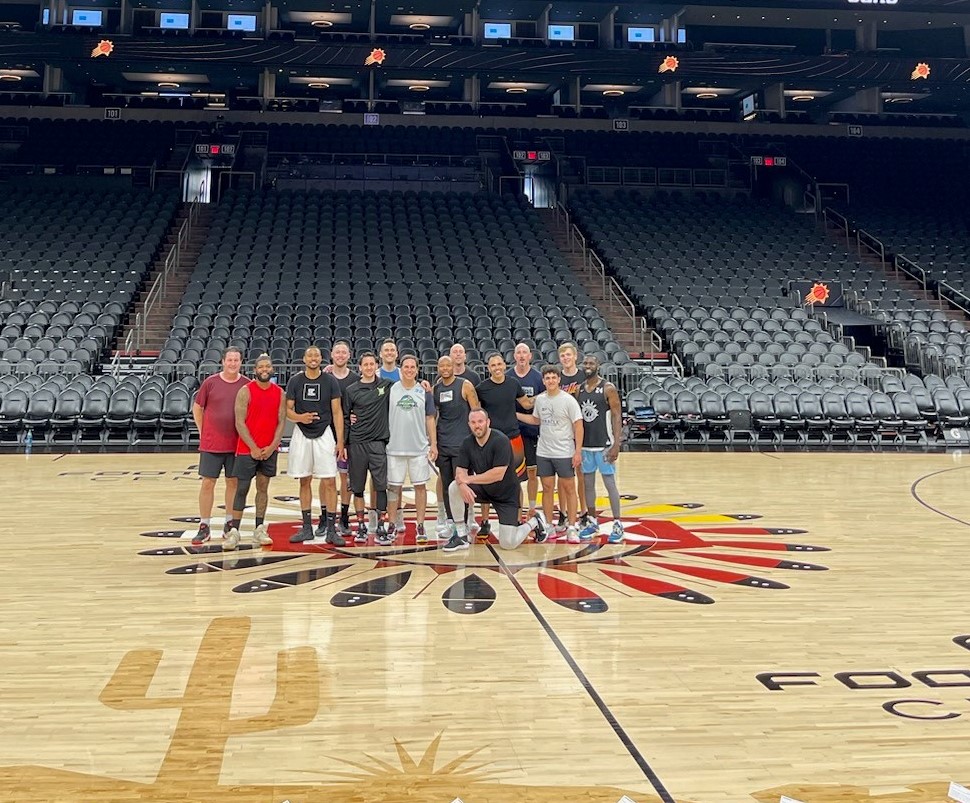
    Last week I got to play on the Phoenix Suns court. It was an awesome experience, one of the coolest things I’ve ever gotten to do. Huge shoutout to Robert, his wife Brooke, and Blake for making it happen. We got exclusive access to the court and were able to play pickup for three hours. Well, some of us were able to play for hours… more on that later.

    Some basketball thoughts from playing on a real NBA court.

    First, those lights are bright. When I’d shoot from the corners, if I watched the ball arc up before it got to the rim, I’d be blinded by the lights. If I looked up unconsciously while playing, I got blinded. Never thought about what it would be like to actually play under the “bright lights.”Speaking of the corners, it is a tight fit. Shooting an NBA three from the corner gives barely enough room for your feet. If you take a step back at all to try to explode toward the hoop, you’re stepping out of bounds. I have size 10 shoes. I don’t know how the size 20s even do it.

    Speaking of the lights, part of the package with getting to play on the court was we got to watch the Suns play that night against the Orlando Magic. We got to watch from the suite level with food and drink included. I’ve been to many Suns games, but this was a unique game to watch due to having been on the court just hours earlier. These things I mentioned like the lights and the tight space from the corner were things I considered more than I ever had before. The other thing that stood out to me that I’d never thought about before was how hectic an environment this was for NBA players to play basketball in.

    Basketball is a refuge for me. It’s therapeutic. Playing on an NBA court with thousands of people watching cannot be therapeutic.
    An NBA game is a chaotic and hectic experience. Of course, there are the thousands of people watching, yelling, and trash-talking. That’s crazy in and of itself. But what struck me the most after having played on the court was how loud the music was. While we played, we had a pretty chill March Madness game playing on the big screen with the volume on what I’d guess was around medium. It was still distracting. Watching that game later against the Magic I was focused on the NOISE, the MUSIC, and the BASS.

    It is pandemonium at an NBA game. For some reason I’d always thought the NBA players were a bit sheltered from the noise. After playing on the court, I realized it’s the opposite. They are at the bottom, center of a dome. All the noise and chaos are amplified on the court. It gave me my first true appreciation of home-court advantage. That chaos is one thing, but when it’s a chaos you’re not used to, (on the road visiting another stadium) with fans heckling you the whole time, it’s complete sensory overload.

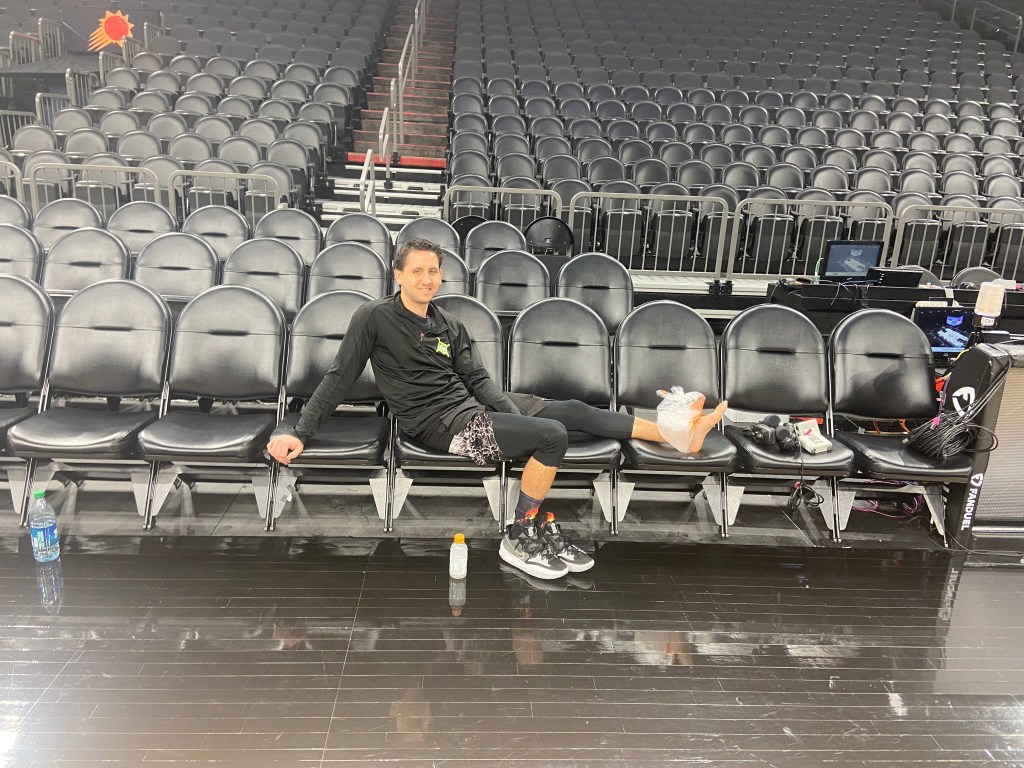
    So, back to my time on the court, unfortunately I got hurt the beginning of the second game. I was running and just stepped wrong and twisted my ankle bad. It actually happened at almost the exact spot where Kevin Durant twisted his ankle while doing a routine warm-up layup a couple weeks earlier.

    Probably exactly what my ankle looked like, same spot.

    After I rolled my ankle, I at least got to see what it was like to be treated like an NBA player for a moment. Multiple trainers checked on me and brought me ice. It was a bit embarrassing. I got to spend the rest of the pickup session jealously watching with ice on my ankle from the sideline.

    Here’s the part where I insert what I learned spiritually from this experience.

    I’ve twisted that ankle at least 3 dozen times, not exaggerating. It’s never fun. It’s always painful.

    That night, I was laying in bed with my ankle propped up on pillows. I’d already discarded the ice that was on it. It was the middle of the night and my foot was THROBBING. It hurt.

    It hurt badly enough that I started praying for relief. I don’t want to be dramatic. I know that on the pain scale, what I was experiencing was pretty mild. But still, it hurt. That’s when I started thinking about every groin pull, every sprained ankle, every concussion, every headache, every upset stomach, every scalping, every stitch, every ingrown toenail, every scratch, every bruise, every heartache, every heartbreak, every disappointment, every fear, every doubt.

    How could He have felt it all?

    Here I was, writhing in pain, whining, praying for relief, over a sprained ankle. And He felt every sprained ankle of every person that ever did or would exist, all in a moment. He felt it all. How?

    I ponder often on the Atonement. I’ve tried to wrap my head around it. It’s not something we can wrap our heads around. That’s the point. He did something unimaginable. He did something incomprehensible. And he did it for us.

    I believe (I know) that Christ felt it all that night at Gethsemane. I don’t know how; I can’t understand it. But I know He did. It’s why I write about Him, it’s why I think about Him, it’s why I serve Him. Because for a long time, I tried to forget what He did for me because of guilt, or incomprehension, or selfishness. But now I think the most important thing I do outside of anything with my family is write about Him.

    I think the most important thing I do for my daughters is teach them about Him. Few things bring me as much joy as when Ivy sees a picture, I ask, “who’s that?” And she replies, “Jesus.” I hope someone reads this that needs to remember Him and what He did for us. When you think about what He did for us, ultimately it must make us more loving because we’re considering a love that is unfathomable. That makes us better.
  • Dontcha know I know

    Dontcha know I know

    All of Ivy’s life, when she’s been upset or crying, I’ve said, “Dontcha know I know?”

    This is my way of saying jokingly, “Don’t you know I know what it’s like to not want to get dressed, not want to eat certain food, to be hungry, to be tired, to be upset, etc.?”

    Today was Sunday. I woke up from a nap and I watched a video depicting the Atonement that Jesus Christ performed.

    Sage started crying in the other room. She’d been having a rough day. We think she has some acid reflux and stuff like that. Sometimes her tummy gets upset. This day seemed to be hard for her.

    Sage likes to tilt her head way back and stretch out her stomach. Apparently, this is a sign of acid reflux. I went to the other room and picked up Sage and put her into her favorite position. Head in my hands tilted back, stomach stretched, looking up at a ceiling fan (she LOVES looking up at ceiling fans).

    This provided a little relief, but she was still crying on and off.

    When Sage was still fussing, I started to say my automatic, “Dontcha know…”

    And that’s where I stopped.

    I didn’t know what it was like to have acid reflux, and for my stomach to hurt like hers did, and to not be able to find relief whatsoever on my own, and to only attain some relief if Mom or Dad came to hold me a certain way. Even if I had that experience as a baby myself, I don’t remember. I didn’t know or remember what Sage was feeling.

    But someone did. I believe that Christ, during that infinite and indescribable Atonement, even felt the pains of an infant with acid reflux. I believe He felt it all.

    “Children are alive in Christ” (Moroni 8:12).

    I couldn’t know what Sage was feeling. Dontcha know I didn’t know. But He knows, and He felt it, and He remembered it.

    When Sage cries she’s communicating to us that she needs help. It’s me and Beth’s job to come to her aid and help her with what she can’t help herself with. How many things, as adults, do we need help with that we can’t do ourselves? As adults, we think of ourselves as so independent. But all we do relies on the Lord. We rely on Him to allow our breath to work within our bodies, water to hydrate us, food to nourish us. These things don’t happen of ourselves but because of Him.

    God and Christ come to our aid when we need it and especially when we ask for it. Christ knows how to hold us just right to help ease our pain and give us relief. Rely on Him for aid just as little children rely on their parents. Be ye as little children (Matthew 18:3).

    Christ felt it. Christ remembers it. Christ experienced it. Turn to Him and He will help all our pains, challenges, and afflictions.

  • Burdens Made Light

    Burdens Made Light

    Mosiah 23:23 reads:

    “For behold, I will show unto you that they were brought into bondage, and none could deliver them but the Lord their God, yea, even the God of Abraham and Isaac and of Jacob.”

    “They” in this verse was referring to the followers of Alma. Some time earlier in the Book of Mormon story, Alma recruited a group of people who were baptized and covenanted to follow Jesus Christ. This group of people then fled from the rule of their wicked king, Noah.

    Before Alma’s people could flee, though, a prophesy was made by a man named Abinadi.

    Mosiah 12:2, Abinadi speaking:

    “Yea, wo be unto this generation! And the Lord said unto me: Stretch forth thy hand and prophesy, saying: Thus saith the Lord, it shall come to pass that this generation, because of their iniquities, shall be brought into bondage [emphasis added], and shall be smitten on the cheek; yea, and shall be driven by men, and shall be slain; and the vultures of the air, and the dogs, yea, and the wild beasts, shall devour their flesh.”

    This epic part of the story in the Book of Mormon is long and complex but long story short – Alma and his people fled wicked King Noah. Then King Noah is attacked by the Lamanites and flees into the wilderness where he is eventually burned and killed. His son, Limhi, takes over as king of the people. Limhi’s people are brought into bondage.

    Some time later, the Lamanites stumble upon Alma’s people, and Alma’s people are also brought into bondage.

    Remember, Alma’s people at this point had repented of their sins, been baptized, and turned to Christ with all their hearts. Remember Abinadi’s words, “this generation…shall be brought into bondage.” When Abinadi spoke these words, he was prophesying in the name of the Lord. Can the Lord lie? The Lord cannot lie. When He speaks, it must be true, and it must come to pass.

    Despite their new covenants, prophesy still had to be fulfilled, and Alma and his people had to be brought into bondage.

    There are many important lessons we can learn from this story. In particular we can learn from the people of Alma. Despite their good choices, they were still brought into bondage. Making good choices, being good people, doing all the right things like keeping our temple covenants, serving others, going to church, taking the sacrament; none of these things exclude us from adversity. Just because we’re following Christ and doing everything right, doesn’t mean everything goes perfect for us. Bad things happen to good people.

    Why do bad things happen to good people? Because lessons are learned through trial.

    What lesson is learned here?

    Mosiah 24:13-14 is the Lord speaking to Alma and the people, amidst their trial:

    “Lift up your heads and be of good comfort, for I know of the covenant which ye have made unto me; and I will covenant with my people and deliver them out of bondage [emphasis added]. I will also ease the burdens which are put upon your shoulders, that even you cannot feel them upon your backs, even while you are in bondage; and this will I do that ye may stand as witnesses for me hereafter, and that ye may know of a surety that I, the Lord God, do visit my people in their afflictions.”

    The Lord could not lie. The people had to be brought into bondage. But, importantly, the Lord would be with them, He would make their burdens light. And also importantly, as Mormon said in verse 23: “I will show unto you that they were brought into bondage, and none could deliver them but the Lord their God, yeah, even the God of Abraham and Isaac and of Jacob.” Since the Lord could not lie, the people could know that when he covenanted to deliver them from bondage, it would happen. They were brought into bondage because the Lord said it would be, now He was saying He would deliver them. They knew they could trust the Lord’s word.

    Amidst our hardest trials and most difficult times, we can turn to the Lord, and know that He will support, protect, and redeem us. No matter how difficult it gets. You, reading this, have your trials been as bad as becoming slaves to a harsh and bloodthirsty people? Rely on the Lord, and don’t murmur against Him. Continue to do your best and trust Him.

    Limhi’s people were in bondage for an estimated 18 years while Alma’s people were in bondage for 1 year. Do you think it made the one year any easier for Alma’s people because the people they’d left got it at least 18 times worse? Of course not. In that time, they had made all the right choices and still had to give 365 days of servitude. But ultimately, because of their covenants with the Lord, He delivered them.

    Don’t forget: with God, your burdens will be made light. Follow Him.

  • Are Women more Faithful than Men?

    Are Women more Faithful than Men?

    Why are women more faithful than men?

    I’ve often wondered this. Others may disagree, but in my experience, generally, it is true. Why is it that women are more faithful than men?

    There are countless examples of faithful men in the scriptures. There are also examples of faithful women in the scriptures, though less countless. Where the LDS church does have countless examples of women with great faith is in our pioneer stories. There are so many.

    Some of the examples of faithful women in the scriptures include Elizabeth, the mother of John the Baptist, Mary, the mother of Christ, and Mary Magdalene. I think often it is mothers that convert while fathers fight.

    From what I’ve seen today, in modern times, women have more faith than men. Women are more open to spiritual experiences.

    I think this is somewhat due to the “natural man.” In my opinion, man is much more natural than woman.

    I also think it has to do with Christ’s admonition, “be ye as little children” (Matthew 18:3).

    Don’t women possess more of the good qualities of children than most men? Women are generally more humble, meek, kind, caring, and gentle than men. I think few would disagree with this. Women possess more quantities of all the positive attributes of little children that most men lack. It doesn’t make men necessarily bad. I think it does create a gulf between us (males) and God, though.

    If men can learn to be what we are with a positive light, and attain the meekness and humility of little children, we draw closer to God. I think this is what the Priesthood is meant to help us to do. We are to learn to be humble with authority. Learn to be meek with power.

    What was Christ but complete humility with complete power?

    The Priesthood of God can not be wrought with unrighteous dominion (Doctrine and Covenants 121:37).

    We must be as little children. Meek and humble, and let our faith be as the women who surround us, who often far surpass our ability to trust, believe, hope, and have faith.

  • Maybe (The Story of the Chinese Farmer)

    Maybe (The Story of the Chinese Farmer)

    “There once was a farmer whose horse ran away. Upon hearing the news, his neighbors came to visit. ‘Such bad fortune,’ they said, full of sympathy.

    “‘Maybe,’ the farmer replied.

    “The next morning the horse returned, bringing with it three other wild horses. ‘What great fortune!’ The neighbors exclaimed.

    “‘Maybe,’ replied the old man.

    “The following day, the farmer’s son tried to ride one of the untamed horses. He was thrown off and broke his leg. The son would forever limp. ‘What terrible fortune!’ The neighbors cried.

    “‘Maybe,’ answered the farmer.

    “The next morning the army came through the farmer’s village to draft young able-bodied men for the war. Seeing his son’s limp, they passed him by. The neighbors congratulated the farmer. ‘What wonderful fortune!’ They said.

    “‘Maybe,’ said the farmer.”

    So, it’s hard to know which experiences will turn out to be fortuitous and which will be unfortunate.

    Another story to consider.

    A dog is at the vet. It is there with its wonderful owner. The dog knows his owner loves him very much. The dog’s owner provides food and shelter to him every day. His owner takes him for walks every day and loves him so much. His owner would never do anything to harm him.

    At the vet, the dog is due to get shots.

    The owner knows the importance of these shots. The owner knows the dog needs the shots to keep him healthy. The owner knows the shots are for her dog’s ultimate benefit.

    While the dog is getting shots, all he can think is, “why oh why is my owner letting them do this to me? It hurts so bad! Why is she letting this happen?” The dog looks at his owner and cries and cries. He’s in so much pain. “Why is she standing there ignoring my pain? Why isn’t she doing anything? Doesn’t she love me?”

    The gap between the dog’s understanding and his owner’s understanding is vast. If the owner tried to explain to her dog germ theory and why he needed his shots, he wouldn’t understand any of it.

    The gap between God and us must be infinitely more expansive than the gap between our understanding and that of our pets.

    We don’t know completely why bad things happen to good people. We don’t know why some live while some die.

    The restored gospel of Jesus Christ tells us some key information. This information doesn’t completely answer the question of why bad things happen to good people, but it does add important information.

    We all chose to come here.

    We all knew it would be hard.

    Some knew they would experience unimaginable pain.

    We all chose to come here.

    The good news of the Gospel of Jesus Christ is that no pain, no hardship, no difficulty, no tragedy, is without meaning or purpose. It’s all for one great design: to make us better and stronger. Even as I say that, “to make us better and stronger” those words fall flat. Someone experiencing immense pain doesn’t care that they’ll be stronger in the end. Saying “to make us better and stronger” is akin to telling the dog, it’s going to be ok. Our understanding is limited. That doesn’t take away from the fact that everything that happens here is meant for our ultimate good. Everything here is to help us to reach our full potential.

    Do you think that dog understands those shots will help him live longer? Could we possibly understand if God tried to explain to us the mysteries of the universe and how that unimaginable pain can be for our benefit?

    Does this make unimaginable pain easier to endure? I think it does. I’m not in the throes of pain at the moment, though.

    When I thought I might die, and I thought how desperately I would miss my wife and my one month old daughter, when I thought about how I wouldn’t get to teach her to talk, shoot a basketball, or ride a bike, my heart hurt. But then I knew something amazing. I knew that, even if I had to leave my daughter and my wife, I’d see them again. Life is one eternal round with God and nothing would be lost. I knew that if I had to leave, it was for my ultimate benefit, and the benefit of my family. I had to trust God in that moment. That brought me peace.

    Could the farmer’s son have realized that breaking his leg and being limp for the rest of his life would actually save his life? He couldn’t know it. But someone did.

    When bad things happen, take comfort. Trust Him.

    How do we know what is a blessing and what isn’t? We don’t. Someone does. Trust Him.