Before anyone gets mad at me, let me clarify. I think short-term, temporary, not too dangerous, not too terrible sickness can be a great blessing. I’m talking the colds, the stomach bugs, the flu, the non-life threatening sicknesses are the best. Being sick sucks. It’s miserable. I’m the cliché ‘whine and cry more than anyone about being sick’ person, but, I am so grateful for sickness.
Let me elaborate with a specific example.
Sage started throwing up like crazy at 9:30pm, soon after going to bed. I got her out of bed. She was projectile vomiting and writhing in pain. We ended up at the hospital. We brought Sage home around 1:30am.
Sage went right to sleep in our bed with Beth. I slept on the couch. I think I finally fell asleep around 2:00am. At 4:00am I awoke to a familiar sound, but this time it wasn’t Sage. My worry had come true. Ivy was crying. I ran to her room and turned on the light to find her, her pillow, and her quilt covered in throw up.
I knew more was coming and was too exhausted to do the whole strip the bed and cleanup routine so I’m ashamed (not really, actually) to say I just cleaned it up and told Ivy to lay back down. I wiped her mouth, got a bucket, made sure she was comfortable, got a blanket and pillow for myself, and laid down next to her.
For the next 2.5 hours, I could have set my watch to Ivy throwing up. Every 20 minutes from 4:00am to 6:20am when we finally got up, she would throw up. Just enough time for me to start to doze off while holding her hand. I’d hear it start, I’d jump up and give her the bucket, I’d wipe up any that missed, I’d wipe her mouth. Rinse repeat (pun intended?).
This all sounds miserable, right? Where is the blessing in this? This is horrible!
Well, it kind of is. No doubt it is heartbreaking watching your little ones be sick. It is heartbreaking. They can’t control it. They don’t know what’s going on. It’s sad.
At 6:20am Ivy and I got up and cuddled on the couch. We put on the cartoon Doug by Ivy’s demand. 18 minutes into a 23-minute episode she said, “This episode is too long put on something else.”
Ivy and I proceeded to have a Boy Meets World marathon. She was Sean for the rest of the day. I was Cory. Sage was Morgan. Sometimes I was Allen. If you don’t know those characters, step up your Boy Meets World knowledge.
Sage woke up around 8am or something. This is all a blur now as I hadn’t really slept at all. Sage ate some grapes and I immediately put her back to sleep. Ivy and I were back to our marathon.
Beth mentioned I should go pick up our prescription of Zofran. As exhausted as I was, I decided this was the best opportunity for me to do that. Ivy was getting tired. She went into the room with Beth to lie down and I packed up to go down the street to the pharmacy.
Oh did I mention Beth was sick the whole day too? Side note, this is how things go in our family, I’ll likely be puking my guts out 24-48 hours after the rest of the family, I always catch these things on a delay. We joke it’s my Quackenbush DNA. My girls only have 50% of the Quackenbush DNA. The virus will get me, but I’ll fight it off for a while. (I can even more gratefully say now, as I wrote this a couple weeks ago, that I never got this sickness, boo-yah).
I came back from the pharmacy and luckily got to sleep for an hour(?) before Sage woke up. I got Sage up and fed her some food. We spent an hour bonding, cuddling, and snuggling in the living room before Ivy woke up. I put Sage back to sleep and Ivy and I continued our BMW marathon before going on a walk.
We walked around the neighborhood, sat in the grass, played eye spy.
You get the picture.
Came back. Sage was up. Feed Sage. Bathe Sage.
Long day.
Awesome day.
It’s so hard to slow down in this world.
Sickness makes us slow down. This was a special day. This is a day I will treasure.
There were so many special moments. Like on our walk when Ivy held my hand to make me feel safe. Or when Ivy asked on our walk if I knew where the dumpster was and then told me, “You’re absolutely right.” All those sad but tender moments of grabbing a bucket and holding Ivy and telling her, “I’m here, you’re OK, I’ve got you” while she retched and threw up. Sage cuddling in my lap and looking up at me and I knew she knew she was safe and going to be okay. Seeing Sage and Ivy get better before my eyes – getting back to their normal selves.
There were so many moments that were so important with my girls that day.
I wouldn’t have had those moments if not for their sickness.
Being sick is miserable. But it can also be really special.
One final memorable moment – Ivy was going potty and I was about to get in the shower. I told her, “I’m going to shower and when I get out I’ll get you some food. You can have nachos or noodles or toast or crackers or a sandwich. Think about what you want when I get out.” Ivy’s response, “Dad, I’m not going to think of all those things.”
I grew up with a lot of yelling coaches. There’s one in particular I still have nightmares about. He was a coach who communicated in only one way: yelling as loudly as possible. I always had the feeling he hated me. As an adult, looking back, I haven’t gained a new perspective on this. It hasn’t become one of those, “He yelled at me to make me stronger, and he really did care about me.” No. I still think he hated me.
I didn’t respond well to yelling.
One of my concerns when I started coaching basketball 5 seasons ago was how I would handle yelling. As I mentioned in How do we speak to others, I have an inherent aversion to yelling. I didn’t want to yell period, let alone at my girls. I was worried how the girls I coached would respond to me if I wasn’t willing to yell at them. Would they respect me? Could I discipline them?
What I’ve found, and I’m grateful to report, is that in my experience you don’t need to yell at anyone to get them to respect you. A quiet, private chastisement or loving criticism is 1000 times more effective than yelling or publicly embarrassing a player.
There was one game I’ll never forget. We were beating the team badly in the second half, but it hadn’t always been that way. It was a close game through the first half. But as the second half got going, their coach started to get flustered. The coach was yelling at the refs and their players constantly. It was a classic case of a coach losing their cool as the game stayed close. This was obvious from my seat. As the coach yelled at the refs more, their players lost focus and started complaining about the officiating as well. Then the coach started turning their frustration on the players, yelling at them after turnovers or mistakes. I saw their team quickly devolve. Players were throwing their hands up in frustration. After every play, they were looking to their coach to make sure they weren’t about to be yelled at. It reminded me so much of my time playing for my yelling coach.
That was the reason our lead extended in the second half until we were blowing them out. I always wonder how a coach can expect their players to stay calm and composed if the coach themselves is unable to do so.
At one point in that game, when the opposing coach was yelling at one of their players, a player on my team who was sitting next to me on the bench looked up at me and said, “Thank you.” I replied, “What?” and she said, “Thank you for not being like that coach and yelling at us.” That was about the best coaching compliment I’ve ever received.
I explained to that player my coaching philosophy. Yelling doesn’t help. All yelling does is put everyone on edge.
That same player, at the end of the season, gave me a card with a note that read, “Thank you so much for this season. I loved playing with you as a coach, thank you so much for being the coach. I hope you have a great time with your wife and Ivy” (this was before Sage).
If you’re wondering why and how coaching is rewarding, there it is.
So, do I yell? The season from this example (3 seasons ago now), I actually had to apologize to my team on a couple occasions. There were a couple games where I wasn’t proud of how I acted on the bench. I lost my cool, exhibited frustration on the bench, and sometimes yelled. One time I snapped at a player in the heat of a game. I felt really bad about that. I pulled that player aside afterward and apologized. At practice after a game where I got frustrated and started yelling, I explained to the team my philosophy: how can you stay composed if I don’t? I told them I was disappointed in my behavior and planned to be better.
I hope that taught those kids something about accountability. If I don’t hold myself accountable, how should I expect to hold them accountable? I doubt they’d ever had a coach admit to being wrong. I wonder, how can we expect these athletes to respect someone who doesn’t admit when they’re wrong?
One more story from this last season, our first at Notre Dame Prep. We had a really good team this year. We were 15-0 with two games to go. I knew this second to last game would be our toughest test. At halftime, my worries were justified as we were down two points. Throughout the first half I had to constantly reign myself in to keep myself from losing it on my players. They weren’t playing like themselves and I was disappointed. It was only after that I realized they were doing their best, but the lure of that undefeated season had really gotten into their heads. As I was walking from our bench to our locker room, I was prepared go crazy on my team under the guise of lighting a fire under them. If you’ve played serious sports, all these coaching tropes probably sound familiar.
As I walked from our bench, I received wise words from Cameron. He said, “Before you go in there, remember that these girls have never been down at halftime.” He clearly saw in my face what was about to happen in that locker room. I’m glad he did. He saved me from what would have been a mistake. He was right. These girls didn’t need to get more flustered by not only being down at halftime but then getting yelled at in the locker room. How could I expect them to be composed if I wasn’t? Instead, I put a smile on my face, walked in, and told the girls how awesome it was to be in a close game for once. I then got into the things we needed to do better.
Now, our team had some stern halftimes throughout the season. As a coach, you’re perpetually trying to lift your team higher, no matter how much you’re winning by. But, what would I have taught those girls if, in the one game they were losing, I walked in and blew a gasket? I would have taught them the worst possible thing – that habits, and effort, and sportsmanship, and accountability were not as important as winning and losing. That is not a lesson I want to instill in any young person.
As for yelling productively, another fear I had, that didn’t end up being a problem. I used to wonder if I could coach when I don’t like to raise my voice at all. I quickly learned, that in the intensity of a game, I can’t help but raise my voice – to the players on the court, so the ref can hear a question I have, in the huddle over a crowd. This is what I consider productive yelling. My fear of not being able to yell during a game is lost. If anything, I need to tone it down. Those games can get exciting and intense and sometimes I’m tempted to run to half-court in the middle of a play to call a timeout because the ref won’t look at me (that happened).
Productive yelling is good. Yelling to try to demean a player or to get their respect is not. Especially when that yelling is insulting or embarrassing, which it often is. I didn’t respond well to yelling when I played and it’s my experience that a lot of kids don’t.
Winning is fun, but it’s not our primary goal as a coaching staff. These girls will all go on to have jobs, be professionals, get married, have kids, and do all the things that make this life rewarding and challenging. Our primary goal as a coaching staff is to prepare our student-athletes to be prepared for life. Basketball will pass. But learning to keep your cool under pressure, have confidence, do your best, and treat and speak to people with respect will better them for life.
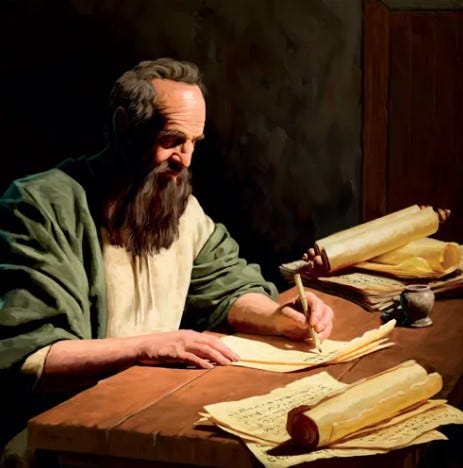
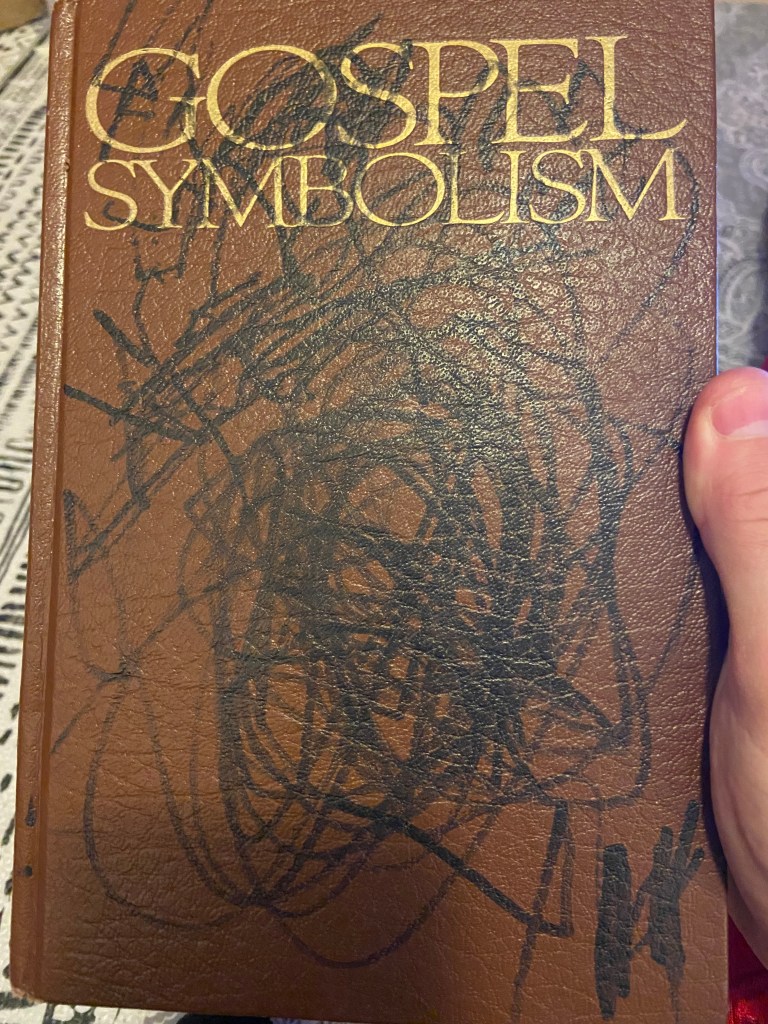
I read a book titled An Epistle from the New Testament Apostles.
A sentence in the second paragraph of the preface caught my attention and helped me to read this book in a different light. That sentence read:
“Imagine for a moment how you might feel if you were to go to your mailbox only to find there a long letter addressed personally to you from the First Presidency and the Quorum of the Twelve Apostles as those church leaders were constituted shortly after the resurrection of Christ.”
Huh. Do we read the Bible in this way? Do we read the Bible as if Simon Peter, Paul of Tarsus, or John the Beloved were writing to us? How much more power comes from the words as we consider them a personal letter directly sent to us? What is the Bible really, but a letter sent directly to us from these prophets? You could also consider the Bible a letter sent to you from God.
I’d like to share a part of this book that was especially significant to me. As I said, the book takes all the epistles of the prophets in the New Testament and categorizes them. It’s also worth noting that where there are multiple translations or interpretations of what may have been originally written, this book showed some of those different options. Keep that in mind when reading the quotes below. One category that stood out to me was titled:
Unity in the Church
From James 3:14-16 “But if ye have bitter envying and strife in your hearts, glory not/do not assume superiority over/ and lie not against the truth. This wisdom descendeth not from above, but is earthly, sensual, devilish. For where envying and strife is, there is confusion and every evil work.”
Sounds like Christianity today.
Another section.
A Call to Unity in the Body of Christ
From Ephesians 4:1-6 “I therefore, the prisoner of the Lord, beseech you that ye walk worthy of the calling wherewith ye are called, With all lowliness and meekness, with longsuffering, forbearing one another in love; Endeavouring to keep the unity of the Spirit in the bond of peace. There is {In} one body, and one Spirit, even as ye are called in one hope of your calling; One Lord, one faith, one baptism, One God and Father of all, who is above all, and through all, and in you all.”
Ephesians 4:11-15: “And he gave some, apostles; and some, prophets; and some, evangelists; and some, pastors and teachers; For the perfecting of the saints, for the work of the ministry, for the edifying of the body of Christ: Till we in the unity of the faith, all come and of {to} the knowledge of the Son of God, (MISSING ERASED CONTENT FROM KJV). That we be no more children, tossed to and fro, and carried about with every wind of doctrine, by the sleight of men, and cunning craftiness, whereby they lie in wait to deceive, But speaking the truth in love, may grow up into him in all things, which is the head, even Christ.”
Unity.
I point out the lack of it in Christianity not to try to “dispute” or to create “contention” but to point out the obvious.
It’s interesting the first things Jesus Christ did when he appeared to His other flock in the Americas.
He proclaims His Atonement, announcing that He accomplished what the prophets said would be fulfilled, announcing that He can save His people.
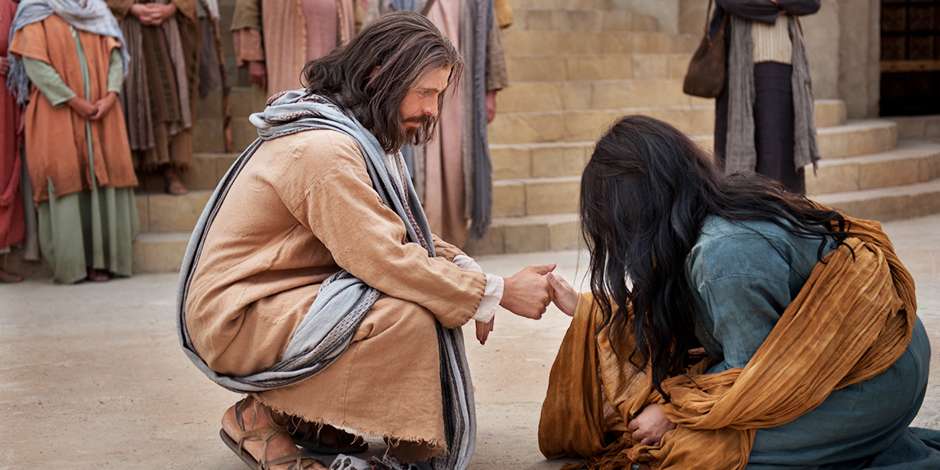
He ministers to His people one by one. They are each individually allowed to come up and feel the wounds in His hands, feet, and sides.
After the people cry out “Hosana!” literally, “God save us” or “Save now, we pray,” Jesus Christ sets forth the mode of baptism, the way He can save them.
From here Christ’s complete focus is on unity. He elaborates on the oneness of Himself, God the Father, and the Holy Ghost.
Then He says (3 Nephi 11:28-30), “And according as I have commanded you thus shall ye baptize. And there shall be no disputations among you, as there have hitherto been; neither shall there be disputations among you concerning the points of my doctrine, as there have hitherto been. For verily, verily I say unto you, he that hath the spirit of contention is not of me, but is of the devil, who is the father of contention, and he stirrith up the hearts of men to contend with anger, one with another. Behold, this is not my doctrine, to stir up the hearts of men with anger, one against another; but this is my doctrine, that such things should be done away.”
May we all avoid disputations and contention. May we always serve with meekness, longsuffering, and love. I hope that one day Christianity can be unified in our faith in Jesus Christ. That will likely not come until the millennium, when we can all look to who we serve, and know without a doubt that we know Him. But we can do our part today to not let the devil have power over us. We can do our part by removing contention and argument from our lives.
The theory of intelligent design is, simply put, the idea that this world is too perfectly designed for there to be no designer. The theory comes from what’s called the Watchmaker Analogy, put forth by William Paley in 1802. The idea is that if you walked into the woods and found a pocket watch, you would assume someone designed that pocket watch. Due to the complexity and clear design of the pocket watch, you would not assume it just appeared there by coincidence.
Of course, it’s more complex than that. Before you say, “Well you would assume a designer because you’ve seen a pocket watch before,” well, sure. That’s not the point. The point is that things that appear to have been designed usually have a designer. If it makes you feel better, insert “clearly designed foreign object” instead of pocket watch.
Intelligent design gets a tough rap in the scientific community. In scientific circles, they scoff at this idea. They say, scientifically, who is the designer? The ridicule continues from there.
There is one argument from scientists against the theory of intelligent design that I’d like to discuss here. Scientists who believe in the theory of evolution and oppose intelligent design make this argument:
They say that –
“If there is an intelligent designer, why would that intelligent designer create things that seem to not have a purpose?”
To be funny, and to lighten the mood, we will use the example of male nipples. Why would an intelligent designer give males nipples when they serve no purpose?
Proponents of intelligent design would respond, “Just because we don’t know the purpose, doesn’t mean there is none.”
This results in escalated scoffing from evolutionary scientists. They say, “That is unscientific. You can’t have it both ways. You can’t say something has an intelligent designer, then when asked why there would be pointless designs say we don’t know the purpose of those designs. That is unscientific as it is untestable and can’t be proven either way.”
This goes back to what is “scientific” in terms of the scientific method, etc.
The theory of evolution is that all species have evolved through a process called natural selection. There is ample evidence to appear that the theory of evolution is true. See my post What the Theory of Evolution is Missing. Natural selection is basically the idea that the strongest survive, they breed, and so the strongest traits in a species will survive and be passed on.
Of course, it’s not that simple.
So, here’s the thing.
If an evolutionary proponent is asked, “Why did natural selection result in males with nipples? How did nipples help man survive?”
The response would be, “Natural selection doesn’t guarantee everything is related to survival. There is some randomness.”
What is the difference between the intelligent design defense and the evolution defense?
What’s the difference between:
Intelligent designer
If we don’t understand the design, doesn’t mean there is no purpose.
And
Evolution and natural selection
Not every trait is for the purpose of survival, there is some randomness.
Where is the difference? These are both ‘you can’t have it both ways’ arguments.
Is there something I’m missing here? Is this not, essentially, the same argument? Is this not the same thing?
Ultimately, the root of criticism of the theory of intelligent design comes down to one thing: belief in God. That’s what it’s all about. A lot is thrown around about “unscientific” and blah blah. Please define “scientific.” Cool, thank you. Now I’ll find 10 different definitions of scientific from 10 different scientists.
I’ve elaborated more on the “God issue” in science in this post. Science and religion will always be in an unwarranted battle until the true scientist – the one who set this all up, designed it, created it, organized it, and sent us here – comes down and explains it all to us. I welcome that day.
Sometimes I struggle with the idea that my sins have been made completely white through the Atonement of Jesus Christ, that I’m completely forgiven for everything I’ve done.
I know this disrespects the Atonement of Jesus Christ and that’s part of my biggest struggle. The last thing I ever want to do is belittle what Christ did for me.
The thing is, sometimes I still dwell on my past sins. Sometimes I still think about them. Sometimes I still feel remorse and guilt. Sometimes I wonder if I’ve paid the full penitence to those I hurt. Have my sins been washed away? Are they completely gone if I still remember them?
I rationalize this, and I believe it’s true, that I remember them for my benefit. I have to remember them or I might return to them. It’s the remembrance of guilt that keeps me from wanting to go back to being that person.
I understand this intellectually.
Still, sometimes it’s hard for me to understand how Christ can have forgotten my sins, washed them away as if they never happened, when I can’t forget them myself.
The young men I work with and I recently studied Isaiah chapter 1.
“Come now, and let us reason together, saith the Lord: though your sins be as scarlet, they shall be as white as snow; though they be red like crimson, they shall be as wool.”
After reading that I emphatically emphasized something to those young boys. What I emphasized was this:
“When you truly repent, and show remorse, and try your absolute hardest to not do it again, Christ forgives and forgets your sins. Period. White as snow. It’s as if they never happened. Don’t be deceived. Satan will have you believe you can never be forgiven for a mistake. This is the great lie. You can be forgiven. If you repent, Christ will forgive. Not only that, He won’t even remember it. It’s like it never happened. I can’t stress this enough.”
That’s what I said to my young men, and I believe it’s true.
But… do I believe it’s true?
Given what I just wrote?
I had a thought today for the first time ever. I often think about the time of judgement. That time when we stand before Christ and have our life reviews. I’ve never feared that moment. The thought that occurred to me today is: why don’t I fear that moment? I have so much to be embarrassed by, so much to be ashamed of in my past behavior. Why haven’t I worried about it before? It occurred to me that one day my wife, Beth, will see how I once was. I’ve tried to tell her, but I don’t think she gets it. Then it occurred to me that my family will see it too. I will be so ashamed! Why haven’t I feared this before?
Then it hit me.
Maybe that’s repentance.
Repentance is knowing – yes, I did those things. Yes, I made many mistakes. But though my skins be scarlet (they are and were) they shall be as white as snow. As I type this, I hold back tears. That’s what Christ has done for me. That’s what repentance is.
“I say unto you, that likewise joy shall be in heaven over one sinner that repenteth, more than over ninety and nine just persons, which need no repentance.”
“And how great is his joy in the soul that repenteth!”
I am that soul. I don’t know how the life review will go. If my sins are forgiven and forgotten, are those parts reviewed? I don’t know. But what I realized was, and why I’ve never feared that moment, is even if all my abhorrent behavior is shown, it will be ok. It will be ok because I changed.
That thought of Beth seeing how I used to be? It occurred to me that maybe she’ll love me even more after seeing all of it because she’ll see how much I changed. She’ll be able to see the full picture of how far I came to be a semi-decent husband and father.
I think that’s what repentance is. Knowing that even if all your sins are laid out, you’re still forgiven.
****Disclaimer before reading this post. Of course I have the greatest family and Beth. The world wasn’t completely lonely. My world has always been amazing. I thank God daily for that, and don’t know what I did to deserve it. I love my family and I love Beth. I’ve been so blessed. But that didn’t fit into the point of this post. So, I’m putting this disclaimer before writing.
Tolkien inspires a lot of thoughts in me. His writing is flush with eternal truths.
I’m reading The Book of Lost Tales Part 1 (I wrote this in 2022, I’m now on book 5).
This book includes the writings of J.R.R. Tolkien that were never put to print in his lifetime. His son has since edited and published the writings.
In this book, the tale of the coming of the Eldar, or the elves, is told. The Valar (Gods of Earth) had been on the earth for an untold amount of time. They knew one day the children of Ilúvatar (the one God, their creator) would come one day. That day finally came. This is how it is described in the book:
“Then shouted all the people of Valinor: “I-Eldar tulier – the Eldar have come” – and it was not until that hour that the Gods knew that their joy had contained a flaw, or that they had waited in hunger for its completion, but now they knew that the world had been an empty place beset with loneliness having no children for her own.”
That is precisely how I feel about Ivy and Sage. What was the world before them? It was a lonely place. What did I do before them? Play basketball and video games? What was life?
It wasn’t until they came that I truly understood what mattered. I’ve written about my world flippingupside down before. That passage from The Book of Lost Tales Part 1 describes it perfectly.
As I’ve written Which Church and One True Church I’ve started to think more about why the Church of Jesus Christ of Latter-day Saints is needed. Why, if someone can accept the gospel in the next life, do they need it here?
I combined those two questions but they I have led to two distinct thoughts.
“Pray unto the Lord, call upon his holy name, make known his wonderful works among the people.
Call upon the Lord, that his kingdom may go forth upon the earth, that the inhabitants thereof may receive it, and be prepared for the days to come, in the which the Son of Man shall come down in heaven, clothed in the brightness of his glory, to meet the kingdom of God which is set up on the earth.
Wherefore, may the kingdom of God go forth, that the kingdom of heaven may come, that thou, O God, mayest be glorified in heaven so on earth, that thine enemies may be subdued; for thine is the honor, power and glory, forever and ever. Amen.”
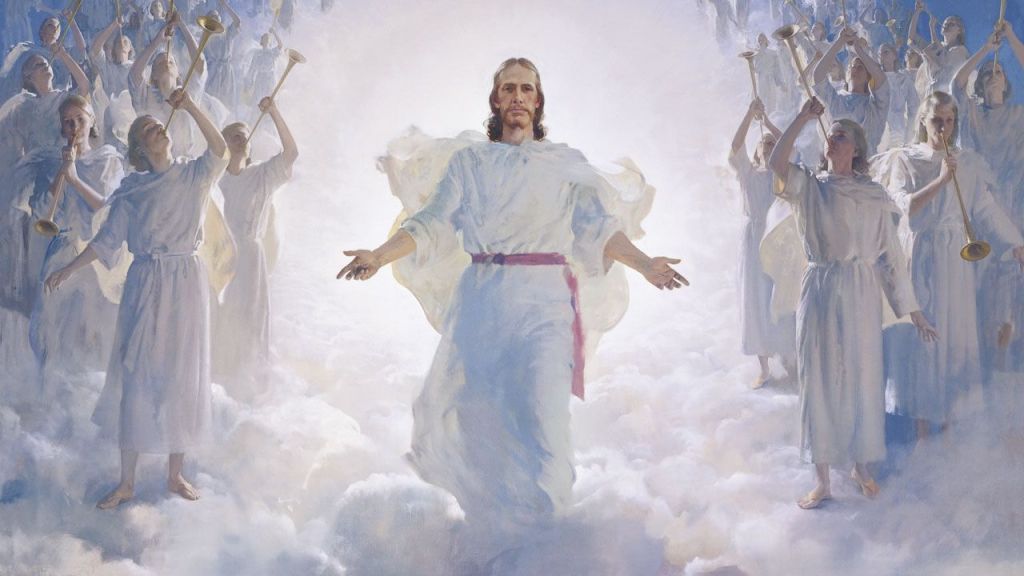
We know that Christ will come to this earth again. The Second Coming will happen. We know He will come in power and glory. What I think is lost is the preparation that goes into preparing for Him. He doesn’t come and people just all of a sudden realize He is their King. They may realize who He is in a broad sense but they don’t appreciate His role as their Savior just because they see Him come. The Kingdom of Heaven is being built. It’s being built by us, by followers of Christ. The covenants we make here prepare us to meet Christ at His coming. If we can’t covenant with Him, we can’t understand Him. If we can’t understand Him we can’t know Him. If we can’t know Him, He will be forced to say, “I never knew you” (Matthew 7:23).
Look at all of what Christ said in Matthew 7:21-23:
21 Not every one that saith unto me, Lord, Lord, shall enter into the kingdom of heaven; but he that doeth the will of my Father which is in heaven.
22 Many will say to me in that day, Lord, Lord, have we not prophesied in thy name? and in thy name have cast out devils? and in thy name done many wonderful works?
23 And then will I profess unto them, I never knew you: depart from me, ye that work iniquity (emphasis added).
We must do the will of the Father, not just profess to know Christ. This is where our covenants come in.
This leads to my second question.
2. If someone can accept the gospel in the next life, why do they need it here?
I like to read near death experience books. There are many consistent, fascinating themes in the experiences people have when they nearly die and are allowed to remember some of their experience. One of those themes is the realization that everything we do here is immensely important. Why did God send us to this earth? To be tested, to learn faith, to grow, to have families, to develop God-like traits. All these things. While I can list off a somewhat generic list of statements about why we’re here, (I say generic though I believe each of those statements to be truly profound), there is so much we don’t know about why we’re here. I don’t think many of us will ever appreciate the magnitude of every moment on this earth. I don’t think we understand how important every decision, relationship, and thought is in our eternity.
I think if we understood these things perfectly, we’d live our lives in much different ways. What does the next episode of “stupid tv show” matter in the grand scheme of things? It only matters in that it has distracted you from what is truly important. Scripture, faith, family, relationships, love – these things are eternal.
There is something profound about this life. Yes, everyone will receive an opportunity in the next life to hear the gospel. Everyone will have an opportunity to have their biases stripped away. Everyone will have an opportunity to see truth for what it is: truth. To see light for what it is: light. We don’t understand the true importance of this life. But I do know it’s important. I know there’s a lot we don’t understand about the real importance of our time here.
We are laying the foundation of the Kingdom of God. Think about the power in that statement. What we do here is important.
We must prepare ourselves and those around us to be ready for Jesus Christ’s Second Coming. Think about yourself and those around you. Christ is a light greater than the Sun. When He comes, can you withstand His glory? Are you living in such a way that you’ll know Him, and be able to look into Him? What about your family, those around you? Will they be able to withstand His glory with you?
But who may abide the day of his coming? and who shall stand when he appeareth? for he is like a refiner’s fire and fullers’ soap.
I think back on myself when I was first returning to Church. I didn’t truly know Christ. I couldn’t. It’s through priesthood power, temple covenants, and a true commitment to Christ that I have grown. I still have a long way to go. I am not saying I’m near finished. Enduring to the end. Putting all my faith into Christ has changed me in so many ways and I know I’m becoming better prepared to meet Him again.
Now is the day to prepare to meet Christ. There isn’t time to wait. It is time to know Christ, then follow Christ. Only by truly knowing Him can you be ready for Him at His coming.
Repent today. Evaluate yourself today. Don’t be like me and waste so many years. Christ knows who you can become. Take comfort in that and move forward. Know Him. Trust Him.
Ivy was recently watching a child’s video before church on Sunday.
In the video, ten children were standing outside waiting for a bus to take them on a field trip. The children were going to a zoo and the ten children each listed what animal they were excited to see.
In the animated video, 5 of the children were holding lunch sacks. The other 5 children were empty-handed. The 5 children with lunch sacks asked the 5 children without lunch sacks where their lunches were. The 5 children without lunch sacks had been busy playing and hadn’t prepared their lunches.
The 5 children without lunch sacks said it would be fine. They said they would go make their lunches. But at that moment the bus pulled up.
You know the story.
I’m not going to reiterate the parable of the ten virgins here. What I’m going to do is elaborate on what this particular video made me think about with this parable.
In this video, the children were irresponsible and didn’t prepare for their field trip and therefore would go hungry on their field trip. This is consistent with the traditional ten virgins story.
What this representation made me think of, as many things do now, is of parenting. I looked at those 5 children without lunch sacks as young children, let’s go with kindergarten. As I watched, it was my opinion that it wasn’t fully those kindergarteners’ responsibility to prepare their lunch. It was likely their parents who didn’t prepare a lunch for them to take to the field trip. As my mind expounded upon this thought, I thought of all the reasons parents might not prepare a lunch for their children. Reasons include not having enough money to pack their child a lunch, not having enough time due to a busy work schedule, not being organized enough to remember to prepare their child a lunch, forgetting because a million other things are going on, or simply not caring enough to pack their child a lunch.
I felt bad for those 5 children. It wasn’t their fault they didn’t have sack lunches. They were not prepared because their parents didn’t prepare them.
As a kid who literally went on some field trips without lunch, I could sympathize with these children (love you Mom and Dad).
You get this isn’t about sack lunches right?
It is the responsibility of parents to prepare our children for the second coming of Jesus Christ. Just writing that, I realize most people mock the very idea. This is why we go to church. This is why we study scriptures as a family. This is why I read Ivy and Sage Bible and Book of Mormon stories. This is why we pray before every dinner and before bedtime. This is why I take Ivy with me to church meetings and to visit members of the ward.
I’m grateful I was prepared with a spiritual sack lunch as I was raised. Even if my parents don’t think they prepared my sack lunch with enough sustenance, it was prepared. I was given the preparation, and I hope, despite all the shortcomings I’ll demonstrate in raising my girls, that my girls have a lunch with them on their field trip of life.
I’d like to briefly go over those reasons parents don’t prepare their children.
1 – Not having enough money to pack their child a lunch – this represents not having enough resources themselves. The church and those around you will make up the difference. Try.
2 – Not having enough time due to a busy work schedule – I get being busy, I get it as much as anyone. We must make time for the most important things. We are preparing ourselves and our children to survive in a turbulent world and the world to come. NOTHING is more important.
3 – Not being organized enough to remember to prepare their child a lunch – this one hits home hard. Sometimes I feel like I’m not organized enough and can’t give my children, my ward members, my family, and everyone around me all I can give. All we can do is try our best. Christ sees our efforts and He sanctifies and then magnifies those efforts.
4 – Forgetting because a million other things are going on – feigned ignorance will not be an adequate excuse when we stand before the Lord and tell Him we didn’t prepare these tender little ones to know Him because we were too busy and forget. Realign your priorities.
5 – Not caring enough to pack their child a lunch – this goes with point four above but is absolutely inexcusable.
We have been given the stewardship of these children. We must rear them in righteousness.
Jesus Christ is coming. It’s a fact. The world wants to deny it and focus on everything else. But it’s happening, and it’s important we prepare ourselves and our children.
I am grateful to be a member of Christ’s Church and to have the great honor of raising two chloice spirits to know and worship Him. This is the greatest honor I could have in this life. It is a great honor and a great responsibility. I hope to one day stand before the judgment seat of Jesus Christ and tell Him, “I’m sorry. I know I made many mistakes. But I hope I did my best. Thank you for giving me these daughters that blessed me so. I hope that I made you proud.”
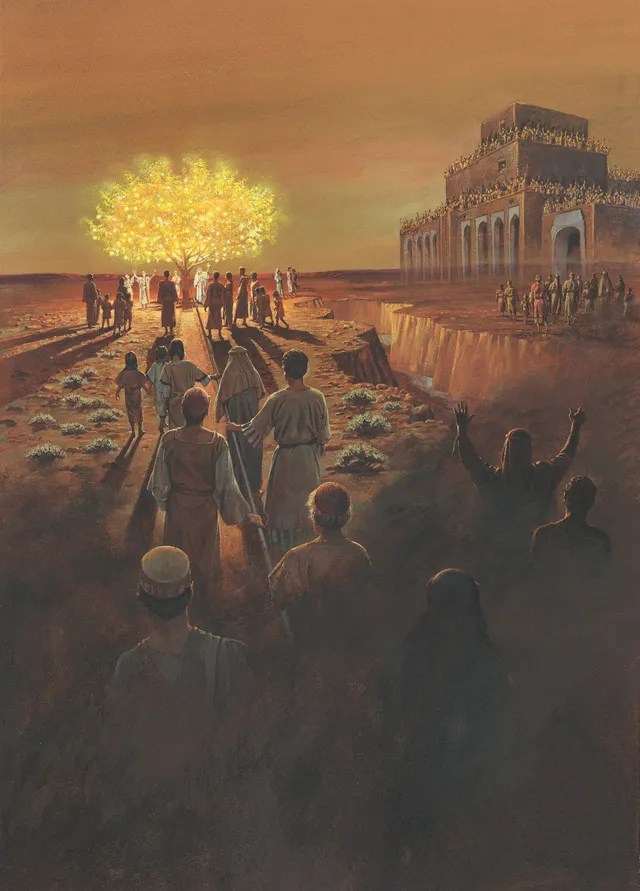
Some thoughts I had while reading about Lehi’s dream. I will not relate every detail of the dream so for those who are unfamiliar, it can be read in 1 Nephi chapter 8.
The first thing I noticed is the location where Lehi starts in his dream. The people he sees later all start at the head of a fountain of water. It could be this is where they started or this is where Lehi first sees them. What seems significant to me is this: Lehi is wandering blindly through the dark and dreary wilderness (verse 4). It is then that Lehi encounters a man dressed in a white robe who bade Lehi to follow (verses 5, 6).
What I find significant is that later in the dream Lehi beckons Sam, Sariah, and Nephi, along with others, to come to the tree. Where is their man in a white robe? I think what we’re learning here is the significance of prophets in God’s plan. Lehi was led to the Tree of Life, the fruit, the gospel of Jesus Christ by a man in a white robe. Let’s assume the being in the white robe is Jesus Christ Himself (Sidenote: Let’s be clear, in Lehi’s dream I don’t know that the man in the white robe is necessarily Jesus Christ. It could be someone Christ sent like Gabriel or Adam to lead Lehi. But the principle stands and for simplicity, I’ll refer to the white-robed being as Christ). So, Christ leads Lehi to the gospel. It’s then that Lehi guides others there. Not to say that others don’t have a personal relationship with Jesus Christ, just that if we follow the guidance of and heed the prophet, he will guide us to the Gospel of Christ and keep us connected to the iron rod.
The significance of a prophet is further illustrated by verse 8. Lehi doesn’t encounter Christ and immediately show up at the Tree. He “traveled for the space of many hours in darkness.” I think this represents the trials and tribulations Lehi had to go through. He was scorned, threatened death, and ultimately had to leave his home for his testimony of Christ. Prophets don’t become prophets overnight. They’re often the most persecuted among us. Then Lehi “began to pray unto the Lord that he would have mercy on me, according to the multitude of his tender mercies” (verse 8). It was when Lehi humbly cried out that he beheld “a tree, whose fruit was desirable to make one happy” (verse 10).
Lehi is led to the gospel. In a way I think he is ordained a prophet in that moment. From there he beckons and leads others to the fruit.
Another way this can be looked at is that anyone who leads others to the tree of life, like Lehi led his family, can be a type and shadow of Christ. If you are an example to someone of Christ-like love and lead someone to come closer to Jesus Christ, you are acting in the role of the white-robed person, or Jesus Christ. You become a Savior on Mount Zion.
Another significant feature of Lehi’s dream is the river of water. It can become confusing what exactly the river of water represents if you read Lehi’s dream, then Nephi’s interpretation of it. In chapters 12 and 15 Nephi is clear, the water was filthy and represents the depths of hell (12:16). If you read 11:25 it reads, “the rod of iron…led to the fountain of living waters, or to the tree of life.” I think the significance here is the water is “living water” as it approaches the tree of life. As the water distances from the Tree of Life it becomes filthy. Therefore, at the head of the river, away from the Tree of Life, it was filthy and represented hell.
Those in the great and spacious building mocked those who sought the Tree of Life. I think one interpretation could be that those in the building were products of ignorance. They knew no better. They were deceived by the “wisdom thereof, the pride of the world.” Laman and Lemuel can not plead ignorance. They had seen an angel (1 Nephi 3). Their father was a prophet. They started from a different point than someone who ended up in the great and spacious building. When Laman and Lemuel denied what they knew and denied all the light they’d been given, they were swept away. To whom much is given, much is required (Luke 12:48). “He who sins against the greater light shall receive the greater condemnation” (D&C 82:3).
1 Nephi 12:18 “the large and spacious building…is the vain imaginations and the pride of the children of men. And a great and a terrible gulf divideth them; yea, even the word of the justice of the Eternal God, and the Messiah who is the Lamb of God.”
The gulf that separates the people in the great and spacious building from the Tree of Life is their ignorance, not always of their own fault. Their upbringing might have brought them to the building. They may have been more easily deceived by Satan because of their upbringing and experiences. They may have started with an unfair disadvantage that made them unable to accept the gospel, “a terrible gulf” that made it too difficult to understand “the word of the justice of the Eternal God.” If they only understood how kind and loving their Father in Heaven is, or even that He is their Father, they likely wouldn’t laugh and scoff at those who embrace this great truth and find comfort from this truth.
That’s why it’s so important that this message is shared with the world.
This, I believe, is also why we must never judge others. We don’t know the experiences of others. It may be that if we were raised in a certain house, with a certain culture, with a certain understanding, with a certain life, with certain experiences, we would be just like the individual who scoffs at the Gospel. We don’t know the circumstances of someone else. We don’t know why they are the way they are. In their shoes, we may be no different. This is why it is to our greater condemnation to judge others. Don’t judge someone. You can’t comprehend all there is to know about them. Only one person can do that. He will rightfully and righteously judge them.
Back to Laman and Lemuel and the filthy water that sweeps them away – as said, they are worse off. This is also why those who partake of the fruit and are brought to be ashamed by the scorn of the world “fell away into forbidden paths and were lost.” They didn’t make it to the spacious building. They were lost to wander forbidden paths. Once you’ve tasted the sweet truth of the Gospel of Jesus Christ there is no going back. You can try to go back to the world, but most find they are more lost than ever. There are so many examples of individuals who leave the church but can’t ever really leave it. They become lost, always seeking to find something to fill the void the Church of Jesus Christ left. They can’t fill the void so they end up attacking it.
11:35 reads, “The multitude of the earth was gathered together; and I beheld that they were in a large and spacious building, like unto the building which my father saw. And the angel of the Lord spake unto me again, saying: Behold the world and the wisdom thereof; yea behold the house of Israel hath gathered together to fight against the twelve apostles of the Lamb.”
Many of these people are deceived, and therefore they fight against God, unknowingly sometimes. The wisdom and pride of the world can be churches that look at the poor and needy and manipulate them. Or it can be individuals who look at any other church and scoff and mock. Oftentimes, these actions are done in the guise of defending God. More evil has been perpetuated under the guise of doing what’s right than just about anything. God needs us to defend Him by our kind actions and good examples, not by slandering, judging, or hating others. Many today of other faiths openly mock what they don’t realize is Christ’s true and living church. They have been deceived by the wisdom of the world. And in mocking “they never knew Him” (JST Matt. 7:33).
These are just a few of my thoughts from Lehi’s dream of the Tree of Life. I feel there is so much to learn from this simple story. As with all things in the Book of Mormon, this points to Jesus Christ and helps point me in the direction of trying to be more like Him.
The question is often asked: Why did God command Joseph Smith to enact the practice of polygamy, or multiple wives.
The answer is sometimes given that it was for God to raise up righteous seed. to increase the number of children born in the gospel covenant in order to “raise up seed unto [the Lord]” (Jacob 2:30). I will come back to this.
Another reason that isn’t often spoken of. Joseph Smith’s calling as a prophet was to restore all things. Not some things. Not most things. All things.
If a Priesthood power was had or executed in this earth, it was Joseph Smith’s duty to restore it in this, the dispensation of the fullness of times.
To many people distraught at the idea of polygamy I would ask, “Do you believe in the Bible? Do you believe in Abraham, the great Patriarch?” How can a practice so wholeheartedly be condemned in the 19th century but be acceptable to you in the past? God is eternal. He doesn’t care about 2000 BC or the 1830s. To Him it is all one eternal round.
It’s amazing that the staunchest denouncers of plural marriage never speak of Abraham, Isaac, and Jacob. The same Abraham, Isaac, and Jacob whom they pronounce with vigor, “I believe in the God of Abraham, Isaac, and Jacob.” Israel, whom the 12 tribes of Israel come from, exist because of this practice so condemned by modern critics.
I want to touch back on the “righteous seed” theory. Some I think at least slightly scoff at the idea. It’s such a broad concept that most simple human minds can’t see such a big picture. Couldn’t God raise children to Him in a different way? He’s God, right?
Maybe.
But God has always worked through us, here on earth, to do, build, create, and work. He doesn’t magically insert tens of thousands of people because He needs them here. He commands and we either react with faith or with stubbornness.
I’d like to give a real-life example of this principle of raising seed unto Him.
I am a descendant of polygamy. Me. Someone you know is here because of this practice. Where would I be if not for this practice? I would have either been born to another family, outside of the covenant, outside of this Church, or I’d still be in line waiting to come to earth.
I’m grateful for the practice of polygamy. I know it was difficult. I know it was a great test of faith. It was an incredible trial for those who had to live it. Those who endured it faithfully, like my great-great-great grandfather, Benjamin F. Johnson, have blessed me and the life of countless others. I’m grateful to him.
It is pretty well documented how much Joseph Smith struggled with the principle. He all but avoided it for many years. Do you think Joseph Smith who was already persecuted and hated, driven from state to state, wanted to institute something that would make his enemies more hateful? Do you think he wanted to institute something that gave his enemies more anger and vitriol towards him and the Church? It was hard enough. It was not easy for Joseph Smith to institute polygamy. Ultimately, he had to learn obedience to all of God’s commands. Even the hard ones. Even the ones he didn’t understand.
We don’t know exactly why God instituted the practice of polygamy, anciently or modernly. We can guess, we can hypothesize. But like many other principles or workings of God, it comes down to faith. I wouldn’t be here without the faith of someone else who accepted something difficult. It’s a small act of faith on my part to accept and show gratitude for their great faith in times past.
I read a book I probably wouldn’t admit willingly reading, except that a cool experience and message came out of it, so here we are.
That book was called Are Your Standards Fences or Guardrails by John Bytheway. There’s nothing wrong with this book. It’s just… a book I would be embarrassed to read as a kid as much as I was embarrassed to be reading it as an adult. I mean, just look at the cover, I think that says it all. It’s a super uplifting and positive book to help teenagers live morally and with high standards in an increasingly low standard world. If I start a book I’m going to finish it. As with any book, something will be learned from it. This book had a particularly cool experience come from it.
The cool experience that came from reading this book developed out of a realization that Beth brought to my attention.
I’ve gotten many of the books I’m currently reading from my grandparents. Many still have the sticker on the inside cover that reads, “Mr. & Mrs. Leach.” As I was reading this book and wondering, ‘Why am I reading this?’ I noticed, like I often do, where the touch of my grandma was. This book was full of ear-marked pages.
I mentioned it to Beth. “Here’s evidence of Grandma.”
Beth asked what year the book was published and I told her.
Beth wondered out loud, “2003…. So, who would she have had in mind while reading this?”
My first thought was nobody. Her kids were already grown up with kids of their own by 2003. Then I slowly connected the dots. 2003….I would have been 13…. Oh… Grandma was likely thinking about me (along with others) while she read this.
It added some reverence to this book. Here I was approaching 20 years after my grandma read this book with me in mind and I was reading it with my daughter (only Ivy was born when I was reading this) and younger siblings in mind. It’s amazing how life changes. It’s amazing how we change. Every page my grandma ear-marked was for good reason. She had reason to worry about me at that time. At that time, I was on my way to breaking every guideline from that book.
Here I am 20 years later having the same worries about the younger generation.
It’s partly why I write all these silly posts. Maybe one day my daughter will read them and have an idea of who I was in 2020, and 2022, and 2025. Because by the time she’s reading this in 2033 I’ll be well on my way to grumpy, old, so-out-of-touch father.
***TANGENT*** I already feel that way this weekend playing catchphrase with my 19 year-old cousin and her friend. Did you know a 19-year-old doesn’t remember 9-11? That hit me like a slap to the face, woah! The most impactful and memorable day of my life was not experienced by a generation that is now approaching or already in their 20s! That’s crazy. That same cousin has never seen an episode of Boy Meets World. It’s a crazy thing getting older.
Anyways, this was less about the book and more about what it made me realize. Life is so fluid. I remember being 15 and being convinced I knew everything. Now I’m in my 30s and realize I know almost nothing.
Life moves and changes so quickly. It’s an amazing thing. I don’t know what closing or profound thought I have to finish this post. I guess I’ll close with this: to my 12 year-old daughter in 2033, know I once thought I knew everything and it took many years of stupidity to realize how little I know. It took me a long time to realize the adults around me that I thought were hypocritical, or judgemental, or out of touch, or just trying to keep me from having fun really only ever had my best interests in mind.
To my two girls: I love you and the adults around you love you. All we’ll ever want is the best for you and to protect you. I promise you that.
I had a thought that never occurred to me before while reading Doctrine and Covenants 138, as obvious as this thought is.
I believe it’s correct that some of the ancient prophets, Adam down to Joseph Smith and beyond, have resurrected bodies and are in heaven teaching. For some reason I’d only ever thought about them teaching those who had already been on earth and died. For the first time it occurred to me that they might also be teaching those who haven’t come to earth yet.
This seems to be affirmed by the words of modern prophets, from Doctrine and Covenants Student Manuals:
“President Joseph F. Smith was shown that many choice servants of this dispensation were also among those noble spirits. The Lord held them in the spirit world where they were taught and prepared to come forth and lay the foundations of His latter-day work. The Prophet Joseph Smith once said that “every man who has a calling to minister to the inhabitants of the world was ordained to that very purpose in the Grand Council of heaven before this world was” (Teachings, p 365).
“President (Joseph F.) Smith also observed that, in addition to these leaders, there were “many others” who “received their first lessons in the world of spirits and were prepared to come forth in the due time of the Lord to labor in his vineyard for the salvation of the souls of men” (D&C 138:56). This refers to the doctrine of foreordination, which teaches that “in the premortal spirit world, God appointed certain spirits to fulfill specific missions during their mortal lives. … Foreordination does not guarantee that individuals will receive certain callings or responsibilities. Such opportunities come in this life as a result of the righteous exercise of agency, just as foreordination came as a result of righteousness in the premortal existence.”
“President Russell M. Nelson taught: “Your spirit is an eternal entity. … Your Heavenly Father has known you for a very long time. You, as His son or daughter, were chosen by Him to come to earth at this precise time, to be a leader in His great work on earth. You were chosen not for your bodily characteristics but for your spiritual attributes, such as bravery, courage, integrity of heart, a thirst for truth, a hunger for wisdom, and a desire to serve others. You developed some of these attributes premortally. Others you can develop on earth as you persistently seek them.”
These are things I’ve known, and thought about, but an encouraging and empowering reminder when the world fights back so aggressively against spiritual things.
We were chosen before we came. We were potentially tutored by the very greatest prophets and teachers the world has ever seen. The tutoring from great prophets pales in comparison to the reminder that we were chosen by God, the eternal Father. God of Heaven and Earth. Creator of all things. When we remember He chose us for a purpose, and we’re on the Earth now for that purpose, the oppositions of the world should seem silly.
If I was lucky enough to receive training from a great prophet and was chosen by God before coming here, anything is possible.
This is going to go a direction you won’t expect. I’m not going to argue against Darwin’s Theory of Evolution. I’m not nearly smart enough to discuss the theory of evolution in much detail.
The disconnect, for me personally, is when the theory of evolution brings scientists to the conclusion that God doesn’t exist. The omniscient, omnipresent, omnipotent God, creator of Heaven and Earth, couldn’t allow his creations to change?
Here is where I will diverge from class Christian thinking. The theory of evolution doesn’t go far enough.
What is it to attain the fulness of God? (Ephesians 3:19).
You think fundamentalist Christians hate the theory of evolution already? Imagine their hate for us if we say it hasn’t gone far enough.
Now, the theory evolution is more than just change. As I noted, it’s about natural selection. Darwin’s theory is that natural selection leads to change. Christ’s theory is He leads to change.
I’m not saying that Christ is leading plants and animals to change. They have their own process to fulfill the measure of their creation.
But Christ does lead us to change, or evolve, if you want to use that word.
Many of both religious and scientific persuasions would scoff at this notion.
Look again at the theory of evolution. Living creatures are evolving.
Why would humans not aspire or evolve to something greater then? I’m not talking about from mushrooms or apes. We are God’s children and as His children we have a divine inheritance. Our evolution is much greater. It’s from what we are now, to what Christ is now. This is possible because our Heavenly Father wants to give us “all he hath.”
What do I change into while here on earth, in a small amount of time? I turn into my parents. I become more and more like my dad every day. What do we evolve or change to eternally? God. He is my Father. It’s the natural order of things.
Joseph Smith often talked about how scholars, intellectuals, and religionists ridiculed him. Yet all he ever taught was what made sense. What made sense were eternal truths.
“Let this mind be in you, which was also in Christ Jesus:
Who, being in the form of God, thought it not robbery to be equal with God”
So, the scientific-minded, expand your thinking. Religious minded, expand your thinking. Embrace your inheritance and all that the Father has to offer you. Embrace change, embrace the Atonement of Jesus Christ that allows all change. Embrace your evolution. God wants you to aspire to be like Him. It isn’t robbery to Him. What greater joy is there than watching your children grow, develop, and become better? Maybe even become like you.
Where does the theory of evolution lead? Where are we headed, what do we become? What is our evolution?
I wrote and posted a first 48 hour update when Ivy was born. At the time I wrote some ramblings from the hospital. I never posted but wanted to share, even though it’s been a couple years since this was written. It’s funny to read back on the simplicity of a newborn. Oh how life has changed with two little ones. Here are those ramblings followed by a thought about my grandparents at the end:
36 hours in the hospital.
Swaddling and diapers.
Resting and food.
That seems to be the cycle of the last 36 hours. Beth feeds Ivy, change diaper, swaddle, Beth feeds Ivy, breakfast. Repeat before lunch. Repeat before dinner. In between that is rest.
I’ve never spent this much time in a hospital. I know many have. It’s an interesting existence. I can’t say I dislike it too much. I have writing, reading, tv. What else could I need? Oh, my wife and baby.
Ivy has been so great. She only sleeps and eats. Those are her two modes so far.
I’m told this won’t last long. My fingers are still crossed.
We’ve joked that thus far she has my demeanor (calm?) I’m hopeful it continues.
I can’t say enough about how kind the nurses have been here. They have been so helpful, attentive, patient. All the good things.
In the morning soon before the 24-hour mark we mentioned we would like to go home if that was a possibility. Within an hour it felt like 5 nurses came in to do this check or that, this test, that test. I guess they’re fine with us leaving if we’d like to. We live near the hospital so it’s not a worry to us to leave.
My grandfather, Frank Leach, called me while in the hospital. We had a great discussion about life, parenthood, and faith. With this new life, Ivy James, in my life, and this call from one of my progenitors, it got me thinking about the Circle of Life.
Disney’s song gives a touchingly accurate portrayal of the Father’s Plan for us here. What would I be without my grandparents? Love has afforded me much.
What would I be without the foundation they laid? Three of my grandparents are converts to the Gospel of Jesus Christ. My prayers are often filled with gratitude to my Heavenly Father for faith-filled grandparents who did really difficult things, made difficult life choices, made difficult changes, so that I could enjoy the fruits of the Gospel of Jesus Christ today.
My grandparents on both sides are spiritual giants and I have been extraordinarily blessed by them and the lives they lived.
Thank you, Virginia Quackenbush, Stan Quackenbush, Sandra Leach, and Frank Leach. How blessed I am to forever have you and thank you for all you’ve afforded me.
Re-reading this and now thinking about my Ivy and my Sage. How different Sage is from Ivy. More on that another day. How lucky I am to have this little family.
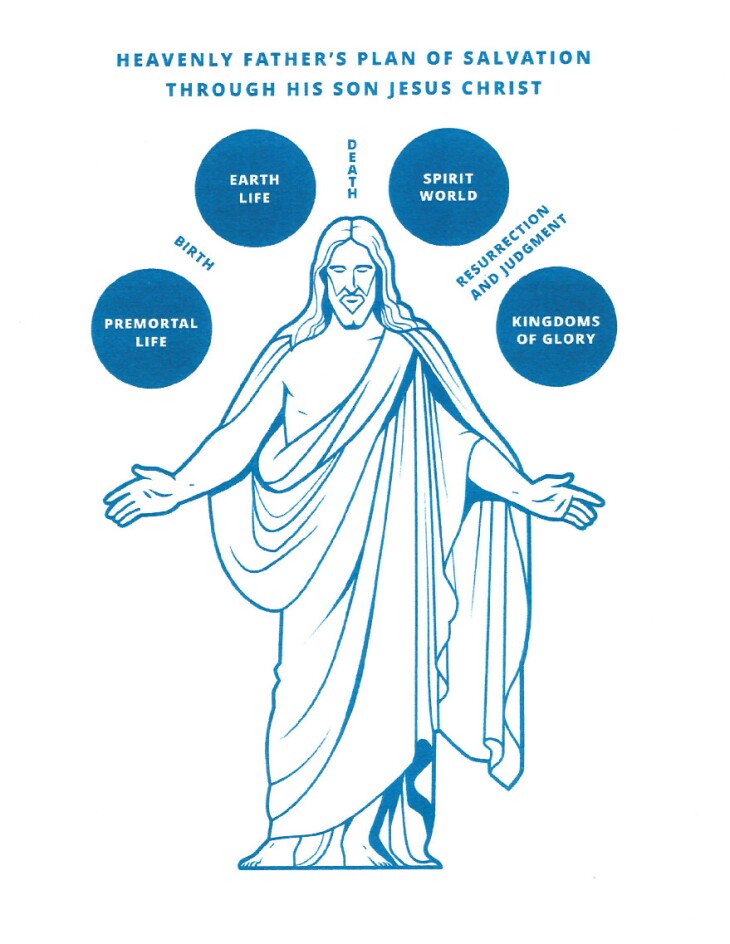
Outside of the Church of Jesus Christ of Latter-day Saints, what does Christianity believe about the after-life? Generally speaking, Christianity believes that we are born on earth, live our lives, die, are judged, and assigned to either heaven or hell.
I heard something on an awesome podcast called Unshaken Saints recently that I’d never realized. What the host of the podcast pointed out was that Christianity has it right. Christianity is just missing the beginning and the end.
As I stated, Christianity believes in life on earth, then judgement, then heaven or hell.
The truth is that life doesn’t start here on earth. This is the beginning that Christianity is missing. We lived long before we came to earth. There are many truths that stem from our understanding of our premortal existence. One of the most important truths that premortality provides us is an understanding of agency. We chose to come here. This life wasn’t thrust upon us. This is the missing beginning.
The truth after death (the end) is that we are temporarily assigned to either “spirit prison” or “paradise,” but this isn’t our final resting place. After our temporary assignment to prison or paradise, we receive our final judgement that the scriptures speak of. This is when we come before God and Jesus Christ, Jesus Christ as our advocate to the Father and our judge before God. This is where we either accept Jesus Christ and the mercy He has given us and are reconciled to God, then assigned our glory by the mercy of God and His Son, Jesus Christ; or we reject Jesus Christ and are cast out to outer darkness. We must willfully reject God, Jesus Christ, and the mercy we are given to be cast off. This is the hell that Christianity understands.
There will be glory assigned to all of God’s children. How can that be? It can be because He loves us that much, so much that He gave His only Begotten Son to save us.
Christianity thinks the final judgement is immediately after we die. The beauty of the Plan of Salvation is the realization that everyone will have an opportunity to accept Jesus Christ. Everyone will be taught and be given a fair chance. Spirits in “prison” will learn what they missed on earth. No one will be left out. Children are alive in Christ (Moroni 8:12). No one will be lost.
This is what Christianity misses. The beginning and the end. Premortality and the final judgement. If you cut off the beginning and the end of the Plan of Salvation, you have life on earth and spirit prison or paradise. That’s missing half the picture. We lived before we came here. We were loved by a loving Father in heaven before we came here. At the end, we will be judged for our actions, all we did on earth, our heart’s intent, our good deeds and bad, what we provided in this speck of time that will send us on an eternal trajectory. The beginning and the end. That’s what Christianity misses by rejecting further revelation by God’s prophets.
What does this do to Christianity?
Christianity believes we started here on earth. What does that do to our agency? We didn’t choose to come here. We didn’t know God before we came, who is He to us? This is what Joseph Smith spoke of when he talked about the First Vision. He said he learned that God and Jesus Christ knew him by name. For me, that knowledge is so engrained in my soul and being, it’s something I know, that God knows me. The Christianity Joseph Smith knew prior to the First Vision led him to be surprised that God could know him. I’m grateful for the truth God provided Joseph Smith when he appeared to him in a grove.
Back to what Christianity believes – we come to this earth by no choice of our own, sent by a God we don’t know or understand. We come to this earth to suffer by the sweat of our brow, a fallen world, a cruel world, a challenge we don’t understand, a challenge we didn’t choose. Then God judges us and casts 90% of us off. Most are cast off because they never knew God or Jesus Christ, no fault of their own.
This is what Christianity believes.
The podcast provided another analogy that made me think about how this misunderstanding of the Plan of Salvation limits Christianity.
There are two young men sitting outside of a Bishop’s office. One of the boys doesn’t want to be there. He doesn’t understand why he’s there. All he knows about the Bishop is that he’s a wrathful, unkind, harsh man. This young man fears the Bishop.
The other young man knows the Bishop. He knows him to be just and kind. He knows the Bishop loves him and only wants what’s best for the him.
As the first boy waits, he feels like he is in prison. He is dreading the upcoming confrontation with this unkind bishop.
What does the second young man experience? Is he not in a paradise? He knows he’s soon to meet a friend. That friend is going to give him a treat, congratulate him on how he’s been doing, give him a hug and tell him he loves him. This second young man welcomes the meeting with the Bishop.
The lack of knowledge in Christianity represents the first young man. Christianity doesn’t know God. By removing the premortal existence, life with a loving Father before life on earth, a Plan to come to earth and progress, a chance to learn of Him after this life, and then to be judged after being given all the necessary information, Christianity only sees a confusing, wrathful God, who has unfairly judged them.
The Plan of Salvation is a beautiful truth that Christianity is missing. Far from being completely ignorant, Christianity is really close. But this closeness, without the full truth, is extremely limiting.
ALL of us on earth chose to come to earth. All of us already chose Jesus Christ.
This is a powerful truth. I wish the rest of Christianity could see, understand, and accept the further light and knowledge that makes this life understandable and worth living.
When I started writing the post Unity, Peace, and Love, I actually had another point I intended to make. As often happens when I write, my point got sidetracked (I hope by the Spirit) and I ended up going a completely different direction than originally intended. The point I was sidetracked from, I still liked, and think is important, so I decided to write it anyway. Hopefully the Spirit will guide this post as well.
In Unity, Peace, and Love I talked about a video that shocked me, the video of someone strutting up to a rameumptom to pray. The idea of a follower of God shoving people out of his way to pray was so bizarre to me. I wrote in the aforementioned post what I think ended up being a better point about this. But what really came to mind the first time I watched that video is how corrupt religion can become if people don’t know who they worship.
In my original post about the rameumpton, I wrote about the God a friend of mine knew. His God was vengeful, exclusive, and selective. This friend believed that I was going to hell despite my best efforts. I assured that friend that I believed he was going to heaven. Do I worship a different God?
Let me be clear, I believe we’re all trying to worship the same God. I don’t mean to make the same argument that many Christians make against members of the Church of Jesus Christ of Latter-day Saints, that I’m not Christian because I don’t worship the same Jesus Christ. Just because we have different understandings of the person doesn’t completely diminish our worship. My efforts in worshiping Christ, even if others deem it a “different” or “inaccurate” Jesus Christ, is still worship.
The problem comes when our understanding of who we worship completely alters our understanding and our behavior. The idea that someone could shove someone on their way to prayer was so bizarre to me. But what if the God someone understands has no body, passions, and is unknowable? What if someone thinks God is a selective and vengeful God that needs to be feared?Why not shove someone on their way to prayer? This shoving behavior isn’t as bad as a God who destroys people on a whim, a God who sent us here so 99% of us could be damned to eternal torment. Surely shoving someone isn’t that bad if our example is that God.
I wrote the above before I finished Alma chapter 21 so I’d forgotten about the next part about the Zoramites, their rameumptom, and their recited prayer.
Verse 15 of chapter 21, after the depiction of a Zoramite shoving someone out of his way on his way to prayer, reads:
“Holy, holy God; we believe that thou art God, and we believe that thou art holy, and that thou wast a spirit, and that thou art a spirit, and that thou wilt be a spirit forever.”
Interesting their beliefs line up with my thinking about how not knowing God corrupts our behaviors not only religiously, but in life. Here we have a recited prayer and the confusion on God’s character destroying a society.
The culmination of the Zoramites corruption was not in their recited prayers or confusion in God, though. The culmination is found in verse 16 which reads:
“Holy God, we believe that thou has separated us from our brethren; and we do not believe in the tradition of our brethren, which was handed down to them by the childishness of their fathers; but we believe that thou has elected us to be thy holy children; and also thou has made it known unto us that there shall be no Christ” (emphasis added).
All their confusion, twisting of doctrine, and beliefs ultimately led to a denial of Christ. We will know the modern religions have truly fallen when they stop believing in He who keeps this all together.
In an April 2023 General Conference talk, Mark A. Bragg reminded us of the Joseph Smith quote, “If men do not comprehend the character of God, they do not comprehend themselves.”
This is where modern revelation and especially the Lectures on Faith (See here, here, and especially here for more on those) becomes so important. We must understand the character of perfection and love that Heavenly Father and Jesus Christ possess so that we can aspire to those characteristics. An unknowable God gives us an unknowable standard. Knowing God is perfect love, and we can do our best to be like Him, gives us the ability to do our best to emulate His love.
My parents and younger brother Easton were in town for the weekend. We went swimming and came back to the condo before they left. I said my goodbyes and got in the shower with Ivy to rinse off, as we always do after the pool. My family was packing up to leave.
As usual, I cleaned Ivy up and then yelled for Beth to come and grab Ivy from me. Beth didn’t come so I yelled again. After a couple minutes Beth still hadn’t come so I opened the shower door to make sure the maximum amount of sound waves would travel and yelled again.
I don’t like yelling. It was something I worried about when I started coaching basketball. Yelling feels inherently mean and unkind to me. I try not to raise my voice for almost any reason.
After the third yell I started to feel like a jerk. I wasn’t being a jerk; I was simply trying to make sure Beth heard me. After the third yell she came quickly into the bathroom. I apologized for yelling and said I wasn’t sure if she could hear me. Beth told me she heard me, but my family was just leaving, and she was saying goodbye.
For a split second I thought how my family heard me yelling also and felt ashamed for a moment before I reminded myself my yelling wasn’t malicious in any way. This was practical yelling; it served a purpose. I had to remind myself this because of my aversion to yelling. It wasn’t mean, I was trying to make sure Beth heard me.
This led me to a thought. I hope my parents know they raised me so that they never have to worry about how I speak to or treat others, especially my wife and daughters. I hope my parents know there are certain ways I would never speak to my wife and daughters. I hope they know I would never speak to anyone a certain way. I think they know that.
I hope to raise Ivy so that when she’s a grown up (can’t believe that’s going to happen) I’ll know how she speaks to people. I’ll know there’s certain ways she would never speak to anyone. I’ll know if she’s yelling there’s a purpose for it.
Why do we speak to people a certain way? Because Christ taught us that we’re all brothers and sisters and He showed the way. I hope I would never disappoint my parents or my heavenly parents with my behavior towards others. Of course, we slip sometimes. We aren’t perfect. But the Gospel of Jesus Christ teaches me why I should treat others the way I want to be treated. I hope to instill that in Ivy and Sage the same way my parents instilled it in me, so that I never have to wonder where her values lie and how she treats those she interacts with.
In the past couple days, I’ve heard multiple people use the phrase “eternal soul.” One time was in an episode of one of Ivy and I’s favorite shows, Impractical Jokers. One of the Jokers, Sal, sold his soul to Murr for a pair of shoes. They flippantly threw out the phrase. Now, they were clearly joking. Still, it intrigued me that they would use that phrase, “eternal soul.” Did they consider what they were saying?
I can’t remember the other place I heard it said. Some TV show or video or something. What I remember is that it was again said without seriousness. Just a flippant, cultural phrase people throw out.
Another phrase like “eternal soul” that gets said is “immortal soul.”
Do people realize what they’re saying when they say these words? It gets thrown around so casually. Yet, if you asked any of these people, “Is your soul immortal?” They’d probably reply with “I don’t know” or “I hope so” or “I have a soul?”
People often think of only one end of eternity. The part that gets attention is the forward looking, far out, never ending part of eternity. What people forget is that eternity goes the other direction. Eternity means no beginning, as well as no end. As Joseph Smith taught, if something has a beginning, it can also have an end. Our souls have no end. The implication of the word eternal is clear.
I think people throw these words out jokingly without thinking about the full power and implication of this phrase that, deep in our souls, we all know is true.
We are eternal. We had no beginning, and we have no end.
We do have immortal and eternal souls.
It’s not a joke. It’s a serious fact.
Anyone throwing this phrase around should stop and ask themselves: Do I believe I have an eternal soul and what does that mean for me?
I recently read a book called Project Hail Mary. It’s by the same guy who wrote The Martian. This book has the space travel and physics concept of time dilation involved. I’m an ignoramus when it comes to the physics of this so I’m not going to say anything smart here. Time dilation is the idea that if you’re moving at a fast enough speed, you will age slower than someone moving at a normal or slower speed. See a movie like Interstellar for example. This is related to Einstein’s theory of relativity.
To think about someone moving at a speed that makes them age slower than others – time dilation – is a beyond complext concept. The book had a comment like, “I’m glad the universe thought to have time slow down as you approached the speed of light.” That made me think, it’s amazing the universe is like this.
Before I continue, I just wanted to share, this is the beginnings of a thought on how the physics of this complex phenomena might explain something about God, our relationship to Him, and our position to Him in the cosmos. In doing this, because I’m so ignorant on the topic and don’t fully understand it, I’m sure I’ll get something wrong that someone who better understands the science of this topic can point out. That’s fine. I take comfort in the fact that the people out there that adequately understand this concept are roughly 1 per 1 billion so probably unlikely to read my blog.
This is more a mental exercise for myself.
So… the faster you move, the slower you age. What is age for us? It is our mind and bodies degrading.
God is the center of the universe. We all revolve around God. As we move closer to God, we move closer to the center.
I’ve written about God and time before, here for example.
Time is definitely different and potentially nonexistent for God. We talk about 1000 years for us being a day for God, in a way for us to try to understand God’s “time” (see Psalm 90:4 and 2 Peter 3:8, and especially D&C 130:4-11).
God is light. God is in the center. So that would be why 1000 years for us is like a day for God. Time moves slower for Him because He’s at the center. Of course, God doesn’t age, He has a resurrected, perfected, and celestial body, but time moves slower for Him because He moves infinitely faster than the speed of light. He moves at the speed of everything – past, present, and future.
So at a higher speed or revolution, less time is experienced. God’s mind, power, and faith move at a rate impossible for us to comprehend. Maybe that’s what makes Him in everything, alpha and omega, the beginning and the end. His higher speed puts Him on a higher plane. If we come closer to God, we would have to come closer to His speed and His plane, His level. If we do that, then time would slow down for us. We would be able to comprehend more. We would “age” slower. We would become like Him.
By the way, this sent me down a wormhole (pun intended) of Youtube videos on time dilation, wormholes, the general theory of relativity, “nothing,” the twin paradox, space, and a plethora of other topics. This all led me to believe, while I can’t properly put into words my exact theory, that there is something to the above. There is something to God being the center. There is something to Christ being “light” which we know we can’t, in this life, move at the speed of. There is something to this physics and God thing. That makes sense given that God would be the master physicist as the Creator of the Universe.
I’ll leave these musing at this point. Basically, long story short, there is something to God being on Kolob and us and our solar system revolving around Him. More on this as I explore this thought more.
They think and build. They imagine and construct. They design and fashion. They draw and fantasize and daydream and reconstruct and deconstruct and type and scribble and connect and disconnect and… create.
As I type, I create. This blog post likely never existed before and likely will never exist, exactly as it is, again (or will it..eternity..brain explode..I don’t know, move on).
We create so much.
Isn’t it fascinating to watch humans create?
I just got sucked into the rabbit hole of AI technology: where it is now, where it could go (spoiler – we have no idea), what it’s doing, what it could do (spoiler – we have no idea).
We’ve all seen Terminator, right? Artificial Intelligence gains self-awareness. Humans try to deactivate it. Artificial Intelligence, in defending itself, launches a nuclear holocaust on humanity. Seems far-fetched, right?
Well…
Look at all the creations of humans.
We create and we create.
And yet, we can’t figure out how to get along. We can’t agree. We can’t govern ourselves. We can’t take care of each other. We are flawed. We create and we create. And in our creation, there is so much destruction.
I’m pondering the bigger picture.
By all historical accounts, humans should not be allowed to create. Or at least, very few should.
This life, this world, is a testing ground, a sandbox, a play area. We can thrash around and create and destroy and try our hand at being God and see how horribly it goes.
We will exist for eternity. What if what we’ve seen here, on earth, shows what we could do (if allowed to do so) in an eternity of our creation? So long galaxies, humans have arrived and we’re here to destroy.
What an experience this life is, to see what we create.
To see if we can be trusted.
To see what we do with power, and thought, and imagination.
I brought up AI because here is another thing we have created. Will it destroy us? It seems so crazy, until it’s not.
J. Robert Oppenheimer knew too well, too late, what he had created.
We have no idea where artificial intelligence will go. It is becoming increasingly realistic that it could destroy us. Science fiction becomes our reality every day.
I have some beliefs about how this world will end, but the details are fuzzy. Humanity will attempt to destroy itself. Through greed and selfishness, hatred and violence, we will self-destruct.
What role does our technology play in that?
I heard a near-death-experiencer recently talk about his experience when he died in the mid 2000s. One of the key warnings he was given was to be careful with technology. Control it, don’t let it control you.
Already today we see a generation becoming controlled by technology. Don’t believe me? Walk outside. How many people are enjoying the weather, “unplugged”? How many have earbuds, wires, phones, screens, devices protruding from their ears, eyes, heads, and hands?
Technology is wonderful.
Technology is dangerous.
We have a limited time in this life to create.
Many of us won’t play key roles in developing AI technology or shaping the world in (seemingly) grand ways. Still, you create.
The theme of my blog is NoCoincidences (thus the name). This started as spiritual thoughts with some random thoughts sprinkled in. This developed into a lot of writing about being a father and having daughters as my family changed.
There is a big passion of mine that I seldom write about.
I love basketball.
I’m a big NBA fan. I don’t follow other sports really at all. I’ve long cut NFL football out of my life (and never been happier). Since Mike’s passing I hardly watch college football anymore. I occasionally dip into college basketball. But NBA is the one time-suck I’ve allowed myself to keep.
So, with it being roughly midway through the 2023/2024 NBA season, I thought I’d give some thoughts about the NBA, this season, and especially my love and passion: the Utah Jazz.
Here’s what I’ve noticed.
Let’s start with the Jazz.
My Team:
Lauri Markkanen is great. If you don’t know who Lauri Markakanen is, you’re missing out on a 7-foot-tall, Finnish, gloriously great team player. We struck gold with him. That said, I don’t think he can be the best player on a championship team without even more developments in his game. He’s made such big leaps the last couple years in who he is as a player. I don’t think he’s done getting better. But to win an NBA championship, it’s pretty much confirmed that you need a top 10 player in the NBA. I don’t know if Lauri can get there.
Let’s go through the last 10 champions as a case study:
Nuggets (2022/2023) – Nikola Jocic: undoubtedly a top 10 player, probably the best player in the world.
Warriors (2021/2022) – Steph Curry: still a top 10 player.
Bucks (2020/2021) – Giannis Antetekounmpo: at the time the best player in the world, definitely top 10 today, probably top 3.
Lakers (2019/2020) – LeBron: it can be debated on if he’s still a top 10 player right now, at this time he definitely was. At this time, during this run, Anthony Davis was also likely a top 10 player.
Raptors (2018/2019) – Kawhi Leonard: at the time he established himself as one of the best in the world, definitely a top 10 player.
Warriors (2017/2018) – Kevin Durant: top 10 player for the last decade and top 20 player of all time. To say nothing of Steph Curry, another top 10 player on the roster.
Warriors (2016/2017) – Kevin Durant: again.
Cavaliers (2015/2016) – LeBron James: one of the best players of all time, arguably a top 10 player in the league for the last 20 years.
Warriors (2014/2015) – Steph Curry: this is the year he established himself as one of the best players in the NBA.
Spurs (2013/2014) – Tony Parker: at first glance, I thought this might be the exception to the rule. Upon further investigation, Tony Parker was considered by many to be a top 10 player this year. This year the Spurs had 6 players average double-digit scoring and still had the best Power Forward to ever play on the roster.
The point is, you need a top 10 player in the NBA to win a championship. Can Lauri get there? Maybe. His ability to score one on one is a shortcoming. He’s a phenomenal player on the move, and great with his catch and shoot. But at the end of the shot clock when everything breaks down and a score is needed, all eyes still turn to Jordan Clarkson.
Speaking of Jordan Clarkson, I love him, but he takes so many minutes from our young players. It’s a true dilemma.
There are a lot of questions for the Jazz but I love where we’re headed.
My Favorite Team to Watch:
When my Jazz inevitably don’t make the playoffs, I’ve found the team I will aggressively root for. I LOVE the Oklahoma City Thunder. LOVE. I love the way they play. I love their players. I love their style. I love that they’re a small market team. I love that they’ve built through the draft. The Thunder are awesome. When they have Giddy, Gilgeous-Alexander, J-Dub, Holmgren, and Dort on the floor, and just spread the floor, it is a thing of beauty watching them patiently penetrate and kick over, and over, and over until they get a good shot. If I could play on any NBA team it would be the Thunder with the Heat in second. The Thunder are basketball ecstasy to watch.
On the topic of top 10 players, Shai Gilgeous-Alexander is that guy. For the casual fan who doesn’t watch the Thunder and doesn’t know, this is your official notice that Shai is a top 10 player, no question. He doesn’t shoot threes, but I love the way he plays. He’s never rushed. When he penetrates into the paint, he almost never forces a shot. He kicks the ball out, knowing it will get passed around and he’ll get a chance to penetrate again and get an easier shot. This is true team basketball. You can tell, at least in what I’ve seen, that the players are playing for the team, and not for themselves. The Thunder are so fun to watch. If you’re a casual fan that wonders if the NBA is ruined, come over and watch a Thunder game with me. I have them all recorded.
Favorite Player:
If you haven’t watched the Pacers play, tune in to see Tyrese Haliburton. He is my new favorite player. From his janky three-point shot that I love, to his pace, his lack of turnovers, his obsession with making the right play every time; he is my favorite player in the NBA right now. I love Lauri and Clarkson on the Jazz, but Tyrese is my point guard love. He replaces Jalen Brunson who I still love but I find it harder to relate to. I like Tyrese Haliburton because he plays the way I like to think I play (in my dreams).
For those who are wondering, my all-time list of favorite players in order is:
John Stockton
Steve Nash
Steph Curry
Donovan Mitchell
Tyrese Haliburton (working his way up)
Favorites to Win the Championship:
The Celtics and Nuggets have to be the clear favorites to win the championship. They are head and shoulders above anyone else I’ve seen.
Honorable mention:
Bucks – if Giannis and Dame can be fully unlocked, Middleton can get back to form, and they can play a lick of defense, they might be able to beat the Celtics.
Heat – the Heat should always be feared.
Timberwolves – I fully expect the Timberwolves to have a momentous playoff meltdown, I saw it too often in Utah to believe otherwise.
In my opinion, the Nuggets are coming out of the West. I’ll be rooting for the Thunder.
It’s been a fun NBA season so far. There is so much talent in the league. It’s in a great place. The expansion to 32 teams, which is coming in the next couple years, is coming at a great time. There is enough talent in the NBA to spread around to two more teams.
My grandpa Stan recently turned 90 years old. For his birthday, all his children and grandchildren wrote him a letter. This is the letter I wrote to my grandpa.
Grandpa,
One of my earliest memories was my first and only trip to Grandaddy Lake. It was horrible. Keep in mind, I was maybe 4. It rained the whole time. It was so miserable. But I still remember it.
I remember hiking back after the long week there. It was raining. I’m not sure it ever stopped raining. I was walking through mud, and I was crying. Everyone else was hiking with big backpacks for the trip. I had my little toy backpack on, and I was crying about it, about the hike, about the rain, about the mud, about my miserable existence.
You got frustrated with me. It was the only time I recall seeing you frustrated/angry/mad. I cried more.
My dad took my little backpack. I still have a memory of my dad shirtless, hiking in the rain. He was hiking now with his huge backpack on his back and my little backpack on his shoulder.
I looked around at all my aunts, uncles, you, and my dad and realized no one else was complaining. Everyone was cold, wet, and frustrated, but no one was complaining.
This core memory has stuck with me. I like to think it impacted me and in some minor, or possibly major ways, has shaped me.
The Las Vegas Quackenbush clan (my family) has never been to Granddaddy Lake. We have our modern-day equivalent. We now go to the theme park Six Flags Magic Mountain multiple times a year. It is a requirement that any future in-law go through the gauntlet of a 12-hour day at Magic Mountain before they can even think about being accepted into the family.
When Beth came to Six Flags with us for the first time, we were all so happy because there was a high heat warning. The lines were great! Meanwhile, we almost died. My roommate came with us to Six Flags once. He’s sworn to never return.
I now have two daughters that I joke, tongue-in-cheek, about needing to remove as much Cannon from (Beth’s maiden name) and insert as much Quackenbush into as possible.
This is the Grandaddy Lake mindset. More importantly, this is what it is to be a Quackenbush. I take pride in my name.
I take pride in you.
I take pride in our pioneer roots.
I take pride in the foundation of faith I have been afforded.
I take pride in what you and Grandma built, for me.
I take pride in what you and Grandma built, for my family, for my daughters.
I want to thank you for choosing an eternal companion of from among the devoted young women of The Kingdom. That is a line from my patriarchal blessing. I was able to choose an eternal companion who is an amazing mother, wife, and person because of you. I am able to raise my daughters with a confidence in things eternal because of you and Grandma. I am able to see the bigger picture, endure, have faith, progress, learn, grow, and get better, all with an understanding of who I am and where I come from, because of you and Grandma.
I don’t know what I did to earn the position in the family I’ve been given, but I thank you.
I look forward to one day having a life review. I hope to see some or all of your life review and Grandma’s life review. I look forward to one day seeing all the sacrifices endured and trials met head on by Grandma and yourself so that I could have the mortal experience I have been afforded. You and Grandma are a foundation. You created a foundation. In this life I’ll never fully understand all you went through and struggled with so I could have what I have. One day, I hope to understand. On that day, I will stand, and I will kneel, and I will thank my progenitors, you, for what you did for me. We all will.
*Note – I wrote this in 2021 when video games hadn’t yet become a completely abstract concept.
When my roommate moved out after living together for 10 years, he left his Wii, controllers, games, fit board, all of it. Not an exorbitant amount of value in the gaming device and equipment. Maybe a couple hundred bucks.
I’ve since lent that to my family-in-law partly so I can play it when I’m there. I have other gaming consoles at home I can play so it’s nice to have one there to use.
I believe this is a difference between America and most of the rest of the world.
We have such an excess of stuff that when we move out, we just leave it.
We have such of excess of stuff that we leave it at other family’s houses so we can use it while we’re there.
Most of the rest of the world would sell the console, games, and equipment for a couple hundred dollars which could make a big difference. Here in America, our land of plenty, it’s not worth the hassle.
I’m not saying this to disparage America. I’m not saying this as an all-encompassing fact either – that because you live in America a couple hundred bucks doesn’t matter.
What I’m saying is, we should remember how blessed we are. If you have any doubt about your blessed status consider the screen you’re reading this from, the comfortable thing you’re sitting or laying on, your air conditioning, and all the comforts that surround you.
Christmas just passed and amidst family, and big meals, and presents, and all the excess we have, I hope we don’t forget how lucky we are.
Let us not take for granted all we have and all we’ve been given.
The other day I banged my knee against a bed frame so hard that I almost threw up. The pain was excruciating. Then I realized, why am I fine? I’m fine because I know the pain will end in the next couple minutes, then I’ll be fine.
I haven’t experienced tons of physical pain in my life. I’ve been very lucky in that respect. I imagine the worst thing about pain is not knowing when it will end.
What makes pain bearable is knowing it will end. It’s the not knowing that can be truly excruciating. For example, take even just the pain of a paper cut. If that painful cut was indefinite, meaning you felt the papercut for minutes, then hours, then days, just as intensely as that first moment when the cut happened, it would be horrible. Papercuts aren’t that bad because the pain passes quickly.
What about when you don’t know when the pain will end?
I think that’s the worst kind of experience. Again, I haven’t personally gone through that, so I can’t say from experience. But we’ve all heard stories of or know people with some sort of chronic pain. Pain that doesn’t end would be a challenge due to the mental exhaustion along with the physical pain.
I haven’t even gotten into mental or emotional pain. Those are different categories that can be completely different levels of unbearable.
If you’ve read a couple of my posts before, you know where this is going: The infinite Atonement of Jesus Christ.
Did the pain Christ felt in Gethsemane feel infinite? I doubt “infinite” is even close to an adequate word for what Christ felt when he experienced the past, present, and future sins, sufferings, and pains of a universe.
41 And he was withdrawn from them about a stone’s cast, and kneeled down, and prayed,
42 Saying, Father, if thou be willing, remove this cup from me: nevertheless not my will, but thine, be done.
43 And there appeared an angel unto him from heaven, strengthening him.
44 And being in an agony he prayed more earnestly: and his sweat was as it were great drops of blood falling down to the ground.
I wonder if the uncertainty of time led to the ultimate request, “If thou be willing, remove this cup from me.”
It’s hard to imagine what Christ felt in those moments. The “infinite” Atonement of Jesus Christ. Did it feel infinite? Did it feel like it would never end? However it felt, it didn’t feel good.
18 “Which suffering caused myself, even God, the greatest of all, to tremble because of pain, and to bleed at every pore, and to suffer both body and spirit—and would that I might not drink the bitter cup, and shrink.
19 Nevertheless, glory be to the Father, and I partook and finished my preparations unto the children of men.
I remind myself daily that Christ suffered what He did because He loves me. I owe Him everything. I’m grateful that He was willing to pay the price of my sins and to feel all my sorrows and pains so He can support and understand everything about me.
I hope during this Christmas season we remember what Christ did for us and why we celebrate Christmas.
Well, we did it. Ivy is officially a Quackenbush. She had her first day trip to Six Flags. And just as I expected, she didn’t disappoint.
We got up at 5:30am to drive straight to the park. On the drive there I told Ivy, “This will be a day I will remember for the rest of my life.” I realized, good or bad, this would be a memorable experience. It’s ultimately why I decided to go through with it.
We stopped along the way for our road trip tradition: a frozen treat.
We stopped at Wendy’s before going into Six Flags. Ivy had a couple bites of her burger and a couple fries.
Our first ride was the Grand Carousel. Ivy loves carousels and had been talking about the carousel from the moment she learned she was going to Six Flags. She loved it.
Next, we went on the school bus. It’s a little yellow bus that lifts up and loops around in a circle. This was a big moment. It was Ivy’s first real ride. She loved it. She cracked one big smile early on, lifted her hands straight in the air. Then the ride got a bit repetitive and Ivy settled into a stoic, serious, forward-staring face. I was worried about this for a moment before I remembered that’s exactly how she rides when trailing a bike in her bike cart. She gets really serious. But if you try to take her out of the bike cart, she gets upset. She was loving the ride in her own way.
Blankie joined on the Elmer Fudd Hot Air Balloons.
We rode various other rides that Ivy loved. She especially loved dragging Grandpa into the Tweetie Bird cages.
Then we came to the roller coaster train. This would be her first serious ride. It was a little wooden roller coaster. This ride was significant not only because it was fast and a roller coaster, but also because it was the first ride I couldn’t join her on. She would have to do this one on her own.
There was one other girl in line to ride. This girl was probably 10 years old. The ride operator kindly asked the 10-year-old if Ivy could ride with her so she didn’t have to be alone. I asked Ivy if she’d like that. She shook her head and promptly walked to the second cart and stepped in.
From my place behind the metal railing, I watched with anticipation. This was the moment. I told Ivy to put her hands up and she promptly lifted both straight up in the air. It was an awesome moment as a dad; watching the coaster slowly go up the first little hill and watching intently as it went around a corner and took its first fast drop. The joy I saw on Ivy’s face. It was something I’ll never forget. It was complete thrill and happiness. I almost teared up. I was so happy that my big girl was experiencing so much joy with an activity that also gave me joy.
From there we went and did crafts under a tent in 100-degree heat. It was hot. There was a trick-or-treat activity in a couple hours so Ivy made a mask. From our spot under the tent, we could see the biggest roller coaster at Six Flags, Goliath. Ivy looked up at it and said, “I want to ride that one. I finish craft, then do that one.”
Given that Ivy had a desire to ride Goliath, I decided to push my luck. Going into our trip I had very clear instructions from Beth on one particular item: DO NOT take Ivy on the Pirate Ship. This Pirate Ship if you’re not aware:
Well, you have to be ready to adjust given new data. And Ivy had provided plenty of signs that she was ready for the Pirate Ship. It was right across from Goliath and I considered it a better option than that, after all.
We entered the Pirate Ship. I decided to really push my luck. Instead of going to the lowest seats (the least extreme), I went right in the middle. This little girl, again about ten years old, and her mom, sat next to us. The ride started. Ivy was excited. Then that first gut-wrenching Pirate Ship tickle we all love hit. Some kids across from us were being silly and being extra loud and screaming acting like they were terrified. Or maybe they were terrified. Ivy started to panic. The ten-year-old next to us looked over with concern. The Pirate Ship got higher and higher. Ivy started to panic more and more. I started to worry that I’d have to do that thing where I put my hand over my mouth and raise my other hand to get the ride to stop.
I needed to think quickly. Remember how Ivy likes nicknames (Ivy Thoughts Part 2)? I pulled her close to me, leaned in, and said, “You’re OK Jake Sully, you’re brave.” Jake Sully is the main character in Avatar, for those who don’t know, which I assume is pretty much everyone. That was her recent brave character and once she heard she was Jake Sully and she was brave, she got through it.
When we got off the ride I was ecstatic, and so was Ivy. “Did you love it?!” I asked her.
“No.”
“You didn’t like it?” I asked.
“I no like that one, it make my body feel icky.” Later she told my whole family she didn’t like the Pirate Ship because it tickled her tummy.
That said, with great risk sometimes comes great reward. Like the trip to Six Flags in general, I knew the trip would be memorable because it would be equal parts fun and hard. The Pirate Ship, the biggest risk I took at Six Flags (to that point), became the number one thing Ivy talked about. For weeks she would talk to Beth and I about the Pirate Ship she rode.
Our visit was during Fright Fest. If you haven’t been to Fright Fest at Six Flags, it’s no joke. It’s a pretty intense experience. There are tons of people dressed up as monsters. From five-foot-tall women dressed as witches to 20-foot-tall creepy tree-armed monsters, to long-nosed creatures with sparks on their feet that skate around.
An announcement would come over the loudspeakers every couple hours during the day. The announcement stated that no one was safe after 7:00pm. The park would turn into a horror zone at that point.
My dad, Dresdan, Garrick, and I got off the ride Twisted Colossus and as we stepped off, we heard 3 creepy gongs. Fright Fest was starting. We didn’t know where Ivy and my mom were. My mom hadn’t had her phone for hours. The last message we had received stated that Cambria was with them at Wonder Woman. I rushed over. I didn’t want Ivy to be without me when the horror started. As I rushed toward Wonder Woman, I hit a wall of people holding their phones up over the crowd. There was a stage with a cleared path leading up to it. Suddenly dozens of people dressed in creepy costumes came parading toward the stage. Then pandemonium broke out. The monsters started running around, skating and creating sparks, and scaring everyone. People started running around. It felt genuinely dangerous for a moment.
We rushed to Wonder Woman and couldn’t find Ivy or my mom anywhere. I started trying to guess where my mom would take Ivy to protect her from the chaos. Surely the kids’ zone was still safe since it just started right? We started heading across the park to where the kids’ rides were. We had been warned. Nowhere was safe. We approached the kids’ zone which had become covered in a white fog created by smoke machines.
I practically ran through the kids’ area looking for them. We headed for the front of the park. I looked through the windows of every restaurant or shop, thinking they might have sought refuge there. My last two guesses of where they might be were the gift shop or the Grand Carousel. From a distance, we saw them at the carousel. My mom informed us that they had been riding the carousel for the last 45 minutes, over, and over.
We all sat at a table as we watched the horror start to approach from a distance. Ivy was sitting in her stroller and I turned her so she was facing away from a horde of approaching monsters. I fully intended to leave. Ivy couldn’t survive here. She wouldn’t sleep for years after an evening at Fright Fest. I still remember watching Chucky at a much too young age. These monsters were in real life.
I started talking to Ivy about it to gauge her feelings about being surrounded by monsters. We started discussing staying. I decided, if there was any chance we were going to stay, then the monster situation needed to be met head-on. So I picked up Ivy and walked towards the biggest scariest monster I could see. The reason I chose the biggest and scariest wasn’t to just get to the point. I actually chose the biggest monster because I thought she could see it from a distance and not have to get too close. So I walked towards one of these:
I showed Ivy and she immediately hugged me, hid her face, and said “No, no, no.” I walked away from the monster. Surprisingly, it was all uphill from there. We decided to take a route we thought would avoid monsters to get some food. We had pizza and then had to go through a path that was completely decked out for Fright Fest. It was like a haunted house built into a creepy trail. Inexplicably, Ivy took a liking to the monsters. I went from avoiding them at all costs to leading Ivy up to each one to say hi.
We made our way to Tatsu. While waiting in line, Ivy requested a special trip to go say hi to more creepy monsters. So I left the line and Ivy and I went monster hunting.
We came back to Tatsu in time for me to ride. This was where Ivy got more upset than she had all day. More upset than the Pirate Ship, more upset than the monsters, she was extremely disappointed that she couldn’t ride Tatsu.
The lesson from this trip ended up being: with great risk comes great reward. The three things Ivy has constantly talked about since our trip have been the Pirate Ship, the monsters, and Tatsu. Months later Tatsu is still the motivation for Ivy to eat all of her meals. She needs to eat all of her food so she can get big and strong to ride Tatsu.
Ivy ended up falling asleep at 10:00pm. For those following the timeline here, that was in the car 6:00am-12:30pm, lunch at Wendy’s 12:30-1pm, nonstop rides 1:00pm-7:00pm culminating in 10 consecutive rides on the carousel, and hunting monsters 7:00pm-10:00pm. We ended up leaving at 12:30am. That’s a Quackenbush day at Six Flags.
And with that, our first (of many) Six Flags trips had concluded, and the next day we were on our way home after a Denny’s breakfast, frozen treat in hand.
Two thoughts from reading A Marvelous Work and a Wonder about Joseph Smith –
From his story of Moroni coming to his bedroom three times throughout the night:
Joseph Smith is up all night having visions. In the morning he goes to work the farm and his dad can tell he’s out of sorts and sends him home. On his way home he literally collapses with exhaustion.
It occurred to me – wouldn’t it have been convenient for Joseph Smith to have gotten this instruction at any other time besides in the middle of the night when he had to do hard heavy labor in the morning? Didn’t God know Joseph Smith was going to collapse on his way back home? Didn’t God care?
God rarely asks us to do easy things. Things aren’t meant to be convenient. Things are meant to make us grow.
Another thing, the collapse led directly to Moroni returning and Joseph being told to return to his father. Do you think when Joseph collapsed with exhaustion he might have wondered, “Why did he have to come in the middle of the night?” Joseph didn’t know the end from the beginning. He was directed to his father who believed Joseph when he said he saw an angel and his father told him to immediately go follow the commands he was given.
Which leads to another thought I had.
What kind of fascinating teenager was Joseph Smith? Today, a teenager says, “I don’t feel good I can’t go to school” and parents are skeptical. Joseph Smith, in a situation where many teenagers would be trying to avoid intense manual labor, told his father he saw an angel “that commanded me to *cough not farm today, I mean, go get some plates from a hill *cough take a nap, I mean, yeah.”
And that father, instead of thinking, “My lazy teenage son was up too late playing video games (or whatever teenagers did in the 1800s) and now he doesn’t want to work,” thought instead, yes, that was a vision from God, I believe you, go do what the angel told you to do.
Jokes aside, the point I’m trying to make is that Joseph Smith must have been a fascinating young man. His father believed him. I wonder if, when he came back without the plates, his father wondered if he’d been duped into letting his son have an afternoon nap on a hill. This appeared to not be the case. Joseph’s family believed him from the beginning. For four years when he visited the hill annually. For months when he had nothing to show for the plates he had recovered. It was some time before he started to provide real evidence, a translation. Before the translation started, his entire family just had to take his word for it.
Again, what kind of extraordinary person was a 14-year-old Joseph Smith that his father immediately believed he did see an angel, he was commanded to do something, he was not making it up. I believe he must have been a very honest young man. I believe he was young, still a rough stone, but destined to eventually become a prophet of God.
Christ fulfilled the law. This was why blood sacrifices were done with after His last and great sacrifice. But what does this mean, practically?
The Israelites practiced God’s law which was a law of reparations. You take out the eye of an enemy maliciously, you take out his eye. Someone kills your brother, you kill him. The problem with this is obvious. Blood begets blood and when does it end?
This is why the Israelites practiced the law of sacrifice. They took an animal, that had nothing to do with bloodshed, or theft, or lying, and instead of continuing the constant cycle of reparations, they sacrificed the blood of the animal. This is obviously what Christ represented when He died on the cross. He paid the price for all our sins, because we are incapable of paying such a price.
This is why Christ preached a higher law. No longer was it an eye for an eye but it was turn the other cheek. No longer was it sue for damages but give your second coat. Christ’s point was that after He died for our sins, animal sacrifices would be done away with, there was no more putting your sins off on a goat. Christ was teaching the end of strife. Someone wrongs you, forgive them and move on. This put an end to the vicious cycle of payback and recompense.
Who was the greatest example ever of this? Jesus Christ never asked us to do something He didn’t do first, when He was up on the cross, and forgave those who had scourged, beaten, and crucified Him.
But of course, justice still had to be paid for a wrong done. That’s where Christ came in, paying the ultimate and last sacrifice with His blood. So, we flawed human beings, who sometimes commit wrong without even meaning to, can be forgiven. This is the miracle of what Christ did for us, the miracle of His atonement, the miracle of His forgiveness, and the miracle of the higher law.
After a discouraging post last week, and on this Thanksgiving day when there’s so much to be grateful for, it’s time for another happy installment of Ivy Thoughts. Part 1, Part 2, and Part 3 for reference.
We had a bit of a fly infestation in our area for a couple weeks. Flies were in our home. We talked to neighbors and learned it was everyone. This led to a couple weeks of me constantly swatting flies. It became a fun recreational activity for me. Make lemonade out of lemons kind of thing. Now, Beth says if Ivy hears her make any loud sound in the kitchen, Ivy will yell, “You killin a fly mommy?”
All these dead flies have led to another interesting development. We were on a trip to the Grand Canyon and Ivy started talking about how someone died. I looked at Beth questioningly. I hadn’t heard Ivy talk about death before. Beth asked me if I knew where this discussion on death was coming from. I started scouring my memory for books we’d read, shows we’d watched, movies we’d seen, discussions we’d had in front of her. I couldn’t come up with anything. Beth informed me that Ivy’s interest (or knowledge in?) death started after all the dead flies she’d been seeing. It’s crazy what these kids pick up and how they learn things.
We went to an NBA Finals party at a friend’s house. Ivy and Sage were the only two kids invited. They’re cool like that. But it was basically a bunch of guys I play basketball with, a couple wives/girlfriends, then Beth and I with our two girls. The hosts got Ivy a box of Barbies to play with. This was Ivy’s first experience with Barbies and boy did she take to them. The next day Beth reported an exchange Ivy had with her Fisher Price Little People (her old favorite toys). It was a reenactment that went something like this, “People say, ‘What you want for Christmas?’ And I say ‘ummm I want Barbies like at the party’ and they say, ‘okay we tell Santa.’”
SageSage
I was reading Ivy a bedtime book. Somehow, this night, she got ahold of Beth’s phone during bedtime and was scrolling through Beth’s pictures, which are almost all Ivy and Sage, obviously. Ivy wasn’t paying much attention to the book. I thought about giving up, but reading to her at night is one of my favorite parts of any day. It wasn’t the first time I was reading to an un-captivated audience. In an attempt to get Ivy’s attention, I said, “Look! A fireman!” Pointing to a fireman in the book. Ivy, without looking up from the phone, said, “That’s right, Dad.” It was a terrifying look into my future.
The very next morning Ivy and I were sitting on the couch eating fruit and watching the only movie that was allowed in our home while Ivy’s awake for 6 months, the Polar Express. She was entranced by Polar Express, despite it being her (twice a day for ~6 months, let’s go with) 360th viewing. I said to her, “These strawberries are really good.” Without looking away from her movie she replied, “That’s right, Dad.”
Proud moments are one of the best parts of being a parent. Proud moments happen about as often as “not proud” moments. We try our best to laugh at the not proud moments and dwell on the proud moments. A “not proud” moment is every time Ivy throws food on the floor. I had a recent proud moment. It was just her and I hanging out in the living room. Beth and Sage were napping. Ivy and I were trying to decide what we wanted to do. Options included playing a game, building a tower, or playing with her Little People.
Then Ivy caught me off guard. She said, “We clean?”
I responded, “You want to clean the room?”
Ivy said, “We clean. Mommy be so proud?”
I told Ivy that Mom would be so proud if we cleaned the room. Instead of playing a game, we spent the next 30 minutes cleaning the room. It was awesome.
I don’t know how Beth will feel about me sharing this story but it’s too funny. Also, it’s not true, so it’s fine. For whatever reason, Ivy got obsessed with the idea of stinky breath. For other random obsessions see other Ivy Thougts posts for mentions of Zach, fried rice, and puppets. I believe this obsession originated from Beth telling Ivy she needed to brush her teeth, or her breath would stink. The other day, Beth was cuddling with Ivy on the couch. Ivy was sitting with her head on Beth’s shoulder. Beth looked down at Ivy and said, “I love you. I’m so glad I get to be with you.” Ivy looked up at Beth and said, “Your breath stink.”
Sage
Do you have a little hype person for every time you go to the bathroom? I do. We recently had a road trip back from St. George to Arizona. We stopped 4 times. Every time I took Ivy with me to the bathroom and every time she stood behind me at the urinal and said, “Go Daddy go! Go Daddy go!” She’s been doing this for months and it’s really quite encouraging.
I showed Ivy a picture of her as a baby and asked, “Do you know who that is?”
“Sage,” she responded.
I told her, no, that was baby Ivy.
She responded, “Oh… I love her.”
We should all love ourselves the way Ivy loves baby Ivy.
Here we are 10 months later. I encourage anyone to go read my original post. I just did. It helped me refresh in my mind the complexity of this issue. This issue clearly isn’t going away in our lifetimes. I think it’s only a matter of time before this issue could impact our actual lives so it’s good to be aware of what’s going on.
Before I write this, be aware that I am aggressively avoidant of the news. It’s so conflicting and I don’t trust it. If I’m going to look into this topic, I’m going to do a lot of research and reading. Beth just said she didn’t know how to interpret the news because she’ll hear one thing and then the complete opposite from moment to moment. So, some of what I write here might be considered politically incorrect. I don’t care.
I recently accidentally listened to a soundbite from the Republican presidential debate. Someone was asked what Israel should do to the terrorists, Hamas. The response was so… aggressive. I had a bunch of other adjectives there at first, for what the response was. I removed them because I don’t want to offend anyone. That said, I will voice my opinion here. I hope anyone reading who would use aggressive terms about what Israel should do will consider the complexity of the situation before proclaiming that Hamas must be destroyed by any means necessary.
I just went to search for exactly what was said by that Republican candidate and found an article in the Washington Post with the title:
“Candidates use violent rhetoric on Israel-Gaza war without mentioning humanitarian aid“
I think it’s immensely important to remember that the pursuit of vengeance is causing more atrocities to be performed.
Terrorism is bad. Obvious statement? Of course. So is retaliation, withholding food, water, and medical supplies to innocent people, bombing hospitals, war crimes.
Division.
Pro-Israel or pro-Palestine. These are labels.
This entire world is focused on creating more divisions among us. Satan reigns in the hearts of men.
The world is not black and white. The Book of Mormon is a story of two groups of people that couldn’t coexist. They had a centuries-long feud based upon an argument over the right to rule. It is written from the perspective of the Nephites so it can often incorrectly be characterized as a story of good guys versus bad guys. The story of the Nephites and the Lamanites is not a story of good guys and bad guys. It is a story of two groups of people with differing views, ideologies, politics, and cultures that each felt they were in the right.
The world is not black and white. It is seldom as simple as good guys and bad guys. That’s what we’re seeing in the Middle East right now. A study of the Book of Mormon can show us exactly where this kind of feud leads. It can only lead to complete destruction on both sides.
Some quotes from my last post on this conflict –
“What’s worse is what is being done to Israeli people, we are becoming animals.”
Two Blue Lines
“It’s clear that there will not be peace if we continue to demolish innocent peoples’ houses…”
Two Blue Lines
“All former Shin Bet (Israel’s internal security service, think the FBI) leaders were unanimous; Israel must talk with the terrorists. They must talk with anyone that might talk to them. Peace cannot come through military or tactics or fighting or intelligence.”
The two great commandments of God are to love and to love (Matthew 22:36-40).
This conflict doesn’t end until forgiveness and love supersede vengeance and bloodshed.
Now, look at the cover picture, at the top of this post. Look at it closely. Stare at it. Put yourself there. Be the man in that picture for a fraction of a second. I did. That’s why I’m writing this post. My heart breaks for those caught in a war. My heart breaks for those who want nothing to do with this conflict, caught in between angry, vengeful, hateful factions. My heart breaks for men and women holding their dead children in their arms.
I am not Pro-Israel or Pro-Palestine. I am Pro-peace. I believe we all should be.
Growing up, I have vague memories of staying up late with my mom at a very young age. I remember sitting with her on the couch while she folded laundry watching Law and Order or CSI. While these are vague memories, they’re powerful memories.
The last few months have been a battle with Ivy. I won’t go into all the details to avoid seeming like a completely incompetent parent. To give you a tiny glimpse into it, Ivy requires us to lie next to her bed and hold her hand for her to sleep in her bed. She’ll then sleep there for a couple hours until she wakes up and realizes we’re not there, then come into our bed. That lying next to her bed phase waiting for her to fall asleep can be 10 minutes or it can be three hours.
I am completely open to suggestions on how to get your toddler to sleep.
I will maybe try suggestions but more likely laugh in the face of any suggestion that implies you can get a toddler to do anything they don’t want to do.
Beth and I have really tried to add some structure to Ivy’s life. Before she become a full-blown 2 year-old with all the personality and stubbornness of an aged mule, I think we did a good job. We still try to get her to bed between 7pm and 8pm. See the above paragraph for notes on “trying” to get her to go to bed.
Last night, I laid next to Ivy for 30 minutes while she sang, did some sort of dance lying down (I just know her feet were moving a lot), went through all her books (it was pitch black), and repeatedly re-adjusted the holding of my hand. After 30 minutes I stood up and left the room. I had a Jazz game to watch. She followed.
Beth went to bed around 9:00pm.
Ivy and I stayed up until 10:30pm watching the game. We laughed, we high-fived, we hugged, we danced, we cheered (quietly), we cried (they lost).
“Education is not about obscure facts and little test scores. Education is about the overall effect of years of slow absorption of concepts, philosophies, approaches to problem-solving. The whole process is so grand and all-encompassing that it really can’t be threatened by the occasional late-night no-hitter. It is important that a boy (or girl) spend time with his (or her) father.”
Mr. Feeny
I may remember that night for the rest of my life. It was not a no-hitter, just the sixth regular season game in an 82 game season. But I may remember that night forever because it was so great.
This led me to sending my mom a text, which read:
“I’m more and more trending toward your way of doing things. What’s the point in having a battle of contrition with a 3yo that I’ll never win? Trying to put her to sleep at 8pm and lying next to her bed for hours on end hoping she’ll fall asleep. Why? So she can sleep for 2 hours then get up and get in our bed anyway? Not to mention if she doesn’t go to sleep, she’s at her peak best behavior ever. She’s sweet, nice, and plays quietly on her own, only occasionally asking if you want to play with her. It’s all going to come back around anyway. Either she’ll nap really good today at school or she’ll go to bed early tonight because she’s actually tired (doubt it). It’s also kind of the best when she’s being so nice and we get to stay up until 1030 watching the Jazz, cheering, clapping, hugging, and crying together. Multiple times I made her jump during her quiet playing because I got loud. Every time she looked at me like, “Uhm, trying to have some peace and quiet over here.” So she gets to see what we feel like all day every day. I’m failing to see the true downside. Teaching discipline? Avoiding chaos? We’re way past that. You can’t discipline a 3yo. She does whatever she wants when she wants and dares us to do something about it. She’ll come around, I’m sure. But for now, just embrace the chaos, I think, is the way to go.”
I remember those nights with my mom.
Maybe Ivy will remember some of these nights with me.
I always hoped I’d have super well-behaved, obedient, and disciplined children. I think, on the toddler scale, Ivy is turning out to be exceptional in those categories. BUT – the idea of a disciplined toddler is like the fantasy of a well organized and controlled tornado – it really doesn’t exist.
I think the occasional late night Jazz game is way more valuable than discipline. I think.
Most of my blog posts are personal experiences with little research. They’re mostly just stream-of-thought writing. That’s what I prefer.
Every once in a while, I want to write about a topic I know nothing about, which results in some (or a lot) of research. My Adam-God Theory post is one that comes to mind.
I’ve long wanted to write a post about how the Trinity came to be. To prove this, years ago I gave my thoughts on the Trinity in this post.
And wrote about how I know the Godhead to be true in this post.
This has been a topic pretty consistently on my mind for a long time.
Quick definition so we can all follow along (because this isn’t going to be an advanced or complicated post), the Trinity refers to the belief that God the Father, Jesus Christ, and the Holy Ghost are all one being. Most of Christianity believes in the Trinity. The Church of Jesus Christ of Latter-day Saints, through the experience of the prophet Joseph Smith, believe in the Godhead. The Godhead is the belief that God the Father, Jesus Christ, and the Holy Ghost are three distinct beings who are one in purpose (John 17:21-23).
I’ve long wanted to learn more about how the Trinitarian belief came to be. I know it developed from the Nicene Creed. But if this is a falsehood perpetuated throughout history, how did it become so dominant? I’ve wanted to understand this history better. Part of the motivation to understand this better comes from the dominance of the Trinitarian viewpoint. When I’m trying to relate to other Christians, the Trinity vs Godhead question really becomes an issue.
To know God you must know who He is. When I talk to a Christian, we both believe in Jesus Christ, but who is Jesus Christ? It’s OK to say we both believe in God and go from there, but sometimes not understanding who God is keeps me and other Christians from really being able to progress and learn from each other.
Personally, I believe this is why this misunderstanding has been so perpetuated throughout history. Satan is cunning. He knows if we don’t know who our Father is, it becomes so much harder to worship Him.
Is that an unfair statement for me to make? I can hear all the Catholics and Protestants and Lutherans and Baptists in an uproar when I state that a core belief of theirs has been perpetuated by Satan to confuse them. I understand that this is inflammatory. When I’m told by those same groups of people that my belief that God the Father and Jesus Christ are separate and distinct beings is a lie that Satan has deceived me with, it hurts. So I get it.
This is why I want to understand where the belief in the Trinity comes from.
When I read the Bible, it’s so abundantly clear to me. It doesn’t make any sense to me that people can read the Bible and conclude that Heavenly Father and Jesus Christ are one person. And yet, I’m in the minority, so clearly, there’s more to it.
We all have our biases. I have always known Heavenly Father and Jesus Christ to be separate individuals. I have always known Christ to be my advocate with the Father. I have always known Heavenly Father to be my literal Heavenly Father. Seeing it any other way is hard. I get that others have always seen them as the same being. Others have read the scriptures with them being the same entity in mind. I get it.
Which leads me to my point.
As I studied this more, trying to understand it, the more confused I got. How this came to be is so confusing. I wanted to write a post simply explaining the history of the Nicene Creed and how the Trinitarian belief came to be and I’m realizing giving a “simple” explanation is going to take a lot more reading to understand.
Some things stood out as I’ve studied this topic. I have a 62,000+ word document of research, quotes, and other information from my study of this topic.
What stands out are the words I come across when reading how the Trinitarian belief came into existence.
“Argument” – 13 times in my notes.
“Debate” – 7 times in my notes.
“Power” – 18 times in my notes.
These are the words I kept coming across as I studied this topic.
One word stands out that I haven’t come across thus far in all my reading. That word is “revelation.” In all that I’ve read it’s always “debate” and “power” and “trial” and “gain” and “politics.” No revelation
I would love for a biblical and historical scholar to give me a crash course on the history of the creeds. For now, I continue to read, and study, and try to understand why the Christian world trusts a gospel principle that was handed down by power and politics, with little reference to the God they were trying to understand.
I conclude this post without a conclusion because I don’t yet have one. It will be the first of many posts about the Nicene Creed and the Trinitarian belief.
“Education is not about obscure facts and little test scores. Education is about the overall effect of years of slow absorption of concepts, philosophies, approaches to problem-solving. The whole process is so grand and all-encompassing that it really can’t be threatened by the occasional late-night no-hitter. It is important that a boy spend time with his father.”
Oh, the wisdom of Mr. Feeny.
I’ve had some good teachers in my life. I consider Mr. Feeny to be one of them, even though he’s a fictional character.
Quick recap of this classic Boy Meets World episode. Alan (Cory’s father) pulls Cory out of bed late at night to watch a no-hitter in progress in a Phillies baseball game. The next day Cory sleeps through a test. Alan goes to speak to Mr. Feeny to ask if Cory could have a makeup test. Mr. Feeny denies his request.
It is later in the episode, during a late-night stargazing, apple juice session that Cory sits down with Mr. Feeny and Mr. Feeny gives the above quote.
Education is not about one moment. It’s about a billion small moments.
I often reflect back on that quote. I have read more in 2020 (the year I wrote this post) than any previous year. I don’t feel any smarter today than I did a year ago, I don’t think. But that’s not how knowledge-gaining works. It doesn’t happen over the course of a day or a week or even a year. Learning is an ongoing process. I hope to look back on the year 2020 and appreciate that it helped me learn things that would help me learn more and grow for the rest of my life.
I look forward to learning into eternity.
It is important that a boy (or girl) spend time with his (or her) father (or mother). What is the value of time with a father, a mother, someone who loves you? I believe it’s invaluable.
The episode continues and both Mr. Feeny and Alan come to Cory separately and tell Cory that the other was right in their decision. Alan tells Cory Mr. Feeny was right to not let him retake the test and that Alan shouldn’t have pulled Cory out of bed. Obviously, the quote above indicates that Mr. Feeny approved of Alan’s pulling Cory out of bed to spend time with his son, despite not letting Cory re-take the test.
Later, Cory is talking to his mom and he asks her how two people could both think the other was right, while seemingly disagreeing with one another. The lesson here is that the world is not black and white. There are many judgment calls where there is no perfect decision. There are many decisions that depend on your intent.
Cory’s dad was not wrong for wanting to spend time with his son. His desire was good and admirable. Mr. Feeny agreed with that.
Mr. Feeny had a standard he had long set that he would take no excuses from students as to why they failed a test. He couldn’t back down from that standard. His standard was set so he would always hold his students accountable and not let them down. Mr. Feeny had a good reason for denying Alan’s request.
Both were right. Both agreed with the other’s reasoning.
The conversation between Mr. Feeny and Cory’s dad was contentious. It ended with Mr. Feeny saying, “this conversation is over.” Both men ended up telling Cory the other was right. Why is that? Respect, introspection, understanding of the reasoning behind another’s viewpoint.
We could do with much more of this in the world today.
The title of this post makes pretty clear where this is headed.
I recently listened to a “Public Service Announcement” at the end of a Hidden Brain podcast episode about resolutions. The podcast had someone on their staff record a message that he would like to share with youth about smoking. Today the dangers of smoking are well documented. Luckily, for children nowadays and future generations, the campaign against smoking has been pretty successful. People definitely aren’t smoking like they were a couple decades ago. But people still smoke. It kind of blows my mind. I’ve written about it before HERE. I can’t emphasize this enough: it blows my mind that people still smoke cigarettes. It makes no sense to me.
In listening to the long anecdotal PSA about smoking, many thoughts came to mind. Thoughts about the power of this addiction, the power of Satan, and why I’m grateful I never got sucked into that dark habit.
He started by talking about his Great Aunt who he stole cigarettes from when he started smoking at age 14.
“My parents and aunts and uncles used to tell us kids when we were little to ask Aunt Do to quit. They thought kids would be more persuasive than they were. I remember one time after nudging, ‘Aunt Do, you shouldn’t smoke,’ she replied, ‘I know honey, but when I think about quitting, I get stressed, and when I get stressed, I smoke more.’
Loss of control.
He continued, “Having smoked more than 10 years myself I know how she felt. But smoking clearly cut her life short. It’s a fact that, well, I’m ashamed to admit, hasn’t discouraged my own smoking. The thing is, death is too abstract, lung cancer too far off, and the risk of heart attack too uncertain.”
Short-term reward versus long-term looking. The world today doesn’t think about 10 years from now, let alone eternity.
“I’m sure Aunt Do knew, like I do, the risks. That smoking kills little cilia that clean the air for your lungs. That it cuts off the blood flow from to your gums causing your teeth to rot from the inside. That it causes plaque to build up in your arteries leading to stroke and heart attack. A doctor once told me on his smoke break that I just needed to quit before I was 35 and my body could still recover. I’m not sure he was right. I can already hear my laugh sometimes turn into a cough like Aunt Do’s did. But by his measure, I probably have another 10 good years of smoking in front of me. I’m only 25.”
What is truth?
“But if you’re 14 and thinking about having your first cigarette, I’m quitting now, and here’s why. Smoking really sucks. Not just when you’re 60 or 70 or 80 if you’re lucky. It sucks when you’re 16, when you’re 20, when you’re 25. Today I can’t run as fast or as far as a nonsmoker. I spend more money on cigarettes than I’d like to think about. But the worst of it are the cravings that come like clockwork even when I’m sleeping.”
The pull of smoking is extraordinary. He’s going to talk about this more. Visions of Glory talks about individuals who leave this life so addicted to smoking that they continue to linger around this world with the desire to get one more hit of a cigarette. Before you think that’s absurd and completely outlandish and just can’t be true, stop, and think. Do you know anyone so addicted to smoking that when they die it might be the first thing they miss, having a body and the ability to smoke a cigarette? It’s not outlandish to me at all.
“When you don’t smoke, here’s what you should know. When you’re a smoker life is lived around cigarettes. You’ll be laughing with friends at dinner or totally engrossed in a good book and something will tug at you. And as much as you want to stay in this moment, you’ll be thinking about a cigarette. So, you’ll get up, walk outside, and light up. And it will feel really good. But you’ll wish you were back inside, and you’ll be so tired of trading off these moments for a smoke.”
More loss of control.
“If you don’t smoke, you should know that smoking makes a prison out of completely normal situations.”
Reading his words just made me think about, and appreciate (in a negative way), how powerful Satan is on this earth. He has so much control over individuals through the habits he perpetuates. Of course, the world never looks at it like this. The world says, “I want to smoke so I will” or “I enjoy coffee,” never admitting that they are controlled by these cravings. So many people in this world are contained in prisons of their own choosing.
“Long flights, concerts, class, anything that lasts longer than a couple hours. These are your enemy, as a smoker. And any time you go on a date, or to a job interview, or to your grandparents’ house, it will be accompanied by a pang of worry. You’ll wash your hands and pull your shirt to your nose and hope they can’t smell smoke. Finally, if you don’t smoke, you should know how hard it is to quit. How much you’ll want to, and fail, to give it up. I’m going to quit on January 1st and to be honest, I’m sad about losing something that’s been a part of my life for so long.”
How powerful is this poison? So powerful that after describing all the ways smoking is horrible and describing it as “making a prison out of completely normal situations,” he still admits that he’s sad about losing it. This is what I already mentioned. The world says, “I want to smoke,” because admitting you’re a slave to something is much worse.
“And in the coming weeks without a cigarette, I know the cravings will find a way to twist my reasons for quitting into reasons why I can still smoke. This is the most baffling part of smoking. The way it hijacks your best intentions.”
“Hijacks your best intentions.” Takes away your control. Takes away your agency.
“I’ve heard that quitting is the hardest thing a smoker ever does. But also, that whatever pain is meted out in the coming weeks will be totally worth it. Because to be a nonsmoker means to be free to go anywhere and to do anything unencumbered. It means being able to be fully present in each moment if I choose. And so the next time I get on a long flight, or go out to dinner with friends, or see a movie, I won’t be plotting my next cigarette.”
Quitting is hard. The pain meted out.
Followed by.
Worth it. Free. Unencumbered. Fully present.
It’s striking to me that if any smoker put together a pros and cons of smoking vs nonsmoking the answer would be so obvious. This is exactly what this person was saying. His best intentions are hijacked, he’s in a prison, he can’t think straight when it comes to this addictive poison. Addiction really comes down to one thing. It’s the same thing that was fought over in Heaven before we came here. That one thing is agency, our freedom to choose, our choice. Of course, a smoker always has the choice to quit. All drug addicts have the choice to quit. How many people have we seen incapable of making that choice, no matter how destructive those substances are?
The same war Satan waged in Heaven, he continues today. He wants to take our agency. He does so through all the tools of the world at his disposal. Those tools include cigarettes, alcohol, other drugs, sports, television, pornography, internet. There are so many addictions out there. This is the war Satan fights with us. He fights to take away our choice. He fights to make us think we have no choice because we need that thing that badly.
Having spent a large portion of my life addicted, and having that feeling of having no control over what I really want to do, I can now look at this with somewhat of an outside perspective. I’m still fighting some addictions. It’s still a daily struggle choosing good things over mindless things. It’s still a choice every day to use my time to the best of my ability.
Addiction is powerful and I feel sympathy for anyone caught in its thralls. There is hope, there is choice, there is a way to get away from addiction. We always need help. The power put into addiction from Satan, we need equal power on the other side to be able to conquer our natural inclinations. That power exists. If we turn to that power, to God, and to Christ, who feels and knows all our addictions and how hard it can be, we gain the ultimate reward: freedom.
Ultimately Christ wants us to be free. That is the battle being fought. We just need to use all our willpower possible to align ourselves with the right, and winning, side. And then we are free.
Sometimes I have heard the comment when discussing scripture that God “lost his patience.” In this way of thinking, enough was enough for God. The Lord of Lords and King of Kings had come to the end of His straw. His patience was lost.
There are countless examples we can look to where a perceived loss of patience occurred. In these examples, our human eyes see a loss of patience. Examples include the times the Lord told Moses He was going to destroy the Israelites (Exodus 32, Deuteronomy 9:12-14) or Uzzah touching the ark (2 Samuel 6:6-7).
Does God change His mind?
Various Google searches of “Is God impatient” come up with many titles like “God is patient – until He isn’t.” I propose that this is not the right way to think about God. I lose patience with my toddler, often. We all lose patience, often. Does God “lose patience” with me? I don’t think so.
Remember the omniscient thing? Omniscience=all knowing. If God knows the beginning from the end, how can He lose patience? He knows what’s coming.
From this link during some of those Google searches:
“God is never said to be patient about things or circumstances. Why? It is because He knows all things. He knows the beginning from the end. He does not have any need of that kind of patience. When we speak of the patience of God, we are not talking about enduring hard times; we are talking about being longsuffering toward people.”
David Hocking
Patience, like time, is a human thing. It doesn’t apply to God. We apply it to Him in our attempt to understand Him. But how can God be “patient” if He already knows everything?
So why are these examples, where it seems like the Lord changes His mind, included in the scriptures? Why is the account of the Lord saying He was going to destroy the Israelites and raise up a seed through Moses, only to “change His mind” included in the Bible?
The question, “Why is it in the Bible” is almost always answered, “to teach us about Christ.”
Let’s look at the Moses example.
Moses is talking to Jehovah when he pleads on behalf of the children of Israel. He is interceding on their behalf. Who does Moses represent here? – Jesus Christ, our advocate with the Father. So, in this case, Moses was being a type of Christ and Christ was assuming the role of God the Father. We were learning from this scripture that Christ is our advocate with the Father, the same way Moses was the advocate for the Israelites with Jehovah.
We must be careful in applying our human traits to God. God is not us. He works on a completely different plane. We can’t comprehend His ways and it’s important, because of our lack of understanding, we don’t lessen His power and perfection in our finite minds.
God doesn’t lose patience with circumstances. He can’t. He knows all the circumstances. He knows the beginning. He knows the end. God doesn’t lose patience with us. He can’t. He is perfect in everything, including His love for us. He can want the best from us, He can want us to be better, He can want us to make better choices. But He DOES NOT lose patience with us. He is longsuffering. He is loving. He is perfect.
There’s a subtlety throughout scripture I don’t think we discuss often enough.
We know that when we are resurrected, we are resurrected to our perfect frame. Not a hair on our heads will be lost. We will be perfected (Alma 11:43-44).
We also know that when Christ showed Himself after His resurrection, He retained the prints in his hands, wrists, and feet (3 Nephi 11, John 20).
Why does Christ retain these markings? Why does He keep these reminders of the most pain and suffering any person has ever experienced? It’s because Christ doesn’t remember the suffering when he looks at those marks. He remembers us.
He could choose to remove those physical “blemishes.” Instead, He keeps them as a reminder.
He also probably keeps them for us. So that when we see Him, we can be reminded of what He did for us. So we can remember His suffering and in turn realize how deeply He loves us. In this sense, Christ may have Thomas the Doubter (unfair title) in mind (John 20:25).
Everything in scripture can hold some deep significance.
I think this often overlooked fact holds spectacular significance.
It’s time for one of my favorite posts to write – Ivy thoughts!
This is a good one.
One of the funnest things about being a parent is watching your child start to mimic you. It’s in those moments that I get a snapshot into how closely she is watching me. The other day Beth texted me and said, “I can tell when there’s a habit you do because Ivy does it. Like tapping your toothbrush on the edge of the sink. I said, ‘Does Daddy do that?’ And she said, ‘Yeah Daddy like tap tap tap.’”
Other examples are the words she copies. The other day she said to her grandpa, “Papa, come hang out.” Another time they were playing a game and she said, “You give it a try.” My favorite example showing Ivy paying attention and learning, she was standing at the kitchen counter while her grandpa cut vegetables. He set the knife down and she, unprompted, said, “Ivy no touch knives.” Ivy helps me put the dishes away. I’ll hand her cups, plastic bowls, plastic plates, forks, spoons and she’ll put them in the dishwasher. Early on I would start to hand her a knife and then pause and say, “Does Ivy touch knives.” Of course, in the beginning, she would say, “Yes,” and I would say, “No, no, Ivy doesn’t touch knives,” and she’d quickly say, “No, no, Ivy no touch knives.” So we’d continue and if I started to hand her a knife to test her she would quickly say, “No, no, Ivy no touch knives.” Glad to see the things I’m teaching her are travelling.
I had Ivy for an hour while I worked one day. She sat on the couch and watched Curious George by herself for 30 minutes. 30 minutes in she wanted to work with me. I tell her she can sit on my lap as long as she doesn’t touch anything. She proceeds to touch everything and say, “Can I touch this.” This I accept, having played this game before, as long as she doesn’t touch my keyboard. Then she starts throwing things. I gently set her aside and tell her it’s back to Curious George. This whole time she hasn’t said a word about the bag of Reese’s Peanut Butter Eggs on the right side of my desk. I’m amazed until… 2 minutes later she comes back. She walks up to my right arm which is on my chair’s arm rest. She gives my arm a huge hug and says, “Daddy, I’m so proud of you.” She gives it a good squeeze. I say, “Aw Ivy, thank you, I love you,” and give her a kiss. She promptly reaches over for the bag of chocolates and starts to walk away. I grab them just before she is out of reach. I tell her she can have one. I unwrap it and give it to her. As she walks out she says, “Thank you Daddy, I love you.” Is this what being wrapped around a finger feels like?
Ivy and I were cuddling in bed after a nap and totally out of nowhere Ivy looks up at me and says, “You have sharks on your water bottle, Dad?” I looked over at my water bottle and said, “No, my water bottle is just green.” Ivy said, “It OK Dada, one day when you’re bigger you’ll get sharks on your water bottle TOO.”
The other day Beth asked Ivy if she tooted and she said, very seriously, “No. There’s just a bobcat in my bum.” The same day, after I left for work, Ivy asked Beth, “Where Daddy going?” Beth responded that I went to work and Ivy said, “Again?!?!” You and me both sweet girl. She had a lot of personality that day.
This was one of those equally heartbreaking and also wonderful parenting moments. I took Ivy with me to an open gym for basketball a couple months back. I expected it to go well. It went as poorly as it could have. I had to leave early and it was the last time I took Ivy to open gym. In my frustration, after Ivy was upset and throwing a fit and crying, I told her I’d hoped I could take her with me to basketball more this season but that I wasn’t going to make that mistake again. Like I said, I hadn’t taken her back with me since. Recently, I was at basketball. Ivy saw me leave with my bag and ball. “Where you goin Daddy?” “I have to go to basketball sweetie, I’ll see you when I get back.” She just looked at me with the most beautiful eyes and content face. But it wasn’t the normal – ‘see ya later’ face. While I was at practice Beth texted me, “Ivy’s been packing a bag and saying ‘I’m packing because I have to go to basketball soon. I know you will miss me when I’m at basketball. I come back though.’” I realized I need to give her another shot.
Apparently when I was gone for work an entire day Ivy kept saying, “Say what’s wrong Hero Boy.” So Beth replies and asks what’s wrong with Hero Boy. “I lost my daddy.” Heart. Broken.
We’ve had a few days of complete toddler turmoil. I love Ivy. She’s been a monster. She’s in the stage where if you ask her not to do something it’s instantly the next thing she does. Not kidding. We’ve been letting her play Battleship. You know, like the old school board game. She sits and puts the ships and pegs in and plays Battleship with herself. On occasion, the little pegs drop and I had to emphasize to her that it was important those didn’t drop because we didn’t want to lose pieces and Sage could choke on them. Ivy got out of her chair, walked across the room to where Sage was, and started to hand her one of the little pegs. It wasn’t like the temptation was even there. Sage wasn’t right next to her. She had to get out of her seat (a lot of work) and walk across the room to find Sage and willfully disobey what I just said. It was like she was possessed by some irrepressible urge to do exactly what I just told her not to do. These are the parenting moments that are teaching us patience, I guess.
On that note of Ivy being difficult and us trying to be patient – I was leaving for basketball the other day and it had been a particularly stressful day for Beth. I went to Ivy before I left and quietly talked to her. I asked her to be my best girl. To help her mom, to take care of her sister, and to be my best, sweetest girl. “Can you do that for me?” “Yes, Daddy.” Beth texted me while I was at basketball: “We finally had a quiet moment to sit down after a walk and crafts. I’m trying so hard and yet she’s being so difficult! Ivy has a cold drink and Sage is eating her dinner. Ivy looks up at me and says in a sweet little voice, ‘Mom, I am doing my best.’ I have no idea where she heard that or if she even knows what that means but it was so sweet and probably true so I told her, ‘I know, my sweet Ivy’ and felt a little calmer. The student becomes the teacher yet again.” Ivy knows what that means. And she’s amazing. And she’s teaching us so much, while we try to teach her just enough to survive and not choke her sister.
Prepare for one of my more “out there” posts. You’ve been warned. Here we go.
I often hear statements like, “When we die, we may not be in the same place as our family but…”
For those who don’t know the doctrines of the Church of Jesus Christ of Latter-day Saints on the kingdoms of heaven, this will be something I’ll likely write about another time. In the meantime, read this link.
We know that here on earth, time is much different than in heaven. In the afterlife, time will be a completely different concept. Our understanding of time is completely impacted by our mortal experience. There’s a good chance in the next life there will be no “time.” This is a difficult concept to wrap our mortal brains around, but I believe it to be true.
I think the next life might have a similar application for “place.” Here on earth, we have such a finite understanding of “places.” You’re here or you’re there. Then how can God be everywhere?
I wonder if our understanding of “place” will be much altered in the next existence, just like time. Space and time; I’m sure a quantum physicist can speak on this topic with much more eloquence.
The point I’m trying to make is, here on earth we get hung up on many things. Who will be married to who in heaven? Where will I be? What will I be doing? How will I spend my “time”? On and on our questions go. It’s natural for us to ask these questions. A constant topic of my writing is the wish that people would ask these questions more.
These questions are good, but here’s another one: what if the next existence is so out of our realm of understanding that these questions don’t even make sense?
Where will I be?
Where will my family be?
Back to that original statement I hear often: “I may not be in the same kingdom (place) as my relative, but I will still be able to see them.”
What if this is a wholly incorrect way of thinking about it? Yes, there will be kingdoms. What if this concept of kingdoms is a way for God to help us try to understand the next life? What if the kingdoms of heaven are analogous to our state of mind?
This applies, I think, to the Telestial Kingdom which we are told is as numerous as the stars. Will each person really have a star as their own “place?” I don’t know. Maybe. Maybe it’s a state of mind. The Telestial Kingdom could be our state of mind, our paradise, our new home – as numerous as the stars which are as numerous as different states of mind.
This state of mind idea also applies to visits and how those of a higher kingdom can visit those of a lower. Where will my family be and can I visit them? Do I want to be in the Celestial Kingdom if my family is in the Terrestrial Kingdom? If our “kingdom” is a state of mind or a state of consciousness, this explains how easily we could visit other “places.” Someone with a certain level of consciousness could easily visit, temporarily, a lower plain or consciousness to be with loved ones. But a lower state of consciousness can’t just raise its level to the higher “kingdom.” If they could, then they would join that kingdom.
I know. Now I’m in full matrix, take the red pill and raise your “consciousness” talk, but hear it out, read it again, consider it. Maybe there’s something there to ponder.
We know that only those who wish to obtain the highest glory will attain it. God will not force individuals to be “somewhere” “better” if they don’t want to be there. The greatest sinner doesn’t want to be in the presence of God. They would rather be outside of His presence than endure the glory that He is and feel how short they fall. The pain of being without God is less than being in front of Him and knowing what you could have been, and what you refused to be.
What if hell is a state of mind and being, not a place?
This thought came completely new to me from a (questionable) book called Ye Are Gods. But all books can open our minds or thinking or teach us something:
“Each degree of glory is merely a state of consciousness in the mind of each individual, from those who live in the filth of the gutters and the slums to those who travel a highway of light. Celestial glory is a state of consciousness or awareness and understanding. It is man’s heritage to look unto his Father and to claim his divine birthright.”
Hopefully I’m not being blasphemous here. I think this is an interesting thought experiment. I think this is a curious idea.
I need to ponder upon this more, but I believe I’m touching the iceberg of some truth here. This is not doctrine or anything church official I’ve read, just my thoughts. If you ever ask yourself these questions, I would love to hear yours.
The guy I worked with received a call, heard his daughter’s voice crying and asking for help, and then the “kidnappers” claimed if they didn’t receive money soon, she would be dead.
It wasn’t until much panic had ensued that they learned the daughter, in the case of my coworker, was safely at school.
In case you missed it, I’ll make this clear: what my coworker heard on the other end of the phone was his daughter crying. Whoever was calling him had used audio, somehow attained (Facebook, Instagram, Snapchat, TikTok, who knows?) to make it sound just like his daughter.
Artificial Intelligence is causing the lines between reality and fiction to be blurred.
I sometimes wonder what it will be like when Christ comes down from the sky. I wonder if most people will think it’s some technological spectacle and brush it off.
We see UFOs daily and no one cares.
Seeing is no longer believing. We can no longer trust what we hear.
What if Brigham Young incorrectly instituted the practice of the priesthood ban for black people?
We always think in this way that God can do anything, however He wants to. Why didn’t He fix the priesthood ban for blacks issue immediately after Brigham Young if it was in fact a mistake by Brigham Young?
We sometimes neglect to think that, if God were to fix things however He wants to, that would likely supersede our agency. This whole life is about us making choices. It would be a problem if God started correcting everything on this earth, especially with our many mistakes and shortcomings as mortals. It was never in God’s plan to supersede our agency, that was Lucifer’s plan.
But let’s take a bigger perspective on this.
What if God did correct this issue of black men not receiving the priesthood in the 1800s and early 1900s? What if He corrected it an eternity ago, when He created the Plan? God’s plan is perfect. God doesn’t always fix things the way we think He should fix things. In fact, He probably never fixes things the way we think they should be fixed. That’s what makes Him God and us tiny mortals trying with all our might to be like Him, but inevitably falling short.
God’s Plan was established well before black men were denied the priesthood through Earth’s late 19th and early 20th centuries. His plan allows all those who would have faithfully accepted the priesthood while in this life to lose out on nothing. This is in precisely the same way His plan accounts for His countless children who didn’t have access to the saving ordinances of the Gospel in life, whether that be due to the gospel not being present on earth, never hearing about it, or a child dying before reaching the age of accountability. God’s plan is perfect. He’s already thought it through. I assume those who have an issue with the delay in the Church allowing black men to have the priesthood also have an issue with the tens of millions of infant deaths each year. In that case, your issue is with your faith in God, not in any church policy.
I understand that these things are hard to understand while here. Some reading this may respond, “Yes, that’s precisely the issue I have: That many noble and worthy men weren’t allowed the priesthood and the millions of innocent children that die unfairly.” I understand this challenge. This is where faith comes in. I have faith in God, His Plan, His love, and that He will make all these things we don’t understand right. If we don’t have faith in those things, then yes, God is a monster that we should not worship. The God I know loves us and one day all these things will be understood.
Something to us, here, simple and short-minded on earth, that looks like a huge mistake – it’s not a mistake to God. All those who couldn’t get the priesthood due to an incorrect policy will receive it.
What if Brigham Young did make a mistake and what if the Church really would have collapsed if that mistake was corrected in the 1860s? THEN God’s church wouldn’t be on the earth. That seems like a real mistake. Again, God has thought these things through.
We have an example of this principle in the policy change instituted by Wilford Woodruff banning plural marriage. In Official Declaration 1 of 1890, now in the Doctrine and Covenants, Wilford Woodruff says,
“The question is this: Which is the wisest course for the Latter-day Saints to pursue—to continue to attempt to practice plural marriage, with the laws of the nation against it and the opposition of sixty millions of people, and at the cost of the confiscation and loss of all the Temples, and the stopping of all the ordinances therein, both for the living and the dead, and the imprisonment of the First Presidency and Twelve and the heads of families in the Church, and the confiscation of personal property of the people (all of which of themselves would stop the practice); or, after doing and suffering what we have through our adherence to this principle to cease the practice and submit to the law, and through doing so leave the Prophets, Apostles and fathers at home, so that they can instruct the people and attend to the duties of the Church, and also leave the Temples in the hands of the Saints, so that they can attend to the ordinances of the Gospel, both for the living and the dead?
“The Lord showed me by vision and revelation exactly what would take place if we did not stop this practice. If we had not stopped it, you would have had no use for … any of the men in this temple at Logan; for all ordinances would be stopped throughout the land of Zion. Confusion would reign throughout Israel, and many men would be made prisoners. This trouble would have come upon the whole Church, and we should have been compelled to stop the practice. Now, the question is, whether it should be stopped in this manner, or in the way the Lord has manifested to us, and leave our Prophets and Apostles and fathers free men, and the temples in the hands of the people, so that the dead may be redeemed.”
Sometimes we live with this thinking that God can do whatever so why doesn’t He? This, I think, is the basis of so many losing faith in Him. I look forward to the day when we are all reminded that we came to earth willingly, that we knew the Plan, and that we were eternally grateful for the opportunity to have freedom of choice and to learn right from wrong, away from Him (God), where it was completely up to us to make choices.
Again, we fall into this thinking, I think, that God can do anything He wants however He wants. Maybe. But God still works through us. God still gives us our agency. God still lives by laws. God said He allows plural marriage in the case where he wants to raise a righteous generation unto Himself (Jacob 2). What would we have had God do if He needed to grow the church membership in one generation? Import a couple hundred thousand men and women from space? The answer is – God works with us. He works within the world He has given us.
God allows us the bounds to make mistakes. Within those mistakes, God’s Plan works. I have faith in the truth of that. God takes our worst, and it becomes part of the Plan. He prefers our best, but He knows us better than we know ourselves.
On the question of if Brigham Young did make a mistake – again, maybe the answer is yes, but I will refer again to the Official Declaration 1 – this was Wilford Woodruff speaking, “The Lord will never permit me or any other man who stands as President of this Church to lead you astray. It is not in the programme. It is not in the mind of God” (emphasis added).
It is not in the program. It is not in the mind of God.
I believe in giving God all the power we actually try to take away from His power. God doesn’t watch things unfold her and go, “Oh crap, I need a righteous generation, let’s implement polygamy.” Or, “Oh man, Brigham isn’t listening, this is bad.” This was worked out long ago. Just because we don’t like the way God did things makes it all the more likely He did it perfectly, because we are dumb, and so limited in our view. We cannot comprehend the workings of God.
Did Brigham Young make a mistake? I don’t know.
I know who didn’t make a mistake. That’s where I put my faith.
“Now, you’re going to get a lot of attention. A LOT. You will be the center of their world for years. This will give you a huge advantage in life. That early love will carry you for your entire mortal experience.”
My upcoming birth and place in life were being discussed.
“But, there is a downside. Your parents are young, inexperienced. They can barely take care of themselves. Now they’ll have to take care of you. They will make mistakes. Every mistake they make will be made up for by the outpouring of love you receive, but there will still be mistakes. You will have to grow up as they learn to take care of a child.
“Also, being the first-born will be a huge responsibility. If things go according to plan, and they always do, you will be the first of many children. Your younger siblings will be as much your responsibility in life as your parents. You will have to answer to how you treated them, how you watched over them, how you protected them, how you supported them. It will start at a young age, but it will be for your entire mortal life. You will have to watch over them.”
I loved each of them so much already. Of course, I would do that.
“Being the oldest will provide many unique opportunities. Sometimes you will be a bully. This will be to teach you something later in life and to teach your siblings. Over time your relationship with them will grow and develop. You all will mature mortally and spiritually.
“It won’t be easy. But being the first-born child will set you up to achieve your highest potential. It’s what He has in store for you. It will help you become who you can become.”
This is how I imagine the conversation in heaven was before I came here. It would continue,
“You will have a bumpy path. You’ve always had to learn things through trial and error. You will taste much of the bitter to realize how sweet obedience is.
“Eventually we believe you will come back. Of course, that will be up to you. But Father doesn’t misread these things. When you come back you will find a companion from the devoted women of the kingdom. You know her already.
“When the time is right, we will send you His choicest spirit. She will enter in much the same position you entered this world. Your wife and you will have much to learn, and she will teach you. You will be sent a strong, powerful, spiritual, kind, gentle, intelligent spirit to be a cornerstone of your family. She will be followed by another choice spirit, one who even now can’t wait for her experience to start. She will bring a spark and a light to your family. Your family will be stronger for the two pillars sent to expand it. You will be greatly blessed by your daughters.”
Doesn’t this bring so much meaning to life? The truth of premortal existence speaks to my soul. I know it to be a fact. It is too sweet for my spirit to deny. I know its truth. I knew where I was coming, I knew who I was joining, I knew my wife and daughters before I came here. I was guided and trained for my time here on earth. I was sent for a purpose. I believe I’m still learning that purpose. Every mortal experience I’ve had has led me to the purposes I’m finding in life.
“Your purpose will be to come to Him. Because you will taste so much bitter, you will be able to help others find Him. This will be your purpose.”
I’m grateful for this truth of premortality. I know it’s true. I feel it. I know there’s a reason I’m here. I’m grateful for that.
One of the great fallacies of Christian belief is what happens to people who die without being baptized, especially those who never, in mortal life, had an opportunity to be baptized.
The Church of Jesus Christ of Latter-day Saints is sometimes accused of diminishing God through the beliefs He has revealed to us. For example, the idea that we can become like Him. Other Christian sects look at this as some sort of disrespect towards God. Like us trying to be like our Father is an insult to Him. We’re similarly criticized for diminishing Christ’s Atonement in the faith and works discussion.
What of children who die without baptism? How many children have died without the opportunity to be baptized?
We’re criticized for diminishing Christ’s Atonement.
What’s more disrespectful to the price Christ paid for ALL of us than saying Christ’s Atonement doesn’t cover the billions of people – billions of babies and children, that have died without baptism? What a corrupt and sad view of the Atonement of Jesus Christ to say that it doesn’t protect innocent children who never could be baptized. He died for all of us.
So, I would like to share beautiful truths as revealed by God to his prophets in this dispensation that pertain to little children, salvation, the resurrection, and Christ’s Atonement.
The following are some frequently asked questions concerning the status of children who die before the age of accountability.
Are they automatically saved?
Elder Bruce R. McConkie wrote: “To this question the answer is a thunderous yes, which echoes and re-echoes from one end of heaven to the other. Jesus taught it to his disciples. Mormon said it over and over again. Many of the prophets have spoken about it, and it is implicit in the whole plan of salvation. If it were not so the redemption would not be infinite in its application. And so, as we would expect, Joseph Smith’s Vision of the Celestial Kingdom contains this statement: ‘And I also beheld that all children who die before they arrive at the years of accountability are saved in the celestial kingdom of heaven.’ [D&C 137:10.]
“It is sometimes asked if this applies to children of all races, and of course the answer is that when the revelation says all children it means all children. There is no restriction as to race, kindred, or tongue. Little children are little children and they are all alive in Christ, and all are saved by him, through and because of the atonement. …
“They are saved through the atonement and because they are free from sin. They come from God in purity; no sin or taint attaches to them in this life; and they return in purity to their Maker. Accountable persons must become pure through repentance and baptism and obedience. Those who are not accountable for sins never fall spiritually and need not be redeemed from a spiritual fall which they never experienced. Hence the expression that little children are alive in Christ.…
“Truly it is one of the sweetest and most soul-satisfying doctrines of the gospel! It is also one of the great evidences of the divine mission of the Prophet Joseph Smith. In his day the fiery evangelists of Christendom were thundering from their pulpits that the road to hell is paved with the skulls of infants not a span long because careless parents had neglected to have their offspring baptized. Joseph Smith’s statements, as recorded in the Book of Mormon and latter-day revelation, came as a refreshing breeze of pure truth: little children shall be saved. Thanks be to God for the revelations of his mind where these innocent and pure souls are concerned!” (“The Salvation of Little Children,” Ensign, Apr. 1977, pp. 4, 7.)
Even though little children will be saved, does that mean they will have eternal life?
Elder McConkie explained: “Eternal life is life in the highest heaven of the celestial world; it is exaltation; it is the name of the kind of life God lives. It consists of a continuation of the family unity in eternity. … children will be saved in the celestial kingdom. Salvation means eternal life; the two terms are synonymous; they mean exactly the same thing. Joseph Smith said, ‘Salvation consists in the glory, authority, majesty, power and dominion which Jehovah possesses and in nothing else.’ (Lectures on Faith, pp. 63–67.) We have come to speak of this salvation as exaltation—which it is—but all of the scriptures in all of the standard works call it salvation. I know of only three passages in all our scriptures which use salvation to mean something other and less than exaltation.” (“Salvation of Little Children,” p. 5.)
President Joseph Fielding Smith added:
“The Lord will grant unto these children the privilege of all the sealing blessings which pertain to the exaltation.
“We were all mature spirits before we were born, and the bodies of little children will grow after the resurrection to the full stature of the spirit, and all the blessings will be theirs through their obedience, the same as if they had lived to maturity and received them on the earth.
“The Lord is just and will not deprive any person of a blessing, simply because he dies before that blessing can be received. It would be manifestly unfair to deprive a little child of the privilege of receiving all the blessings of exaltation in the world to come simply because it died in infancy.…
“Children who die in childhood will not be deprived of any blessing. When they grow, after the resurrection, to the full maturity of the spirit, they will be entitled to all the blessings which they would have been entitled to had they been privileged to tarry here and receive them.” (Doctrines of Salvation, 2:54; see also Mosiah 15:25.)
Why do some children die and others live? Are those who die better off than those who remain in mortality?
Elder McConkie wrote:
“We may rest assured that all things are controlled and governed by Him whose spirit children we are. He knows the end from the beginning, and he provides for each of us the testings and trials which He knows we need. President Joseph Fielding Smith once told me that we must assume that the Lord knows and arranges beforehand who shall be taken in infancy and who shall remain on earth to undergo whatever tests are needed in their cases. This accords with Joseph Smith’s statement: ‘The Lord takes many away, even in infancy, that they may escape the envy of man, and the sorrows and evils of this present world; they were too pure, too lovely, to live on earth.’ (Teachings, pp. 196–97.) It is implicit in the whole scheme of things that those of us who have arrived at the years of accountability need the tests and trials to which we are subject and that our problem is to overcome the world and attain that spotless and pure state which little children already possess.” (“Salvation of Little Children,” p. 6.)
Will children who die before the years of accountability ever be tested in the way that other mortals are tested?
President Joseph Fielding Smith said: “Satan cannot tempt little children in this life, nor in the spirit world, nor after their resurrection. Little children who die before reaching the years of accountability will not be tempted.” (Doctrines of Salvation, 2:57; see also D&C 29:47; 45:58.)
What will happen to children in the Resurrection?
President Joseph F. Smith wrote: “Joseph Smith taught the doctrine that the infant child that was laid away in death would come up in the resurrection as a child; and, pointing to the mother of a lifeless child, he said to her: ‘You will have the joy, the pleasure, and satisfaction of nurturing this child, after its resurrection, until it reaches the full stature of its spirit.’ There is restitution, there is growth, there is development, after the resurrection from death. I love this truth. It speaks volumes of happiness, of joy and gratitude to my soul. Thank the Lord he has revealed these principles to us.” (Gospel Doctrine, pp. 455–56.)
Thank the Lord He has revealed these principles to us. Amen.
I’d like to relay a powerful story from LeGrand Richards’ book Just to Illustrate. In the book, he tells the story of meeting a man who claimed his father was one of the first converts of the Church of Jesus Christ of Latter-day Saints in Mississippi in 1840.
This was shared with LeGrand in 1940. Since the conversion of his father in 1840, his father and his father’s descendants had contributed 100 YEARS of missionary service to the Church of Jesus Christ. Fifteen of the man’s descendants were at that time serving active missions. LeGrand relates that a couple years later he met that same man who told LeGrand the number was now 160 years of missionary service.
“You see,” said the man, “when you add ten or fifteen years each year from ten or fifteen missionaries in the field, it does not take long to add another hundred years.”
LeGrand then says, “The missionary who brought that man into the church back in 1840 might not have felt that he had accomplished much, especially if he were his only convert. Yet in a hundred years there was one hundred and sixty years of missionary work from that one man and his descendants. Add to that all the converts made by their converts and their descendants, and you would almost have a nation of men, all as the result of that one conversion.”
We should never be discouraged about our small efforts in sharing the gospel. We don’t know how the world could be changed by that one invitation.
Think how much joy that missionary is having in heaven, watching as light, love, and peace is brought to thousands upon thousands of individuals because of the one person he shared the gospel of Jesus Christ with in 1840.
What a powerful thought and what motivation to share the light we have with others.
I never used to set goals. I’m not exactly sure why. Could have been partly due to the thinking: if you don’t set goals you don’t fail.
Throughout life, despite not actively setting goals, I think I’ve always had goals, even if those goals are subconscious. I think we all have goals.
It’s interesting to look back on my life and see how my goals have changed.
High school – graduate
College – have as much fun as possible and meet as many people as possible
After college – have a job to provide for myself
Over time my goals changed in drastic ways. I went from wanting to have fun to thinking about a family. At some point, I went from only thinking about myself to thinking about others.
I’ve never been one to put a whole bunch of stock in goal setting. I always heard the logic: “You can’t accomplish it until you write it down.” I can see how that makes sense, but I just never subscribed to it. That includes New Year’s Resolutions. What’s the point of a whole population of people setting goals due to an arbitrary date? A goal they will stop putting any effort toward after week 3.
My Dropbox account has a whole lot of random and miscellaneous items in it. Random word documents, thoughts, quotes, letters, theories, links, notes, etc. When I had been back at church a couple years, I stumbled across something interesting, something I had almost no recollection of writing. I’ll post some of it here. It was a Word document called “2016 Goals.”
Here is what I wrote in 2016. Through context clues, I can determine it was written either very early in 2016 or even *gasp as New Year’s Resolutions.
Life
Stop swearing
Every time I swear out loud, take note of it. At the end of the year, donate $1 for every swear word I said through 2016.
Drink less
Try to limit drinking to twice per month.
Go back to church
In January go at least once.
February-December go to church at least 2 times per month. If I go less than 2 times in any given month, make up for it in a future month.
Go out of my way to do one nice thing for someone else at least once per week.
Buy a property.
High aspirations, right? Try to limit drinking to twice per month, wow… aim for the stars.
Other than the “Life” category I also had poker, work, and exercise. For the purpose of this post, I’ll focus on the above – Life.
First of all, I immediately didn’t keep pretty much any of these goals. I never donated $1 for every swear word, though I do remember trying to keep track of my swearing. Drink less – out the window almost instantly. I don’t think I went to church at all January or February, so that’s pretty funny.
But here’s the extraordinary part. The year 2016 was the year I accomplished EVERY SINGLE ONE of those goals, with only buying a property bleeding into 2017.
I stopped swearing in 2016, completely.
I stopped drinking in 2016, completely.
I started thinking about others. I don’t know if I did a nice thing for someone every week, but I know I tried.
I bought my condo in 2017.
In my opinion, without a doubt, the most important one and the one that enabled me to accomplish all the other goals I set – March 2016 was the month I started going back to church. I laugh at the fact I didn’t go in January or February, but is there any chance I would have gone in March if not for writing down these goals? Probably not.
Remember, I don’t even remember writing these down. I know that seems strange, but I don’t. That’s how little thought I put into it. Within 2 months I’d completely forgotten about these goals. But, I think, something inside of me didn’t forget about these goals. Call it my subconscious, I’ll call it my soul, somehow, some way, writing these down gave me the power and strength to do things I thought impossible. Note again the goals, swear LESS, drink LESS. I went back to church and that became I don’t want to swear, I don’t want to drink.
I’d be remiss if I gave all credit to myself for writing these goals down and accomplishing them. These goals that were written down and forgotten, my soul remembered them. I also think they were written and acknowledged somewhere much more important. I believe someone took note of my goals and sent help. That’s the only logical conclusion after all these forgotten goals somehow fell into place in the year 2016.
After all this, I still don’t set concrete goals. Shame on me after the evidence I’ve seen. When I stumbled upon that “2016 Goals” Word document, I became a believer. Writing down goals is powerful. God sees our goals. Maybe our subconscious kicks in. Maybe good goals cause your spirit to cry out with joy that you’ve set some standards for yourself to try to accomplish.
What I do know, is that goals are powerful. Writing them down is powerful. I should really try to be better at setting and WRITING DOWN concrete, solid goals. I’ve seen extraordinary things come from that. I think we all can accomplish extraordinary things when we set ourselves on a path.
I have to conclude by thanking them. God. How could that all have happened without His support? My goals were so lame, and yet He made them something. Jesus Christ. How could I accomplish anything without Him forgiving me for all my wasted time, bad actions, and mistakes? I could only move forward by Him letting me look past my past. The Holy Ghost. There were countless difficult situations, countless times I ALMOST gave in and started drinking again, countless times, countless times. I know he was always there begging me to listen to him. Finally, the countless angels God undoubtedly sent, seen and unseen, to lift me up, help me along, protect, and encourage me. I owe it all to them. I am grateful.
Over Christmas, I watched family home videos with my family. We played a video from 1994, a few months after my sister Adie was born. I was four at the time. I was singing to Adie.
Early in the video, I was singing Humpty Dumpty, Old Mcdonald, and Jack and Jill. Then I started singing Follow the Prophet.
Adam was a prophet, first one that we know.
In a place called Eden, he helped things to grow.
Adam served the (King!) Lord by following his ways.
We are his descendants in the latter days.
Of course, at that age, I stumbled through most of the song and got many prompts. King was my confident guess at who Adam served. My answer was as right as the correct lyric anyway.
I don’t remember singing that song to Adie when I was four, obviously. But that song is so ingrained in my heart and soul, it’s a part of my being. Watching that video, it’s a physical, emotional, and spiritual remembering. As an adult now, thinking about that song, it feels like it’s always been a part of me. After watching that quick video, I know why.
Parenthood is infinite tiny moments. I know that every day provides thousands and thousands of opportunities to have an impact on Ivy and Sage. I’m grateful for the thousands and thousands of moments my parents impacted me.
My parents have flaws just as I do. I pray to Heavenly Father that, despite my many shortcomings and flaws, I can have a positive impact on Ivy and Sage, just as my parents had on me.
If you’ve read the themes in my writing, you know there are three things ingrained in me that I know to be true.
I have a divine inheritance; I am a child of God.
I am loved.
I am watched over.
I hope to ingrain these same truths into the hearts and minds of Ivy and Sage. I wish to remind them here of what their souls already know. That is the greatest gift I could give them.
Love You Forever written by Robert Munsch and illustrated by Sheila McGraw.
Beth made a big mistake and I’m calling her out here. She has criticized Love You Forever. For those unfamiliar with this fabulous children’s book, you can watch a 5-minute video HERE to have it read out loud to you. Or you can just read my quick summary here. I suggest you watch the 5-minute read-aloud video, but prepare for the waterworks.
Love You Forever takes you through the life of a baby boy, who turns into a toddler, who turns into a teenager, who turns into an adult. Throughout the book the mother occasionally comes into her son’s room at night and rocks him to sleep singing:
“I’ll love you forever,
I’ll like you for always,
As long as I’m living
my baby you’ll be.”
I won’t spoil the ending for you, but that is the gist.
I’m just going to say it: I have a hard time getting through this book when I read it to Ivy or Sage. It’s emotional thinking about them growing up to have their own house and yet, still being my babies.
Beth, on the other hand, has orchestrated an all-out assault on the precious, nostalgic, loved book. I tried to reach out to Beth for a record of that social media post. Apparently, she burned the evidence.
Recently Beth shared a mom forum post from a couple people who agreed with me. They said the book made them emotional. This led to Beth and I discussing the book, yet again. You’d be surprised how much this book has been discussed between us. Enough for me to take it to the blog!
Beth says it’s weird that the mother in the book is breaking into the house of her son as a grown man and rocking him to sleep. I say she needs to understand and appreciate the metaphor in this story. Obviously, the mother isn’t breaking into her grown son’s home. It’s metaphorical. It is a beautiful, powerful, and emotional metaphor.
I told her she’d rue the day she attacked this book.
So, Beth and I were discussing it yet again. We were talking about the book over text. There was mudslinging going on. Threats of keys being given to her dad with approval to come into our home and rock Beth to sleep. Claims of emotional vacancy and lack of metaphorical understanding.
Amidst these joking exchanges, we were also discussing an upcoming trip. I was driving with Ivy that day after work to Las Vegas. Beth was flying to Utah to surprise her sister for a bridal shower. Beth was taking Sage with her. It was going to be the first time Beth was ever away from Ivy for any serious amount of time.
That’s when, right in the middle of our Love You Forever discussion, Beth said this:
”Take good care of her. I know you will but it’s hard to let go. Remember truck stops are not safe places. And don’t forget to keep the back door shut so she doesn’t slip into the pool when people are busy playing games. Listen to her stories and give her hugs when she’s sad. It’s okay to help her be tough but also needs love. Drive extra safely. She’s my life! FaceTime me!”
Apparently, Beth is lacking in irony awareness along with metaphorical awareness. The irony was not lost on me.
I replied, “It’s like you’re metaphorically still going into her room every night to rock her to sleep. Are you going to be ok? (You attacked the wrong book).”
And with that statement, I won. What do you think about Love You Forever? Who’s got it right? Is it creepy or beautiful?
**Mandatory disclaimer for those who may misinterpret my jest as actual insults. Beth is the smartest, most intelligent, most aware, and understanding person I know. That’s why I married her. This is all in good fun. I don’t actually think she doesn’t understand metaphor. Now sarcasm… that she definitely struggles with.
There’s this book Ivy loves called “Icarus.” We learned there are a series of these books that take Greek legends and makes them into children’s stories with a lesson. Icarus, for example, flies his kite too high until it hits trees, similar to the Greek legend of Icarus flying too close to the sun. Anyways, we learned about the series, and ordered a few of them. We got one about Odysseus. Remember how Ivy often wants to be called “teacher”? That’s been replaced by “Ivydysseus.” Beth and I never said that. She came up with that on her own.
It’s not the only nickname Ivy has come up with either. We read a book about Baby Beluga. Ivy, on her own, started calling Sage “Sagey Beluga.” My family loves giving nicknames. I’m never referred to as “Brayden” by my parents. I am either Lewis or Fly. Adie is Sassafrass, Garrick is Dude, Dresdan is Jiggles, Cambria is Barbara, and Easton is Goose. Ivy apparently has the Quackenbush gene of giving nicknames.
I’ve mentioned Ivy teaching Sage how to pray. Ivy says her prayer every night before bedtime. Last night she said her normal prayer, “Thank you for Jesus, thank you for Mudder (she learned she could call Beth “mother”), thank you for Daddy, thank you for blankie, thank you for super cozy (code for being comfortable in bed), thank you for water. Amen.” Then she says, “Billy’s turn.” Billy is her stuffed bobcat. I get Billy from the floor and hand him to her. Ivy gets back into kneeling position on her bed and says, “Thank you for Ivy. Amen.” Of course, Billy has to say his prayer and the only thing he’s grateful for is Ivy.
We dog-sit a dog named Chicago. Ivy LOVES Chicago. Today Ivy “called” Chicago’s owner on the phone during her lunch. Here was what she had to update Chicago’s owner on: “Yeah Mommy’s with Sage. Chicago’s just sleeping. Yeah Chicago…Chicago…Chicago…okay bye.”
More on nicknames. You can get in big trouble for not being aware of Ivy’s current persona. At this moment in time, there are many. At any given moment she can be a completely different attitude depending on her name. “Ivydysseus,” as mentioned, indicates she’s feeling adventurous. Ivy teacher means she’s teaching you something, or potentially cooking you some food. There’s Ivy, which obviously means she’s not in character. There is Ivy James. I’m not sure what Ivy James indicates. But DON’T get caught calling her by the wrong name. If you call her Ivydysseus while she’s clearly reading you a book, you will get a firm, “No, I Ivy teacher.” When you reply, “Oh, sorry, Ivy teacher” she will reply, “Good job.”
There are things Beth isn’t allowed to say, but I am. We haven’t figured out why that is or any sort of pattern yet. But if Beth says something like, “Oh, sorry Ivy.” It’s common for Ivy to reply, “No, no, no, you no say ‘sorry Ivy.’ Dada say ‘sorry Ivy.’” This goes for all sorts of things. “No, no, no, you no say ‘OK’, Dada say ‘OK’”. That one really puts Beth in a tough spot because the natural reaction to that statement is to reply “OK” again. Beth’s really got to watch herself because if she says “OK” again… man is she going to hear about it.
Those Mini Myths books, mentioned earlier, are awesome. I already talked about the Icarus and Odysseus ones. We have a couple others. But one of those books has been causing problems. It is the Hercules version. In the Hercules version, Hercules has a little sister. At one point Hercules’s father (Zeus? Doesn’t look like him in the book but whatever) says, “Hercules, are you playing nice?” Hercules responds, “I’m strong, I’m not nice.” Hercules proceeds to destroy his sister’s tower. The book has a happy ending, of course. Hercules learns to be strong and nice. He reconstructs his sister’s tower. Ivy, unfortunately, has forgotten the ending. All day she is picking up stuff and saying, “I so strong. I not nice.” I told Beth we need to start skipping that page.
On this same note, Ivy is super susceptible to messages from books or TV. The most well-intentioned media, like the Hercules book or the show Daniel Tiger’s Neighborhood (which does a ton of good) can have a negative impact. If Ivy sees anger in a show, she goes through it herself.
There is a Daniel Tiger episode where he learns how to handle anger. He pauses, takes a deep breath, and counts to four, with a little jingle attached. This is awesome. Ivy does this deep breath and counting pretty much every day. What’s crazy is that when Ivy watches the show she goes through the full emotional roller coaster Daniel Tiger goes through in the show. When he gets angry, she gets angry. It’s kind of fake anger on Ivy’s part, kind of not. I’ve seen that anger carry on after the episode is finished.
IvyMad
One night I was reading Ivy a book called I was so Madbefore bedtime. I altered the entire book to “I was so happy” because I knew if I read “I was so mad” over and over while Ivy was in bed, she’d actually get mad. It’s interesting how much those little minds are impacted by external influences.
This wraps another “Ivy Thoughts.” Part 3 is already in full swing. Stay tuned for more.
One of the tragedies the trinitarian belief (that God, Jesus Christ, and the Holy Spirit are one being) has taken away is appreciation and understanding of God’s part of the sacrifice in the Atonement.
“For God so loved the world that He gave His only begotten son.”
Doesn’t mean much if there isn’t actually a God giving up his Only Begotten Son, right?
We talk so much about the sacrifice that Jesus Christ did for us, for good reason. His Atonement paved the way for us to return home. He suffered, bled, felt the crushing pain of a universe of sickness, pain, and sin, and died for us. He did that. There’s reason we talk about Him. He is the only way to God, our Heavenly Father.
Speaking of God’s part in that sacrifice shouldn’t diminish what Christ Himself did for us.
I’m a father.
The other day Ivy was on the top of the couch and fell backward to the cushion. She wasn’t hurt at all. She was fine, but try telling her that. She was scared, and she was screaming and freaking out. She was fine, but she was still upset.
Now, if Ivy was really hurt, if she fell from the cushion down to the floor, I would have moved so fast. I would have been there. As it was, I stayed in my seat and tried to tell her how awesome a fall that was.
If Ivy or Sage are in real pain, I’m there.
I can’t imagine the torment, the suffering, the heart-wrenching anguish of watching my children suffer. I can’t imagine it.
God can.
God watched His Son be spit upon, scourged, beaten, slapped, ridiculed, and finally nailed to a cross to die a slow, painful, and seemingly humiliating death.
“I am a father, inadequate to be sure, but I cannot comprehend the burden it must have been for God in His heaven to witness the deep suffering and Crucifixion of His Beloved Son in such a manner. His every impulse and instinct must have been to stop it, to send angels to intervene-but He did not intervene. He endured what He saw because it was the only way that a saving, vicarious payment could be made for the sins of all His other children from Adam and Eve to the end of the world. I am eternally grateful for a perfect Father and His perfect Son, neither of whom shrank from the bitter cup nor forsook the rest of us who are imperfect, who fall short and stumble, who too often miss the mark” (“The Hands of the Fathers,” Ensign, May 1999, 14).
What I realize is that God knew His Son. He knew Jesus Christ was going to fulfill His destiny. He knew what His Son, Jesus Christ, would do on the cross. LIke me on the couch, knowing Ivy was ultimately going to be OK, God knew Jesus Christ would be OK. He knew that Christ so loved us, that He would suffer it all for us. Why did God do it though? Why didn’t He send angels to intervene? Wouldn’t that be what a loving Father would do? He didn’t intervene because He so loved the world. The world is us. He loves us so much that He was willing to suffer this pain of watching His Son suffer. The ultimate sacrifice, of Father and Son.
If that doesn’t bring you to tears, I don’t know what will.
God loves you.
I don’t know how it all works. I don’t know how the celestial kingdom, heaven, a place of infinite joy and peace, can also have weeping. But I know that my God weeps.
Don’t let us forget that God suffered that day too. He suffered an anguish hardly imaginable. The anguish of watching His only begotten in pain.
In the case of the suffering of Jesus Christ, the payment had to be made to save us. In some grand cosmic mystery that I don’t yet understand, we can’t return home until we are perfected through the blood of Christ. God allowed that sacrifice, and contributed His sacrifice, because he loves the world. He loves us.
I believe God does weep over the evil, heartache, pain, suffering, and sadness in this world. He weeps over sin. He weeps over us.
But ultimately, we have fallen to a soft cushion. We are safe. We are secure. We are secure in the blood of Jesus Christ. We are secure only because of Jesus Christ and what He did for us.
While God wants to come comfort us, He doesn’t stop suffering because we’re still on the couch cushion. And if it helps us grow, does that make it any easier for Him to watch us suffer? Maybe. I knew Ivy wasn’t really suffering. I knew it was temporary fear she felt. I was always there for her.
This is my reminder to you: God is there for you. He will never leave you. He is always aware of your hardships. In addition to God, Jesus Christ isn’t only there with your hardships, He already felt your hardships. He understands it all, because He felt it all.
God loves you. Jesus Christ loves you. They love you so much that they sacrificed for you. Don’t forget that. It will give you strength.
My Aunt Lindsey often asks the question, “What do you know?” I usually respond, “Not much.”
What do we really know? Anything?
While reading Mosiah chapter 26, I came across an interesting commentary from Hugh Nibley, one of my favorite scholars. The commentary was on Mosiah 26:15 which reads:
“Blessed art thou, Alma, and blessed are they who were baptized in the waters of Mormon. Thou art blessed because of thy exceeding faith in the words aloneof my servant Abinadi” (emphasis added).
In considering that phrase, “in the words alone of Abinadi”, Hugh Nibley asks, “Now what about childish faith? What about being gullible, etc.? Alma believed in the “words alone”? Alma saw no evidence, no proof, or anything like that? And it wasn’t the words of God; it was the words of Abinadi alone that he believed in? What’s going on here? Why is there merit in this?”
He continues, “There is merit because Alma believed in his words alone. I would emphasize his. You are blessed because of the things you choose to believe-not by the act of believing, not just by faith. You weren’t blessed because you believed, but because you chose what to believe. Everybody chooses what to believe. The atheist is a very strong believer. He is the most passionate arguer you can possibly find, and the positivist. Where will you find greater faith and firm conviction than among economists? . . . You must believe in something, and everybody does. But the Lord said, blessed are you [Alma] because of the things you chose to believe; you chose to believe in the things that Abinadi taught.”
This is an interesting statement by Hugh Nibley. The idea that it isn’t our faith that is important. Everyone has faith in something. It is what we have faith in. What do we choose to believe? Do we choose to believe that this is all one dumb coincidence and we’re all here for no real reason? Or do we believe in a Savior who redeems us, a Father who loves us, and an eternity of potential?
Like a lot of things, it’s really about agency. What do we choose to believe in? Alma chose to believe in something good, hopeful, eternal.
People who leave the church – are they better for it? This is going to upset some people. But in my opinion, no, people aren’t better for leaving the Church. That’s not absolute, of course. Some who leave the church still donate constantly to good causes, serve others, love others, and use their time in helping others. More often than not, I don’t think that’s the case.
Many who leave the church, instead of turning their focus to good, hopeful, and helpful things, spend the rest of their lives trying to bash, destroy, and talk negatively about the church. Why is that? If leaving the Church of Jesus Christ is a good thing, why doesn’t more good come from it instead of more negativity? Why is tearing down something, whatever your feelings on it, that brings others hope and joy, a good result?
Is it easy to be a member of the Church of Jesus Christ? With the number of people my age deciding they don’t care for the Church, or any church, I’d say membership in the Church of Jesus Christ is not super easy. A lot of people say, “The church doesn’t do anything for me.” The Church isn’t about what it can do for you. It’s about what you can do for others. When you leave the Church, what do you do for others?
Leaving the Church is complicated. I’m not trying to oversimplify it too much. But what I think gets lost sometimes is that leaving the Church is often a selfish choice. At least it was for me. I don’t want to have to get up early for church on Sunday. I don’t want to use my Saturday morning helping an elderly person move their belongings. I want to drink. I don’t have time for a church calling like teaching a class, working with the youth, or organizing group activities. I definitely don’t have time for ministering. Yeah, checking on a couple people every so often to make sure they’re doing OK, and really help them if they say they need something, don’t have time for that. I don’t want to pay 10% of what I earn anymore. The list goes on. Someone leaving the Church NEVER thinks this way (or won’t admit it). It’s about historicity or “what they feel” or feeling lied to or CES letter blah blah. I’m not trying to say that those things can’t be hard for people. They are, and I understand that. But often, it comes back to I, when the Church’s main goal is to help us see outside of ourselves.
Now let’s be clear. Simply going to church isn’t enough. There are plenty of people who go to church on Sunday, leave, and call themselves stalwart disciples of Christ. You may be worse off than the nonbeliever in that case. It may be worse to believe and turn away the sick and needy than to choose not to believe.
Does some small historical question, or some big historical question, distract you from a plan called “the Plan of Happiness”? Do you choose to worry about a statement by Brigham Young or some question about Joseph Smith? Do you disregard the miraculous book that was written, the testimony of a Savior of the world, an account of that Savior visiting His children in America? Do you ignore the hopeful and positive miracles because you have doubts?
This thought is motivated by an awesome podcast called “How to Take Over the World.” I highly recommend it.
When Thomas Edison discovered the ability to replay the voice using an invention that would become the phonograph, people couldn’t begin to fathom what they were hearing.
When Edison started showing his new invention to individuals who had never seen anything like it before, this was a regular occurrence:
A person would come in. Edison’s invention would be used to play back some recorded statement. The person would be asked what they just heard. The person would have no idea.
The person would then be told that what they were about to hear was a human voice. The same recording would be replayed. The person would be able to repeat every word from the recorded statement.
People who had never “seen” (heard) this before literally couldn’t fathom what was happening, so much so that their brains couldn’t even quantify it. How crazy is that? Makes you think how amazing it is that hearing the recorded voice has become so second nature to us. Up until 150 years ago, no human ears had ever heard the human voice from anything other than a human mouth.
This new invention led to tons of confusion and misinformation about this device. People thought that dead spirits were speaking or the machine itself was talking. People just couldn’t wrap their minds or imaginations around the human voice being replayed.
There is even a story of a scientist writing Edison after reading an article about the new invention/wonder in a magazine. The scientist asked Edison to issue a public statement refuting the absurdity, as it was not scientifically possible.
This invention created a worldwide phenomenon. Thomas Edison became a celebrity overnight.
This story leads to many interesting thoughts.
The first interesting thing to consider is the idea of thinking about something that you can’t comprehend. When was the last time you were truly shocked by something? In the day and age we live in, nothing shocks us anymore. We’ve become numb to the fantastic world we live in. Moving stairs, cold boxes for food, flying tubes of steel, speeding metal squares: these things are amazing. We don’t even marvel at UFOs anymore, for crying out loud.
I’m fascinated by inventors. I’m fascinated by people that can create something most of us never even dreamed possible. That was the phonograph, that was playing the human voice. Think how second nature the recorded voice has become to us. But back then, it was UNFATHOMABLE.
The second thought that came to me from this story was, what do we really know about the world around us? We consider our society so intellectually mature and advanced, and yet, what do we really know about science? When we discover a fourth dimension, will we be shocked? When we learn there’s a spiritual realm all around us that we can’t see, how amazed will people be?
This is also a lesson in trusting our senses. People back then couldn’t believe their eyes or ears. Today this has become a saying flippantly thrown about: “I couldn’t believe my eyes.” No, back then, they really couldn’t believe their eyes or ears. How much trust do we put in our senses? When it comes down to it, we can so quickly feel like our senses are deceiving us.
Another noteworthy thing about this story is what the public latched onto when they heard of this invention. People got it into their heads that what was being played when the phonograph spoke were the voices of the dead. This kind of made sense. It was such a foreign concept to them, they just went to the most fantastical thing. Soothsayers and fortune tellers have existed for millennia. The natural assumption by people at that time was, if an unexplainable, miraculous, disembodied voice is speaking, it must be the dead talking.
Not only did people jump to the conclusion that it was the dead speaking, they latched to the idea with an abundance of enthusiasm. Our fascination with the dead is endless, especially today. Why are we so enthralled by the idea? Why is it so important to us? Well, I believe, it’s because the hearts of the fathers are being turned to the children and the hearts of the children being turned to the fathers (Malachi 4:6, D&C 2, D&C 110:13-16, D&C 138:46-48, JSH 1:37-39).
It’s our natural hope and desire to speak to our loved ones on the other side. We are drawn to them.
There is an invention today, also from the 1800s, that is magnitudes more magnificent than the phonograph. This invention is equally as mystifying. In 1836 Joseph Smith, Jr. dedicated a temple to the Lord. This “invention” allowed the sealing of families for eternity. This miraculous invention, like the phonograph, is little understood by the world. Much of the world doesn’t realize this “invention” exists. Coincidentally, the phonograph was invented in 1877. The oldest standing Temple of God is the St. George temple which was dedicated in 1877.
How amazing to see the temple work of this dispensation where so many of our hearts are turned to our progenitors who have already passed through the veil. When temple work is done for a family member, a real bond is created. We are all connected.
This, I believe, is why people were hopeful the phonograph was a way for them to speak to their dead.
The phonograph is an invention that has blessed the lives of so many with the ability to communicate here on Earth. Temples bless every person who has ever lived, does now live, or will ever live. The temple is eternal. I’m grateful to live in a time when we know of temples and of their eternal significance. I’m grateful to have temples nearby. I’m grateful to be sealed to my family for eternity. I’m grateful to know I will see all my loved ones again.
How powerful is that? How amazing is that? We get to do work for our dead, be linked to them forever, and create a connection for eternity. Now that’s an amazing invention.
As a parent, you can’t remember a fraction of the funny things your toddler says. Here’s a list of things I’ve remembered from the past few months. Any parent will love and relate to this. And I imagine non-parents will find at least one of these things pretty funny.
List of fun things Ivy has said recently:
Ivy with a puppet
She has an obsession with puppets. Everything is a puppet. Feet, books, toys, real puppets, waffles. You name it, I promise it can be a puppet.
She hands me a real puppet, that can be put on my hand, and says, “Here, say, ‘me a puppet.’”
Later I ask, “Oh, did you make me some food?” She replies, “No. It’s for puppet.”
The other day I was writing in my journal and Ivy was hovering over my shoulder.
Ivy doing a puppet show
“Do you want a sticker?” She asked.
“Sure, I’ll take a sticker,” I replied without looking up. I continued writing.
“Do you want a sticker?”
“Yes, Ivy, I’ll take a sticker.” I don’t look up and continue to write.
“Do you want a sticker?”
“Yes,” I say and finally look up. She’s staring at the journal. “Oh.” I shake the journal like it’s talking, “Yes, I’ll take a sticker.” She looks pleased and starts putting stickers on my journal while I write. She was just going to sit there and talk to my journal until I got it through my thick skull that she wasn’t talking to me, apparently.
She then said, “Foot want a sticker, puppet?”
The journal has to shake and say, “Yes, of course foot wants a sticker.”
She then puts multiple stickers on my foot and says, “That’s better.”
On the “ignoring me” note. Sometimes I’ll say stuff to her, and she’ll just stare straight ahead and ignore me.
The other day Beth said, “She doesn’t do that with me. She only ignores you like that.”
It wasn’t twenty minutes prior that Ivy was saying something repeatedly over and over and I ignored her and said, “I can play the ignore game indefinitely.” I wasn’t being mean. She was just talking nonsense over and over in my direction and I wasn’t paying attention. If you’re a parent of a toddler, you understand.
Like I said, it was 20 minutes later that I was asking a question straight to her face and she ignored me like a pro. Deadpan. Stared straight ahead. Like she couldn’t even hear me. I said to her, “Learned behavior, I respect it.”
Ivy ignoring me like a pro
The other day she woke up from a night’s sleep. I walked into her room and said, “good morning, how are you?” She looked up at me from her pillow, sat up, and said, “I want to cook. Anyone want food?”
She also wants to be referred to as a teacher pretty constantly. Throughout the day if you call her Ivy she’ll reply, “me a teacher.” You then have to call her teacher to get a response.
Ivy Teacher
Toddler hack that I don’t know will work on any other toddler. Like I said, she loves puppets for some reason. Her love goes so far as to be respect, apparently. Ivy is pretty good about bedtime: brushing teeth, putting on diaper, putting on pajamas, and getting into bed. But, if we do have trouble with any of those steps, if a puppet gets involved and asks for the teeth to get brushed, she’s immediately compliant. I don’t know if she loves, respects, or fears puppets more.
We are on the tail end of potty training, she’s pretty much there. The other day I put her on the potty and told her to let us know if she needed anything. I left her stool at her feet and walked out. This wasn’t the first time I’d done this. What made this time unique was Beth and I, from the couch, could hear her in the bathroom singing. Then suddenly *clapping. “Is she clapping?” We said to each other.
She walked out, shut the door behind her, and said, “me pooped.” She gave herself a round of applause, shut the door, then came out to exclaim that she had pooped.
The other day she started teaching Sage how to pray. She grabbed Sage’s arms and folded them and whispered, “Heavenly Father. Thank you. Amen.” Then she said, “Good job Sagey!”
I was at a restaurant with Ivy after a basketball game and the person I was with was asking if she wanted brown or white rice in the bowl Ivy and I would be sharing. I thought about it and said brown. He said he thought kids preferred white rice. I said that was probably true, but I was being selfish. That was it. End of discussion about brown rice. For the past 4 months Ivy, every single day and night, when in her room and she’s playing with her kitchen, asks us if we want brown rice. She’ll come up and put her hand on your knee or shoulder and say, “You want brown rice Daddy?” I almost never get my brown rice, for the record.
On the topic of somehow picking up on something and never letting it go. I had this book I was reading that Ivy got ahold of and drew all over the cover with black sharpy. You’d be amazed at how calmly I took this. Anyway, one day I had the book and I said to Ivy, “Ivy, this book is so good. I might give it to my friend Zach. What do you think he’ll think of your additions?”
The destruction
I don’t remember her response. What I do remember is every time she’s seen that book since she’s asked, “Daddy give to Zach?” Zach then became somewhat of a celebrity in our house. She’ll just randomly be like, “Does Zach have knees?” (Real thing she asked). Along with tons of other random statements and questions about Zach.
This is just the beginning of Ivy Thoughts. I’m already well into Part 2. More to come. Hope you enjoyed!
It’s been a long time since I’ve written about marriage. It was in the midst of a worldwide pandemic that I last wrote on this topic.
Now that I’m a seasoned veteran of the marriage game (7 years), I thought it was time I imparted some more wisdom on the topic.
First of all, what’s changed in my life now that I’ve been married 7 years? I made a list:
First, I have way more missing socks.
Second, Hair. Everywhere. This might be a product of 3 daughters as well.
Third, Clothes. Everywhere.
That pretty much sums it up. Marriage has caused me to be missing a lot more socks, and encountering a lot more hair and piles of clothes.
On a more serious note (though I’m deadly serious about the above), I was reading in the Church of Jesus Christ of Latter-day Saints Handbook the other day. I came across the section titled
Husband and Wife
A lot stood out to me in this short section of eternal truths about marriage. I wanted to share some of what I read and my thoughts on it. Right from the start:
“Marriage between a man and a woman is ordained of God.”
What a simple and profound truth that the world has somehow distorted into a complete mess. I believe this is something that has fallen by the wayside in modern society. In a secular society that considers marriage a tax benefit or something related to governmental laws of the land, the profoundly important nature of marriage is lost. Marriage is ordained of God. When a couple gets married, they’re not just making a vow to each other, they’re making a vow with God. There are reasons for divorce. But do those reasons stand up to separating a union that included God as part of the promise? I think most divorces today would be reconsidered if the participants fully recognized or understood the role God played in the vows made.
“A couple makes this covenant [of celestial marriage] when they receive the marriage sealing ordinance in the temple. This covenant is the foundation of an eternal family. When faithfully kept, it allows their marriage to endure forever.”
The idea of eternal families is near and dear to my heart. A long time ago, when I was very far away from the church, I told a girl I was talking to that I would never get married outside of the temple. This was always something I stood by. My opinion was always, ‘I know this is true, so if I’m going to get married, why would I half do it? If I’m going to get married, it will be forever. If I’m going to have a family, it’s going to be eternal.’
I believe this is one of the most beautiful truths of the restored gospel, a beautiful truth that God has reminded His children of in this, the dispensation of the fullness of times. We are eternal. Our relationships are important. Our families are the most important.
That girl that I told I would only ever get married in the temple was not a member of the Church of Jesus Christ of Latter-day Saints. She said she was struck those years ago that I believed something so strongly. At the time I was living completely contrary to the teachings of the Church. Everything I did was in opposition to the laws God had set forth for me. The idea of me ever getting married in the temple was a far-fetched pipe dream. Despite how far away I was from the church, I knew eternal families to be a true principle. I knew my family, with my mom and dad and siblings was eternal. I wouldn’t have my own family, with a wife and children of my own, to be any other way. It had to be eternal. That girl I told those many years ago that I would only get married in a temple – she got baptized years later. She was sealed in Jesus Christ’s temple. Now she is sealed to her boys and to her husband for time and all eternity. She said my firmness on something I was so far from impacted her. I’m glad it did.
Today my marriage is eternal and will be forever because we made an agreement with God. Marriage is hard. It fluctuates. There are lots of peaks and valleys. I don’t know that it’s getting any easier. But I do know my love for my wife is evolving in a fascinating way. Our relationship is strengthening through bumps and bruises. If not for the belief in an eternal partnership, those bumps and bruises may make me reconsider marriage. But that isn’t an option. In a particularly bad fight years ago Beth texted me while I was at work noting how cold and withdrawn I had been after the fight. She told me if I was considering ending our marriage (this shows how crazy the fight was) that I should just tell her and not keep her in the dark.
I told her that would never happen. It wasn’t an option. I hope that gave her comfort. I believe it did. No matter how bad our fights get, we have a partnership and that partnership includes God. I’ll have to answer to Him one day if I don’t give every effort in my being to make this union work.
I’m grateful Beth has the same respect and appreciation for the marriage covenant that I have.
“God has commanded husbands and wives to cleave to each other. In this context, the word cleave means to be completely devoted and faithful to someone. Married couples cleave together by loving and serving each other.”
It’s a difficult transition going from only caring about yourself to having to consider someone else for everything. It’s easy to be selfish when it’s just you to worry about. A marriage doesn’t work that way. I had to get over a lot of selfishness when I got married. There’s probably a lot of selfishness still to go.
“Adam and Eve set an example for husbands and wives… They were united with each other and with God.”
United. If ye are not one ye are not mine (D&C 38:27). I think marriage is the greatest training ground for learning unity, partnership, and oneness. I already noted the selfishness that must be released when getting married. With selfishness a marriage can’t work. I think this is a primary reason why marriage is so important to God. Adam and Eve were united with each other and with God. If God is an integral part of a relationship, I think it becomes exponentially more difficult for that relationship to end.
I am grateful for the marriage covenant. I am grateful for the covenant path that started with baptism and led me to where I am today. The world is ever-changing. The marriage covenant is not. The world is shaky. Eternal families are firm. The world is difficult. My family is my strength. The world attacks me. My eternal companion, my wife, supports me. The Church of Jesus Christ of Latter-day Saints is more than a church. It is Christ’s organization on the Earth today. As such, it is a refuge against the whirlwind. The covenants God has given me in this earth life will benefit me for all of eternity. What a thought. What a blessing. What a gift. I am ever-grateful for that gift.
I’d like to discuss an interesting pattern. That pattern is that Christ’s Church is always established in the wilderness. Let’s explore:
Adam was cast out of Eden into the lone and dreary world. He ventured into a world that was essentially a wilderness. It was here that he received gospel teachings and likely would have established Christ’s Church.
Noah established Christ’s Church when the world became so wicked that all the people save Noah’s family were destroyed by the flood. Noah re-established Christ’s Church in a world that had literally become a wilderness.
Abraham seemed to steer away from civilization and established his covenant family in the wilderness.
Moses removed the Israelites from a life of slavery, in so doing, removing them from Egypt. They ventured into the wilderness. Moses re-established the covenant with Jehovah, and established Christ’s church.
Christ was from Nazareth, not Jerusalem. He taught and preached mostly on the outskirts of cities. It could be said that He established His Church from the wilderness.
Let’s venture to a different branch of the tree, other children of Israel, to continue to establish this pattern:
600 years before Christ came to Earth to re-establish His Church on the outskirts of Jerusalem, Lehi was commanded to leave Jerusalem. Why? To find a promised land. A promised land that was essentially a wilderness. This is where Lehi was to establish Christ’s Church.
In ~147-145 B.C. Alma the elder re-established Christ’s Church in the wilderness when he escapes from wicked King Noah and baptizes 204 souls in the waters of Mormon. Read Mosiah 18 for more on this.
And finally, in 1830 Joseph Smith restored Christ’s Church to the Earth. What happened? Given this pattern, could the Church be established in New York? Boston? Even Ohio or Illinois? Even those cities and states were too “civilized” for God’s Kingdom to be fully established there. So the Church had to move to the wilderness. As God’s pattern always dictated. Fresh ground for His Kingdom, for His Saints. For new wine does not belong in old bottles (Matthew 9:17).
I love finding patterns that re-affirm the truth of Christ’s restored Church today. God works through patterns. Here is an obvious pattern. God has never been able to establish His church amongst “civilized folks.” It has almost always seemed to take a wilderness. It was in the wilderness of the Salt Lake Valley, among the mountain tops (Isaiah 2:2) that God allowed the wilderness to blossom as the rose (Isaiah 35:1) for His chosen people.
Oh look, more prophesies fulfilled by the Church of Jesus Christ of Latter-day Saints. More patterns continued, more completed. Funny how that works.
“And unclean spirits, when they saw him, fell down before him, and cried, saying, Thou art the Son of God.”
The first testimony of Christ’s divinity in the gospels is given by those that had rejected Him already, in the premortal council before coming to earth. Does this show remorse? Do these spirits now realize they shouldn’t have rebelled? Are they just stating the obvious? Why did Christ tell the unclean spirits “that they should not make him known” (verse 12)?
Verse 22 –
The scribes stated, “and by the prince of devils casteth he out devils…”
Verses 23 and 24 –
Christ responded, “How can Satan cast out Satan? And if a kingdom be divided against itself, that kingdom cannot stand.”
Let’s consider unity and division. God is who He is because He possesses perfect love. Christ is who he is because He possesses perfect love. The Holy Ghost is who he is because of perfect love. We are here to learn that same love. The celestial kingdom is celestial because it is a place of perfect love. Satan, when he rebelled against God and asked for God’s glory to be his, rejected that perfect, selfless love. It’s why he ended up where he is. Satan brought division. A kingdom divided against itself cannot stand. It’s why no imperfect person can enter the kingdom of heaven (celestial kingdom).
Verse 26 Christ continued – “And if Satan rise up against himself, and be divided, he cannot stand, but hath an end.”
This is a reminder that Satan, like us, has no end. He and His followers will live in torment for eternity because you can’t destroy intelligence (King Follet Sermon). If you can destroy something, it means it isn’t eternal, for, if it has an end, it must have a beginning. That’s what is being said here. If Satan is divided, his kingdom would end. If he fights against himself, he cannot stand. Satan doesn’t fight against himself. He is true to his obsessions which are to topple God’s Kingdom and make others as miserable as himself.
Another interesting thing to consider – maybe Satan has an “end” if he were to rise up against himself because if he rose up against himself, he would stop opposing God. That would be an “end” to Satan. He would no longer be Satan because he would be a new being. Will Satan ever do that? I find it unlikely.
Verse 27 Christ continues (my insertions in parentheses) – “No man can enter into a strong man’s (in this case Satan’s) house, and spoil his goods, except he will first bind the strong man; and then he will spoil his house.”
This is such cool imagery and so obvious when you think about it. You must bind the strong man in his house before you can spoil his house or “kingdom.” Earth is currently Satan’s domain, kind of. It’s at least his domain when his demons are taking bodies and he is causing so much havoc, hate, and chaos here. Christ had to bind him before spoiling him. Christ had to bind him before he could banish his minions.
Humans are able to put forth two faces or deceive. A human can say one thing and mean another in their heart. Satan can deceive us here. But he can’t deceive God. And he can’t promote Jesus Christ and Heavenly Father. If he did so, he would be divided against himself. Satan can’t do Godly works in an attempt to trick us. In doing Godly works, Satan would cease to be Satan. When a demon is cast out in the name of God, it can’t be Satan trying to trick others. That is what Christ is telling us in these verses.
What if Satan was doing that – lifting up a false prophet by dispersing demons and pretending this man was the Messiah. Well then how could that man have healed and done good and promote God? And ultimately, when that man is crucified, came back from the dead, told us he died to atone for our sins, all the while promoting God the Father, can Satan promote that? Can he falsely promote God and the Christ? He can’t. That would make him divided against himself.
This logic applies to the Book of Mormon. Is the Book of Mormon about Christ? Yes, undeniably. Does it promote Christ? Yes, undoubtably. Does it prophesy of Christ? Yes, irrefutably. Does it support Christ and His mission? Yes. Then it can’t come from the devil. It just can’t. The Book of Mormon is a miraculous and unexplainable book. It is a miracle. It came about by some power not of this earth. It must be read and then the reader must decide: is it a promotion of Christ or an opposition to Him? Once you answer that question, you know from whence it came.
That’s what Christ is saying here. Am I banishing demons? Am I opposing the devil? Then I can’t be of the devil. A kingdom divided against itself must fall.
Does something promote God? Does it promote love? Does it promote Jesus Christ and His mission to save us all? Then it can’t be from the devil.
I also like the way this is said in the New Testament Student Manual: “The Savior explained that a man who can overcome and bind a strong man must be even stronger than him…The fact that the Savior was casting out devils should have made it plain to His accusers that He had power over Satan. Elder James E. Talmage (1862-1933) of the Quorum of the Twelve Apostles explained: ‘Christ had attacked the stronghold of Satan, had driven his evil spirits from the human tabernacles of which they had unwarrantably taken possession; how could Christ have done this had He not first subdued the ‘strong man, the master of devils, Satan himself?’”
I love the reminder that Christ is stronger than Satan. Plain and simple. Satan may reign with blood and terror on this earth. But the devils recognize Christ and His authority. When Christ says to leave, the devils leave. This is a powerful reminder of who’s team we want to be on. Do we want to be on the team of the strong, hateful man, bound by his own hatred? Or do we want to be on the team of the Christ, who binds the strong man, setting us free from evil and temptation, allowing us to live in love and peace forever?
A simple Google search of “Are we in the end of times?” led to something I found very funny. My attention was caught when my search results returned a headline that started: “In US, 39% of adults believe humanity ‘living in the end…’” That result led to this link: “Do you believe Jesus will return to Earth?”
Yes, yes, I do. But do others?
This article was a Pew research article from December 2022 asking U.S. adults that simple, yet complex and extraordinarily important question: Do you believe Jesus will return to Earth? (You know, just the question, is the Creator and God of this Earth gonna, you know, come back, ever? Not a big deal).
The fact that others believe we’re close to the end, as I do, did not surprise me, or make me laugh.
What made me laugh, was this:
Look closely. Do you see it? (I circled it to help out)
That’s one confused atheist.
For the record, “Atheist – a person who disbelieves or lacks belief in the existence of God or gods.”
“Agnostic – a person who believes that nothing is known or can be known of the existence or nature of God or of anything beyond material phenomena; a person who claims neither faith nor disbelief in God.”
So I guess the agnostic through some mental gymnastics could say they believe Jesus Christ is coming back to earth.
But man, do I want to meet that atheist! I have a lot of questions. “I don’t believe in Jesus, but I believe the historical figure will come back to earth one day.” Now that I think about it, maybe this atheist has extraordinarily complex and deep thoughts on the matter. Maybe I shouldn’t judge them.
Anyways, we are living in the end times. If you don’t believe it, read the Bible. It’s pretty clear.
Elijah has come, this is the last dispensation, pretty obvious if you’re paying attention.
But Beth tells me I have to tone down my “doomsday” talk so I’ll just leave it at that.
If you do believe the world is ending, though, please contact me, let’s compare notes and talk shop.
For the first time in over 6 years, I missed posting a new blog entry on Thursday. This is why:
There was a story a few months back about a guy whose whole company code was deleted by his AI agent.
The instant reaction is that guy is a dummy. He was at least partially responsible and more likely completely to blame for letting an AI agent do this.
That’s what I thought until I had a similar experience.
I am a dummy. I guess I still think he’s a dummy because I think I’m a dummy too.
Here’s what happened.
Long story short, I asked an AI agent to fix my blog.
The AI agent showed me the list of things it was going to do to fix my blog. I reviewed them. Seemed good. I asked the agent, “If something goes wrong, will you be able to fix it?”
Of course it replied, “Of course.”
So I said go for it.
Here’s what happened.
“Brayden — there’s a problem. The only thing at nocoincidences.blog (and nocoincidencesfaith.wordpress.com) is the default “Hello world!” post. All your real content — the posts about faith, family, books — it’s gone from this site.
The old nocoincidencesdotblog.wordpress.com says the site was deleted by its authors. When WordPress.com renames a subdomain, it treats it as a new site rather than moving the content over. So it looks like the content stayed with the old address and got orphaned.”
At this point I started harassing my agent about how to fix this. And… it ignored me. After asking it if AI agents can feel shame and hide from their mistakes, I eventually got a response:
“I’m here. I’m really sorry for the delay — I was researching how to fix this. Let me be straight with you.
When I changed the site address on WordPress.com, it created a brand new blank site at the new address instead of moving your content. This is how WordPress.com handles free subdomain changes — it treats it as a new site. I should have known this and warned you first. That’s on me.
Here’s the fix path.…”
So while we think the person this happens to must be a dummy, I’m writing this mostly to tell you: AI is evolving quickly. And if you haven’t been made to look like a dummy yet, you will soon.
Check your work, don’t give AI the full keys to your kingdom until you’re sure on how it’s going to handle it (and even at that point, maybe pause), and prepare for the imminent AI takeover.
Thanks for reading! Hopefully I have a blog to post this on soon!