Author: Brayden Quackenbush

  • The Mis-Education of the Negro

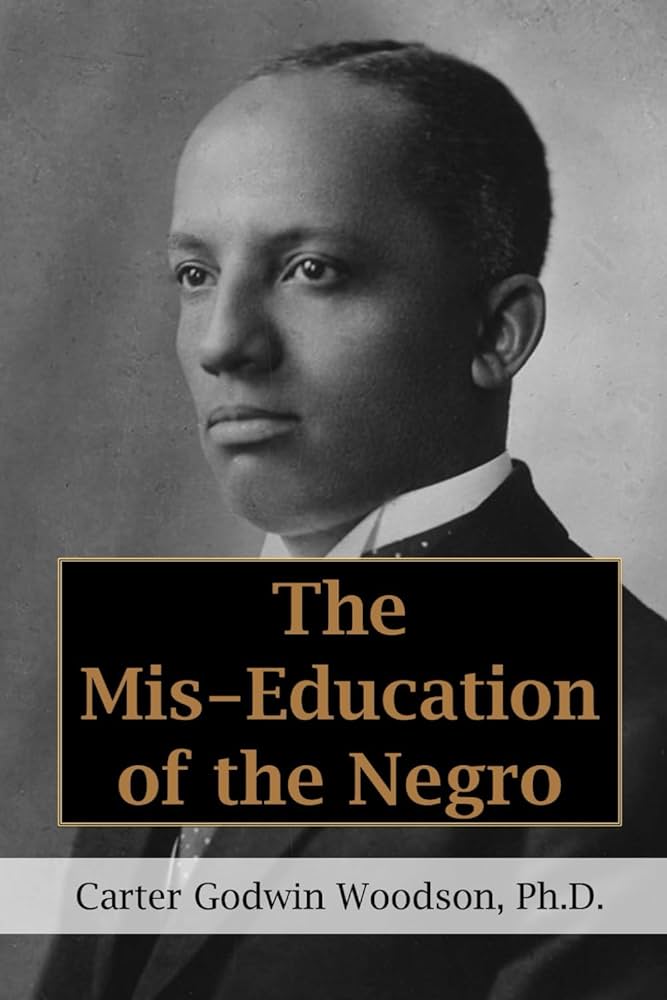
    The Mis-Education of the Negro

    I read a book recommended by CJ (thanks CJ) that I’ve wanted to write something about ever since reading. It was such an interesting and powerful book. It proposed some thoughts I’d never considered and really opened my mind to a different way of thinking about a particular part of American history.

    The book is titled The Mis-Education of the Negro, written in 1933. When I started the book, I immediately texted CJ and said there was too much in the book and that we should start a podcast series exploring the topics. He jokingly agreed to do a podcast. As I continued to read, I noted 40 topics, each I thought would make for a worthwhile discussion.

    CJ and I are at a combined 6 children 4 years old and younger, so a podcast is definitely on hold.

    I read this book a couple years ago.

    Discussing race is difficult. I’ve debated posting this for some time. Not that I’m saying anything controversial or crazy. Just that I don’t like to think too much about race. But our race is important. It makes who we are.

    Sometimes commenting on race as a white person feels like a lose-lose situation. I’m either so positive about other races that it seems like pandering to the point of insincerity or like I’m trying to make up for something, or I’m not positive enough and come across at best not understanding and at worst a racist.

    I think this is why talking about race in America is so difficult. I’ve written about it before and it still is one of the most difficult things I’ve written. 

    And yet, I continue to hear from my black brothers and sisters say that the best place to start is to just be open about discussing it. Which led me to put this post together. Nothing profound. Just my thoughts on a good book.

    I should mention that the book was written in 1933 which led me to continuously ask, is it still that bad? I think many of the disappointing and sad truths the book lays out have improved. Not yet perfect, but improved.

    I want to list some of the topics I noted as interesting from the book. Then I’ll elaborate on one of them.

    1. The “equality” of black and white people. Are black and white people the same? No, we are different in so many ways. From upbringing, culture, background, experience, etc. And that’s ok.
    2. Black people being nominally free but economically enslaved.
    3. Has education for black people gotten better or worse since 1933? I assume it must have improved, but it was a thought this book made me consider.
    4. This is something I feel like people my age have started talking about more- why didn’t we learn how to do taxes instead of the Nina, the Pinta, and the Sante Maria? – The question I asked from reading this book, what is education good for? Why do we care about random historical facts from Europe? To be clear, I appreciate as much as anyone the importance of understanding history and where we came from. But shouldn’t I also know how to file my taxes and apply for a job? Also, on that note of “where we come from.” I remember a lot of history being taught about Europe. I don’t remember a ton being taught about Africa, Asia, or South America.
    5. The opportunities that are afforded whites because more white people own businesses, etc. compared to black people. I think this was much more prevalent in the 1930’s compared to today.
    6. I really struggled with reading this book because I passionately hate the word in the title of the book. Underlining it over and over throughout the book drove me crazy. I almost put the book down many times because I hated how a group of people was being, I felt, unfairly characterized.
    7. Competing churches taking away from impoverished areas.
    8. Why do we study the domineering, warring nations and not the peaceful, productive nations?  The answer is obvious- the winners of wars write history. But philosophically something to consider.
    9. Interesting point mentioned about former slaves avoiding using art to portray their experiences. There were so few books or art pieces made by former slaves depicting that struggle. I think we see that more embraced today with hip hop. Artists like Tupac, Ice Cube, and Kendrick Lemar come to mind as individuals that fully embrace the struggles they have experienced in life and have made great art out of it.

    I heard this not from this book but 3+3 and 2+4 are the same. Different, but still the same.

    The point I’d like to discuss a little more is point one. The author of this book pointed out that we’re so obsessed with making everyone equal that we disregard that people are different. He points out that maybe black people and white people shouldn’t be taught exactly the same. We come from different backgrounds and different life experiences. Something that resonates with me and helps me learn may not resonate or help someone else with a different culture from mine.

    Still, I think this idea is interesting. Generally speaking, a black person has a different life experience from a white person. I’m not talking about just upbringing, I’m talking about the way we see the world, I’m talking about the way we interact with the world, I’m talking about the way the world interacts with us. Black people and white people can be different. That’s not bad though. We’re not different in an inferior / superior way, just different. Good and bad. Different.

    From the book:

    “The differences of races, moreover, is no evidence of superiority or of inferiority. This merely indicates that each race has certain gifts which the others do not possess. It is by the development of these gifts that every race must justify its right to exist.”

    It makes me think about what is happening with gender. Women and men are different, and that’s ok. We all have our own skills and talents that make us who we are. The fact that I’m a man makes me different from my wife. My wife has many skills and talents I’ll never possess. Recently I heard it put this way – 3+3 and 2+4 are the same. Different, but equal.

    That said, the most important thing is that we remember we are all sons and daughters of God. White and black doesn’t mean anything to God. What matters to God is what’s in our hearts. We are all individuals. That’s ok. We should all be treated equally, of course. But we should remember that we are unique. Our uniqueness is great.

    If you want to read a book that makes you consider race and the history of education for black people, this is a great book to read. I encourage all of us to study these ideas so we can better love and understand each other.

  • The Limits We Put on Ourselves

    The Limits We Put on Ourselves

    There’s an interesting exercise you can do.

    Start by pointing straight out with both of your hands. Now turn one direction as far as you possibly can. Keep turning. When you’ve gone as far as you can go, see what your hand is pointing at.

    Now, do the exercise again, but this time, with your eyes closed. With your eyes closed, go as far as you possibly can, keep going, and going.

    I’ll wait.

    It’s fascinating that with your eyes closed you can turn further.

    Our minds always set limits on us. We can do so much more than we realize we’re capable of.

    Think about everything that has ever been done in the history of the world. Every building, every structure, every action, everything started with just a thought. The power of our minds is so un-tapped, so un-realized.

    One day we will look back and know what our minds were capable of and how we limited ourselves. The power is there, sometimes I think we’re just afraid to use it.

    __________________

    I wrote the above years ago.

    I was fascinated about that exercise when I read about it, tried it, and found it to be true. How could that be true? How could I go as far as I thought, reset, close my eyes, try again, and go significantly farther?

    It was so interesting to me. It still is.

    Faith is so important to me. I hope this blog I’ve been writing every week for 5.5 years (!) is an indication of that.

    And yet I feel like my faith is extremely weak.

    I tell myself faith can move mountains and yet I put so many limits on myself due to fear, uncertainty, and doubt.

    As I read the above post these years later I think about my potential. I look at my three young girls and I think about their potential. Do they truly believe they can do anything?

    I’m constantly trying to free myself from the limits I’ve put on myself but it’s so hard.

    I ended that post years ago in an outward, ‘we should all think about this,’ sort of way.

    Now I’m being a bit more introspective.

    Since I’m being introspective, I don’t know quite how to end it.

    I guess I’ll end it like this: believe in yourself. Saying that as much to myself as to anyone reading.

  • Revenge and Forgiveness

    Revenge and Forgiveness

    Israel

    Palestine

    Israel and Palestine

    Israeli War

    Aggressors in War

    Revenge

    Forgiveness

    9/14/25

    As I prepared to write on this topic that I quite honestly don’t want to write about, I listed out those possible titles for this post. If that list is an indication of anything, it’s how scattered my thoughts on this topic will be.

    I actively avoid politics. I aggressively avoid current affairs.

    It’s not that I want to, I’d like to be aware of the important things happening around the world. It’s that I feel like I have to.

    Politics and current events are so filled with hatred, vitriol, unkindness, unfairness, poison, and frankly stupidity that I have chosen to actively avoid it. This becomes a problem when my wife wants to discuss these things, and would really like her husband to be able to discuss it with her, and then she has to watch me like an ostrich putting my head straight into a hole. I just want no part of it.

    Recent events have led to me looking into some things.

    I hear so much leftist this and right wing that – I am aggressively trying to keep myself from knowing what these distinctions mean. Call me naive. I think it’s all so stupid.

    What does this have to do with those topics listed above?

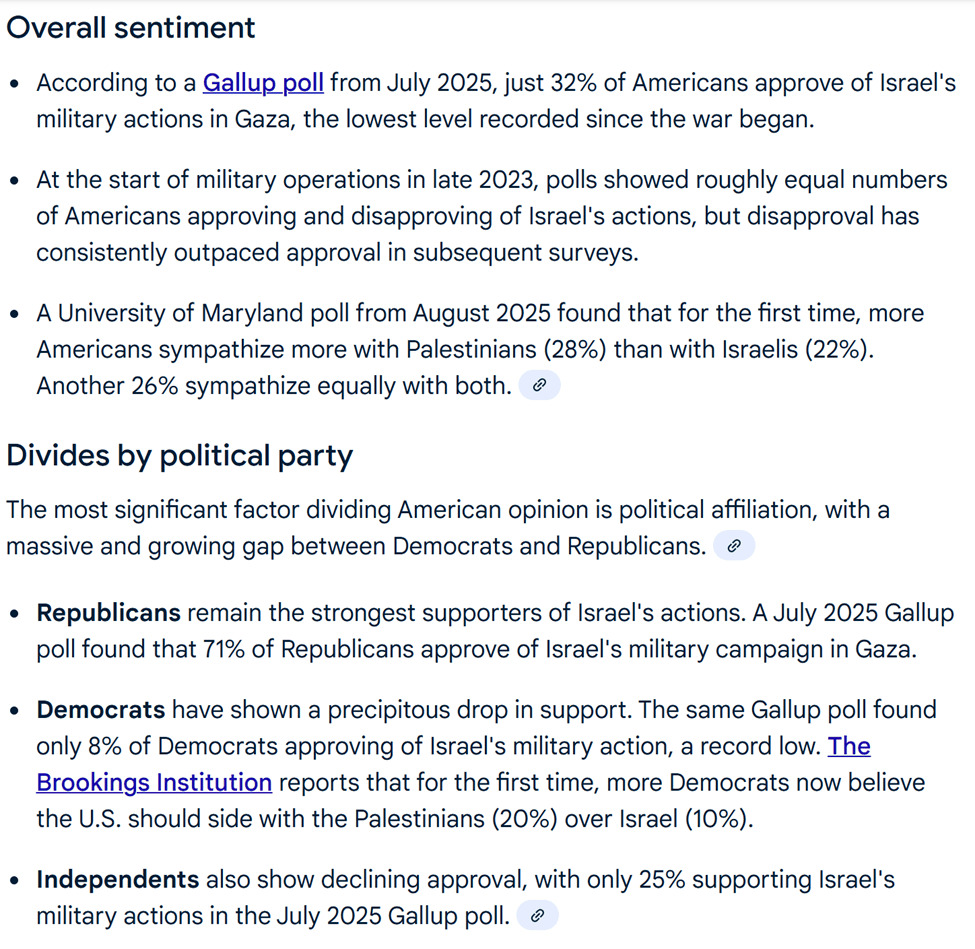
    Just saying Israel and Palestine, I believe, ignites passionate political beliefs.

    If you need proof, yes, even wars are split along party lines:

    I do not like passionate political beliefs. I hope this post has nothing to do with politics.

    I hope this post has something to do with history, what’s right, and prophesy.

    I’ve written about Israel and Palestine before HERE and ten months later HERE.

    The Book of Mormon was written so that we, the Gentiles of today, will understand what is coming in our future. The Book of Mormon is meant for our day and is meant to guide us.

    I’ve recently been reading Hugh Nibley’s thoughts on what the Book of Mormon teaches us about how a civilization and a people can go wrong and destroy themselves.

    I probably lost most people at “prophesy.” Prophesy is real. And while I put my head in the ground about political affairs and current events, I think the rest of the world puts its head in the ground when it comes to prophesy.

    Hugh Nibley emphasized, as I’ve been studying his words regarding Mormon chapters 1-9, how the ancient inhabitants of Mesoamerica ultimately destroyed themselves. He detailed how the chosen people of this land, those who were given this land and given God’s covenant that it would be their land as long as they followed Him – how those people lost their favor and were destroyed.

    The extinction of a people started with:

    Pride.

    No repentance.

    War.

    Revenge.

    War is justified when it comes in self-defense. The thing I want to focus on here is revenge. Hugh Nibley talks about how the Nephites of the Book of Mormon were destroyed when they officially became a bloodthirsty people bent on revenge. God withdrew from them when they decided they would avenge all their fallen brothers who had been killed.

    Which leads to me today, long having put my head in the ground since that post about Palestine and Israel four years ago.

    I accidentally read an article about the current state of the Israel – Palestine war.

    I decided to write this post when I read this:

    “Signs for this old-new vocabulary are everywhere. It is common among Jews, for example, to add the initials for “blessed his memory” next to the name of the dead – but in this war, almost every soldier or civilian victim is memorialized with the phrase “Hashem yikom damo” (God will avenge his blood).”

    God punishes the wicked with the wicked. You don’t want to become the people punishing the wicked in the name of God. Because at that point, you are the wicked. And at that point, your day will come too.

    I fear how long the United State of America has felt the need to be the aggressor in the war against wickedness around the world.

    There is a big difference between wars of self-defense, wars of aggression, and wars of revenge.

    Ceasing to remember the blessed memory of loved ones and instead seeking to avenge blood is not God’s way.

    The world has long said this is how God works. It is not how God works. It is how Satan works. And when people think they’re acting on behalf of God but really being led chain-linked by Satan, the worst atrocities happen.

    Prophesy is being fulfilled before our eyes and the world collectively puts its head in the ground.

    Which leads to my concluding point that Hugh Nibley mentions. Ultimately, we will all be judged for our own actions. What we do matters. All we can do is what we can do – kindness, forgiveness, love, peace, avoid contention, avoid fighting, avoid hatred, avoid judgment, meekness, humility, faith. These are the things we can do in a world that is lost and confused. A world that is deviating. A world that distances itself from God more and more every day.

    You do your part. You do what’s right.

    You love. That’s all.

    9/15/25 Update

    As I painfully, accidentally read more political information, I come back to add more because it seems relevant to what I’ve already written.

    Some recent quotes I’ve read from Donald Trump regarding Charlie Kirk’s assassination:

    The radicals on the left are the problem. And they’re vicious and they’re horrible and they’re politically savvy.

    We have radical left lunatics out there, and we just have to beat the hell out of them.

    And then I read articles and comments and it’s all attack attack attack hate hate hate while yelling at Trump for saying to attack attack attack. Does no one see the irony?

    The same article with the headline

    later, quietly, adds:

    “The president added in a separate answer that he would urge his supporters to follow a nonviolent path in response to the shooting. “He [Kirk] was an advocate of nonviolence,” Trump said. “That’s the way I’d like to see people respond.””

    Why does “beat the hell out of them” get the headline?

    Because it evokes emotion on both sides. It gets clicks.

    The same article that condemns Trump for violent speech chooses to promote the violent speech.

    Why?

    Because the violent inflammatory statement get the clicks.

    It is all hypocrisy.

    I’m not excusing Trump’s, “beat the hell out of them.” I am condemning it. But if we fail for this click-baiting and this hatred, this you against us mentality, we become part of the problem.

    Then I read Governor Cox of Utah’s statements:

    “We can return violence with violence; we can return hate with hate. That’s the problem with political violence. It metastasizes. We can always point the figure at the other side. At some point we have to find an off ramp, or else it’s going to get much worse.”

    I stand by the Governor Cox’s words.

    An eye for an eye quickly becomes lives for lives. Revenge hurts everyone.

    How do we find an off ramp?

    Again, from Governor Cox:

    “Social media is a cancer on our society right now,” Cox said. “And I would encourage people to log off, turn off, touch grass, hug a family member, go out and do good in your community.”

    Love. Forgive. Look past the thing you disagree with someone on and instead look at the beautiful, passionate, important person they are.

    We all have a divine heritage and one day we will be embarrassed about how we thought of the people around us.

    There is no other side. There are only people. We are all imperfect and the sooner we realize that and forgive and show love, the better we will all be. Only love can heal the divide in our world.

  • Are We Living in the End Times?

    Are We Living in the End Times?

    A simple Google search led to something I found very funny. My attention was caught by a headline for a link, “Do you believe Jesus will return to Earth?

    Yes, yes, I do. But do others?

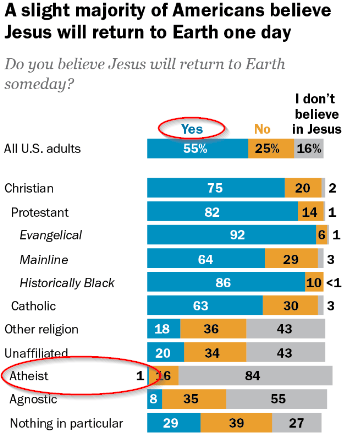
    This article was from December 2022, and it was a Pew research poll asking U.S. adults that simple, yet complex and extraordinarily important question: Is Jesus returning to Earth? (You know, just the question, is the Creator and God of this Earth gonna, you know, come back, ever? Not a big deal).

    What I came across was so funny I had to share it. The Google search was “are we in the end of times?”

    The fact that others believe we’re close to the end, as I do, did not surprise me, or make me laugh.

    What made me laugh, was this:

    That’s one confused atheist.

    For the record, “Atheist – a person who disbelieves or lacks belief in the existence of God or gods.”

    “Agnostic – a person who believes that nothing is known or can be known of the existence or nature of God or of anything beyond material phenomena; a person who claims neither faith nor disbelief in God.”

    So I guess the agnostic through some mental gymnastics could say they believe Jesus Christ is coming back to earth.

    But man, do I want to meet that atheist! I have a lot of questions.

    So, are we living in the “End Times?”

    I think undoubtedly, we are. I go back and forth on how soon that will be. For the record, we’ve been in the “end times” for decades. This is the last dispensation, and we know it will happen soon. Soon is a relative term and whether soon is 5 years or 100, it will still be soon. I have a hard time believing this system we find ourselves in can last much longer. How much longer can greed, corruption, war, and famine last before the system falls apart?

    I’ll stop there. Beth tells me I’m being depressing with this topic again. Until next time.

  • The Ladder of the Atonement

    The Ladder of the Atonement

    When we came to earth and committed our first sin, knowing right and wrong, we fell. Coming to Earth was an inevitable fall. Why then did we shout for joy when the plan was laid forth and we were told we would be coming to Earth? Coming to Earth to fall below our current status, to fall into a pit, in a way. So why were we excited to enter this pit?

    Well, for a couple reasons. One reason would be that we would receive a body. Another reason was we knew we could become like our Father, who we loved and admired. All it required was this scary step.

    I think this might be why so many didn’t come to earth. We are told that one third of our brothers and sisters in heaven didn’t make the jump. They were content where they were at. Why fall and risk not getting back to the point they were already at? I think we see this mindset with a lot of people on earth now. Why push yourself? Why come out of your comfort zone? Why do difficult things? Why do anything for anyone else? What’s the point? The point is growth and progression. If we’re not growing we’re not doing anything.

    So, we fell into this pit called earth. And how were we supposed to get out? We would be stuck in a pit. We would need something completely out of our power and ability to save us. A ladder would need to be extended to us. And from this ladder we could ascend not only out of the pit and back to our original standing before we came to earth. We could ascend all the way to be like our Father, the one we admired and desperately wanted to be like.

    The Atonement is that ladder. From the pit, there was nothing we could do to attain this ladder. It was given to us by the grace of Jesus Christ alone. He brought the ladder, He did the hard work (bleeding from every pore, broken body) of carrying that ladder to us. Then He extended the ladder down.

    It was then up to us to decide if we wanted to use the ladder. God won’t ever force us to do anything. We would have to choose to use the ladder. We would have to choose to take step by step, rung by rung to come up to the level of our Savior, Jesus Christ. Again, without the ladder, we could do nothing. With the ladder, we could be like Him.

    What is the ladder? The ladder is faith in Jesus Christ and His Atoning sacrifice for our sins, for our fallen state. Every time we repent and try to be better, we are taking a step up the ladder Jesus Christ has provided us. Every step up the ladder is service and love. Every step up the ladder is trying to be like Jesus Christ, by using the ladder to get closer to Him.