Author: Brayden Quackenbush

  • Lazy Christianity

    Lazy Christianity

    I wrote this in 2022. As I re-read it before posting, I cringed a little. I wondered if I should post it. It’s a little aggressive. I felt this way in 2022. We all go through ups and downs in our faith and devotion, and as I feel like a lazy Christian at this very moment, I think it’s all that more important to post. This is a call to repentance for myself.

    If you don’t read Jesus the Christ by James E. Tallmadge at least twice in your life, you’re not a real Christian.

    Of course, this is an exclamatory statement. I say it to make a point. 

    I hear so many people profess Christ. Sometimes when this book is mentioned people will say, “It’s so long.”

    Jesus Christ literally suffered the pain and suffering for your sins and mistakes, but the book is too long?

    Before anyone gets mad at me for being high and mighty, let me be clear: I have not read Jesus the Christ twice. But I plan to.

    I think that’s the point. We’re all trying to be better “Christians” or followers of Christ, but, really, what effort are we putting in?

    Are we serving others? Are we thinking about Him? Are we trying to be like Him? Are we reading about Him?

    I think we need to put in more effort.

    On that note, if you’re a member of the Church of Jesus Christ of Latter-day Saints, and you haven’t read the Book of Mormon cover to cover at least two times: get to reading. This is latter-day scripture. Joseph Smith died for this book. Everything we have been given is because of this book.

    We must strengthen our testimonies of Christ as these days get darker and the second coming approaches.

    When Christ returns, will you know Him?

    Will He know you?

  • Story of Compassion

    Story of Compassion

    *This is from a true story I read 4 years ago that I can’t find the source for now.

    There is a story of a person named Om whose mother was killed when he was a young child. After his mother was killed, Om was shipped off to another country. There he was held and kept by the very people who killed his mother.

    Om lived in captivity like this for twenty years, mistreated, and kept by those who murdered his mother. At the age of twenty-four he was shipped back to his home and allowed to be free. Twenty years he was with the people who killed his mom and held him against his will.

    One of those captors tried to befriend Om. This person’s name was Marc. Marc wasn’t directly responsible for Om’s suffering. Marc wasn’t the one who killed Om’s mother. But Marc was still one of them. Marc was the enemy.

    The people directly responsible for the murder of Om’s mother told Marc to be careful around Om. Om hated them all and would kill Marc the first chance he got. 

    Over time Marc started to befriend Om and Om did not attempt to kill Marc.

    While in captivity, Om developed a close relationship with a young child. This friendship was one of the few joys Om had in his difficult life.

    One day Marc slipped and startled the young child that Om was so fond of.

    Three female chimpanzees charged at Marc over his mishap and started to bite and attack him.

    As Marc was being attacked, he saw Om charge toward them. Om was furious. Surely Marc was going to pay for startling Om’s precious young one. Om’s time of revenge had finally come. He was going to kill Marc.

    To Marc’s surprise, Om fought off the three female chimpanzees and kept them at bay while Marc crawled to safety. Marc made it to a hospital and barely survived.

    Here was Om, whose mother had been taken from him and his life destroyed by the people Marc represented. Om could easily view Marc as the ultimate evil. And yet, over time, they had become, if not friends, at least friendly.

    Om stands for Old Man.

    You’ve probably figured out by now that Om is a chimpanzee.

    What can we learn from Om?

    We humans consider ourselves so smart, so intelligent, far removed from the beastly chimpanzee. Here is a creature, an animal, a beast, who could show so much forgiveness that he would save a man who represented the destruction of his life.

    We humans might immediately point to the lack of intelligence in Om as the reason behind his forgiveness. “If he really understood the situation, as we humans do, he wouldn’t be so quick to forgive.”

    What if the opposite is true? What if it is a sign of Om’s intelligence that he was able to forgive?

    Om showed compassion and forgiveness.

    While we are human and chimpanzees are beast, we can learn something from Om.

    The next time you find it difficult to love, or forgive, or understand, remember Om, a chimpanzee capable of great compassion.

  • Salt of the Earth

    Salt of the Earth

    In studying the scriptures, it can be beneficial to have an understanding of the cultural background of those people and situations we read about. I recently read something that added a whole new perspective to the phrase “salt of the earth.”

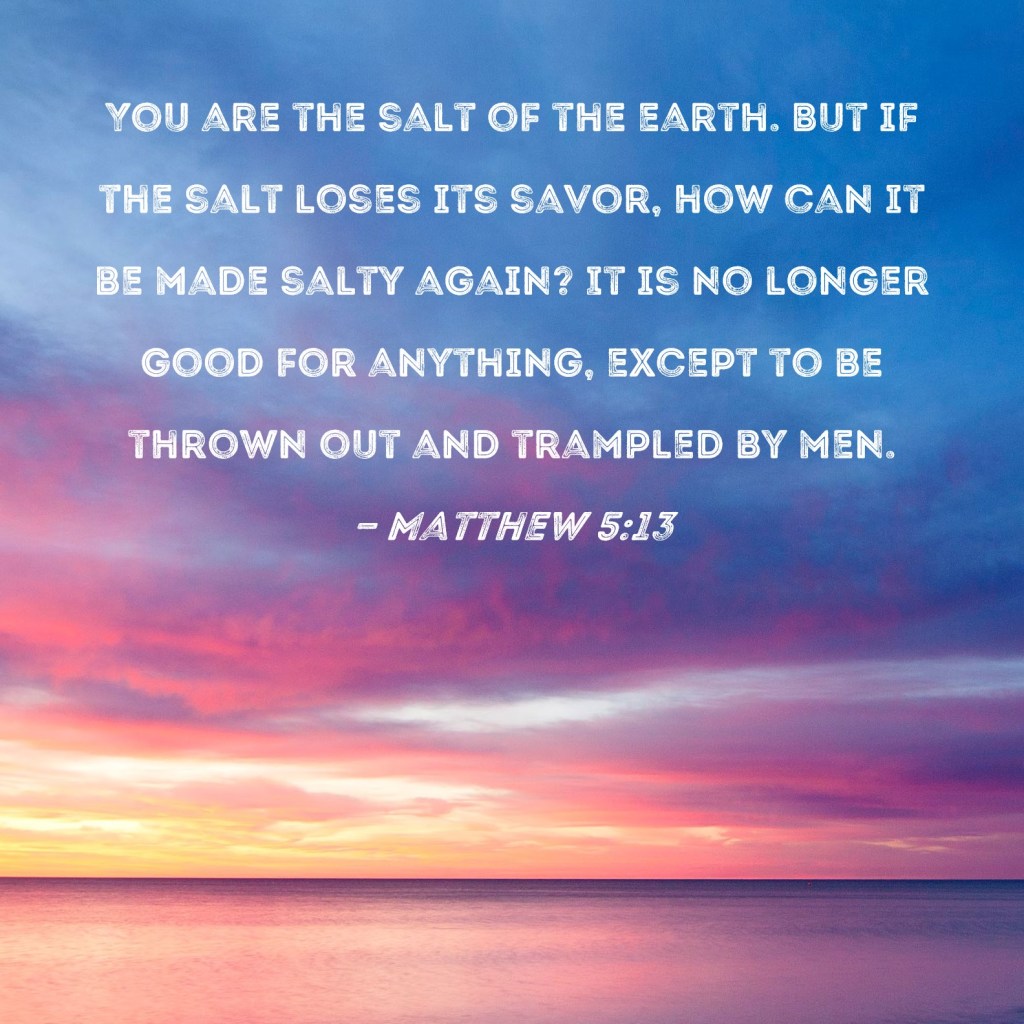
    Matthew 5:13 reads

    “Ye are the salt of the earth: but if the salt have lost his savour, wherewith shall it be salted? It is thenceforth good for nothing, but to be cast out, and to be trodden under foot of men.”

    3 Nephi 12:13 reads

    “Verily, verily, I say unto you, I give unto you to be the salt of the earth; but if the salt shall lose its savor wherewith shall the earth be salted? The salt shall be thenceforth good for nothing, but to be cast out and to be trodden under foot of men.”

    I don’t know about you, but when I think about salt the first thing I think about is taste. Especially when the word “savor” is used. But this is NOT what those hearing these words come from the source (Jesus Christ) would have thought about.

    In using the metaphor of us being “the salt of the earth”, with my understanding of taste, I would think about being a representative of the gospel to help it “taste” good to others. That by seeing the way I live, others can see that the Gospel is good. Another thought that comes to my mind about salt is its preservative properties. This metaphor could be looked at as those who are the salt of the earth conserve and preserve the Gospel, keeping it active and alive.

    How would the ancient Israelites and inhabitants of ancient America have viewed this metaphor? Turns out, the primary purpose of salt to these cultures would have been its ability to impact the smell of sacrifices.

    The commentary I read stated:

    “When sacrifices were offered upon the altars of ancient Israel, the Israelites did not give the Lord the flesh of the animal, the fruit of the ground, or the ashes or smoke of such sacrifices. The acceptable part of the offering presented to the Lord was the smell, ‘a sweet savour unto the Lord’ (Leviticus 1:17). (Many translations have the word “aroma” in the place of “savour”). In the Bible, the word savour most often refers to the pleasant smell of burning sacrifice in the temple. To ensure that the smell would be sweet, the Mosaic law required that the offering be liberally sprinkled with salt.

    “The scent of an unsalted burnt offering would be the stench of scorched flesh. But if the meat were generously salted, the odor would be quite different, ….. due to the reaction of the salt upon the cells that compose animal flesh. Under high-salt conditions, cellular fluid rapidly escapes the cells to dilute the salts outside cell membranes. ………When accentuated by heat, these fluids cause a sweet savour to emanate….

    “In this context the charge to be the ‘salt of the earth’ takes on marvelous significance. The Lord said, ‘I give unto you to be the salt of the earth; but if the salt shall lose its savour wherewith shall the earth be salted?’ (3 Nephi 12:13). The Savior’s audience no doubt understood the law of Moses and the close connection between salt and acceptable sacrifice (emphasis added).

    “It is clear that under the new covenant the followers of Christ, as “salt,” are responsible for extending gospel blessings to the whole earth. “When men are called unto mine everlasting covenant,” the Lord explains, “they are accounted as the salt of the earth and the savor of men” (D&C 101:39). It is our privilege and blessing to lovingly lead our brothers and sisters to Christ, helping them receive their covenant blessings. As we do so, we become the figurative salt that makes it possible for them to offer the acceptable sacrifice of a broken heart and a contrite spirit. In addition, our own covenant sacrifice of time, talents, and means is pleasing to the Lord.”

    The commentary concludes with this statement:

    “So how do we become the salt of the earth? The Apostle Paul points out that charity is a key to this process: “Be ye therefore followers of God, as dear children; And walk in love, as Christ also hath loved us, and hath given himself for us an offering and a sacrifice to God for a sweet smelling savour” (Ephesians 5:1-2).

    This gives the analogy of salt of the earth a whole new meaning.

    Without the gospel of Jesus Christ, and those keeping the covenants of God on earth, there is no acceptable sacrifice on the earth.

    I’ve written before about the One True Church and why it’s important. Our covenants are important.

    Malachi 4:5-6 reads

    Behold, I will send you Elijah the prophet before the coming of the great and dreadful day of the Lord:

    And he shall turn the heart of the fathers to the children, and the heart of the children to their fathers, lest I come and smite the earth with a curse.

    Modern revelation gives us more insight into this curse.

    D&C 128:18 reads

    the earth will be smitten with a curse unless there is a welding link of some kind or other between the fathers and the children, upon some subject or other—and behold what is that subject? It is the baptism for the dead. For we without them cannot be made perfect; neither can they without us be made perfect. Neither can they nor we be made perfect without those who have died in the gospel also; for it is necessary in the ushering in of the dispensation of the fulness of times, which dispensation is now beginning to usher in, that a whole and complete and perfect union, and welding together of dispensations, and keys, and powers, and glories should take place, and be revealed from the days of Adam even to the present time.

    We are the salt of the earth. We are the enabling welding link, through the power and priesthood of Jesus Christ Himself, that allows the sacrifices of this world to be of any worth, of a sweet savor, to God Almighty.

    What a beautiful and powerful responsibility. What a calling. Without the gospel our sacrifices are for naught. Our covenants are important.

    We must be the salt of the earth to save it from the curse, to make our sacrifices acceptable to God, to link ourselves to our past generations, and to one day come before God, having fulfilled our salt-like duties. To preserve, save, and help the earth on its eternal trajectory. What a sobering an humbling thought.

    As I always say, I am grateful for the Church of Jesus Christ of Latter-day Saints. I am grateful for the priesthood attached to it. I am grateful that we can help in God’s glorious plan.

  • Growing Up

    Growing Up

    I recently saw a compilation video. This video showed dads seeing their daughters with their boyfriends for the first time.

    This made me think about when this will happen to me one day.

    I started to think about Ivy, Sage, and Wren one day growing up. I started to think about my Ivy, my partner, my girl who cuddles with me at every chance and always wants to play. I thought about her growing up.

    I started to feel an intense pain in my chest. Like serious, gotta stop thinking this kind of pain.

    I don’t know if other parents get this.

    You know those “memories” videos that iPhones create? IPhone takes all your photos for a year or something and puts them together with emotional music in the background. I can watch them in very limited spurts. I will definitely start bawling my eyes out. Tears are the best case scenario. Worst case, the aforementioned heart pain extends to my whole body and it feels like my body will explode.

    This will sound like an exageration. It is not. It is a real feeling.

    You’ll notice above when I talked about Ivy cuddling with me and always wanting to play, I stopped there. I could have listed a million other examples of the loving affection between us. I could have used more examples with Sage and Wren.

    But as I type these thoughts and consider them getting older, my chest starts to hurt, and my eyes fill, and I have to stop. There’s a reason I’m not getting more detailed.

    My love for them is so all encompassing, so palpable, so excruciating, that I feel physical, overwhelming pain when I think about it one day changing. I know it has to change, one day. Until that day…

    Having three kids now five and under (because Ivy is five, yeah, let’s not talk about it), is extremely, extremely hard. It’s taxing. It feels like almost every day is a marathon that never ends. Sometimes I’ll find myself thinking I just want it to be over. I want them to be able to pour their own cereal and put on their own pants and wipe their own bum.

    Then Ivy started putting on her own pants and pouring her own cereal. Sage started wiping her own bum.

    And as I type this, and the screen becomes blurry, I remember to embrace the bum wipings and all the mundane. Because one day might be the last day Ivy says, “Daddy, do you want to play with me?”

    I hope that day never comes. But I guess it probably will.

    Okay. I need to stop now.

    Am I the only one? What is this love? A father for his daughters.

    I’ll be patient, one more month
    You’ll wrap your fingers ’round my thumb
    Times are changing, I know, but who am I if
    I’m the person you become
    If I’m still growing up

  • Walking into Darkness

    Walking into Darkness

    As we start a new year, I was pondering on a simple but powerful concept.

    Have you ever noticed that if you walk into darkness, with light at your back, you can’t see anything?

    On the other hand, if you walk into light, the room is clear.

    What an analogy for life.

    I was trying to do this one time back in our condo. I was walking into darkness, with the light from the open blinds on the balcony at my back. It was a perilous journey. I was risking a turned ankle at every step. Those with toddlers will understand. Of course, I couldn’t just turn on the lights, that’s for wimps and quitters.

    On my way back through the condo, heading toward the light from the balcony, I could see clearly where I was going. It was like night and day (pun intended).

    This made me reflect on how much of my life I spent walking into darkness. I spent so much time not knowing where I was headed. I had stuck my head into the ground akin to an ostrich and didn’t want to think about why I’m here and where I was going. It was a long journey to turn myself around, re-orient my journey, and start walking toward light.

    Now I feel like my life is better illuminated. I have a feel for where I’m headed, I can see the pathway. Those days of walking into darkness, unsure and afraid of every step are (slightly) behind me. There are always moments of hesitation and wonder about what’s next. But when you choose to make God a part of your life, in my experience, every step starts to feel like a step towards light.

    As 2026 starts, if you feel lost, confused, uncertain, afraid, or all the negative emotions this life bombards us with, I invite you to turn to God and walk in the light. It is one of the only defenses we have in this life full of thistles.