Tag: church

  • Salt of the Earth

    Salt of the Earth

    In studying the scriptures, it can be beneficial to have an understanding of the cultural background of those people and situations we read about. I recently read something that added a whole new perspective to the phrase “salt of the earth.”

    Matthew 5:13 reads

    “Ye are the salt of the earth: but if the salt have lost his savour, wherewith shall it be salted? It is thenceforth good for nothing, but to be cast out, and to be trodden under foot of men.”

    3 Nephi 12:13 reads

    “Verily, verily, I say unto you, I give unto you to be the salt of the earth; but if the salt shall lose its savor wherewith shall the earth be salted? The salt shall be thenceforth good for nothing, but to be cast out and to be trodden under foot of men.”

    I don’t know about you, but when I think about salt the first thing I think about is taste. Especially when the word “savor” is used. But this is NOT what those hearing these words come from the source (Jesus Christ) would have thought about.

    In using the metaphor of us being “the salt of the earth”, with my understanding of taste, I would think about being a representative of the gospel to help it “taste” good to others. That by seeing the way I live, others can see that the Gospel is good. Another thought that comes to my mind about salt is its preservative properties. This metaphor could be looked at as those who are the salt of the earth conserve and preserve the Gospel, keeping it active and alive.

    How would the ancient Israelites and inhabitants of ancient America have viewed this metaphor? Turns out, the primary purpose of salt to these cultures would have been its ability to impact the smell of sacrifices.

    The commentary I read stated:

    “When sacrifices were offered upon the altars of ancient Israel, the Israelites did not give the Lord the flesh of the animal, the fruit of the ground, or the ashes or smoke of such sacrifices. The acceptable part of the offering presented to the Lord was the smell, ‘a sweet savour unto the Lord’ (Leviticus 1:17). (Many translations have the word “aroma” in the place of “savour”). In the Bible, the word savour most often refers to the pleasant smell of burning sacrifice in the temple. To ensure that the smell would be sweet, the Mosaic law required that the offering be liberally sprinkled with salt.

    “The scent of an unsalted burnt offering would be the stench of scorched flesh. But if the meat were generously salted, the odor would be quite different, ….. due to the reaction of the salt upon the cells that compose animal flesh. Under high-salt conditions, cellular fluid rapidly escapes the cells to dilute the salts outside cell membranes. ………When accentuated by heat, these fluids cause a sweet savour to emanate….

    “In this context the charge to be the ‘salt of the earth’ takes on marvelous significance. The Lord said, ‘I give unto you to be the salt of the earth; but if the salt shall lose its savour wherewith shall the earth be salted?’ (3 Nephi 12:13). The Savior’s audience no doubt understood the law of Moses and the close connection between salt and acceptable sacrifice (emphasis added).

    “It is clear that under the new covenant the followers of Christ, as “salt,” are responsible for extending gospel blessings to the whole earth. “When men are called unto mine everlasting covenant,” the Lord explains, “they are accounted as the salt of the earth and the savor of men” (D&C 101:39). It is our privilege and blessing to lovingly lead our brothers and sisters to Christ, helping them receive their covenant blessings. As we do so, we become the figurative salt that makes it possible for them to offer the acceptable sacrifice of a broken heart and a contrite spirit. In addition, our own covenant sacrifice of time, talents, and means is pleasing to the Lord.”

    The commentary concludes with this statement:

    “So how do we become the salt of the earth? The Apostle Paul points out that charity is a key to this process: “Be ye therefore followers of God, as dear children; And walk in love, as Christ also hath loved us, and hath given himself for us an offering and a sacrifice to God for a sweet smelling savour” (Ephesians 5:1-2).

    This gives the analogy of salt of the earth a whole new meaning.

    Without the gospel of Jesus Christ, and those keeping the covenants of God on earth, there is no acceptable sacrifice on the earth.

    I’ve written before about the One True Church and why it’s important. Our covenants are important.

    Malachi 4:5-6 reads

    Behold, I will send you Elijah the prophet before the coming of the great and dreadful day of the Lord:

    And he shall turn the heart of the fathers to the children, and the heart of the children to their fathers, lest I come and smite the earth with a curse.

    Modern revelation gives us more insight into this curse.

    D&C 128:18 reads

    the earth will be smitten with a curse unless there is a welding link of some kind or other between the fathers and the children, upon some subject or other—and behold what is that subject? It is the baptism for the dead. For we without them cannot be made perfect; neither can they without us be made perfect. Neither can they nor we be made perfect without those who have died in the gospel also; for it is necessary in the ushering in of the dispensation of the fulness of times, which dispensation is now beginning to usher in, that a whole and complete and perfect union, and welding together of dispensations, and keys, and powers, and glories should take place, and be revealed from the days of Adam even to the present time.

    We are the salt of the earth. We are the enabling welding link, through the power and priesthood of Jesus Christ Himself, that allows the sacrifices of this world to be of any worth, of a sweet savor, to God Almighty.

    What a beautiful and powerful responsibility. What a calling. Without the gospel our sacrifices are for naught. Our covenants are important.

    We must be the salt of the earth to save it from the curse, to make our sacrifices acceptable to God, to link ourselves to our past generations, and to one day come before God, having fulfilled our salt-like duties. To preserve, save, and help the earth on its eternal trajectory. What a sobering an humbling thought.

    As I always say, I am grateful for the Church of Jesus Christ of Latter-day Saints. I am grateful for the priesthood attached to it. I am grateful that we can help in God’s glorious plan.

  • Is Roseto, Pennsylvania Zion?

    Is Roseto, Pennsylvania Zion?

    There was an extraordinary thing happening in Roseto, Pennsylvania in the 1950s. I read about it in an awesome book called Outliers by Malcom Gladwell.

    Roseto, Pennsylvania was an outlier when it came to heart disease. For some reason, instances of heart attacks and heart trouble in Roseto were shockingly different than anywhere else.

    In the 1950s, heart attacks were the leading cause of death in men under the age of 65 (Outliers, p. 6).

    In Roseto, nobody under 55 had heart attacks. Roseto had half as many people with heart trouble over 65 compared to any other area studied. This included next-door cities and towns.

    What’s fascinating about this is that this phenomenon apparently had nothing to do with genetics, diet, or any other seemingly obvious reason. There was no obvoius indicator of why a whole community would be free of heart trouble.

    Heart trouble wasn’t the only thing missing from this community. A sociologist was brought in to study the community. His name was John Bruhn and he said, “There was no suicide, no alcoholism, no drug addiction, and very little crime. They didn’t have anyone on welfare. Then we looked at peptic ulcers. They didn’t have any of those either. These people were dying of old age. That’s it” (Outliers, p. 7).

    What made Roseto unique, then?

    Finding no pattern, those doing the study had to look at anything different about Roseto to try to explain this phenomenon.

    This led to a primary theory. That primary theory behind why Roseto, Pennsylvania residents didn’t suffer heart trouble or many other common diseases had to do with their community.

    Roseto had an old-fashioned way about it in the 1950s, even compared to the standards of its day. The residents of Roseto were primarily Italian-American immigrants. The standard in Roseto was to live at home as long as possible, take care of one another, and generally live a more laid-back and communal way of life. A young man would stay at home and take care of family. If he lost a job, it was okay. The community would often try to keep shortcomings like a lost job secret so as not to create any embarrassment. Kids would take care of parents. Parents would take care of kids. The community took care of each other. It was a family-focused, close-knit community.

    “(Researchers) learned about the extended family clans that underlay the town’s social structure. They saw how many homes had three generations living under one roof, and how much respect grandparents commanded. They went to mass at Our Lady of Mount Carmel and saw the unifying and calming effect of the church. They counted twenty-two separate civic organizations in a town of just under two thousand people. They picked up on the egalitarian ethos of the community, which discouraged the wealthy from flaunting their success and helped the unsuccessful obscure their failures” (Outliers p. 9, emphasis added).

    The fact that Roseto residents had such low instances of heart trouble revealed a potential connection between community relationships and social support to reduced stress and heart disease. The community of Roseto appeared to buffer its inhabitants from the stresses of life.

    This got me to thinking.

    What is Zion? What is the perfect society? What will it look like? What will it be like, practically speaking?

    “…the Rosetans had created a powerful, protective social structure…” (Outliers p. 9).

    Will Zion be a community that goes to church together? A community that stops to talk to each other? A community that continues to live under one roof with their direct family as long as possible? A community where equality reigns? A community where spontaneous cookouts in front yards are common?

    This sounds like Zion to me.

    It’s fascinating that a community basically shielded itself from the stresses of a fallen world by living by these principles. I believe these are God-given principles: fairness, love, community, support, unity – that’s what makes Zion.

    “When presenting (the researchers’) findings at many medical conferences where their peers were presenting long rows of data arrayed in complex charts and referring to this kind of gene or that kind of physiological process, and they themselves were talking instead about the mysterious and magical benefits of people stopping to talk to one another on the street and of having three generations under one roof….No one was used to thinking about health in terms of community” (Outliers p. 10).

    This Christmas season, as I’m inevitably considering the state of our world and where we’re headed, I can’t help but wonder: is it this simple?

    Community, family, support. People supporting people, people uplifting one another, communities looking out for each other. Neighbors waving hi. People engaging with those in their community. Ministering. Fellowship. Is it that simple? Would that fix our world?

    I think it would. I think this is primarily what is missing from our modern-day societies. Love thy neighbor. How about say hi to thy neighbor?

    This holiday season, aim to light the world. Start by dropping off cookies at a neighbor’s house. It might save you from a heart attack.

  • Your True Identity

    Your True Identity

    *I originally wrote this in 2022.

    I’d like to discuss Grace and our Identity.

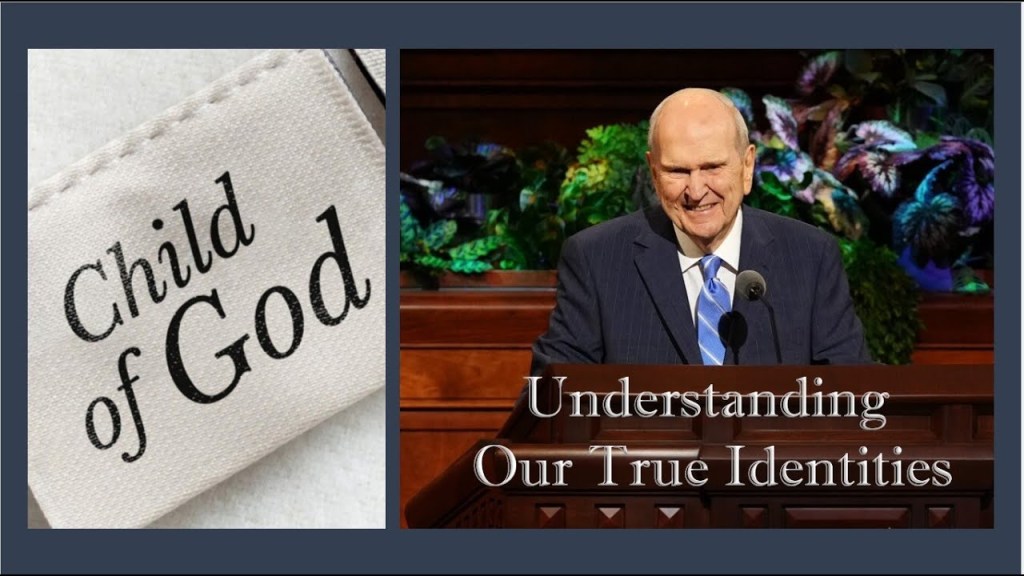
    In a recent address to young adults of the Church of Jesus Christ of Latter-day Saints, the prophet of the Lord, President Russell M. Nelson, talked about the three defining identities of a member of Christ’s church. Those identities were:

    1. Child of God
    2. Child of the covenant
    3. Disciple of Jesus Christ

    The grace portion of what I’d like to discuss, like President Nelson’s identities, will focus on members of Christ’s church. This doesn’t mean what I’m saying here doesn’t apply to all. I believe it does. Whether someone believes in God or not, the first identity of all God’s children is true. Every soul on this earth is a child of God, whether they believe it (or like it) or not. The other two identities are not excluded from anyone. Anyone can be a child of the covenant by aligning themselves with God. Anyone can be a disciple of Jesus Christ. These must be choices.

    Now that I’ve established that this is for everyone, let’s talk more about President Nelson’s message of identity. President Nelson emphasized that if the Lord spoke directly to us, the first thing He’d want us to understand is who we are; thus, the identities. It’s my testimony that the Lord was reminding us of this, through His mouthpiece, the prophet.

    President Nelson said:

    “Tonight, I plead with you not to replace these three paramount and unchanging identifiers with any others, because doing so could stymie your progress or pigeonhole you in a stereotype that could potentially thwart your eternal progression.

    There are various labels that may be very important to you, of course. Please do not misunderstand me. I am not saying that other designations and identifiers are not significant. I am simply saying that no identifier should displace, replace or take priority over these three enduring designations …”

    The world would so quickly have us forget who we truly are, and our true potential. The multitude of designations we can apply to ourselves pale in comparison to “Child of God.” Can you imagine being a prince of a nation, and calling yourself a peasant? Can you imagine being the president of a university and calling yourself a student? Can you imagine being the captain of the team, and calling yourself a bench warmer? That is what many of us do every day when we give ourselves any title but “Child of God.” Wear your title with pride. Your Father is God of the entire universe. He is King, He is Ruler, and you are His Child.

    “Make no mistake about it: Your potential is divine. With your diligent seeking, God will give you glimpses of who you may become. … As you embrace these truths, our Heavenly Father will help you reach your ultimate goal of living eternally in His holy presence.”

    -Russell M. Nelson

    Let’s transition into Grace. I can’t say anything better here than Brad Wilcox said in his talk His Grace is Sufficient, so please read the talk to remind yourself how patient and loving and kind our Savior is. I believe this may be the most powerful address ever given, especially for our day. I mean that literally. His Grace is Sufficient is so filled with eternal and significant truths, you could quote the whole thing. I will quote much of it here.

    I believe there is an epidemic in the Church of people not feeling good enough. I believe this aligns with President Nelson’s message of forgetting our identity. I think it also aligns with a misunderstanding that Satan has perpetuated, a misunderstanding of Grace and the Atonement of Jesus Christ.

    Brad Wilcox said, “Too many are giving up on the Church because they are tired of constantly feeling like they are falling short.”

    He then gave an example:

    “There are young women who know they are daughters of a Heavenly Father who loves them, and they love Him. Then they graduate from high school, and the values they memorized are put to the test. They slip up. They let things go too far, and suddenly they think it is all over. These young women don’t understand grace.”

    I would add – these young women don’t understand who they are. Slipping up doesn’t take away any of your three identities. Because you make a mistake, are you no longer God’s daughter? Because you slip up, are you no longer a daughter of the covenant? Because you’re not perfect, are you not a disciple of Jesus Christ? If that were the case, Christ would never have disciples! Be less hard on ourselves. And remember who we are.

    Few paragraphs in a talk have applied more perfectly to me:

    “There are young men who grow up their whole lives singing, “I hope they call me on a mission,” and then they do actually grow a foot or two and flake out completely. They get their Eagles, graduate from high school, and go away to college. Then suddenly these young men find out how easy it is to not be trustworthy, loyal, helpful, friendly, courteous, kind, obedient, cheerful, thrifty, brave, clean, or reverent. They mess up. They say, “I’ll never do it again,” and then they do it. They say, “I’ll never do it again,” and then they do it. They say, “This is stupid. I will never do it again.” And then they do it. The guilt is almost unbearable. They don’t dare talk to a bishop. Instead, they hide. They say, “I can’t do this Mormon thing. I’ve tried, and the expectations are just way too high.” So they quit. These young men don’t understand grace.”

    For me, it was a process of making mistakes, and then deciding I didn’t need to ask for forgiveness. The guilt of asking for forgiveness wasn’t worth it. I just moved on and stopped asking. But my soul was crying out. What saved me was my testimony of Jesus Christ and His Church, the Church of Jesus Christ of Latter-day Saints. Without that testimony of His restored Gospel, I would have never returned. It wasn’t worth feeling the guilt. But once I did return and reminded myself of the fruits of repentance and the pure joy of forgiveness, I could never go back. I continued to make mistakes and I continued to fall short. I continue to fall short. But that day when I cried tears of joy in a church parking lot, I felt Christ so palpably and so near, I knew I could never go back. I knew I had to keep trying. My soul had been starved for so long and once I felt the grace of Jesus Christ, which I only had to ask for, returning into my very being, I couldn’t go back.

    I plead for all of God’s children, all of you, my brothers and sisters, to not give up. Ask for that forgiveness, endure the guilt, and feel the overwhelming joy.

    Brother Wilcox in continuing to describe me, “…guilt is almost unbearable. They don’t dare talk to a bishop. Instead, they hide. They say, “I can’t do this Mormon thing. I’ve tried, and the expectations are just way too high.” So they quit. These young men don’t understand grace.”

    I definitely didn’t understand grace until I’d felt it’s full magnitude. Don’t give up on who you are. Don’t give up on who you can become. Don’t forget your true identity. “In all of these cases there should never be just two options: perfection or giving up. When learning the piano, are the only options performing at Carnegie Hall or quitting? No. Growth and development take time. Learning takes time. When we understand grace, we understand that God is long-suffering, that change is a process, and that repentance is a pattern in our lives. When we understand grace, we understand that the blessings of Christ’s Atonement are continuous and His strength is perfect in our weakness (see 2 Corinthians 12:9). When we understand grace, we can, as it says in the Doctrine and Covenants, “continue in patience until [we] are perfected” (D&C 67:13).”

    “Grace is not a booster engine that kicks in once our fuel supply is exhausted. Rather, it is our constant energy source.”

    Let Christ be your constant energy source. Don’t give up.

    “I testify that God’s grace is sufficient. Jesus’ grace is sufficient. It is enough. It is all we need. Oh, young people, don’t quit. Keep trying. Don’t look for escapes and excuses. Look for the Lord and His perfect strength. Don’t search for someone to blame. Search for someone to help you. Seek Christ, and, as you do, I promise you will feel the enabling power we call His amazing grace… I believe in you. I’m pulling for you… And Jesus is pulling with you.”

    -Brad Wilcox

    What has Christ done for us? What has God given us? President Nelson reminded us:

    “In short, They have offered you everything! Heavenly Father’s plan for His children allows us to live where and how He lives and ultimately to become more and more like Him. His plan literally makes the richest blessings of all eternity available to us, including the potential for us to become ‘joint-heirs with Christ’ (Romans 8:17).”

    “God will do “everything He can, short of violating your agency, to help you not miss out on the greatest blessings in all eternity.”

    Don’t give up. Don’t be discouraged. Never forget your divine heritage and what it affords you. You are a child of God! A joint heir with our Savior, the King, Jesus Christ. Don’t ever replace your identity with something temporary, that only this world gives. Satan abandoned his identity and now he wants nothing more but to deceive you into abandoning yours. Don’t do it!

    I bear my testimony that Christ’s Grace is Sufficient. He died for me, and He died for you. He did it all. There’s nothing we can do to screw it up if we just turn to Him. There’s nothing we can possibly do to make God abandon us. He loves us with a love we can’t comprehend.

    One day we’ll stand before Him, our Father, and we’ll remember. We’ll remember what love truly is, and we’ll remember who we are. Remember today and move towards that glorious light of living with Him, our Savior, and our families through eternity.

  • Attack in Michigan

    Attack in Michigan

    For those who didn’t hear, there was a shooting at an LDS church 18 days ago. I’m not sure if this was big news outside of LDS circles. Sad when there is “just another shooting.”

    For these last two weeks I’ve considered writing something about the attack.

    It felt like something I should write about.

    But I didn’t know what to say. Especially with all the conversation that started to come up around it, I didn’t really want to contribute to that.

    But again, I felt like it was something I should write about.

    The first thing I felt when I heard the news was a real, deep sadness. A quick, deep sadness, like a punch of sorrow to my gut.

    The next thing I felt was a little ashamed of myself. There are shootings often. Unfortunately. When this happened, it hit me hard. I found other recent shootings that I hadn’t heard anything about. Every shooting brings me sadness. Why did this one impact me so much more? I guess because this shooting happened against my people, I felt it more.

    I don’t like thinking in terms of “my people.” Polarized, tribal views is one of the major issues in America right now.

    Still, these were my people. I now had images of being with my congregation on Sunday when a nightmare might start. These were followers of Christ. These were my brothers and sisters.

    What happened in Michigan hit me. But it’s not what I want to talk about. What I want to talk about is the response.

    What should separate members of the body of Christ? How should members of the Church of Jesus Christ of Latter-day Saints act? How should true followers of Christ respond to an act of violence against them?

    If we are true studiers of the Book of Mormon, true understanders of the Gospel, and true readers of the Bible, we should know that the response should be love and compassion. No matter how hard that is.

    So when I read that a member of the Church of Jesus Christ of Latter-day Saints, not a member of the attacked congregation, but a member nonetheless, when I heard someone started a fundraiser for the family of the man that did something indescribably wrong, I held back tears.

    I encourage you to read that last link becuase Dave Butler, the man who started the fundraiser, makes some good and important points.

    It’s not easy to forgive your enemies.

    Is this a story of forgiveness or is it a story of empathy, love, and compassion? It is an example of all those things. This was just a way for a community of people to show all those attributes in a difficult circumstance.

    We have a commission to look after the widowed and fatherless. There was now a family that needed that. The human family showed its true character when it stepped up to help the widowed and the fatherless.

    If we could just show more love, compassion, forgiveness, and empathy in this world, how different would it be?

    I am proud of my church.

    I am proud of Jesus Christ’s church.

    I’m proud of our members and what we represent. I know that aggression against the followers of Christ will increase. I wrote about this last week. I hope our faith is ready to withstand the trials that await us.

    I hope that throughout our trials we can always remember that love, compassion, empathy, and forgiveness are always the right choice.

  • Parenting Without Faith

    Parenting Without Faith

    Moments where you feel like a good parent doing good things sometimes don’t come often enough. And then one comes that is so impactful it brings you to tears.

    Ivy claimed to be sick this morning. I thought she was making it up until I saw her throw up with my own eyes.

    So she stayed home from school. Without any guidance or prompt, she went upstairs on her own and laid down in her bed. This is very un-Ivy like. She was definitely sick.

    I got a show setup on a laptop for her so she could lay in bed and relax. I brought it to her, and she didn’t want it, she just wanted to rest. Ivy was definitely sick.

    An hour later she came to my room and said she did want a show. We walked back to her room, and I started to get it setup. She said she needed to throw up and inexplicably walked away from her throw up bucket and passed her bathroom down the hall to my bathroom.

    Luckily, she made it in time.

    She knelt in front of the toilet. She looked so big, her little four-year-old body, already knowing how to properly throw up in a toilet. Any parent can relate to and feel the pain of watching their child throw up.

    I held her hair and rubbed her back.

    Ivy stood up.

    She said, through little sobs and stutters as she caught her breath, “Daddy, I ask Jesus in my bed to help me. Will you pray for me at my bed? I asked Jesus to help me stop throwing up.”

    Those words don’t fully capture it. I cannot properly put in words the sweetness, the tenderness, the humility, the vulnerability, the faith, the innocence of what was coming out of Ivy’s mouth. What I put above was roughly what she said. But it was so much more. It was soft, it was gentle, it was pleading.

    This pleading was not with adultlike “this needs to get done” energy, but with patient understanding. This request came with complete innocence. Coming from your four-year-old who is normally all chaotic, joyful energy, these calm, sweet moments can be so jarring.

    I explained to Ivy that Jesus might help her stop throwing up, but I promised her that even if she didn’t stop throwing up, He would be with her and help her. I told Ivy, “You know when Jesus died for you?” She nodded, as this is something we talk about often. “When He died for you, He felt what you just felt, that hurt and pain and sickness of throwing up, He felt it. So even if you throw up more, He is with you.”

    Ivy said, “Even when I get big owies, He feels it.”

    I took Ivy back to her room. I put a show on for her to watch. She lay in bed.

    How do parents parent without faith?

    This parenting thing is hard enough. How could I explain to Ivy that she’s throwing up and in pain and I don’t know why and there’s nothing I can do about it?

    In the last couple weeks, my knee has been healed, my daughter with potential hip dysplasia has been blessed (what happens is yet to be seen), and my Ivy has known that even though she’s sick, Jesus is with her and helping her and there’s a reason for it.

    How do you raise kids without this?

    I don’t know.

    The last thing Ivy said during our conversation at the toilet, “Jesus is God, that is why I ask Him for help.”

    Jesus is our God. Heavenly Father is our Father. They watch over us. As I sit here with tears in my eyes, my sweet daughter laying in bed suffering with a little tummy ache, writing this out, I’m reminded that Jesus is God. And I don’t know what I’d do if I didn’t know that. It would be so hopeless otherwise.

    He died for us, and He knows our pain.

    I wish we could all have the faith of a 4-year-old.