Tag: faith

  • Beth’s Talk on Mosiah 3:19 (January)

    Beth’s Talk on Mosiah 3:19 (January)

    This is a talk, exactly as written, by Beth, that she gave in church in January. She rehearsed the talk verbally to me multiple times before I heard it in church. Of course, through hearing it I knew it was a great talk, but it wasn’t until proofreading and preparing to post this that I was struck by how phenomenal a talk this really was. Hope you enjoy reading it as much as much as I did. And now, Beth –

    Mosiah 3:19 Talk
    January 9, 2022
    Good morning brothers and sisters.
    I wanted to start by introducing my family as we are one of the families that were blended into this ward with the recent changes in the stake. My name is Elisabeth Quackenbush. My husband is Brayden Quackenbush. We met in the Scottsdale Young Single Adult Ward in 2017 and have been married for over 2 years. We have a one year old daughter named Ivy. You’ll see her running around Sunday School for another 5 months but she is very excited to start nursery after that.

    The topic I was given to speak on this morning is the scripture Mosiah 3:19. When I was informed this was my assignment I wasn’t really surprised. This scripture comes into my mind a lot and is brought up in conversations about life all the time when I’m chatting with my husband. I think it sticks in my mind because it stands in such contrast to a lot of the attitudes of the world these days.

    For those of you that memorized scripture mastery back in the day you may remember this scripture, but as a reminder, this scripture is King Benjamin speaking to his people in the Book of Mormon. It reads,

    “For the natural man is an enemy to God, and has been from the fall of Adam, and will be, forever and ever, unless he yields to the enticings of the Holy Spirit, and putteth off the natural man and becometh a saint through the atonement of Christ the Lord, and becometh as a child, submissive, meek, humble, patient, full of love, willing to submit to all things which the Lord seeth fit to inflict upon him, even as a child doth submit to his father.”

    When we break down this verse, we can derive meaning in a variety of ways. The first that I noted is that the natural man is inherently selfish. The second is the importance of change to the Eternal Plan of Happiness.

    Boyd K Packer stated in his 1990 talk, “Put Off the Natural Man, and Come Off
    Conqueror”:
    “Unchecked selfishness [of the natural man] stubbornly blocks the way for developing all of the divine qualities: love, mercy, patience, long-suffering, kindness, graciousness, goodness, and gentleness. Any tender sprouts from these virtues are sheared off by sharp selfishness. Contrariwise, I cannot think of a single gospel covenant the keeping of which does not shear off selfishness from us.”

    Through the influence of the Holy Ghost, and the atonement of Jesus Christ, we can and should change from the narrow focus of the natural man and become, “submissive, meek, humble, patient, full of love, and willing to submit to the will of God.”

    This idea of our ability and strength to change stands in stark contrast to the pervasive attitude of our society. This attitude states that we are born a certain way. We can’t change, and even shouldn’t want to change. If we do change, we are inauthentic. On the surface, this has a false sense of empowerment, I think. However, this idea that change is bad and that we must only be one way for the rest of our life is truly limiting, almost an eternal purgatory of mediocrity. Compare this to the freedom and growth permitted to us through Jesus Christ’s suffering, that we may improve and become like our Heavenly Father and Savior, Jesus Christ.

    My husband and I have had the opportunity to have many deep, religious
    conversations with friends of a variety of backgrounds. We often come across
    criticism of our faith’s belief that we can take steps, including repentance, baptism, and participating in temple ordinances, to change and become like God. We are accused of valuing works and forgetting the grace provided through Jesus Christ. On the contrary… His grace is the key element that permits us TO become new beings.

    In 2 Corinthians 5:17 we read, “Therefore if any man be in Christ, he is a new
    creature: old things are passed away; behold, all things are become new.”

    Brad Wilcox does a beautiful job in his BYU talk, “His Grace is Sufficient” at outlining how the Atonement of Jesus Christ, through His death and resurrection, provides us the need to change… (forgive me for this lengthy quote but as many of you know, this talk is incredible…)

    “[Yes, we are saved by Grace but] Have you been changed by grace? [We] are so excited about being saved that we are not thinking enough about what comes next. We are so happy the debt is paid that we may not have considered why the debt existed in the first place. Latter-day Saints know not only what Jesus has saved us from but also what He has saved us for.

    “A life impacted by grace eventually begins to look like Christ’s life. While many Christians view Christ’s suffering as only a huge favor He did for us,
    Latter-day Saints also recognize it as a huge investment He made in us.

    “As Moroni puts it, grace isn’t just about being saved. It is also about becoming like the Savior. The miracle of the Atonement is not just that we can live after we die but that we can live more abundantly. The miracle of the Atonement is not just that we can be cleansed and consoled but that we can be transformed.“

    Again, just think for a minute… how does that compare to what we are being taught by the world? I can’t change, I shouldn’t change…

    HOW DO WE PUT OFF THE NATURAL MAN AND BECOME LIKE CHRIST?

    We can actively seek this positive change…

    In her 1998 BYU Speech, Wendy Watson, now well known as Wendy Nelson, lists some ways. One is reflection. She notes how Alma directs this type of reflection:

    “Just how does Alma invite these change-inducing reflections? One way is through his use of questions. In Alma 5 alone, more than 40 questions are offered—questions like:
    Have ye received his image in your countenances? Have ye experienced this mighty change in your hearts? . . .
    . . . If ye have experienced a change of heart, and if ye have felt to sing the song of redeeming love, I would ask, can ye feel so now?‘ [Alma 5:14, 26]. Through the process of persistent questioning, Alma invites us to reflect over and over again: on our status with the Lord, on our spiritual growth and development, on things that need to change or have changed—and before we know it our desire for more change increases.”

    Another idea is to listen to the uplifting voices of authority in your life remembering, “As helpful as human voices of authority are, none can or should replace the ultimate voice of authority—the Word himself: the Savior Jesus Christ. What are you doing to hear his voice in your life? What are you doing to establish his voice as the voice of authority for you?”

    Other ways we can develop this change to become more like Him… Consistently and earnestly repent, seek out holy places, take steps of faith, pray to Him daily.”

    Sometimes change finds us…whether it be through loss, grief, depression, or trials in life, change is often thrust upon us in this mortal life. Again, the world finds few answers as to why there is such suffering and grief in the world. His eternal plan of growth and development is sometimes the only answer that makes sense. If we are to become like Christ, our innocent brother that felt all the sufferings of the world, how can we expect to be truly changed without some suffering of our own?

    Peter in speaking of [trials], said: “Beloved, think it not strange concerning the fiery trial which is to try you, as though some strange thing happened unto you: But rejoice, inasmuch as ye are partakers of Christ’s sufferings; that, when his glory shall be revealed, ye may be glad also with exceeding joy.”

    When we endure this life, put off the natural man, and develop into more Christ-like beings, we set ourselves up to feel an even greater degree of joy in this life and in eternity.

    This topic makes me think of a time when I came back to church after living a life that was not in line with what I knew to be right. I made many positive changes when I started coming back and attending the Scottsdale Young Single Adult ward. I starting observing the sabbath day, stopped a lifestyle of college partying, broke off a serious relationship, and made several other difficult but important decisions.

    However, with all this positive change and shunning of the enticings of the natural man, I still felt like I wasn’t receiving the blessings I thought I would. I wallowed in self pity over my own suffering for a while because of this and even wondered if all of my change was for nothing.

    However, I eventually decided I would stop focusing on what I needed and instead turned outward. I made it my mission to seek anyone in my ward that seemed lonely as I was. I sought opportunities to serve those that were also going through a variety of trials. And a miracle happened! The less I focused on my pain, my loneliness, my loss, and focused on loving those around me as Christ did, I really came to find true joy.

    I couldn’t believe how sincerely I loved everyone around me. I didn’t feel lonely. I developed new, Christ-like attributes. And ultimately, I shunned the ultimate trait of the natural man – selfishness. What a blessing that lesson was for my life.

    I know how hard it can be to put off the feelings we have as humans in a difficult mortal journey. It is something we will actively have to work for as long as we live. However, I know that when we let ourselves change and take on the characteristics of Christ we will prepare ourselves to find real joy in eternity. We will truly have cause to rejoice in his second coming.

    I say these things in the name of Jesus Christ, amen.

  • He Hears your Prayers

    He Hears your Prayers

    When I go through difficult times, for whatever reason that might be, I often find myself thinking to myself a lyric from the song “A Child’s Prayer.” 

    “Heavenly Father, are you really there?”

    I was recently having one of those difficult times and was thinking this phrase.

    I went to church that Sunday and said a prayer asking that if there was some guidance I could receive, that I’d hear it.  It was a particularly distracted day with Ivy in church.  Quick side note, it’s amazing how distracting a toddler can be in church.  Ivy is really good in church, and yet I still find it so difficult to focus on the speakers while also making sure she’s ok and entertained.

    Despite the normal distractions, I caught a speaker mentioning, “Heavenly Father, are you really there?”  I can’t remember in what context.  I believe it might have been the youth speaker.  I perked up, but that was it, the moment passed.

    It was a thoroughly uplifting Sunday that day and I found myself feeling in much better spirits.  Still, there were those lingering “difficulties” in the background.

    The next day I was with Ivy in her room.  I am more and more convinced that Ivy, and probably all children, are still at least 50% angel.  The coincidences Ivy causes in my life are too perfect.

    I was in her rocking chair on my computer reading and doing stuff while she played. Suddenly she came over to me which isn’t unusual.  I put my computer away and pulled out my phone instead.  I wanted to look up the songs we had in church the previous day because I had a song stuck in my head but didn’t know it’s name.  I pulled up Youtube to play the sacrament song and confirm it was the one stuck in my head.

    We listened to the song and then Ivy reached for the phone, again, not something out of the ordinary by any means.  She started tapping it with her finger.  I saw her click a couple recommended videos that were on the side of the screen and then she pulled her hand away.  A video started playing.  I didn’t recognize the song (at first).  It had a long introduction and then there were images of children with their parents.  Children praying with their parents, being tucked in, coloring, playing. 

    Suddenly it started.

    Heavenly Father, are you really there?
    And do you hear and answer every child’s prayer?
    Some say that Heaven is far away
    But I feel it close around me as I pray

    “I feel it close around me as I pray” is the part, during times of difficulty, that I struggle with.  Because in those times I don’t always feel heaven close around me as I pray.

    I started to cry.

    The song continued.

    Heavenly Father, I remember now
    Something that Jesus told disciples long ago
    “Suffer the children to come to me”
    Father, in prayer I’m coming now to thee

    I looked at Ivy.

    Then the song continued.

    Pray, He is there
    Speak, He is listening
    You are His child
    His love now surrounds you
    He hears your prayer
    He loves the children
    Of such is the kingdom, the kingdom of Heaven

    It had been so long since I’d heard the full song I truly didn’t remember that part. And when I heard it, it was so clear.  It was so clear.  In moments of challenge I remember the part, “Heavenly Father, are you really there?”  But I’d forgotten the part, “He is there.  Speak, He is listening.  You are His child.  His love now surrounds you.  He hears your prayer.”

    I remembered.

    Sometimes it’s so hard to hear Him.  Sometimes it’s so hard to remember He is there.

    Then He reminds you. 

    I want to remind everyone reading.  He is there.  Speak, He is listening.

    The world can yell at me that it was a complete coincidence that Ivy somehow brought up that song that I’ve never listened to before on Youtube.  I say, that’s ridiculous.  I needed to be reminded that my Father was there and listening, and so he reminded me.  Through my angel.

    I’m grateful for Him.  I’m grateful for all my angels. 

    I know He is there.

  • Sidney Rigdon Miracle

    Sidney Rigdon Miracle

    21 August, 1842. 

    Apparently, it had been thought that Sidney Rigdon meant “to renounce his faith in Mormonism” when he took the stand on 21 August 1842.  Instead, he “appeared to bear his testimony of its truth, and add another to the many miraculous evidences of the power of God.”

    I stumbled upon this story while reading a commentary on Doctrine and Covenants section 124 verses 103-110.  In these verses Sidney Rigdon is admonished to continue to stand by the Prophet Joseph Smith, along with other commandments, and “if he will hearken unto my voice, it shall be well with him” (verse 110).

    Smith and Sjodahl remark that, “Sidney Rigdon, according to a generally prevailing impression, was more or less under the influence of a spirit of apostasy.  It is related that, in Liberty jail, he declared to his fellow-prisoners that the sufferings of the Lord were nothing compared with his, and while the faithful Saints were straining every nerve to complete the Nauvoo Temple, he had no word of encouragement to them.  As a consequence of his disposition, he did not have good health.  Like the Corinthians who partook unworthily of the Sacrament (1 Cor. 11:30), he was ‘weak and sickly.’  The Lord, therefore, points out to him the cause of his ailments and promises to heal him, if he will do his duty and stand by the Prophet as a true counselor.”

    The admonition from the Lord in section 124 was given on January 19, 1841 so it was 19 months later that he took the stand to detail the miracle he had experienced to those gathered.

    As mentioned, given Sidney’s recent state of apostasy, I’m sure the gathered congregation was expecting to see some potential fireworks.  They got fireworks, but not the apostasy-themed ones they were expecting. 

    Sidney told the congregation that his daughter Eliza died.  She was pronounced dead by a physician.  I will quote the story from the Joseph Smith Papers.  “after a considerable length of time she rose up in the bed and spoke in a very powerful tone to the following effect in a supernatural manner: she said to the family that she was going to leave them (being impressed with the idea herself that she had only come back to deliver her message and then depart again,) saying the Lord had said to her the very words she should relate; and so particular was she in her relation, that she would not suffer any person to leave out a word or add one.  She called the family around her and bade them all farewell with a composure and calmness that defies all description, still impressed with the idea that she was to go back.  Up to the time of her death she expressed a great unwillingness to die, but after her return she expressed equally as strong a desire to go back.  She said to her elder Sister, Nancy, ‘it is in your heart to deny this work, and if you do, the Lord says it will be the damnation of your soul.’  In speaking to her sister Sarah she said, ‘Sarah, we have but once to die, and I would rather die now than wait for another time.’  She said to her Sisters that the Lord had great blessings in store for them if they continued in the faith, and after delivering her message she swooned, but recovered again.”

    It goes on to say that she continued in a near death fashion for 36 hours before she called her father, Sidney to her.  Continuing from the Joseph Smith Papers: “the Lord had said to her, if he (Sidney) would cease weeping for his sick daughter, and dry up his tears that he should have all the desires of his heart; and that if he would go to bed and rest, he should be comforted over his sick daughter, for in the morning she should be getting better and should get well.”  Sidney had wept and prayed for his daughter’s life.  His daughter told him the Lord had commanded her to stay for Sidney’s prayers.

    The account continues, (Sidney speaking), “It has also been rumored that I believe that Joseph Smith is a fallen prophet.  In regard to this, I unequivocally state that I never thought so, but declare that I know he is a prophet of the Lord, called and chosen in this last dispensation, to roll on the kingdom of God for the last time.  He closed by saying as it regards his religion he had no controversy with the world, having incontrovertible evidence, that through obedience to the ordinances of the religion he now believes, the Lord had actually given back his daughter from the dead.”

    There is so much to unpack here.  A few things that caught my attention –

    Sydney being weak due to taking the sacrament unworthily. 

    The statement potentially made by Sidney Rigdon to the effect that the Lord’s sufferings were nothing in comparison to his, blasphemous indeed. 

    Interesting that Eliza was commanded to give the precise words of the Lord.  Shows the importance of the Lord’s words, when He speaks, we listen and when we relay His message it must be precise.

    Also, interesting that Eliza at first didn’t want to die, but once she had met the Lord, she didn’t want to come back to life.  Why did she ultimately come back?  Because the Lord commanded her.  I believe this not to be out of duty to Him (though of course it was) but out of love.  The Lord doesn’t force. 

    My concluding thought is on the cunningness of the devil.  I haven’t studied the life of Sidney Rigdon much after he officially left the church.  After reading this story I looked a little more into Sidney Rigdon.  Apparently, after Joseph Smith’s martyrdom Sidney went on missions to the East to preach and gather followers to his new church.  Sidney called it, “the most successful mission he had ever undertaken.”  Where is this church today?

    What I thought about the cunningness of Satan is this: Sidney Rigdon appears to never have denied the faith. Maybe that source exists and I haven’t seen it.  What Sidney did instead was claim the authority as his own.  He was misguided and pride took over.  He believed the authority rested with him and so, instead of denouncing the faith, he tried to promote it in his own way.  God had chosen his prophet.  Sidney Rigdon couldn’t upheave that.

    I believe there is a lot to be learned from this story from Church history. I noted just a couple of the interesting points that could result in their own post. Ultimately I settled on this important point –

    I’m not sure where Sidney Rigdon’s church is today.  I know where the Church of Jesus Christ is today.

  • Faith of an Atheist

    Faith of an Atheist

    I recently heard something I found interesting.  “I don’t have enough faith to be an atheist.”

    This statement came from a religious person who was speaking with a person who said they were an atheist.

    The religious person asked, “Do you hope you’re wrong?”

    The atheist replied, “Yes, I do.”

    The religious person replied, “Good, otherwise you would be hoping for something that is inherently bad, so that’s good, your hope is for something good.”

    Hope.

    Can we hope for something bad?

    The atheist went on to say that he used to be “very Christian.”  But he just doesn’t believe it anymore.  He doesn’t believe there is any life after this.  But he hopes there is.  I find that sad.

    What’s the evidence he relies upon to have a belief that nothing exists after this life?  He couldn’t say.  Just a feeling.  He just didn’t believe it anymore.

    I find that extraordinarily sad.

    Why would we believe one thing and hope for another?

    I’d love for an atheist to have this discussion with me.  Not to argue.  For me to try to understand.

    The religious individual went on to say he didn’t have enough faith to be an atheist.  He didn’t have enough faith to believe that the infinite amount of coincidences that needed to happen for this earth to be formed and for life to flourish on it, he didn’t have that faith.  It was much easier for him to have faith in a supreme creator that built and made this all work.

    I found that to be an interesting point.  Is it easier to believe there was a BANG and the jigsaw puzzle fell together?  Or is it easier to believe there is One God?

    You know where I stand on this.

    No Coincidences. 

  • A Scripture as important to Latter-day Saints as it would be to the Ancient Jews

    A Scripture as important to Latter-day Saints as it would be to the Ancient Jews

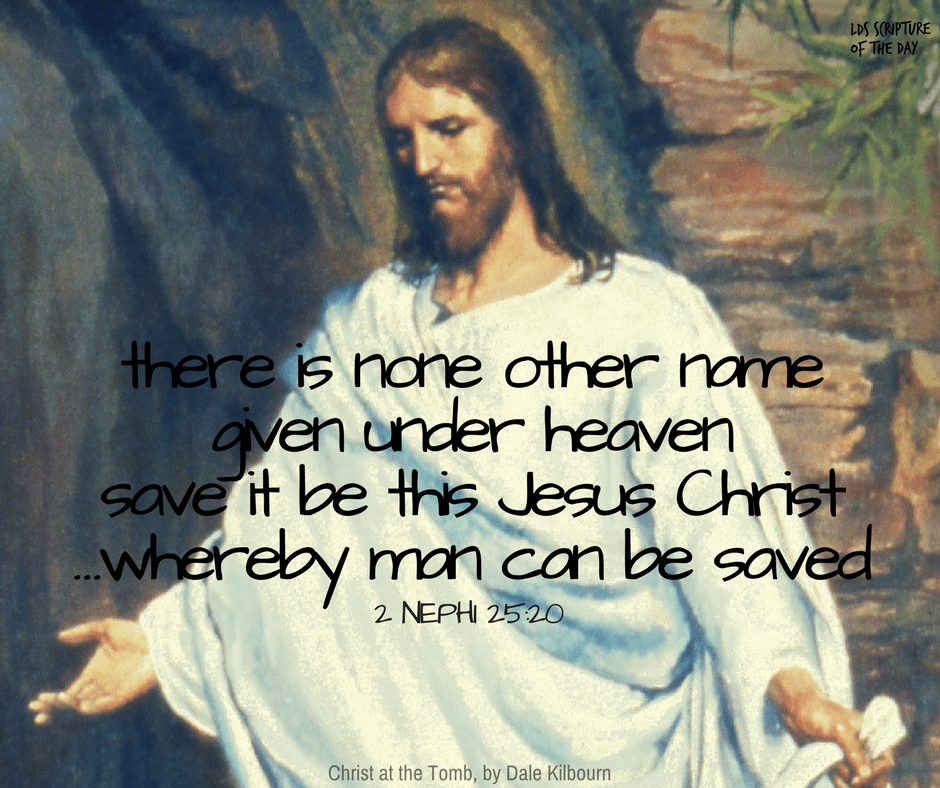
    One of my favorite scriptures of all time is 2 Nephi 25:26 which reads:

    And we talk of Christ, we rejoice in Christ, we preach of Christ, we prophesy of Christ, and we write according to our prophesies, that our children may know to what source they may look for a remission of their sins.”

    A common criticism that the Church of Jesus Christ of Latter-day Saints receives from other sects of Christianity, often Protestant groups, is that the Church teaches works as a form of salvation taking precedence over faith.

    As I read the Book of Mormon with this criticism in mind, I’m struck by how clearly the Book of Mormon teaches this principle – that faith in Jesus Christ is the most important thing.  The Church of Jesus Christ of Latter-day Saints is (as far as I know, open to correction) the only church with an explanation on how faith in Jesus Christ alone can result in being saved. 

    Saved, or immortality, is different from Eternal life and salvation.  All of God’s children who choose to be saved, will be saved, for He loves us all.  You can be saved by simply having faith in Jesus Christ, no works needed.  To attain all that the Father has to give, eternal life and salvation in His Kingdom for eternity, you must follow Him, and do what He asks of you.  For without works faith is dead (James 2:26).

    Sometimes I think the members of the Church of Jesus Christ of Latter-day Saints would be benefitted immensely by reading verses 26 and 27 of 2 Nephi chapter 25 every single day.  I think if we each did this, it would help us to re-orient ourselves and never lose sight of what is most important – faith in the Lord, or Savior, Jesus Christ. 

    The below scripture is what I am referring to in the title of this post.  This scripture is as important to latter-day saints today as it was to the ancient Jews:

    Wherefore, we speak concerning the law that our children may know the deadness of the law; and they, by knowing the deadness of the law, may look forward unto that life which is in Christ, and know for what end the law was given. And after the law is fulfilled in Christ, that they need not harden their hearts against him when the law ought to be done away.”

    2 Nephi 25:27

    I believe this scripture to be extremely important to latter-day saints.  The ancient Jews lost sight of Jesus Christ.  They looked to the law for salvation.

    I bear my testimony that I do not believe the Church of Jesus Christ of Latter-day Saints has lost sight of Jesus Christ.  His name is the name of our church, His prophet has implored us to use His name, our leaders preach of Jesus Christ, prophesy of Jesus Christ, teach of Jesus Christ, emphasize Jesus Christ.  The Church of Jesus Christ of Latter-day Saints points us to Jesus Christ.

    It is we, the members, I think, that need to read verse 27 often.  What is the law without Jesus Christ?  I fear that sometimes church members become focused on the wrong things.  Temple attendance for temple attendance’s sake.  Church service because it’s their duty.  Serving in church callings to keep up appearance as a faithful latter-day saint.  Partaking of the sacrament in a rote, mindless manner, not considering what it really means.

    I know I am at fault when it comes to some of the things I’ve just listed.  Sometimes I lose sight of Jesus Christ.  Sometimes I lose sight of what this is all really about.

    I’ve been back in church activity for 5 years now.  My first couple years of returned church activity were so Christ focused.  They were Christ focused because it was all I had.  He was all I had.  He was my strength, and He was everything.  I felt His forgiveness so potently because I’d so recently experienced it with such power.  As my church activity has steadied and become consistent, I’ve found myself relying on church activities, social events, friendships, and making my appearance as a faithful member.  These things aren’t necessarily bad, but they can be.  If they distract from Jesus Christ, they distract from the point.  If I get distracted from Jesus Christ, I am missing the mark.

    What is the law without faith in He who the law points to?

    I think we could all benefit from a consistent study of verse 2 Nephi 25:27.

    Why do we do what we do?  Is it for love?  Is it to serve Jesus Christ?  Is it to remember Jesus Christ, worship Jesus Christ, thank Jesus Christ?

    When is the last time you thought about all your sins and what Jesus Christ did for you at Gethsemane and on the cross?  For me, it’s been far too long since I’ve been brought to tears considering that event.  I’m glad I’m writing this because in doing exactly that, remembering what He’s done for me, and feeling it in my heart, tears are inevitable. 

    Remember why we go to church, the temple, and serve.  It’s for Him.  Not because we have to but because we want to.  Not because it will get us into heaven but because we love Him.  Salvation is through Jesus Christ.  If we go to the temple 5 days a week without Him in mind, we are wasting our time.

    Without Jesus Christ, all of it: temple worship, baptism, sacrament, service; it’s all for naught.  All these things point to Him.  Without Him as our focus all the items listed above are dead works.  

    This is the misconception of other faiths, that we go to the temple to substitute for Jesus Christ.  That couldn’t be farther from the truth.  We go to the temple because of Jesus Christ.

    I think every once in a while, it’s important we re-center our focus and remember what it’s all about.

    I hope and pray that we continue to steadfastly talk of Christ, rejoice in Christ, preach of Christ, prophesy of Christ, and bring others unto Christ, that we always remember to what source we may look for a remission of our sins.