Tag: god

  • Goals

    Goals

    I never used to set goals. I’m not exactly sure why. Could have been partly due to the thinking: if you don’t set goals you don’t fail.

    Throughout life, despite not actively setting goals, I think I’ve always had goals, even if those goals are subconscious. I think we all have goals.

    It’s interesting to look back on my life and see how my goals have changed.

    High school – graduate

    College – have as much fun as possible and meet as many people as possible

    After college – have a job to provide for myself

    Over time my goals changed in drastic ways. I went from wanting to have fun to thinking about a family. At some point, I went from only thinking about myself to thinking about others. 

    I’ve never been one to put a whole bunch of stock in goal setting. I always heard the logic: “You can’t accomplish it until you write it down.” I can see how that makes sense, but I just never subscribed to it. That includes New Year’s Resolutions. What’s the point of a whole population of people setting goals due to an arbitrary date? A goal they will stop putting any effort toward after week 3. 

    My Dropbox account has a whole lot of random and miscellaneous items in it. Random word documents, thoughts, quotes, letters, theories, links, notes, etc. When I had been back at church a couple years, I stumbled across something interesting, something I had almost no recollection of writing. I’ll post some of it here. It was a Word document called “2016 Goals.”

    Here is what I wrote in 2016. Through context clues, I can determine it was written either very early in 2016 or even *gasp as New Year’s Resolutions.

    Life

    • Stop swearing
      • Every time I swear out loud, take note of it. At the end of the year, donate $1 for every swear word I said through 2016.
    • Drink less
      • Try to limit drinking to twice per month.
    • Go back to church
      • In January go at least once.
      • February-December go to church at least 2 times per month. If I go less than 2 times in any given month, make up for it in a future month.
    • Go out of my way to do one nice thing for someone else at least once per week.
    • Buy a property.

    High aspirations, right? Try to limit drinking to twice per month, wow… aim for the stars.

    Other than the “Life” category I also had poker, work, and exercise. For the purpose of this post, I’ll focus on the above – Life.

    First of all, I immediately didn’t keep pretty much any of these goals. I never donated $1 for every swear word, though I do remember trying to keep track of my swearing. Drink less – out the window almost instantly. I don’t think I went to church at all January or February, so that’s pretty funny. 

    But here’s the extraordinary part. The year 2016 was the year I accomplished EVERY SINGLE ONE of those goals, with only buying a property bleeding into 2017.

    I stopped swearing in 2016, completely.

    I stopped drinking in 2016, completely.

    I started thinking about others. I don’t know if I did a nice thing for someone every week, but I know I tried.

    I bought my condo in 2017.

    In my opinion, without a doubt, the most important one and the one that enabled me to accomplish all the other goals I set – March 2016 was the month I started going back to church. I laugh at the fact I didn’t go in January or February, but is there any chance I would have gone in March if not for writing down these goals? Probably not.

    Remember, I don’t even remember writing these down. I know that seems strange, but I don’t. That’s how little thought I put into it. Within 2 months I’d completely forgotten about these goals. But, I think, something inside of me didn’t forget about these goals. Call it my subconscious, I’ll call it my soul, somehow, some way, writing these down gave me the power and strength to do things I thought impossible. Note again the goals, swear LESS, drink LESS. I went back to church and that became I don’t want to swear, I don’t want to drink.

    I’d be remiss if I gave all credit to myself for writing these goals down and accomplishing them. These goals that were written down and forgotten, my soul remembered them. I also think they were written and acknowledged somewhere much more important. I believe someone took note of my goals and sent help. That’s the only logical conclusion after all these forgotten goals somehow fell into place in the year 2016.

    After all this, I still don’t set concrete goals. Shame on me after the evidence I’ve seen. When I stumbled upon that “2016 Goals” Word document, I became a believer. Writing down goals is powerful. God sees our goals. Maybe our subconscious kicks in. Maybe good goals cause your spirit to cry out with joy that you’ve set some standards for yourself to try to accomplish.

    What I do know, is that goals are powerful. Writing them down is powerful. I should really try to be better at setting and WRITING DOWN concrete, solid goals. I’ve seen extraordinary things come from that. I think we all can accomplish extraordinary things when we set ourselves on a path.

    I have to conclude by thanking them. God. How could that all have happened without His support? My goals were so lame, and yet He made them something. Jesus Christ. How could I accomplish anything without Him forgiving me for all my wasted time, bad actions, and mistakes? I could only move forward by Him letting me look past my past. The Holy Ghost. There were countless difficult situations, countless times I ALMOST gave in and started drinking again, countless times, countless times. I know he was always there begging me to listen to him. Finally, the countless angels God undoubtedly sent, seen and unseen, to lift me up, help me along, protect, and encourage me. I owe it all to them. I am grateful. 

  • Of Goodly Parents

    Of Goodly Parents

    Over Christmas, I watched family home videos with my family. We played a video from 1994, a few months after my sister Adie was born. I was four at the time. I was singing to Adie.

    Early in the video, I was singing Humpty Dumpty, Old Mcdonald, and Jack and Jill. Then I started singing Follow the Prophet.

    Adam was a prophet, first one that we know.

    In a place called Eden, he helped things to grow.

    Adam served the (King!) Lord by following his ways.

    We are his descendants in the latter days.

    Of course, at that age, I stumbled through most of the song and got many prompts. King was my confident guess at who Adam served. My answer was as right as the correct lyric anyway.

    My mom joked while my whole family was gathered around watching, “See, we did teach you about the Bible.”  We laughed.

    I don’t remember singing that song to Adie when I was four, obviously. But that song is so ingrained in my heart and soul, it’s a part of my being. Watching that video, it’s a physical, emotional, and spiritual remembering. As an adult now, thinking about that song, it feels like it’s always been a part of me. After watching that quick video, I know why.

    Parenthood is infinite tiny moments. I know that every day provides thousands and thousands of opportunities to have an impact on Ivy and Sage. I’m grateful for the thousands and thousands of moments my parents impacted me.

    My parents have flaws just as I do. I pray to Heavenly Father that, despite my many shortcomings and flaws, I can have a positive impact on Ivy and Sage, just as my parents had on me.

    If you’ve read the themes in my writing, you know there are three things ingrained in me that I know to be true.

    1. I have a divine inheritance; I am a child of God.
    2. I am loved.
    3. I am watched over.

    I hope to ingrain these same truths into the hearts and minds of Ivy and Sage. I wish to remind them here of what their souls already know. That is the greatest gift I could give them.

  • What do we believe in?

    What do we believe in?

    My Aunt Lindsey often asks the question, “What do you know?” I usually respond, “Not much.”

    What do we really know? Anything?

    While reading Mosiah chapter 26, I came across an interesting commentary from Hugh Nibley, one of my favorite scholars. The commentary was on Mosiah 26:15 which reads:

    “Blessed art thou, Alma, and blessed are they who were baptized in the waters of Mormon. Thou art blessed because of thy exceeding faith in the words alone of my servant Abinadi” (emphasis added).

    In considering that phrase, “in the words alone of Abinadi”, Hugh Nibley asks, “Now what about childish faith? What about being gullible, etc.? Alma believed in the “words alone”? Alma saw no evidence, no proof, or anything like that? And it wasn’t the words of God; it was the words of Abinadi alone that he believed in? What’s going on here? Why is there merit in this?”

    He continues, “There is merit because Alma believed in his words alone. I would emphasize his. You are blessed because of the things you choose to believe-not by the act of believing, not just by faith. You weren’t blessed because you believed, but because you chose what to believe. Everybody chooses what to believe. The atheist is a very strong believer. He is the most passionate arguer you can possibly find, and the positivist. Where will you find greater faith and firm conviction than among economists? . . . You must believe in something, and everybody does. But the Lord said, blessed are you [Alma] because of the things you chose to believe; you chose to believe in the things that Abinadi taught.”

    I’ve written before about The Faith of an Atheist.

    What do we believe in?

    This is an interesting statement by Hugh Nibley. The idea that it isn’t our faith that is important. Everyone has faith in something. It is what we have faith in. What do we choose to believe? Do we choose to believe that this is all one dumb coincidence and we’re all here for no real reason? Or do we believe in a Savior who redeems us, a Father who loves us, and an eternity of potential?

    Like a lot of things, it’s really about agency. What do we choose to believe in? Alma chose to believe in something good, hopeful, eternal.

    People who leave the church – are they better for it? This is going to upset some people. But in my opinion, no, people aren’t better for leaving the Church. That’s not absolute, of course. Some who leave the church still donate constantly to good causes, serve others, love others, and use their time in helping others. More often than not, I don’t think that’s the case.

    Many who leave the church, instead of turning their focus to good, hopeful, and helpful things, spend the rest of their lives trying to bash, destroy, and talk negatively about the church. Why is that? If leaving the Church of Jesus Christ is a good thing, why doesn’t more good come from it instead of more negativity? Why is tearing down something, whatever your feelings on it, that brings others hope and joy, a good result?

    Is it easy to be a member of the Church of Jesus Christ? With the number of people my age deciding they don’t care for the Church, or any church, I’d say membership in the Church of Jesus Christ is not super easy. A lot of people say, “The church doesn’t do anything for me.” The Church isn’t about what it can do for you. It’s about what you can do for others. When you leave the Church, what do you do for others?

    Leaving the Church is complicated. I’m not trying to oversimplify it too much. But what I think gets lost sometimes is that leaving the Church is often a selfish choice. At least it was for me. I don’t want to have to get up early for church on Sunday. I don’t want to use my Saturday morning helping an elderly person move their belongings. I want to drink. I don’t have time for a church calling like teaching a class, working with the youth, or organizing group activities. I definitely don’t have time for ministering. Yeah, checking on a couple people every so often to make sure they’re doing OK, and really help them if they say they need something, don’t have time for that. I don’t want to pay 10% of what I earn anymore. The list goes on. Someone leaving the Church NEVER thinks this way (or won’t admit it). It’s about historicity or “what they feel” or feeling lied to or CES letter blah blah. I’m not trying to say that those things can’t be hard for people. They are, and I understand that. But often, it comes back to I, when the Church’s main goal is to help us see outside of ourselves.

    Now let’s be clear. Simply going to church isn’t enough. There are plenty of people who go to church on Sunday, leave, and call themselves stalwart disciples of Christ. You may be worse off than the nonbeliever in that case. It may be worse to believe and turn away the sick and needy than to choose not to believe.

    Does some small historical question, or some big historical question, distract you from a plan called “the Plan of Happiness”? Do you choose to worry about a statement by Brigham Young or some question about Joseph Smith? Do you disregard the miraculous book that was written, the testimony of a Savior of the world, an account of that Savior visiting His children in America? Do you ignore the hopeful and positive miracles because you have doubts?

    What do you choose to believe in?

  • Thomas Edison and the Unimaginable

    Thomas Edison and the Unimaginable

    How do you imagine something unimaginable?

    This thought is motivated by an awesome podcast called “How to Take Over the World.” I highly recommend it.

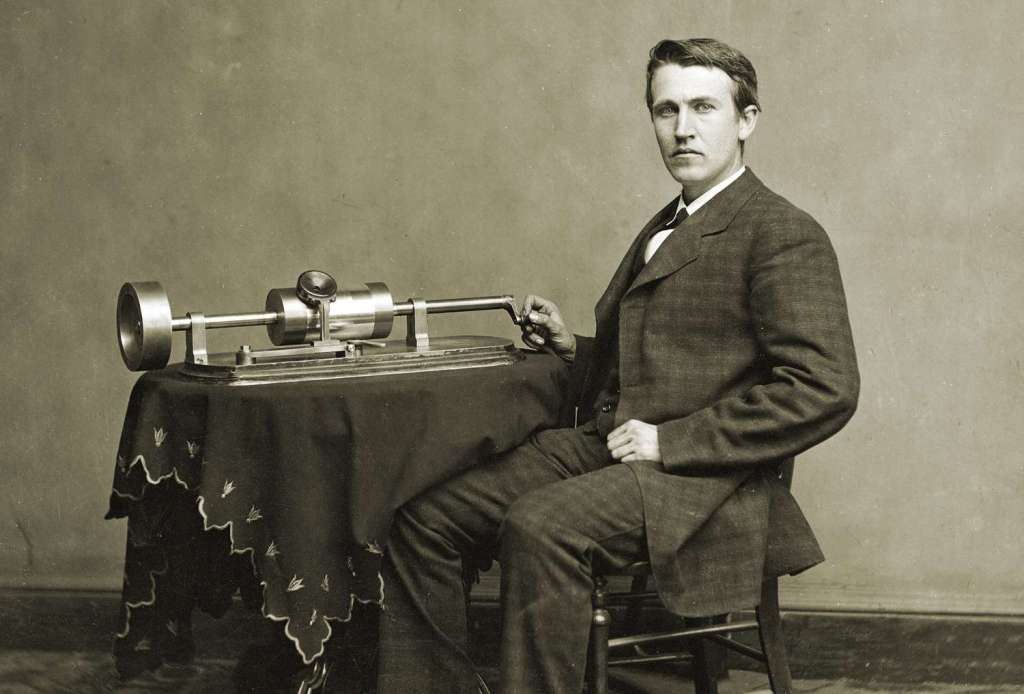
    When Thomas Edison discovered the ability to replay the voice using an invention that would become the phonograph, people couldn’t begin to fathom what they were hearing.

    When Edison started showing his new invention to individuals who had never seen anything like it before, this was a regular occurrence:

    A person would come in. Edison’s invention would be used to play back some recorded statement. The person would be asked what they just heard. The person would have no idea.

    The person would then be told that what they were about to hear was a human voice. The same recording would be replayed. The person would be able to repeat every word from the recorded statement.

    People who had never “seen” (heard) this before literally couldn’t fathom what was happening, so much so that their brains couldn’t even quantify it. How crazy is that? Makes you think how amazing it is that hearing the recorded voice has become so second nature to us. Up until 150 years ago, no human ears had ever heard the human voice from anything other than a human mouth.

    This new invention led to tons of confusion and misinformation about this device. People thought that dead spirits were speaking or the machine itself was talking. People just couldn’t wrap their minds or imaginations around the human voice being replayed.

    There is even a story of a scientist writing Edison after reading an article about the new invention/wonder in a magazine. The scientist asked Edison to issue a public statement refuting the absurdity, as it was not scientifically possible.

    This invention created a worldwide phenomenon. Thomas Edison became a celebrity overnight.

    This story leads to many interesting thoughts.

    The first interesting thing to consider is the idea of thinking about something that you can’t comprehend. When was the last time you were truly shocked by something? In the day and age we live in, nothing shocks us anymore. We’ve become numb to the fantastic world we live in. Moving stairs, cold boxes for food, flying tubes of steel, speeding metal squares: these things are amazing. We don’t even marvel at UFOs anymore, for crying out loud.

    I’m fascinated by inventors. I’m fascinated by people that can create something most of us never even dreamed possible. That was the phonograph, that was playing the human voice. Think how second nature the recorded voice has become to us. But back then, it was UNFATHOMABLE.

    The second thought that came to me from this story was, what do we really know about the world around us? We consider our society so intellectually mature and advanced, and yet, what do we really know about science? When we discover a fourth dimension, will we be shocked? When we learn there’s a spiritual realm all around us that we can’t see, how amazed will people be?

    This is also a lesson in trusting our senses. People back then couldn’t believe their eyes or ears. Today this has become a saying flippantly thrown about: “I couldn’t believe my eyes.” No, back then, they really couldn’t believe their eyes or ears. How much trust do we put in our senses? When it comes down to it, we can so quickly feel like our senses are deceiving us.

    Another noteworthy thing about this story is what the public latched onto when they heard of this invention. People got it into their heads that what was being played when the phonograph spoke were the voices of the dead. This kind of made sense. It was such a foreign concept to them, they just went to the most fantastical thing. Soothsayers and fortune tellers have existed for millennia. The natural assumption by people at that time was, if an unexplainable, miraculous, disembodied voice is speaking, it must be the dead talking.

    Not only did people jump to the conclusion that it was the dead speaking, they latched to the idea with an abundance of enthusiasm. Our fascination with the dead is endless, especially today. Why are we so enthralled by the idea? Why is it so important to us? Well, I believe, it’s because the hearts of the fathers are being turned to the children and the hearts of the children being turned to the fathers (Malachi 4:6, D&C 2, D&C 110:13-16, D&C 138:46-48, JSH 1:37-39).

    It’s our natural hope and desire to speak to our loved ones on the other side. We are drawn to them.

    There is an invention today, also from the 1800s, that is magnitudes more magnificent than the phonograph. This invention is equally as mystifying. In 1836 Joseph Smith, Jr. dedicated a temple to the Lord. This “invention” allowed the sealing of families for eternity. This miraculous invention, like the phonograph, is little understood by the world. Much of the world doesn’t realize this “invention” exists. Coincidentally, the phonograph was invented in 1877. The oldest standing Temple of God is the St. George temple which was dedicated in 1877.

    How amazing to see the temple work of this dispensation where so many of our hearts are turned to our progenitors who have already passed through the veil. When temple work is done for a family member, a real bond is created. We are all connected.

    This, I believe, is why people were hopeful the phonograph was a way for them to speak to their dead.

    The phonograph is an invention that has blessed the lives of so many with the ability to communicate here on Earth. Temples bless every person who has ever lived, does now live, or will ever live. The temple is eternal. I’m grateful to live in a time when we know of temples and of their eternal significance. I’m grateful to have temples nearby. I’m grateful to be sealed to my family for eternity. I’m grateful to know I will see all my loved ones again.

    How powerful is that? How amazing is that? We get to do work for our dead, be linked to them forever, and create a connection for eternity. Now that’s an amazing invention.

    Columbus, Ohio Temple
  • Sent from God – Missionaries

    Sent from God – Missionaries

    The story of Ammon is one of my favorites in the Book of Mormon. Ammon went amongst the Lamanites who wanted to kill and murder him to teach them about Jesus Christ. I wrote about a great conversion moment I had from the story of Ammon before. Here I am 4 years later, still being inspired by the story of Ammon.

    This time it was chapter 18 that struck me. Ammon had just performed a miraculous feet, defending the flocks of the king from a group of men trying to scatter them. In defending the sheep, Ammon smote off the arms of so many men that the other servants he was with felt the need to collect them and show them to the king. It is here where King Lamoni, in chapter 18 verse 2 says,

    “Surely, this is more than a man. Behold, is not this the Great Spirit who doth send such great punishmnets upon this people, because of their murders?”

    Ammon was so powerful that the king believed him to be God.

    In verse 18, King Lamoni asks Ammon if he is the Great Spirit.

    Ammon’s simple reply in verse 19 is, “I am not.”

    Their conversation continues and Ammon begins to teach Lamoni about the one true God. Lamoni asks in verse 33, “Art thou sent from God?”

    This is what jumped out to me and made me think. It wasn’t long ago that King Lamoni thought Ammon was actually God. It’s a natural progression, I think, to then ask if he was sent from God. Ammon’s reply is found in verses 34 and 35:

    “I am a man; and man in the beginning was created after the image of God, and I am called by his Holy Spirit to teach these things unto this people, that they may be brought to a knowledge of that which is just and true;

    And a portion of that Spirit dwelleth in me, which giveth me knowledge, and also power according to my faith and desires which are in God.”

    I am called by his Holy Spirit.

    This made me think. Ammon could have simply replied, yes, I am from God. Instead, he chose to use the question as an opportunity to expound and teach about God and our relationship to Him.

    What do missionaries say when a stranger or someone they’re teaching asks the simple question, “Are you sent from God?”

    I hope it is without hesitation that the response comes, a resounding: YES.

    This led me to think even deeper about this. King Lamoni was asking if God guided Ammon there. Ammon replied that God had. But what if Lamoni was asking if Ammon came directly from the presence of God to teach him? That question isn’t that crazy after asking the person if they were God. Ammon could have equally replied to that question: Yes. He came from the presence of God to teach King Lamoni and his people.

    Every missionary serving Jesus Christ came from the presence of God to this earth with the purpose of going on a mission, teaching others about God, and bringing others unto Christ.

    How often do our missionaries think this way? I hope daily. It is a powerful thing to understand that you were sent directly from God for this important mission.

    Neil A Maxwell when speaking of the star that signaled Christ’s birth said,

    “The same God that placed that star in a precise orbit millennia before it appeared over Bethlehem in celebration of the birth of the babe has given at least equal attention to the placement of each of us in precise human orbits so that we may, if we will, illuminate the landscape of our individual lives so that our light might not only lead others but warn them as well.”

    God knows our missionaries. God loves our missionaries. God sent our missionaries, directly from His presence, to shine their lights and illuminate this world. I am so grateful for our missionaries.