
Tag: god

  • Attack on Mormons

    Attack on Mormons

    Legend has it my grandfather has a hidden room in his home for the day that followers of Christ are rounded up like Jews were in Europe during World War II. I spent much time trying to find that room without luck. I’m still not convinced it doesn’t exist.

    Beth and I recently finished a TV show called Under the Banner of Heaven. If anyone wants to see every anti-Mormon falsehood spouted in 7 hour+ long episodes, I highly recommend it.

    A story made headlines recently. A highly recruited quarterback from Utah was visiting an Oregon football game. He left the game when the student section started chanting “f- the Mormons.”

    The play “The Book of Mormon.”

    Southpark parodies.

    Imagine another religion being treated this way. Can you picture the outrage if a student section chanted “f- the Jews” for example? I felt wrong just typing that.

    And yet the Church of Jesus Christ of Latter-day Saints is not shielded from this. Why is that?

    Under the Banner of Heaven being my most recent exposure to anti-Mormon media, that’s where I’ll focus this post, with my point at the end. Stay with me. Even if you haven’t seen the show (and despite what I said above, I DON’T recommend it) this will still be pertinent.

    An article was written in the Atlantic about the show. That article can be found HERE.

    If you’re interested, you should read the whole article. It’s well written and helped me understand the underlying feelings I had about this show.

    Here are some highlights from that article that I agree with:

    “[It] felt like seeing my religious life in a funhouse mirror, each detail-from the sacred to the mundane-twisted and stretched and distorted to appear frightening and strange.”

    When talking about the absurd use of the phrase “Heavenly Father” in the show, “But I gave up after a few episodes [counting the weird usages of “Heavenly Father], once I realized what was going on. To say that I have never met a Mormon in my life who talks like this would be to miss the point. These lines were not intended as shibboleths for Mormon viewers-they are there to serve a stereotype, to exoticize a people and flatten their faith tradition.”

    “Under the Banner of Heaven is one of the most openly hostile treatments of a minority religious group to appear in popular American entertainment this century. It is also an unqualified hit.”

    I could go on about the flawed and insulting nature of this show.

    Elder Bednar, an apostle for our church, was asked his thoughts on the show. He responded, “We don’t like it, but we don’t spend all of our time responding to it. We have a mission to fulfill.”

    The writer of the Atlantic article stated he initially felt good about Bednar’s response. Then on further thought:

    “But almost immediately, I doubted myself. Wasn’t I just taking the same path of least resistance – above-the-fray politeness, studious nonconfrontation – that Latter-day Saints always seem to take when faced with stuff like this?”

    This is exactly the struggle I deal with. I am in a constant “polite, studious nonconfrontation”-like attitude. It’s how I was raised. I was pretty heated by the end of the final episode. Episodes 1-6 I was just “bluh.” A feeling of, “whatever. They’re making us look weird, the show is weird.” Then that turned into the show is upsetting me. I found myself having an unsettled feeling after each episode that I couldn’t quite pinpoint. Truly, it wasn’t until reading the Atlantic article that full outrage started to settle inside me. How could a show treat my religion like this? Where would it be acceptable to treat any other religion like this? What’s next?

    It was to the point that I didn’t mention to friends I was watching this show because I didn’t want them to watch it. This included close friends that know me and my religion and (I hope) would see through much of the nonsense of the show.

    I hesitated to share because maybe this fear of others seeing my religion as cooky exists inside me. I know what my religion is. It’s precious to me. It’s sacred. It has provided every blessing in my life, I can’t spit upon and laugh at my Church, it’s too important to me.

    So, Bednar’s statement. I like it, in that, it’s how I would respond. Forgive. Turn the other cheek. Don’t get emotional. Don’t get upset. Above all else, don’t let them see you’re upset. But then, at what point do you stop being a cultural punching bag? Is there a point where you stand up for the church and religion that you love? After all, I know this to be Jesus Christ’s Church. Is a show like this really insulting Him? That causes real outrage inside me that I’m willing to speak out about. Spit on me, spit on my faith, spit on my church and my religion. Don’t spit on Him. Maybe that’s ultimately what got me upset. The idea being perpetuated through this show that it was Christ’s church that caused some extremist men to kill a woman and her daughter. I feel for Brenda’s family, her sister, who rightly pointed out that this show unfairly portrays her murder.

    And as the article points out, where is the apology? Where is the script before the show plays saying “Mormons are not an extremist, murdering people. This is a dramatization.”

    In an age where Disney has to apologize before The Lady and the Tramp, Under the Banner of Heaven needs no disclaimer apology for this? Remember that football player at the Oregon game, Oregon apologized for their student section’s behavior.

    As the article points out, we are moving backwards. Rather, we are being pushed backwards. Saints rarely live peacefully in a wicked world.

    What other religion could be ridiculed, spit upon, and disrespected in this way, without public outcry and support, besides the Church of Jesus Christ of Latter-day Saints?

    In our forgiveness, we laugh it off and shrug. But a dangerous thing is happening out there. As Satan does in any dispensation where there are Saints to God, he is stirring up the masses against us.

    This leads to my point.

    The attack of this show on a religion seems like a small enough matter. “Who really cares” some might say, as I did, initially. It does matter. The attack on religion, on faith, on Christ is increasing daily. It seems dramatic to even consider the idea that Latter-day Saints could be rounded up like what happened 80 years ago. We can trick ourselves into thinking we’ve gotten better as a world and as society since then.

    Media attack on faith and on Christ are widespread and increasing. It’s not just the Church of Jesus Christ being attacked when shows and plays and TV openly mock it, it’s all followers of Christ and ultimately Christ Himself.

    This attack is going to increase, and we need to be aware of it. I hope that all my friends and especially those who don’t believe in God realize how important this is to be aware of. Believers need the support of nonbelievers in our defense. Otherwise, this world becomes a scary world for those of faith.

    Maybe it’s time for a return trip to my grandparent’s home to search out that hidden room. I hope it’s not.

  • Lost

    Lost

    I wrote this our first Sunday at church with Sage.

    I don’t know what I wanted out of life as a teenager. I wasn’t someone who pictured certain things. I don’t remember picturing what my ideal life would be.

    Today we sat in church for the first time with Sage. She is 8 days old. She was next to me in her car seat, sound asleep. Ivy was on the other side of me and Beth was next to her.

    Then it hit me. This is everything I could want out of life.

    I grew up in an LDS household. My family went to church. I have lots of siblings. I don’t know if back then I realized how much I would want this. There were large portions of my life where I convinced myself that wasn’t what I wanted. But it was always there, inside me, whether I acknowledged it or not. A deep desire to have a family.

    I realize now, I always wanted a family. Right now, with my two daughters and my wife, being at church, there is nothing more I could ask for in life. This is joy.

    I work with the 11-15 year old boys in our church. After that thought came to me in sacrament meeting, I got to share it with them.

    I don’t know what those boys want out of life. I didn’t know at that age. I was able to bear my testimony to them that there is no greater joy in this life than having children, and I wished it for each of them. I told them they need to figure out what they want out of life. I told them I hoped they could find the joy I’ve been able to find.

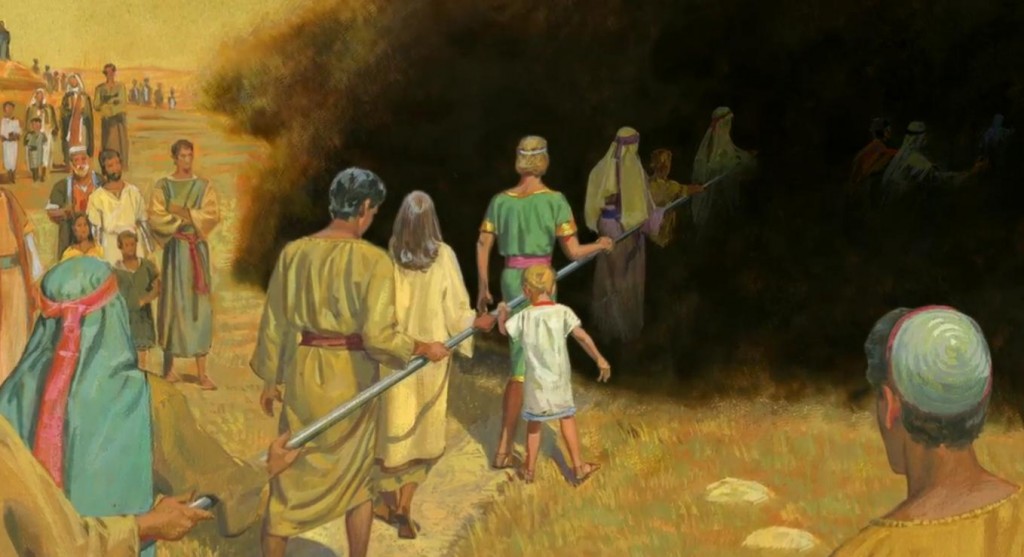
    It was a long journey for me to get here. In that same class with the boys we had a lesson on Isaiah and the iron rod was brought up as a symbol of something greater. One of the boys asked the question: how does the iron rod, which represents the word of God, help us get to the tree of life, which represents Heaven? I told him, it is so easy to get lost. And without the word of God and His commandments, getting lost is almost inevitable. I told this boy I hoped he never had to get lost.

    I got lost. There were many times I didn’t know if I’d ever make it back.

    I often wonder why I deserve so much that God has given me. The answer must be that I don’t deserve anything. He just loves us so much, He’s willing to give us what our hearts truly desire. Whether that be in this life or the next, God has given us everything and will continue to do so. It took me a long time to realize what my heart truly desired. God let me take the long winding road here probably so I could truly appreciate it.

    I do appreciate it.

    I am grateful for the family God has given me. I am grateful for His Church. I am grateful that I’m no longer lost. I couldn’t ask for anything more.

  • The Need for God in the Newborn Days

    The Need for God in the Newborn Days

    Having a newborn is pretty difficult. Understatement? The challenges are diverse and wide-ranging. I don’t believe this is a coincidence.

    As Beth and I were driving to the hospital for her to bring a baby into the world – we prayed.

    As we waited to get checked into the hospital – I prayed.

    As we sat in our first room and Beth’s pain started to increase – I prayed harder.

    As we were moved into the delivery room and the miracle began – I prayed constantly.

    As I held my new daughter – I prayed, holding back tears of gratitude.

    As we took the new member of our family to our hospital room – I prayed.

    As we struggled to stay awake and care for her new needs – I prayed.

    As we drove home – I prayed.

    As we started the first weeks of no sleep, stress, anxiety, and responsibility. As we tried to feed Sage, as we changed her multiple times throughout the night, as we walked around bleary eyed, as she slept on my chest, as she cried in my arms – I pray constantly for help and strength.

    As Beth becomes a zombie from lack of sleep – I pray.

    As I fall asleep holding Sage – I pray.

    As Ivy adjusts to a new sister, the responsibility, and the change to her little world – I pray for her.

    As Beth works to breastfeed every 3 hours and continues not to sleep – I pray for her.

    As I go back to work, Beth having extreme trepidation – I pray, and I assure her it will be ok.

    We’re being looked after.

    As Beth texts me, “You must have said a good prayer for us for today. I can’t believe I feel as good as I do right now.” – I pray with so much gratitude.

    I know we’re being looked after.

    Having and bringing home a newborn is stressful and a momentous responsibility. I don’t think that is a coincidence. I think it’s meant to remind us how much we need Him. I’m grateful for how difficult it is to bring a new baby home because it brings me closer to my Heavenly Father. I have to rely on Him, because I know my strength is nothing, and I know I can’t do it without Him.

    I’m grateful for these challenges because they remind me how much I need Him.

    I’m grateful to know He is there.

    I’m grateful to know we are watched over.

  • Be Ye Therefore Perfect

    Be Ye Therefore Perfect

    There is a message recently brought to my attention in Matthew chapters 5-7. We all know the sermon on the mount. Don’t just not kill, also don’t even be angry. Don’t just not commit adultery, don’t even lust. Be ye therefore perfect.

    What comes next though? I haven’t before considered how the next chapters lead to a great message, a culmination of how we should behave and how we should try to be.

    What does the Sermon on the Mount transition into? What is the theme of chapter 6?

    Matthew 6:1 –

    “Take heed that ye do not your alms before men, to be seen of them: otherwise ye have no reward of your Father which is in heaven.”

    Matthew 6:20 –

    “But lay up for yourselves treasures in heaven, where neither moth nor rust doth corrupt, and where thieves do not break through nor steal.”

    Matthew 6:38 (JST) –

    “Wherefore, seek not the things of this world but seek ye first to build up the kingdom of God, and to establish his righteousness”

    Matthew 6 is all about our motives. In chapter 5 you seek to be perfect by your behavior. Chapter 6 asks, “why are you seeking to be perfect?” Is it for the glory of the world? Is it for more temporal possessions and blessings? Chapter 6 looks at your heart and asks your intention. We should want to be perfect because we love God and we love others. We should want to be perfect because it’s right. Perfection shouldn’t be about us or what it does for us. We should want to be perfect because Christ was perfect, perfect love, and our example. Chapter 6 tells us to look heavenward in all things.

    Which leads us to chapter 7. What does chapter 7 teach us?

    The message of chapter 7 is summed up by verse 1 (JST) –

    “Judge not unrighteously, that ye be not judged; but judge righteous judgement.”

    You’ve worked hard to fix your bad habits, to be loving, to treat others as you want to be treated. You’ve then addressed why you’re doing these things. Your heart is pure, you love others because it’s the right thing to do you. You look heavenward. Chapter 7 is about understanding that not everyone is at the same point on their own journey to perfection. Just because someone is working along their path, and in your mortal eyes may seem to be “behind” you, they’re not. Judge not others. They’re working their way down the path of perfection just as you are.

    That said, we still judge others righteously. Righteous judgement is loving judgement.

    Matthew 7:9 (JST) –

    “Go ye into the world, saying unto all, Repent, for the kingdom of heaven has come nigh unto you.”

    D&C 6:9 –

    “Say nothing but repentance unto this generation.”

    D&C 15:6 –

    “the thing which will be of the most worth unto you will be to declare repentance unto this people.”

    D&C 16:6 –

    “the thing which will be of the most worth unto you will be to declare repentance unto this people.”

    D&C 14:8 –

    “And it shall come to pass, that if you shall ask the Father in my name, in faith believing, you shall receive the Holy Ghost, which giveth utterance, that you may stand as a witness of the things of which you shall both hear and see, and also that you may declare repentance unto this generation.”

    What Christ’s apostles at the meridian of time were told to preach was the same thing those who were instrumental in the restoration of the Gospel of Jesus Christ were told to preach. It’s the same thing we’re supposed to preach today.

    Repentance.

    That’s what brings us and those around us closer to Christ.

    So, work on yourself first, Matthew chapter 5. Work on your motives second, Matthew chapter 6. Then, preach repentance to those on a different part of the path than you. Preach repentance with love and understanding. Never forgetting that you’re on the path too, trying to be your best. That’s all we can ask of each other. Do your best.

    From the book 40 Years And Marching On, an article by John W. Welch (p. 228) he says:

    “First is the acknowledgment that all people are at different stages in the eternal journey toward the glory of God, which is intelligence.”

    This is the message of the Sermon on the Mount. It’s not a one-part lesson, it’s 3 parts. Be perfect – be perfect for the right reasons – accept that others are not perfect (yet).

  • Forgiveness

    Forgiveness

    Forgiveness can be so hard. There’s a reason Christ emphasized it so differently from normal human traditions. Human thinking is, “I can’t forgive them that many times.” God’s response is, “how many times have I forgiven you?”

    That point is brought home in Matthew chapter 18. In verses 21-23, Peter asks that question we’re all tempted to ask. How many times must I forgive? Seven? Surely seven is good. It’s 4 more times than the Hebrew law dictated at the time. Christ’s famous response,

    “I say not unto thee, until seven times; but, until seventy times seven.”

    Christ expounded upon this with the parable of the servant who owed a king a large sum. When brought forward to pay the sizeable debt, the servant fell down before the king and begged for patience. In great mercy, the king waived the debt.

    That same servant then went out and grabbed another servant, demanding that a tiny amount be paid back. The second servant asked for patience and the same servant who had just been shown so much mercy had the second servant thrown into prison.

    When the king heard this he “was wroth, and delivered him to the tormentors, till he should pay all that was due to him” (Matthew 18:34).

    It seems so easy here on earth not to forgive others. What does it hurt us to not forgive? How does that person who wronged me deserve my forgiveness?There is a story from the book Return from Tomorrow. A holocaust survivor is found in a concentration camp. When he is liberated by the soldiers, he is put to work helping with the sick and dying around him. He is energetic and relatively healthy. The soldiers finally say to him, “you must have been lucky. You haven’t been here long, huh?” The man tells them how many years he’d been at the concentration camp; a long time. They marvel at his health. How can it be?

    The man tells them that early in the war, his wife and children were murdered before his eyes. He desperately wanted to hate these men, hate this war, hate this world, hate God. He had every reason to. But, the survivor made a decision. He decided he would not carry that hate with him. He decided he wouldn’t poison himself with hate. Forgiveness saved his life.

    Elder David E. Sorensen said, “When someone has hurt us or those we care about, that pain can almost be overwhelming. It can feel as if the pain or the injustice is the most important thing in the world and that we have no choice but to seek vengeance. But Christ, the Prince of Peace, teaches us a better way. It can be very difficult to forgive someone the harm they’ve done us, but when we do, we open ourselves up to a better future. No longer does someone else’s wrongdoing control our course. When we forgive others, it frees us to choose how we will live our own lives. Forgiveness means that problems of the past no longer dictate our destinies, and we can focus on the future with God’s love in our hearts.”

    We may think not forgiving others is harmless, but hate is poison. Holding onto grievances and refusing to forgive only poisons ourselves.

    In the book, Surprised by Hope, N. T. Wright said: “If you lock up the piano because you don’t want to play to somebody else, how can God play to you?“

    Reading back on the story of the king and the foolish servant who would be forgiven his great debt then demand payment from another. We read that and scoff at the hypocrisy. Yet we all have this same hypocrisy in us. And God is our king, having forgiven us all, and wroth when we can’t extend the same favor to our fellow brothers and sisters.

    Verse 35 concludes that story:

    So likewise shall my heavenly Father do also unto you, if ye from your hearts forgive not every one his brother their trespasses.

    Going along with what Elder Sorensen said, from this link: “I think it is helpful to recognize that offences and injuries are always bottled in our past. So, forgiveness requires us to deal with our past – not our present or future. We have to let go of our past in order to fill up the present and bless the future. When we fail to deal properly with our past, we are like someone whose elastic belt is caught on a barbed wire fence; we can make very little forward progress until we unhook ourselves from our pain and injustice in our past.”

    That quote is perfect in explaining how that man from the concentration camp survived. That man, if he hated, would have been stuck in the past, attached to a barbed wire. Never being able to progress to his future. Instead, he chose to forgive, free himself, and save himself. That is the true power of forgiveness.

    We have all been wronged. We have all wronged others. Some of us have been wronged worse than others. But life isn’t a ledger book. Life isn’t a tally of who has been wronged the most. There is always someone that has been wronged worse than you have. The book The Shack talks about this eternal idea of “being wronged.” If you refuse to forgive someone, and that someone refuses to forgive their father who made them that way, and their father refuses to forgive his father who made him that way: on and on for eternity. Grievances go back to the beginning of time. Forgiveness ends the vicious cycle of hate. 

    Forgive our trespasses as we forgive those who trespass against us.

    There was a point in my life when I realized I’d been carrying around poison for far too long. There was a day I realized I had to forgive some people from my past so that I could move forward. I reached out to some people I hadn’t spoken to for so long. It helped me. I felt that feeling, of getting a weight off your shoulders. For me, it was more a feeling of getting poison out of my system. I thought I’d forgiven. It wasn’t until I actually said it, to the person that needed to hear it, and apologized for my part in pain that was caused, that I realized the burden I’d been carrying for so long.

    We all must forgive.

    Again, I know that sometimes such heinous wrongs are committed that some people feel they have the right to shout, “But I’ve never hurt someone like they hurt me!”

    In those moments think about the person from the concentration camp who refused to hate. He chose to forgive. It saved his life. He had more reason to hate than just about anyone ever has. He chose not to. There’s always someone that deserves to hate more. Choose to love instead.

    Let go of the hate you harbor and forgive. Do you want to come before God and Him to ask, “how can I forgive you, when you never forgave?”

    We all do wrong, and we all get wronged. Remove yourself from the past and progress.

    A forgiveness post would be lacking if it didn’t mention where all forgiveness originates. Always remember, there is only one person who can truly break the vicious cycle of pain and hate. Jesus Christ is the ultimate giver of grace and mercy. If you feel you truly can’t forgive, lean on Him. He felt the pain, He felt all of it, and He has forgiven us. He’s forgiven all of us. He died so that we can experience the true feeling of freedom that He allows. His blood paid our debt, all of it. As we rely on Him, we will find the forgiveness our hearts desperately need.