
Tag: Heavenly Father

  • Faith in Man or Faith in God

    Faith in Man or Faith in God

    Since I’m posting this on Thanksgiving day I think I’m obligated to say I’m grateful for the Book of Mormon, how it makes me a better person, how it makes my home a happier place, what it teaches me about Jesus Christ, and the hope it gives me for an eternal future.

    I will make a simple argument here.

    My thesis:

    Anyone who has read the Book of Mormon and believes it is a made-up story written by a man has more faith in the brilliance of a man than in the Glory of God. It is easier for that person to believe there is a man with otherworldly abilities than that God still speaks to humans.

    Explanation –

    Things that can’t be denied by any logical or thinking person:

    1. The Book of Mormon exists. You can go get a copy now and read it.
    2. The Book of Mormon was brought into existence in our day, for us to read, somehow.

    If the above two points are true, then we can move on.

    Next statements of truth:

    1. Since the Book of Mormon exists, we must determine who played a role in creating it.

    This leads us to only a couple options as far as I can tell. There may be other sub-options, but I think this mostly covers it. I’ve added sub points to each option to add important perspective:

    1. Joseph Smith wrote it by his own mind and creativity.
      • Joseph Smith had a third-grade education.
      • There are many witnesses attesting to Joseph Smith’s involvement in the creation of the Book of Mormon.
      • If historical accounts are to be believed, Joseph Smith dictated it word for word without notes or reference materials.
    2. Someone else wrote the Book of Mormon
      • This is hard to believe given countless eye-witness testimonies of Joseph Smith’s involvement in the creation of this book. It takes some creative gymnastics to determine how this could be true.
    3. Joseph Smith wrote it with the assistance of somebody very learned, ex: Sydney Rigdon.
      • This would require some sort of explanation on why no one else ever came forward to claim writing such a brilliant book.
      • With any minor research we find much evidence to show Sydney Rigdon didn’t meet or know Joseph Smith until the Book of Mormon was published.
    4. Joseph Smith translated the Book of Mormon by the power of God.
      • This would be taking the supposed creator of the book at his word.

    I believe any basic research into this subject proves Joseph Smith’s direct involvement in the creation of the Book of Mormon. Whether that be through point 1 or point 4 will now be briefly discussed. If points 2 or 3 are to believed, then a vast and complex conspiracy has been going on for 200 years. For 200 years, no proof has come forth to show that anyone but Joseph Smith created the Book of Mormon. No one has come forward. No information has leaked.

    If we come down to points 1 or 4, let’s address point 1, that Joseph Smith wrote the Book of Mormon by his own mind and creativity.

    Let’s first just disregard the fact that he wrote it in 65 working days because I feel detractors will just say, “That’s not true” even though the historical account appears to support if not prove this. Let’s say Joseph Smith wrote it with as much time, editing, and re-editing as he needed (which many testimonies argue against, but for the sake of this argument, let’s say he did take months or years to write it before he turned 25 years old).

    Those arguing Joseph Smith created the Book of Mormon from his own mind admit a man with little to no formal education, little to no access to any historical books or other reference materials, wrote a detailed account of a company leaving Jerusalem and travelling to the Americas. Instead of elaborating more on this, I will quote a challenge issued by Hugh Nibley to his students at BYU:

    “Since Joseph Smith was younger than most of you and not nearly so experienced or well educated at the time he copyrighted the Book of Mormon, it should not be too much to ask you to hand in by the end of the semester (which will give you more time than he had) a paper of, say, five to six hundred pages in length.  Call it a sacred book if you will, and give it the form of a history.  Tell of a community of wandering Jews in ancient times; have all sorts of characters in your story, and involve them in all sorts of public and private vicissitudes [daily activities]; give them names — hundreds of them — pretending that they are real Hebrew and Egyptian names of circa 600 B.C.; be lavish with cultural and technical details — manners and customs, arts and industries, political and religious institutions, rites, and traditions, include long and complicated military and economic histories; have your narrative cover a thousand years.

    Keep a number of interrelated local histories going at once; feel free to introduce religious controversy and philosophical discussion, but always in a plausible setting; observe the appropriate literary conventions and explain the derivation and transmission of your varied historical materials.  Above all, do not ever contradict yourself!  For now we come to the really hard part of this little assignment.  You and I know that you are making this all up — we have our little joke — but just the same you are going to be required to have your paper published when you finish it, not as fiction or romance, but as a true history!  After you have handed it in you may make no changes in it. . . .

    What is more, you are to invite any and all scholars to read and criticize your work freely, explaining to them that it is a sacred book on a par with the Bible.  If they seem over-skeptical, you might tell them that you translated the book from original records by the aid of the Urim and Thummim — they will love that!  Further to allay their misgivings, you might tell them that the original manuscript was on golden plates, and that you got the plates from an angel.  Now go to work and good luck!” (The Prophetic Book of Mormon, F.A.R.M.S., 221-222)

    I will add Alan C. Miner’s addition to this challenge, stating, “It shouldn’t be hard, living as we do in the computer world of the internet”:

    “Because your story is supposed to be a religious record, include in your paper over 500 different descriptive titles for deity, all within a proper religious context that will not only explain these titles in relation to what we have in the Bible, but give added meaning and understanding to the text of the Bible and to your own story.  And while you are at it, have most all the proper names of people, places and things have intrinsic and symbolic meaning.  Because this is supposedly an ancient Hebrew record, give hundreds of ancient parallelistic Hebrew literary forms.  In fact, have the whole text written in parallelistic patterns.  Incorporate thousands of phrases from the Bible so that these intertextual usages give added meaning to both the Bible and the Book of Mormon.  Make sure that the biblical sources are from all different parts of the Bible, and for that added touch, use some extra-biblical texts.  But don’t limit yourself to just your own patterns of language, or that of the KJV Bible, also use Early Modern English terms that were dated near 1611 when the KJV Bible was first published and became the bible of the masses.  Weave in an underlying theme of covenants with the Lord, both culturally and scripturally using covenant terms and practices used in ancient times.  In fact, it would be a good idea to make every part of your narrative not only covenant-related, but Christ related as well. For one final challenge you must dictate your story to a scribe without the aid of a written script.  While you may be allowed to tell your scribe to adjust the spelling of proper names, you must leave your script as you dictate it, and never ask your scribe to tell you where you left off after lunch or the end of a day.  On his own, your scribe can adjust capitalization, punctuation, the spelling of traditional words, and some simple grammar, but that is all.  Dictate parts of your story in non-chronological order, and be sure to credit these parts of your story to different writers, varying your manner of using words so that a distinct separation of language style can be detected.”

    What Joseph Smith wrote has been critiqued, criticized, evaluated, and been under a microscope for nearly 200 years. With additional evidence from archaeology, what we know about the Middle East and Jerusalem, and what we know about the Americas, the Book of Mormon is more validated, not disproven, despite what detractors may argue.

    I hope this goes to illustrate how impossible this act would be. It would be miracle of extraordinary human skill, intelligence, and foresight (knowing things that hadn’t yet been discovered yet, like chiasmus).

    Those who believe Joseph Smith wrote the book of Mormon through his own brilliance have more faith in the genius of a man than faith in the idea that God assisted in the matter. Put simply, you either have faith in the brilliance of Joseph Smith or in the Glory of God.

    Those who believe Joseph Smith did not translate the Book of Mormon through the gift, power, and love of God “deny the power thereof” (2 Timothy 3:5, Joseph Smith History 1:19).

    You must come to terms with this truth.  Either Joseph Smith was above and beyond the most brilliant man in the history of mankind.

    Or. 

    God loves His children and instituted a great work through Joseph Smith.

    What does it say if you more easily believe in Joseph Smith than in God?

    I am grateful for the Book of Mormon.
  • Your True Identity

    Your True Identity

    *I originally wrote this in 2022.

    I’d like to discuss Grace and our Identity.

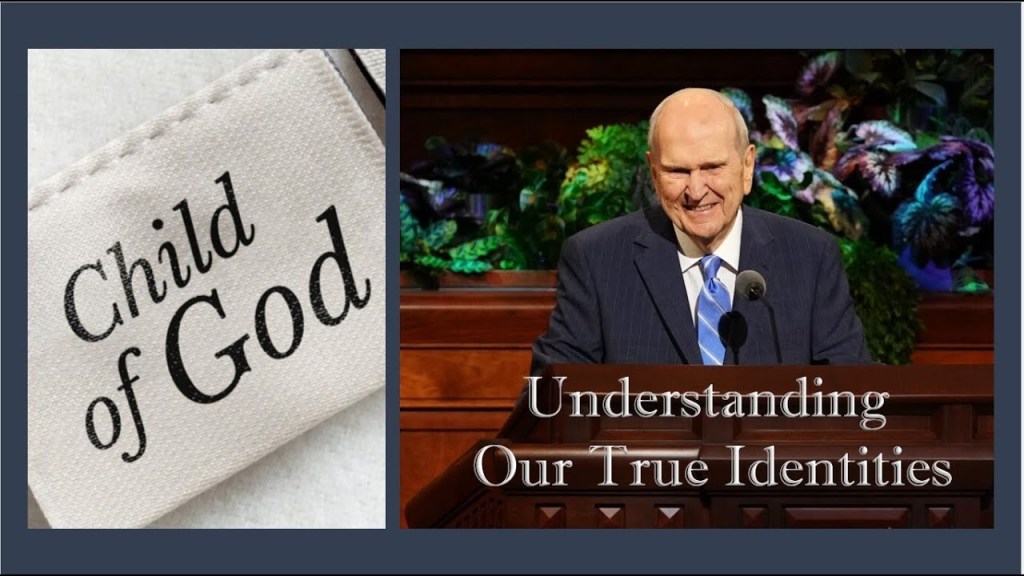
    In a recent address to young adults of the Church of Jesus Christ of Latter-day Saints, the prophet of the Lord, President Russell M. Nelson, talked about the three defining identities of a member of Christ’s church. Those identities were:

    1. Child of God
    2. Child of the covenant
    3. Disciple of Jesus Christ

    The grace portion of what I’d like to discuss, like President Nelson’s identities, will focus on members of Christ’s church. This doesn’t mean what I’m saying here doesn’t apply to all. I believe it does. Whether someone believes in God or not, the first identity of all God’s children is true. Every soul on this earth is a child of God, whether they believe it (or like it) or not. The other two identities are not excluded from anyone. Anyone can be a child of the covenant by aligning themselves with God. Anyone can be a disciple of Jesus Christ. These must be choices.

    Now that I’ve established that this is for everyone, let’s talk more about President Nelson’s message of identity. President Nelson emphasized that if the Lord spoke directly to us, the first thing He’d want us to understand is who we are; thus, the identities. It’s my testimony that the Lord was reminding us of this, through His mouthpiece, the prophet.

    President Nelson said:

    “Tonight, I plead with you not to replace these three paramount and unchanging identifiers with any others, because doing so could stymie your progress or pigeonhole you in a stereotype that could potentially thwart your eternal progression.

    There are various labels that may be very important to you, of course. Please do not misunderstand me. I am not saying that other designations and identifiers are not significant. I am simply saying that no identifier should displace, replace or take priority over these three enduring designations …”

    The world would so quickly have us forget who we truly are, and our true potential. The multitude of designations we can apply to ourselves pale in comparison to “Child of God.” Can you imagine being a prince of a nation, and calling yourself a peasant? Can you imagine being the president of a university and calling yourself a student? Can you imagine being the captain of the team, and calling yourself a bench warmer? That is what many of us do every day when we give ourselves any title but “Child of God.” Wear your title with pride. Your Father is God of the entire universe. He is King, He is Ruler, and you are His Child.

    “Make no mistake about it: Your potential is divine. With your diligent seeking, God will give you glimpses of who you may become. … As you embrace these truths, our Heavenly Father will help you reach your ultimate goal of living eternally in His holy presence.”

    -Russell M. Nelson

    Let’s transition into Grace. I can’t say anything better here than Brad Wilcox said in his talk His Grace is Sufficient, so please read the talk to remind yourself how patient and loving and kind our Savior is. I believe this may be the most powerful address ever given, especially for our day. I mean that literally. His Grace is Sufficient is so filled with eternal and significant truths, you could quote the whole thing. I will quote much of it here.

    I believe there is an epidemic in the Church of people not feeling good enough. I believe this aligns with President Nelson’s message of forgetting our identity. I think it also aligns with a misunderstanding that Satan has perpetuated, a misunderstanding of Grace and the Atonement of Jesus Christ.

    Brad Wilcox said, “Too many are giving up on the Church because they are tired of constantly feeling like they are falling short.”

    He then gave an example:

    “There are young women who know they are daughters of a Heavenly Father who loves them, and they love Him. Then they graduate from high school, and the values they memorized are put to the test. They slip up. They let things go too far, and suddenly they think it is all over. These young women don’t understand grace.”

    I would add – these young women don’t understand who they are. Slipping up doesn’t take away any of your three identities. Because you make a mistake, are you no longer God’s daughter? Because you slip up, are you no longer a daughter of the covenant? Because you’re not perfect, are you not a disciple of Jesus Christ? If that were the case, Christ would never have disciples! Be less hard on ourselves. And remember who we are.

    Few paragraphs in a talk have applied more perfectly to me:

    “There are young men who grow up their whole lives singing, “I hope they call me on a mission,” and then they do actually grow a foot or two and flake out completely. They get their Eagles, graduate from high school, and go away to college. Then suddenly these young men find out how easy it is to not be trustworthy, loyal, helpful, friendly, courteous, kind, obedient, cheerful, thrifty, brave, clean, or reverent. They mess up. They say, “I’ll never do it again,” and then they do it. They say, “I’ll never do it again,” and then they do it. They say, “This is stupid. I will never do it again.” And then they do it. The guilt is almost unbearable. They don’t dare talk to a bishop. Instead, they hide. They say, “I can’t do this Mormon thing. I’ve tried, and the expectations are just way too high.” So they quit. These young men don’t understand grace.”

    For me, it was a process of making mistakes, and then deciding I didn’t need to ask for forgiveness. The guilt of asking for forgiveness wasn’t worth it. I just moved on and stopped asking. But my soul was crying out. What saved me was my testimony of Jesus Christ and His Church, the Church of Jesus Christ of Latter-day Saints. Without that testimony of His restored Gospel, I would have never returned. It wasn’t worth feeling the guilt. But once I did return and reminded myself of the fruits of repentance and the pure joy of forgiveness, I could never go back. I continued to make mistakes and I continued to fall short. I continue to fall short. But that day when I cried tears of joy in a church parking lot, I felt Christ so palpably and so near, I knew I could never go back. I knew I had to keep trying. My soul had been starved for so long and once I felt the grace of Jesus Christ, which I only had to ask for, returning into my very being, I couldn’t go back.

    I plead for all of God’s children, all of you, my brothers and sisters, to not give up. Ask for that forgiveness, endure the guilt, and feel the overwhelming joy.

    Brother Wilcox in continuing to describe me, “…guilt is almost unbearable. They don’t dare talk to a bishop. Instead, they hide. They say, “I can’t do this Mormon thing. I’ve tried, and the expectations are just way too high.” So they quit. These young men don’t understand grace.”

    I definitely didn’t understand grace until I’d felt it’s full magnitude. Don’t give up on who you are. Don’t give up on who you can become. Don’t forget your true identity. “In all of these cases there should never be just two options: perfection or giving up. When learning the piano, are the only options performing at Carnegie Hall or quitting? No. Growth and development take time. Learning takes time. When we understand grace, we understand that God is long-suffering, that change is a process, and that repentance is a pattern in our lives. When we understand grace, we understand that the blessings of Christ’s Atonement are continuous and His strength is perfect in our weakness (see 2 Corinthians 12:9). When we understand grace, we can, as it says in the Doctrine and Covenants, “continue in patience until [we] are perfected” (D&C 67:13).”

    “Grace is not a booster engine that kicks in once our fuel supply is exhausted. Rather, it is our constant energy source.”

    Let Christ be your constant energy source. Don’t give up.

    “I testify that God’s grace is sufficient. Jesus’ grace is sufficient. It is enough. It is all we need. Oh, young people, don’t quit. Keep trying. Don’t look for escapes and excuses. Look for the Lord and His perfect strength. Don’t search for someone to blame. Search for someone to help you. Seek Christ, and, as you do, I promise you will feel the enabling power we call His amazing grace… I believe in you. I’m pulling for you… And Jesus is pulling with you.”

    -Brad Wilcox

    What has Christ done for us? What has God given us? President Nelson reminded us:

    “In short, They have offered you everything! Heavenly Father’s plan for His children allows us to live where and how He lives and ultimately to become more and more like Him. His plan literally makes the richest blessings of all eternity available to us, including the potential for us to become ‘joint-heirs with Christ’ (Romans 8:17).”

    “God will do “everything He can, short of violating your agency, to help you not miss out on the greatest blessings in all eternity.”

    Don’t give up. Don’t be discouraged. Never forget your divine heritage and what it affords you. You are a child of God! A joint heir with our Savior, the King, Jesus Christ. Don’t ever replace your identity with something temporary, that only this world gives. Satan abandoned his identity and now he wants nothing more but to deceive you into abandoning yours. Don’t do it!

    I bear my testimony that Christ’s Grace is Sufficient. He died for me, and He died for you. He did it all. There’s nothing we can do to screw it up if we just turn to Him. There’s nothing we can possibly do to make God abandon us. He loves us with a love we can’t comprehend.

    One day we’ll stand before Him, our Father, and we’ll remember. We’ll remember what love truly is, and we’ll remember who we are. Remember today and move towards that glorious light of living with Him, our Savior, and our families through eternity.

  • The Ladder of the Atonement

    The Ladder of the Atonement

    When we came to earth and committed our first sin, knowing right and wrong, we fell. Coming to Earth was an inevitable fall. Why then did we shout for joy when the plan was laid forth and we were told we would be coming to Earth? Coming to Earth to fall below our current status, to fall into a pit, in a way. So why were we excited to enter this pit?

    Well, for a couple reasons. One reason would be that we would receive a body. Another reason was we knew we could become like our Father, who we loved and admired. All it required was this scary step.

    I think this might be why so many didn’t come to earth. We are told that one third of our brothers and sisters in heaven didn’t make the jump. They were content where they were at. Why fall and risk not getting back to the point they were already at? I think we see this mindset with a lot of people on earth now. Why push yourself? Why come out of your comfort zone? Why do difficult things? Why do anything for anyone else? What’s the point? The point is growth and progression. If we’re not growing we’re not doing anything.

    So, we fell into this pit called earth. And how were we supposed to get out? We would be stuck in a pit. We would need something completely out of our power and ability to save us. A ladder would need to be extended to us. And from this ladder we could ascend not only out of the pit and back to our original standing before we came to earth. We could ascend all the way to be like our Father, the one we admired and desperately wanted to be like.

    The Atonement is that ladder. From the pit, there was nothing we could do to attain this ladder. It was given to us by the grace of Jesus Christ alone. He brought the ladder, He did the hard work (bleeding from every pore, broken body) of carrying that ladder to us. Then He extended the ladder down.

    It was then up to us to decide if we wanted to use the ladder. God won’t ever force us to do anything. We would have to choose to use the ladder. We would have to choose to take step by step, rung by rung to come up to the level of our Savior, Jesus Christ. Again, without the ladder, we could do nothing. With the ladder, we could be like Him.

    What is the ladder? The ladder is faith in Jesus Christ and His Atoning sacrifice for our sins, for our fallen state. Every time we repent and try to be better, we are taking a step up the ladder Jesus Christ has provided us. Every step up the ladder is service and love. Every step up the ladder is trying to be like Jesus Christ, by using the ladder to get closer to Him.

  • Forgiveness, Doves, and The Chosen

    Forgiveness, Doves, and The Chosen

    Surprisingly I haven’t written about the Chosen yet.

    I’m about to finish season 3. I think this is an important TV show.

    In this season, there is a moment when Mary is talking to Tamar, a woman from Ethiopia.

    Mary voices jealousy towards Tamar for seemingly being able to push her way into the group without any hardships. Mary points out that she needed demons cast from her and to be pulled drunk from a tavern to get to her current place with Jesus. Mary seems to think Tamar is lacking humility due to her lack of trials.

    It was at this point that Tamar said something that jumped out at me while I watched:

    “Jesus forgave you, but you choose to hold on to it.”

    An episode later we get a look into Matthew’s past. Matthew is my favorite character.

    We see a flashback to when an old man came to Matthew during Matthew’s time as a tax collector. The man brazenly admits to legally accumulating tons of debt in an effort to help his children. The man will be sentenced to a prison camp because he’ll never be able to pay back the debt. He doesn’t care; he is an old man.

    The man then gives Matthew some prayer tassels. They are seemingly worthless, but the meaning of the old prayer tassels was significant to the old man. To him, those tattered tassels were priceless.

    The man gives them as a gift to Matthew telling him that one day he may regain his faith and need them. Matthew insists that he will never need those prayer tassels. The man insists.

    Matthew held onto those tassels and Mary found them.

    When Mary asked about them, Matthew told her the story. He didn’t understand why the man gave this sentimental item to him. Mary explained that the old man wasn’t giving some prayer tassels to Matthew, he was giving his faith to Matthew.

    Matthew’s response:

    “Why would he do that for someone like me?”

    Mary then told a story about a time she was going to kill herself. The only thing that stopped her was a dove. She saw it in the distance and took it as a sign that she shouldn’t do what she was considering.

    She told Matthew that man who gave away his prayer tassels was Matthew’s dove.

    These scenes from this powerful show gave me a lot to ponder.

    I often feel like Mary and Matthew.

    “Jesus forgave you, but you choose to hold onto it.”

    “Why would he do that for someone like me?”

    I pondered on whether I’m holding onto anything. Are you?

    The second question is a question I ask myself often. Why would God do this for someone like me? Why did Christ suffer, for me?

    Are we too hard on ourselves?

    I think back on some of my doves.

    Love is Powerful.

    The Inspiration.

    RIP Coach.

    Sometimes I think I’m like Mary, holding onto guilt that Christ no longer wants me to hold. That said, I have an interesting relationship with my guilt. I don’t dwell on it. I think a lot of it has left me. Still, sometimes I think I feel unworthy.

    We all hold onto things we should let go, becuase Christ already forgave us.

    We are surrounded by doves, those people that see our potential. We can always be the dove to someone else when they feel like they’re coming up short.

    We all feel unworthy sometimes, even though those around us see our potential. And God always sees our potential.

  • Developing Patience in Turmoil

    Developing Patience in Turmoil

    I gave a talk in church on 6/29/25. Since I put so much time and effort into typing out the thoughts for the talk, I like to put it into a blog post.

    The problem with my talks is I don’t prepare exactly what I’m going to say. I prepare more of an outline and try to “let the spirit guide.” I enjoy this way of speaking.

    On a sidenote, I know I’ve mentioned before my overwhelming fear with public speaking. It has gone from overwhelming to manageable. The last time I spoke in church I decided to wing it and try to speak without any preparation. I only used personal experiences and stories that time speaking but still filled 15 minutes. 6/29/25 was my first time speaking since that time “winging it” a few months ago. I think trying that made the mental fear of speaking in church a lot easier. After going in with no notes or preparation at all it and everything working out fine, surely if I prepare a little it will all work out, right?

    I guess I’m gaining some confidence.

    Anyways, I wanted to share the thoughts I put together from this recent talk.

    The topic I was assigned was “Developing Patience in Turmoil.”

    Beth was speaking ahead of me so I knew my introduction was going to be extra flexible. I had something planned just in case, but I expected to either use something I heard from Beth’s talk or something unplanned. I went with something slightly unplanned. As I’d just walked up from the pews with my girls, removing Ivy from my lap just before walking up, I made a comment about the aptness of my topic given I was brushing fishies and other snacks from my clothes as I walked up. Patience in Turmoil was a good topic for me to consider.

    From here, I’ll just put my notes from my talk, which give a rough feel for what I said that day in church.

    So…  turmoil.

    As I pondered this topic I really focused on that word – turmoil. What a word.

    What is turmoil? What does turmoil look like?

    “Turmoil refers to a state of great commotion, confusion, or disturbance. It can describe a situation marked by uncertainty, agitation, or a lack of order. It can also refer to inner turmoil, which is a state of emotional distress or conflict.”

    As I started thinking about this word, more and more circumstances, thoughts, stories, and examples kept coming to me:

    Me and my girls trying to go to the zoo. Crying, screaming, lost keys, searching.

    Turmoil – church with little ones. The pew we have commandeered in this our new ward has become a place of turmoil from the hour of 9:00am-10:00am every Sunday.

    Turmoil – a 7-hour drive to California with children. Patience.

    Turmoil – an aunt, mentor, and best friend dying of cancer. Patience.

    Turmoil – parents dealing with a daughter struggling at school.

    Turmoil – a good friend who’s 12-year-old daughter is dealing with a serious health issue. He just took her to Colorado for treatment.

    Turmoil – Mayo clinic down the street from us, how many people are dealing with turmoil there right now?

    Turmoil – a 14-year-old girl I coached this season whose father dies of an unexpected heart attack in the middle of a basketball season leaving her and her mother alone.

    Turmoil – Sister Ogle’s talk last week, turmoil in the unknown of church, if we should go, if we belong.

    Turmoil – a teenager that feels like they don’t belong.

    Turmoil – depression, sadness, uncertainty.

    Turmoil – worrying about how you’re going to pay the bills.

    Turmoil – not getting invited to the party.

    Turmoil – missing your best friend.

    Turmoil – a young boy that wants to come back to church but can’t give up all the bad habits he’s developed.

    That last one was me 10 years ago. Some of the others are me now. Some of the others are friends and loved ones of mine. Some of the other examples, I’m guessing, are you, in the audience.

    Turmoil. Turmoil. Turmoil.

    As I prepared for this talk, I really thought about this word. Turmoil. There are an infinite number of ways to experience turmoil. And here’s the thing, because you’re here on this earth, you’re experiencing turmoil. I know you are. I am. We all are. That’s part of this life.

    When I’m preparing a talk, I like to consider the message I can give that might help one person. But with this word, turmoil, there is too much variety, and yet we’re all experiencing it.

    It’s going to get a lot more turbulent in the coming years. We better get used to living in turmoil.

    *Phew. Depressing right? Yeah. I know. I really brought the mood down. Thank you for coming to hear me speak. Have a great Sunday….

    Just kidding. Let’s try to get uplifted.

    Let’s get back to my topic. Another word DEVELOPING.

    I thought about this word a lot too. Developing. How do you develop anything? You have to practice.

    You can only develop patience in turmoil if you’re practicing, meaning, living in turmoil. What an interesting concept. We don’t want to be in turmoil. We are constantly trying to make sure we’re not in turmoil. That means when life throws turmoil at us, we should use it. Don’t waste turmoil. Don’t waste opportunities to grow, and practice, and learn, and be better.

    So we’ve established we’re all living in turmoil, what do we do with it? Let’s get into the happy part of this topic.

    Patience.

    Ultimately patience is a peace around things we can’t control. Patience is trust in God. Patience is an inner calm.

    I have a blog I post spiritual thoughts to weekly. When I received my topic, I opened my computer to start formulating thoughts for this talk. I was reminded of a document I’ve had open on my computer for weeks, a blog post I’ve been working on titled “Was Satan Impatient?” I think it’s fascinating if you read and study Satan’s story in the scriptures closely, I believe there is evidence that he was extremely impatient to come to earth. I don’t think he trusted God’s plan. He thought he knew better, and he wanted to do things his way on his timeline.

    Now we’re not Satan but, sound familiar?

    Patience. Patience. I will use the word peace synonymously with patience. I think peace is patience.

    What can we do to have patience when everything around us is so hard, and we just want it to be better NOW?

    Real life strategies to develop patience:

    Meditation. I meditate for 10 minutes every day, no excuses. This often entails lying flat on the ground while two young girls literally crawl on top of me, slap, and otherwise torment me. Sometimes I get 10 minutes of actual quiet, prayerful, thoughtful, breathing and stretching time. Rarely. I started practicing meditation almost exactly one year ahead of Ivy being born. No coincidences. I think I needed to start that practice to be able to develop the patience I’d need to be a dad.

    Prayer. We have to be praying. Without prayer it is so easy to get quickly wrapped up into our day to day lives. We can be so focused on this earth that we forget where we came from and where we’re going. We should be praying multiple times a day to our Father and talking to Him like He’s our Father. We should be asking Him for help to be able to see the bigger picture and to have the patience we need to endure the trials and challenges we receive in this life.

    Look at the world as a child. LINK Ivy recently started saying in every prayer, “Heavenly Father, thank you for everything we have. And thank you for everything we don’t have.” How often do you thank Heavenly Father for everything you don’t have? I’ve never done that. That is childlike patience. Be grateful for everything Heavenly Father has given you and everything He hasn’t.

    An extremely impactful book I read when coming back to church was Visions of Glory. Something I learned from that book was to see the bigger picture. See that every person and every reaction you have, every pain and challenge is meant to change your very being into being more like God. By being on this earth, you are becoming God-like. This viewpoint, I think, can give us great patience especially when the people around us make life difficult. If you look at those people not as a hindrance but as someone sent here specifically to teach you something, that person becomes an essential and important element of your growth. There is power in this perspective.

    In a similar vein – Another thing we can do is think infinite – think eternal.

    In my personal opinion, the best talk President Nelson has given since becoming the prophet is Let God Prevail. I love this talk.

    How does President Nelson describe her as she is grieving over her father’s approach to death? Miopic. Think about that – President Nelson, the nicest, kindest, gentlest, sweetest soul on this earth. His granddaughter-in-law’s father is dying, and he describes her as miopic or nearsighted. I don’t think there was any malice in those words, just love. In that talk, President Nelson says this,

    “I am very proud of our precious granddaughter-in-law. During this heart-wrenching time in her life, dear Jill is learning to embrace God’s will for her dad, with an eternal perspective for her own life. By choosing to let God prevail, she is finding peace.”

    I will add, she is finding patience in turmoil.

    This is our ultimate strength in our battle to have patience in turmoil. Our greatest strength is to look beyond the troubling moment. Our greatest strength is to look beyond the earthly turmoil.

    I think patience is a Godly virtue. Here is a philosophical quandary for you – if God knows the beginning from the end, can He have patience? If He knows the beginning from the end, it can’t be described as patience, right?

    But here’s the thing, can WE know the beginning from the end…?

    Your immediate gut-reaction answer, I’m sure, like me, is “no.” – we can’t know the beginning from the end.

    Think about it. Can we know the beginning from the end? We can’t know all the details. We’re not omniscient. But do we know the end? We do know the end. We do know Jesus Christ died for us. We do know that ultimately God will prevail. We do know that we will leave this earth and return to a kind, loving, gracious Heavenly Father. We do know everything will be made right. Do you know that? I really want you to ask yourself that question, do you know these things to be true?

    *Give those present time to ponder this question.

    If you know these things to be true, what is there to fear? You can have all comfort through any turmoil. Does that make it easy? Of course not. This life isn’t meant to be easy. It’s meant to stretch us.

    Now consider the great power of this knowledge.

    I would also like you to consider the great power and responsibility in sharing this knowledge with others.

    God has neither patience nor impatience. God has perfect faith. And that’s what He wants us to learn – to have perfect faith.

    Quick aside – does God have patience with us?

    As someone who was lost for so many years, and needed a lot of time to figure out just how much I needed God in my life – I will tell you resoundingly YES, God does have patience with us. He let me be lost until I was ready. God let me live in turmoil because that was what I chose. We don’t have to choose turmoil. Life will give us enough.

    So much of the world chooses to live in turmoil. Some don’t know there is a better option. How many people do you know that seem so lost? Share your light with them. Share the knowledge you have – Of a loving Heavenly Father that you knew and know, of a Savior and brother who loves you.

    We don’t have to choose more turmoil in our lives. Which leads me to…

    A final thought – we must not mistake patience for complacence.

    I feel like I have an interesting relationship with patience / complacence. My friends make fun of me for the happy-go-lucky, everything will work out the way it’s supposed to way I go about life. You know why I think that way? Because everything does work out. And everything will work out.

    The way to develop patience in turmoil is to remember that it will ALWAYS work out. No matter how hard it is. Difficulty serves a purpose.

    But we must not be complacent. Sometimes I fall into complacency.

    Just because the world is in turmoil doesn’t mean we become complacent.

    “There’s nothing I can do about evil in the world.” – there is.

    “There’s nothing I can do to make a change” – there always is.

    “Nobody is interested in the gospel anymore” – not true.

    “There is no good in the world, it’s all backbiting, lying, and hatred.” – NOT true.

    With your knowledge of eternity, you have power to change and shape this world and the minds, hearts, and outlooks of those around you.

    Be positive. Be patient. Be loving. Be sincere. Be honest. Be like Christ.

    What can we do amidst turmoil?

    Don’t miss the mark. Why can we survive in turmoil? Jesus Christ.

    Why can we push forward? Jesus Christ.

    Why can we have faith? Jesus Christ.

    Why is there no reason, ever, for us to fear? Jesus Christ.

    Why is there no reason for us to give up hope? Jesus Christ.

    Why can we cheer for joy, even amongst death, and emotional pain, and everything Satan can possibly throw at us? Jesus Christ.

    Don’t miss the mark. Don’t forget that He did it. He died. He came back. You will come back. You will one day stand by Him. And you’ll know you’re on the winning team. You’ll know this whole life experience, all the pain, all the doubt, all the heartache – He felt it too. And what was its purpose? Its purpose was to make you something you can’t even imagine.

    Will it be worth it?

    When we kneel before Jesus Christ and thank Him, will we even remember the pain?

    There is joy in pressing toward the mark. Don’t forget what you’re aiming for. Jesus Christ is the mark.

    Patience ultimately is peace. We can only have peace in this world if we focus on Jesus Christ.