Tag: humility

  • Be like Little Children

    Be like Little Children

    There is a Neil deGrasse Tyson video that I watched early on in my parenting journey that has helped me ever since. In the video, Tyson points out that when a child makes a mess, or destroys something, or does something seemingly with the only purpose being to drive a parent insane, they’re really just experimenting. Everything around a child is new to them. When a child throws their plate off the table for the tenth time, they’re doing their tenth experiment to see how that plate flies, where it lands, and how the food splatters.

    Children aren’t trying to make a mess. They’re trying to experiment. When you realize this fact you can also realize that being too harsh on a child making a mess sometimes discourages them from experimentation that can help their mind grow.

    It goes without saying that sometimes you need to draw the line: some experiments can be dangerous, and that eleventh plate throw doesn’t necessarily need to happen.

    I couldn’t find the exact Neil deGrasse Tyson video I saw those years ago, but these three videos share similar messages that I believe are extremely beneficial for parents to see, especially new parents.

    1 – The puddle

    2 – The egg and kids as scientists

    3 – Clean house

    “Except ye be converted, and become as little children, ye shall not enter into the kingdom of heaven” (Matthew 18:3).

    I think about this scripture often. There are so many traits of children. Which ones were Jesus Christ primarily referring to?

    Humility.

    Kindness.

    Trust.

    Faith.

    Joy.

    Enthusiasm.

    Curiosity.

    Forgiving.

    Energetic.

    I read this quote recently:

    “Your child is endlessly curious — maybe you’ll learn something, too. Your child is so enthusiastic — maybe some of that energy will rub off on you. Your child is forgiving — no matter what happens today, you can count on a 3-year-old to start tomorrow with a fresh outlook and ready smile. Your child sees the world with wonder.”

    I think that quote sums up what Christ meant when He said we should be like children.

    Curious.

    Enthusiastic.

    Forgiving.

    Fresh outlook.

    Ready smile.

    Wonder.

    In the midst of being a parent – the chaos of day-to-day life – sometimes it’s easy to forget the miracle that children are. I’m glad I have my kids to look at every day and see the wonder, the ready smiles, the fresh outlooks. The forgiveness, the enthusiasm, and the curiosity.

    As I sit here finishing writing this and Sage slowly walks around a coffee table with a little toy motorcycle, and sees me looking at her, and excitedly holds up the motorcycle and says “Look Daddy!” And Ivy, pretending to be Luna Lovegood, brings me, Harry Potter, a new “project” of French fries and dominos on a paper plate, and happily gives it to me, I’m reminded that I need to be a little more childlike today.

    I’ll put this away now so I can go be a child with my girls.

  • Me and Moses

    Me and Moses

    Before you start reading, I will be comparing my WEAKNESS to Moses’s weakness. Don’t worry, I’m not comparing myself to Moses in a good way.

    I liked that title for this blog post because it gives off a good ‘ole image of Moses and I getting ready to go do some fishin’ or somethin’.

    There is never a moment I feel more like Moses than when I’m asked to speak in public, especially in church.

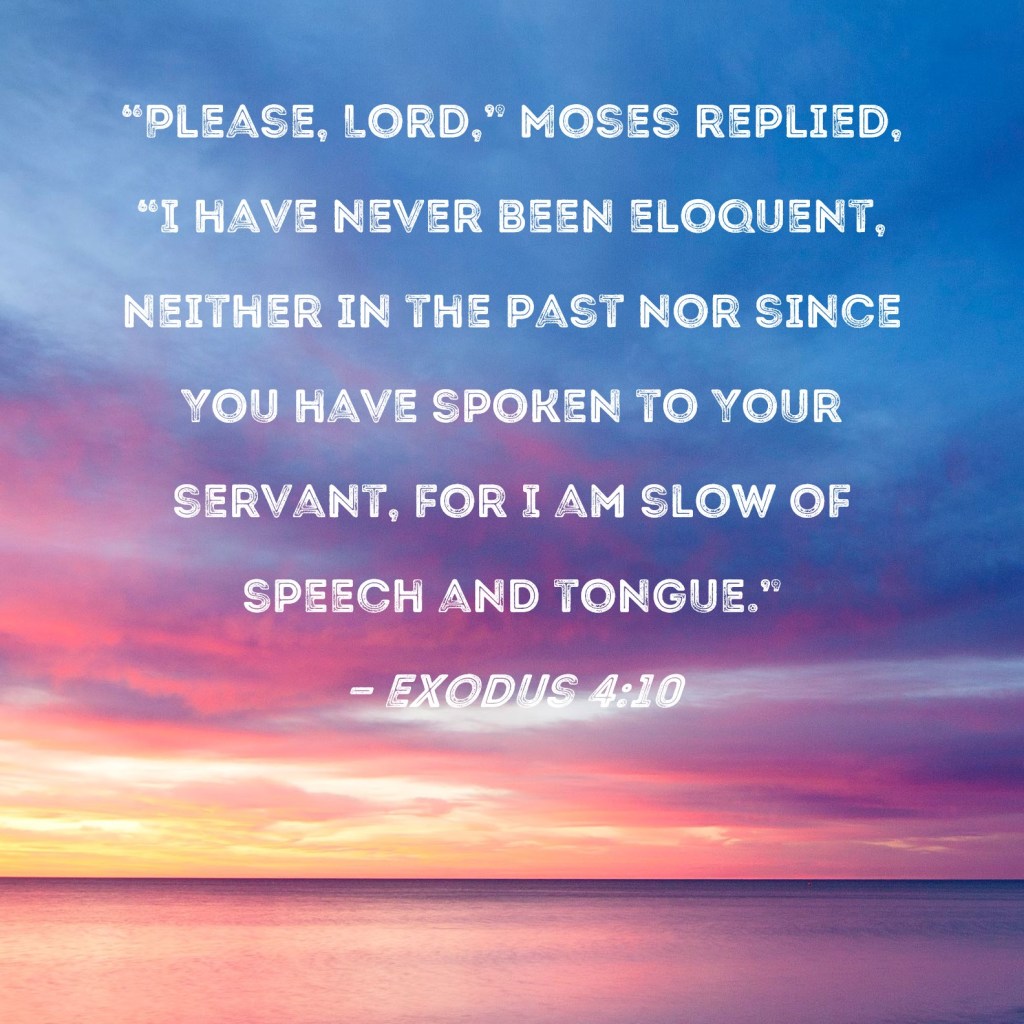
    I’m referring to Exodus 4:10:

    10 And Moses said unto the Lord, O my Lord, I am not eloquent, neither heretofore, nor since thou hast spoken unto thy servant: but I am slow of speech, and of a slow tongue.

    When I first thought about coming back to church in ~2011 there was one overwhelming obstacle in my path: what if I’m asked to speak??? I know to many this seems absurd. But I hope it goes to illustrate how big a fear this was (and still is) for me. I have memories of being a deacon (12–13-year-old) in church and dreading a Sunday School class I learned would be spent reading scripture out loud. It filled my entire body with fear. It made me lock up. It made my throat tight. It made me gulp over and over. It made me sweat. I would start to feel like I might throw up.

    Some of you think you have a fear of public speaking.

    Now do you get how big a fear this was and still is?

    I know others have it worse than me.

    When I did finally come back to church in ~2015, I had to make a decision early on. That decision was that I would not let my fear of speaking hold me back. God had brought me back and I had experiences to share and people to help. Not only that, but I had to learn to lessen the control fear had on my life.

    I decided when I was asked to speak in church, I would accept. That was until that first text came in one morning asking me to give the opening prayer in church that day. I froze. Instead of responding to the text, I called a mentor (I miss you Jessie) and talked it through. He reminded me that if I said no today, when would it stop? By the time I responded to the bishopric member who asked me to give the prayer, he had already reassigned it to someone else. I was off the hook that day, but I promised myself the next time I was asked to speak, I would accept without hesitation, before I could let the fear and excuses set in.

    Little did I know how much that next call would try my faith.

    I was in the middle of studying for a work certification. I’d already failed the test once and this next test was extremely important. I’d been studying for weeks. The test was a couple weeks away when I got the call. I was asked if I could speak in church in two weeks. The excuses flooded my mind: I have this test I’m studying for, I can’t write a talk, and besides, the added stress…! I can’t, I’ll have to accept next time.

    Then I remembered the promise I made myself. 

    “Yes, I will speak.”

    That taught me an important lesson. If we let our fears control us, they will. There are always excuses why NOT to do something that makes us uncomfortable. I spoke two weeks later in church. Beth still talks about that day, hearing me speak, as being the first day I caught her attention.

    From that day forward if I was asked to bless the sacrament, give an announcement in church, say the prayer, teach a lesson, or speak, I always answered yes without hesitation. It petrified me every time. I remember one day I gave someone the Holy Ghost which entailed laying my hands on a friend’s head and giving her a priesthood blessing in front of our entire church. That same day I also blessed the sacrament in front of the whole church, and I gave a talk in front of the whole church.

    Any one of those things in a given day would have given me nightmares.

    Before sacrament, I started to feel sick to my stomach. I thought I was going to be physically ill. I went to an empty classroom, I knelt, and I prayed for help.

    “Please, Heavenly Father, please, just help me get through this. I need you.”

    That may have been the day I solidified my knowledge that I can’t do anything without God, I’m nothing without Him.

    When I gave that blessing to the friend, bestowing the Holy Ghost upon her, I walked up with knees shaking. I thought I was going to, at a minimum fall over, and possibly faint. My throat was dry, and it hurt. I’ll never forget the feeling when I put my hands on her head, with the whole congregation, heads bowed, waiting for me to speak.

    I’ll never forget feeling like a cold bucket of water was poured over my head. From my head down to my toes I felt a tingling. Calm overcame me.

    My grandpa used to say his favorite thing in the world was to give a priesthood blessing because it was the closest he ever felt to God. He said he could feel God in those moments speaking through him.

    That’s what I experienced that day.

    I wrote this on a day that I was speaking in church. I still get kind of sick to my stomach. I still get extremely nervous. I still have to fight back the panic.

    Sometimes people tell me they can’t tell I’m nervous when I speak. I appreciate that, but sometimes I just wish everyone knew. There’s power in putting it out there.

    For others who have this fear, and I know there are many, my biggest advice is to put it out there. Don’t shy away from your fear. When I’m extra nervous, I might just say, “I’m really nervous right now.” Then I feel like I’ve removed the question from those watching and from myself worrying about it. I’ve found this to really help when public speaking.

    I’m grateful for my fear of speaking. It’s assured me, and is a constant reminder, that I can’t do anything without God.

    For those wondering, on the day I wrote this, I did end up speaking and it did go OK. I was supposed to speak for 10 minutes and spoke for 22 due to an excess of time being available. I feel that with practice anything can become more comfortable, and that’s definitely the case with me and public speaking.

    I’ve now taken to challenging myself a little more, to see just how far I can take this reliance on God. The last time I was asked to speak in church I intentionally put zero preparation into my talk. I was asked to speak last minute, a couple days beforehand, due to someone canceling, and the topic was “personal revelation,” so I thought it was a fitting time to try it.

    I got up before the church with little idea of what I was going to share. As I looked around at the congregation, I knew what I wanted to share.

    I’m grateful for the opportunity to speak in church. I’m grateful to be able to share my thoughts and experiences. This fear is a constant reminder that I need God, and I’m grateful for this weakness. Every time I’m asked to speak I’m reminded how weak and silly I am. We can look at all our weaknesses this way, as a reminder of how much we need Him. I know as we do this we come closer to God and better appreciate all He has done and continues to do for us.

  • Will Hitler be Forgiven?

    Will Hitler be Forgiven?

    Before I share this, I will state the obvious. Hitler the man did heinous, horrible acts. He caused as much pain and heartache as any soul ever has on this earth. In writing this silly thought experiment I in no way intend to make light of the horrible choices of others. I believe I will have a hard time forgiving some of the acts I see during life reviews at the great judgment. Forgiveness, thankfully, won’t be for me to decide. I don’t know who will be forgiven for what. I know some will need to ask for forgiveness and likely won’t. I know some will receive forgiveness that we can’t comprehend. I trust in God. Now onto my silly post. Please don’t take the main character too seriously.

    I had a thought while I was in the shower, and it stemmed from this question – will Hitler be forgiven? The mere mention of the idea is enough to get me canceled. 

    The beauty of the plan of salvation and something only the Church of Jesus Christ proposes an answer to, is that God will save all His children and how that could be accomplished.

    The thought I had in answer to this question was – maybe Hitler will be forgiven, only God knows. If someone like Hitler could be forgiven, what change would need to take place in a soul like that for that to happen?

    We see momentous changes in mortality. We can see transformations over small courses of time. Think of someone you’ve seen change over the course of 5, 10, or 50 years. A lot of changes can happen to a spirit over the course of 50 years. Now imagine 1000, 5000, and 10,000 years. How about 3 billion years? Those numbers are hard to imagine. What amount of change could happen in a millennium? A lot, I imagine.

    On the other hand, that amount of time can also show the great weaknesses of a character. A lot of change can happen in a billion years and if there are any flaws in character, cracks become gulfs. Eternity is a long time so luckily we have a long time to change. But if we aren’t working toward perfection, our flaws will grow.

    I have read comments in near-death experiences about the malleability of the soul during mortality compared to after death. I’ve read analogies that compare the soul while here on earth to wet cement while the soul post-death being like settled cement. I believe that’s what makes mortality so critical. Our lack of knowledge and need for faith one way or the other, in a way I don’t understand, allows us to change in ways not possible once this life is over.

    The beauty of the plan of salvation is that God will save all His children that want to be saved. That’s the critical part. The desire to be saved. That’s also something becoming increasingly scarce in our society, the ability to forgive.

    Christ and God will know and understand all, and they will be forgiving beyond all measure.

    Which leads to the question, if we’re going to use Hitler as our abstract understanding of evil: will Hitler want to be saved? Will Hitler want to stand before God and Jesus Christ, Jesus Christ, the one who had to suffer for Hitler’s sins, who had to suffer for all the pain Hitler caused? Will Hitler want to stand before Jesus Christ? Will he have the humility to seek that forgiveness? If the evils of Satan touched his heart and soul as deeply as they seemed to – desire for power, hate, etc., will Hitler want to stand before them?

    Will Satan want to be forgiven? No. He won’t. Envy, evil, and hatred have poisoned his once angelic soul (Isaiah 14:12).

    No one can be forgiven if they willingly continue to deny Christ and ”crucify” Him anew.

    Will Hitler have the humility to bow before Christ and beg His forgiveness?

    I can’t imagine that level of change. It’s hard for me to picture that from someone who did such horrible things and strayed so far from the light. That is millenniums of change which is change my mind can’t fathom.

    What I also can’t imagine is how I can ever be made perfect. Me, with all my flaws, judgements, unkindnesses, shortcomings, deceits, greed, and selfishness. How can I be made perfect? I believe it will take a long time.

    Maybe Hitler will change and be forgiven for his sins. I believe if that’s possible it will take time.

    If we love the gospel plan and Heavenly Father and Jesus Christ’s ability to forgive us for our mistakes, we have to accept that they will forgive others too.

    The gospel plan is beautiful. For one and all.

    None of us deserve the redeeming love and a sacrifice willingly given of a God. Jesus Christ, spit upon and bleeding, shed his mortal blood and gave up his immortal spirit so we can live again. I am grateful for what He did for me and I recognize every day that I don’t deserve it. It makes me love Him all the more.

    Forgiveness isn’t something that should be taken lightly. It is serious.

    But when I stand before Him, and I humbly kneel, I believe He will forgive me. And for that moment, I’ll give anything.

  • An Epistle from the New Testament Apostles

    An Epistle from the New Testament Apostles

    I read a book titled An Epistle from the New Testament Apostles.

    A sentence in the second paragraph of the preface caught my attention and helped me to read this book in a different light. That sentence read:

    “Imagine for a moment how you might feel if you were to go to your mailbox only to find there a long letter addressed personally to you from the First Presidency and the Quorum of the Twelve Apostles as those church leaders were constituted shortly after the resurrection of Christ.”

    Huh. Do we read the Bible in this way? Do we read the Bible as if Simon Peter, Paul of Tarsus, or John the Beloved were writing to us? How much more power comes from the words as we consider them a personal letter directly sent to us? What is the Bible really, but a letter sent directly to us from these prophets? You could also consider the Bible a letter sent to you from God.

    I’d like to share a part of this book that was especially significant to me. As I said, the book takes all the epistles of the prophets in the New Testament and categorizes them. It’s also worth noting that where there are multiple translations or interpretations of what may have been originally written, this book showed some of those different options. Keep that in mind when reading the quotes below. One category that stood out to me was titled:

    Unity in the Church

    From James 3:14-16 “But if ye have bitter envying and strife in your hearts, glory not/do not assume superiority over/ and lie not against the truth. This wisdom descendeth not from above, but is earthly, sensual, devilish. For where envying and strife is, there is confusion and every evil work.”

    Sounds like Christianity today.

    Another section.

    A Call to Unity in the Body of Christ

    From Ephesians 4:1-6 “I therefore, the prisoner of the Lord, beseech you that ye walk worthy of the calling wherewith ye are called, With all lowliness and meekness, with longsuffering, forbearing one another in love; Endeavouring to keep the unity of the Spirit in the bond of peace. There is {In} one body, and one Spirit, even as ye are called in one hope of your calling; One Lord, one faith, one baptism, One God and Father of all, who is above all, and through all, and in you all.” 

    Ephesians 4:11-15: “And he gave some, apostles; and some, prophets; and some, evangelists; and some, pastors and teachers; For the perfecting of the saints, for the work of the ministry, for the edifying of the body of Christ: Till we in the unity of the faith, all come and of {to} the knowledge of the Son of God, (MISSING ERASED CONTENT FROM KJV). That we be no more children, tossed to and fro, and carried about with every wind of doctrine, by the sleight of men, and cunning craftiness, whereby they lie in wait to deceive, But speaking the truth in love, may grow up into him in all things, which is the head, even Christ.”

    Unity.

    I point out the lack of it in Christianity not to try to “dispute” or to create “contention” but to point out the obvious.

    It’s interesting the first things Jesus Christ did when he appeared to His other flock in the Americas.

    1. He proclaims His Atonement, announcing that He accomplished what the prophets said would be fulfilled, announcing that He can save His people.
    2. He ministers to His people one by one. They are each individually allowed to come up and feel the wounds in His hands, feet, and sides.
    3. After the people cry out “Hosana!” literally, “God save us” or “Save now, we pray,” Jesus Christ sets forth the mode of baptism, the way He can save them.

    From here Christ’s complete focus is on unity. He elaborates on the oneness of Himself, God the Father, and the Holy Ghost.

    Then He says (3 Nephi 11:28-30), “And according as I have commanded you thus shall ye baptize. And there shall be no disputations among you, as there have hitherto been; neither shall there be disputations among you concerning the points of my doctrine, as there have hitherto been. For verily, verily I say unto you, he that hath the spirit of contention is not of me, but is of the devil, who is the father of contention, and he stirrith up the hearts of men to contend with anger, one with another. Behold, this is not my doctrine, to stir up the hearts of men with anger, one against another; but this is my doctrine, that such things should be done away.”

    May we all avoid disputations and contention. May we always serve with meekness, longsuffering, and love. I hope that one day Christianity can be unified in our faith in Jesus Christ. That will likely not come until the millennium, when we can all look to who we serve, and know without a doubt that we know Him. But we can do our part today to not let the devil have power over us. We can do our part by removing contention and argument from our lives.


  • Sent from God – Missionaries

    Sent from God – Missionaries

    The story of Ammon is one of my favorites in the Book of Mormon. Ammon went amongst the Lamanites who wanted to kill and murder him to teach them about Jesus Christ. I wrote about a great conversion moment I had from the story of Ammon before. Here I am 4 years later, still being inspired by the story of Ammon.

    This time it was chapter 18 that struck me. Ammon had just performed a miraculous feet, defending the flocks of the king from a group of men trying to scatter them. In defending the sheep, Ammon smote off the arms of so many men that the other servants he was with felt the need to collect them and show them to the king. It is here where King Lamoni, in chapter 18 verse 2 says,

    “Surely, this is more than a man. Behold, is not this the Great Spirit who doth send such great punishmnets upon this people, because of their murders?”

    Ammon was so powerful that the king believed him to be God.

    In verse 18, King Lamoni asks Ammon if he is the Great Spirit.

    Ammon’s simple reply in verse 19 is, “I am not.”

    Their conversation continues and Ammon begins to teach Lamoni about the one true God. Lamoni asks in verse 33, “Art thou sent from God?”

    This is what jumped out to me and made me think. It wasn’t long ago that King Lamoni thought Ammon was actually God. It’s a natural progression, I think, to then ask if he was sent from God. Ammon’s reply is found in verses 34 and 35:

    “I am a man; and man in the beginning was created after the image of God, and I am called by his Holy Spirit to teach these things unto this people, that they may be brought to a knowledge of that which is just and true;

    And a portion of that Spirit dwelleth in me, which giveth me knowledge, and also power according to my faith and desires which are in God.”

    I am called by his Holy Spirit.

    This made me think. Ammon could have simply replied, yes, I am from God. Instead, he chose to use the question as an opportunity to expound and teach about God and our relationship to Him.

    What do missionaries say when a stranger or someone they’re teaching asks the simple question, “Are you sent from God?”

    I hope it is without hesitation that the response comes, a resounding: YES.

    This led me to think even deeper about this. King Lamoni was asking if God guided Ammon there. Ammon replied that God had. But what if Lamoni was asking if Ammon came directly from the presence of God to teach him? That question isn’t that crazy after asking the person if they were God. Ammon could have equally replied to that question: Yes. He came from the presence of God to teach King Lamoni and his people.

    Every missionary serving Jesus Christ came from the presence of God to this earth with the purpose of going on a mission, teaching others about God, and bringing others unto Christ.

    How often do our missionaries think this way? I hope daily. It is a powerful thing to understand that you were sent directly from God for this important mission.

    Neil A Maxwell when speaking of the star that signaled Christ’s birth said,

    “The same God that placed that star in a precise orbit millennia before it appeared over Bethlehem in celebration of the birth of the babe has given at least equal attention to the placement of each of us in precise human orbits so that we may, if we will, illuminate the landscape of our individual lives so that our light might not only lead others but warn them as well.”

    God knows our missionaries. God loves our missionaries. God sent our missionaries, directly from His presence, to shine their lights and illuminate this world. I am so grateful for our missionaries.