Tag: religion

  • Impactful Moments

    Impactful Moments

    In Gravity of God, I wrote about how God is the center of our universe and how His faith and His action holds it all together. I discussed how us being here is an opportunity for us to test how we will use our faith and actions to influence and impact people.

    Will we have a God-like influence of love, help, support, giving, charity, and selflessness to those around us? Or will we use our influence to be more in Satan’s camp of selfishness, hate, judgment, pride, and animosity?

    Our actions matter. We’re here to see how we’ll use the talents and gifts we’ve been given.

    Some moments carry more weight than others.

    I believe everyone we interact with in this life is meant to teach us something. Do you consider the interactions you have to be significant? Do you believe the things that happen to you have meaning? How about the things you do to others?

    I believe when someone is unkind to me here for any reason – they’re here to teach me something.

    I believe when someone does something I disagree with – they’re here to teach me something.

    I believe when someone is kind to me or a good example to me – they’re here to teach me something.

    All these moments matter, and some moments have lasting importance.

    There are so many mundane and average moments in a day. I’m talking about the, “How are you today?” “Good.” “Good.”

    Then there are conversations that change our worldviews, make us think, or expand our horizons. There are some conversations that make us think about eternity. There are some conversations that prepare us for eternity.

    I’ve been given so much in this life.

    I know where I come from, why I’m here, and where I’m going, while so many around me don’t have these answers. Part of the reason I think I’m here and why I’ve been given so much is so that I can share it with others. If everyone around me is asking the important question – why am I here? And I know the answer, and I’m not sharing it with them, then I’m the most selfish person there is.

    Why do you think I put the time and effort into writing this? One day I want to tell God I tried my best to share what He gave me.

    Anyways.

    There is one topic that can be brought up in any conversation and will immediately change the moment from mundane and borderline meaningless to extraordinarily impactful and important. That topic is God.

    I was at a bachelor party once. We went to Palm Springs for a long weekend. Got a house. Played a lot of pool and video games. The rest of the party played golf. I found ways to fill my time while they played golf.

    There were two conversations I had that weekend that were memorable and impactful.

    While playing pool one night, somehow religion got brought up. I’m sure I helped us into that direction one way or another. Me and another guy in the group who I didn’t know very well started talking about eternity, church, and the gospel.

    That conversation was years ago. And seemingly nothing came about from it. But I still remember what that guy said at one point. He said, “When God gets brough up, the conversation changes. It becomes real. Even if it’s slightly or fully contentious, it’s still good if God is in the conversation.”

    He was so right, and it’s the reason I’m writing this.

    He probably doesn’t consciously remember that conversation. But I believe his spirit does. I really believe we keep a record of all we hear, see, and learn here on earth. And one day he’ll see that moment again and I hope it was as impactful as it felt.

    The other conversation that happened was on the drive back. I was in the car with the groom to be and a friend.

    We were talking about the upcoming wedding and what that meant, the topic of marriage, fidelity, vows, our bodies, drinking, habits, and growth were discussed. I know those topics sound wide-ranging. It was a long drive.

    I came out of that conversation feeling like we’d talked about something so important.

    Every mundane conversation is exactly that, mundane, until God is brought up.

    Have more meaningful conversations.

  • Doctrine vs. Practice

    Doctrine vs. Practice

    I want to go over something I’ve always had a hard time understanding. 

    What is a doctrine? What are the core doctrines of the Church of Jesus Christ of Latter-day Saints? What is the difference between a doctrine and a practice?

    Doctrines and practices are much different, though they often get confused.

    The simplest way I learned to differentiate a doctrine from a practice is this simple rule: A doctrine is eternal, it never changes. Practices can be changed.

    According to the First Presidency, there are three guidelines to follow when determining if something is a doctrine or just a practice:

    1. Doctrine is eternal, never changing.
    2. The First Presidency and Quorum of the Twelve is unified on a doctrinal subject.
    3. Doctrines are salvific, it is pertinent to our salvation.

    It’s important to remember that these criteria don’t necessarily confirm something is doctrine. Just because the 15 members of the First Presidency and Quorum of the Twelve are unified on the subject DOES NOT necessarily make it a doctrine.

    Let’s look at a couple examples.

    The sacrament that we take each week is a practice. It has changed in multiple ways over time, throughout history. For example, it used to be the practice of the church to use wine for the sacrament. We now use water. This is just one example of how the sacrament has changed over time.

    The doctrine associated with the sacrament would be the Atonement of Jesus Christ. The Atonement of Jesus Christ is eternal and never changing. It is a doctrine. 

    Priesthood is a doctrine but who holds it is a practice. The priesthood itself is eternal. It is God’s power on the earth. In 2018 we saw a change in who can hold the priesthood when the required age changed from 12 years to 11 years. Another example is when the sons of Aaron were the only holders of the priesthood before it was opened up to the Gentiles in this dispensation. This makes who holds the priesthood a principle.

    I know what you’re thinking. Does that mean women can/should/will one day hold the priesthood independent of any man? I don’t know. I won’t delve into that anymore at this time. I will just say, it will take a revelation from God for that to happen.

    In conclusion, I would like to share the 9 basic doctrines of the Church of Jesus Christ. These doctrines are:

    9 core doctrines:

    1. Godhead
    2. Plan of Salvation
    3. Atonement of Jesus Christ
    4. Dispensation, Apostasy, and Restoration
    5. Prophets and Revelation
    6. Priesthood and Priesthood Keys
    7. Ordinances and Covenants
    8. Marriage and Family
    9. Commandments
  • Why Do I Care?

    Why Do I Care?

    I’ve been thinking recently. Why I care about this?

    This being – the Gospel, the Church of Jesus Christ, the Church of Jesus Christ of Latter-day Saints, Jesus Christ in general.

    Let’s start with Jesus Christ in general. I feel like I write about this constantly and it’s the constant conclusion to one of my posts, so I’ll be brief here. I care about Jesus Christ in general because He has given me everything. The least I can do in return is share Him, follow Him, try my best to be like Him.

    Let’s go broader. Why do I care about the Gospel and the Church of Jesus Christ? That, I think goes in line with why I care about Jesus Christ Himself. If I care about Him, then I would care about His church, and I’d want to share His gospel. That lines up.

    You’ll notice I distinguished the Church of Jesus Christ with the Church of Jesus Christ of Latter-day Saints. This is what I want to focus on and think about here.

    Why do I care to share that I’m a member of the Church of Jesus Christ of Latter-day Saints? Why do I invite people to church? Why do I invite people to activities? Why do I share Book of Mormons? Why do I invite people to meet with the missionaries? Why do I share being a latter-day saint? Why do I talk about it? Why does it matter? Why do I care? Why do I keep doing it with such little success?

    It’s something I think about relatively often. The why?

    How do I stay motivated to write spiritually themed blog posts every week not very many read and fewer still are interested in?

    Why do I keep having gospel discussions with people and trying to convince them that this is the restored Church of Jesus Christ – when everyone I talk to disagrees, or worse, doesn’t care?

    Why do I keep inviting people to church and activities when they never come?

    Why do I keep sharing scriptures and conference talks that no one reads or listens to?

    Why is being a “Mormon” important?

    Hmm.

    Sounds depressing right? Sometimes it’s hard. Being a member missionary is hard. It’s discouraging. It seems like an endlessly fruitless effort.

    And yet I’m not being persecuted or crucified so I have really nothing to complain about compared to saints from earlier times.

    So, I’ve distinguished “The Church of Jesus Christ of Latter-day Saints” from “The Church of Jesus Christ” but that’s really the answer to the question of why. I do all these things, no matter how hard or discouraging, because I believe the Church of Jesus Christ of Latter-day Saints is the Church of Jesus Christ. I believe they are one and the same. I believe this is Christ’s restored church. I believe it is the way back to Him. I believe I was called and sent here to share it. That’s why I do it. That’s why I care.

    I have a friend who converted to this church who once said something I found fascinating. He said, basically, “Whether it’s true or not, I don’t care. This church brings me happiness. It’s made my life better. It’s made me a better person. It’s made me feel closer to God. Is it true? Is it the One True Church? I don’t know. Really, I don’t care.”

    He doesn’t care because for him it’s about his well-being. This church has helped his life and brought him joy. What does he care about the rest of it? While I think in a completely different way, I can appreciate this line of logic, this way of thinking. This person is an extreme pragmatist. So when he said this statement, it told me a lot about him.

    Does what this individual said make him any less of a latter-day saint and disciple of Christ than me? I’ll say, I think it could, but it doesn’t. This person is still one of the most faithful, serving, selfless, Christ-like individuals I know. Ultimately his why doesn’t matter as much as who he is becoming, which is more like Jesus Christ.

    I consider that person’s why somewhat temporal. ‘This church has been good to me and brought me joy, I’m for it.’

    My why is different.

    My question is, what if the church doesn’t bring you joy? What if it makes your life worse? This friend of mine might leave if that were the case. Right now he has no reason to leave.

    Maybe this is why so many leave. They don’t see how the church is benefitting them.

    This friend and I have a mutual friend. The mutual friend is very interested in religion and so we’ve had religious conversations together. After a few discussions, my friend said the mutual friend would never join the church. He said the mutual friend had too much to lose. His family would disown him, his wife would hate him, his whole life would change. It would be too hard. Should that person join the church?

    My friend would say no.

    Again, my why is different.

    I look at that and say, “Is it true?”

    Response from hypothetical person, “Well…”

    “No well, is it true?”

    If it’s true, if God sent a prophet, and that prophet established a church, and it’s Christ’s church – if it’s true – what else matters?

    Is it true?

    I believe it is.

    That’s why it matters. That’s why I care. That’s why it’s so important to me.

    I’ll write more on the temporal vs spiritual benefits of the church another time. But for now, I wanted to share that.

    Is it true?

    Yes.

    Then it matters. It matters more than anything else on this entire earth.

  • Hypocrisy in Intelligent Design and Evolution Debate

    Hypocrisy in Intelligent Design and Evolution Debate

    The theory of intelligent design is, simply put, the idea that this world is too perfectly designed for there to be no designer. The theory comes from what’s called the Watchmaker Analogy, put forth by William Paley in 1802. The idea is that if you walked into the woods and found a pocket watch, you would assume someone designed that pocket watch. Due to the complexity and clear design of the pocket watch, you would not assume it just appeared there by coincidence.

    Of course, it’s more complex than that. Before you say, “Well you would assume a designer because you’ve seen a pocket watch before,” well, sure. That’s not the point. The point is that things that appear to have been designed usually have a designer. If it makes you feel better, insert “clearly designed foreign object” instead of pocket watch.

    Intelligent design gets a tough rap in the scientific community. In scientific circles, they scoff at this idea. They say, scientifically, who is the designer? The ridicule continues from there.

    There is one argument from scientists against the theory of intelligent design that I’d like to discuss here. Scientists who believe in the theory of evolution and oppose intelligent design make this argument:

    They say that –

    “If there is an intelligent designer, why would that intelligent designer create things that seem to not have a purpose?”

    To be funny, and to lighten the mood, we will use the example of male nipples. Why would an intelligent designer give males nipples when they serve no purpose?

    Proponents of intelligent design would respond, “Just because we don’t know the purpose, doesn’t mean there is none.”

    This results in escalated scoffing from evolutionary scientists. They say, “That is unscientific. You can’t have it both ways. You can’t say something has an intelligent designer, then when asked why there would be pointless designs say we don’t know the purpose of those designs. That is unscientific as it is untestable and can’t be proven either way.”

    This goes back to what is “scientific” in terms of the scientific method, etc.

    The theory of evolution is that all species have evolved through a process called natural selection. There is ample evidence to appear that the theory of evolution is true. See my post What the Theory of Evolution is Missing. Natural selection is basically the idea that the strongest survive, they breed, and so the strongest traits in a species will survive and be passed on.

    Of course, it’s not that simple.

    So, here’s the thing.

    If an evolutionary proponent is asked, “Why did natural selection result in males with nipples? How did nipples help man survive?”

    The response would be, “Natural selection doesn’t guarantee everything is related to survival. There is some randomness.”

    What is the difference between the intelligent design defense and the evolution defense?

    What’s the difference between:

    • Intelligent designer
      • If we don’t understand the design, doesn’t mean there is no purpose.

    And

    • Evolution and natural selection
      • Not every trait is for the purpose of survival, there is some randomness.

    Where is the difference? These are both ‘you can’t have it both ways’ arguments.

    Is there something I’m missing here? Is this not, essentially, the same argument? Is this not the same thing?

    Ultimately, the root of criticism of the theory of intelligent design comes down to one thing: belief in God. That’s what it’s all about. A lot is thrown around about “unscientific” and blah blah. Please define “scientific.” Cool, thank you. Now I’ll find 10 different definitions of scientific from 10 different scientists.

      I’ve elaborated more on the “God issue” in science in this post. Science and religion will always be in an unwarranted battle until the true scientist – the one who set this all up, designed it, created it, organized it, and sent us here – comes down and explains it all to us. I welcome that day.

    1. Meaning in Religious Art

      Meaning in Religious Art

      This was an essay I wrote for a meaning of life through art class I took, thus the official format. I feel it was worth sharing.

      Meaning in Religious Art

                  It was with difficulty I prepared to hypothesize about the meaning of life when I believe I know the meaning of life. It occurred to me that if I truly believe I know the meaning of life, and I do believe that, that it would be dishonest to write this essay in any other way than to state what I know in my heart to be true. It’s for that reason that I’ve decided to pick three pieces of artwork; a hymn, a mural, and a piece of literature to give a brief explanation on how those pieces portray what I know to be true about the meaning of life. Given my powerful belief of these principles, and the desire I have to share them in my life, it’s with excitement that I write this essay and explore the meaning of life through art.

      Religion

      It’s important to note that a religious individual cannot begin to explore the topic of “the meaning of life” without their ideologies, beliefs, and understandings that come from their religious upbringing having a huge impact on their exploration. I fully acknowledge that many may disagree with my conclusions and interpretations of these pieces of art. That is what makes art beautiful. Art is completely subjective. My viewpoint on the world will color how I view this art. I look to explore how my viewpoint shapes my perspective on these pieces of art and helps me consider the meaning of life.

      Hymn

                  I’d like to start by discussing my favorite hymn which is titled “A Child’s Prayer” (MormonTabChoir, 2014). A main focus throughout this essay will be the emotion elicited through this artwork. I believe that art that makes one ponder the meaning of life is likely evoking strong emotions. I cannot listen to this song without strong emotions welling inside me. I feel a change come over me as I listen to the lyrics, likely because it’s this song I focus on when I most question about the meaning of life.

                  “A Child’s Prayer” asks a poignant question: “God, are you there?” That’s the portion I ask myself in difficult times. The song unfailingly leads to the important statement: “Pray, he is there, speak, he is listening” (A Child’s Prayer, 1992). This is an important reminder about life and its meaning. The most important line in this song, and the one that most defines the meaning of life on earth is, “You are his child” (A Child’s Prayer, 1992). The meaning of life is to grow and learn and come closer to our Heavenly Father. This hymn is a powerful piece of art that speaks to the soul and reminds one of things often forgotten, but that will forever be true.

      Mural

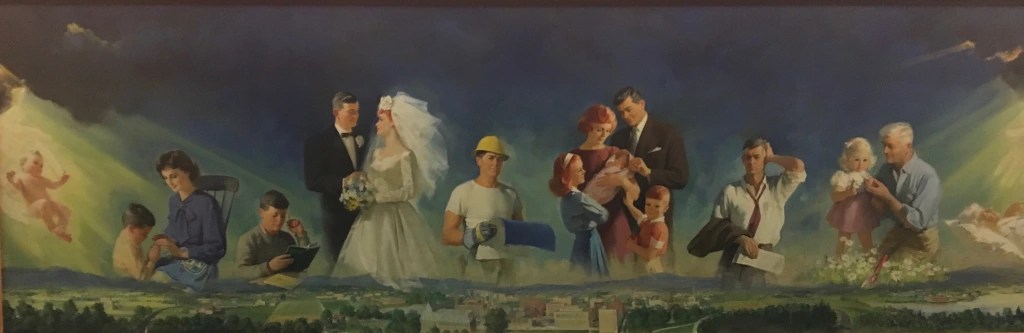
      The second piece of art I’d like to discuss is a mural aptly called, Purpose of Life (Skemp, 1964). Purpose of Life is a simple but compelling representation of the cycles of life and what life is about. Like the hymn, “A Child’s Prayer,” this mural evokes strong feelings within me, and I believe would for anyone who strongly considers its message. 

                  The painting starts by showing a child entering the world. There are subtle hands shown coming from the sunlight, appearing to gently lead the child into this life. The depiction follows a young man growing. First, he is at his mother’s side, then reading, and then getting married. These three quick jumps create a feeling inside. As a result, a question develops: is life really that short? The painting continues, showing the boy, now a man, working. The man is shown with his wife and children. The man is shown with graying hair. The man is shown with his grandchild.

                  The climax of the painting is the man lying on his deathbed. There is light above him, and the same hands that brought him to earth beckon him home. What could better illustrate the purpose and meaning of life than this painting? The purpose of life is to live, love, grow, learn, and then to come home. As my eyes scroll across the painting, powerful emotions arise. I consider growing up with my family. I consider the family I’ve started. I consider that like everyone before me, my life is heading to the same place, a return trip home. This mural does a fantastic job of illustrating the true meaning of this life.

      Book

      I couldn’t write a paper about the meaning of life without crediting a piece of literature that has given meaning to my life. The Book of Mormon is an entire book that focuses on the question, what is the meaning of life? The Book of Mormon is a piece of literature that literally details the purpose of life (Book of Mormon, 1830). Through my study of it, I have learned many important principles. One of these most important principles that give meaning to my life is that God loves and cares about all people, and that includes me. Others include that God is aware of us and is watching our progress, this life is important and there’s a reason I’m here, and that God keeps His promises. These are the principles that give my life meaning. 

      In a world of chaos and confusion, these basic principles give me hope. They provide light to my world. I simply couldn’t write about the meaning of life without discussing the book that has changed my life, brought me so much comfort, and put me on a path that gives my life meaning and purpose. The Book of Mormon is eloquent in its message and is a powerful work of art that I believe to be from Heaven. I can’t read it without feeling that God is there and being reminded why I’m here. 

      Conclusion

      I am grateful for these pieces of art and the feelings they create inside me. It’s these feelings that tell me there is more to this world than meets the eye and that I’m never alone. Great art provokes thought and emotion. Great art can make one stop and ponder. Great art can make one appreciate beauty and see the world in a different light. As Cooper (2003) says, “art, like philosophy, is the act of bringing truth into being” (p. 109). These three pieces of art, the hymn “A Child’s Prayer, the mural Purpose of Life, and the Book of Mormon, are each art pieces that provide this purpose for me, enlighten my life, and remind me the purpose of being here. I am grateful for art that makes us look beyond ourselves, consider purpose, and even see eternity.