Tag: Book of Mormon

  • Sent from God – Missionaries

    Sent from God – Missionaries

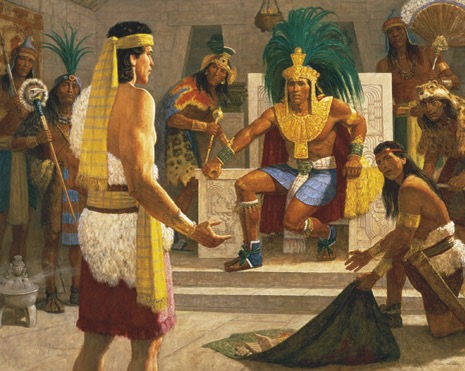
    The story of Ammon is one of my favorites in the Book of Mormon. Ammon went amongst the Lamanites who wanted to kill and murder him to teach them about Jesus Christ. I wrote about a great conversion moment I had from the story of Ammon before. Here I am 4 years later, still being inspired by the story of Ammon.

    This time it was chapter 18 that struck me. Ammon had just performed a miraculous feet, defending the flocks of the king from a group of men trying to scatter them. In defending the sheep, Ammon smote off the arms of so many men that the other servants he was with felt the need to collect them and show them to the king. It is here where King Lamoni, in chapter 18 verse 2 says,

    “Surely, this is more than a man. Behold, is not this the Great Spirit who doth send such great punishmnets upon this people, because of their murders?”

    Ammon was so powerful that the king believed him to be God.

    In verse 18, King Lamoni asks Ammon if he is the Great Spirit.

    Ammon’s simple reply in verse 19 is, “I am not.”

    Their conversation continues and Ammon begins to teach Lamoni about the one true God. Lamoni asks in verse 33, “Art thou sent from God?”

    This is what jumped out to me and made me think. It wasn’t long ago that King Lamoni thought Ammon was actually God. It’s a natural progression, I think, to then ask if he was sent from God. Ammon’s reply is found in verses 34 and 35:

    “I am a man; and man in the beginning was created after the image of God, and I am called by his Holy Spirit to teach these things unto this people, that they may be brought to a knowledge of that which is just and true;

    And a portion of that Spirit dwelleth in me, which giveth me knowledge, and also power according to my faith and desires which are in God.”

    I am called by his Holy Spirit.

    This made me think. Ammon could have simply replied, yes, I am from God. Instead, he chose to use the question as an opportunity to expound and teach about God and our relationship to Him.

    What do missionaries say when a stranger or someone they’re teaching asks the simple question, “Are you sent from God?”

    I hope it is without hesitation that the response comes, a resounding: YES.

    This led me to think even deeper about this. King Lamoni was asking if God guided Ammon there. Ammon replied that God had. But what if Lamoni was asking if Ammon came directly from the presence of God to teach him? That question isn’t that crazy after asking the person if they were God. Ammon could have equally replied to that question: Yes. He came from the presence of God to teach King Lamoni and his people.

    Every missionary serving Jesus Christ came from the presence of God to this earth with the purpose of going on a mission, teaching others about God, and bringing others unto Christ.

    How often do our missionaries think this way? I hope daily. It is a powerful thing to understand that you were sent directly from God for this important mission.

    Neil A Maxwell when speaking of the star that signaled Christ’s birth said,

    “The same God that placed that star in a precise orbit millennia before it appeared over Bethlehem in celebration of the birth of the babe has given at least equal attention to the placement of each of us in precise human orbits so that we may, if we will, illuminate the landscape of our individual lives so that our light might not only lead others but warn them as well.”

    God knows our missionaries. God loves our missionaries. God sent our missionaries, directly from His presence, to shine their lights and illuminate this world. I am so grateful for our missionaries.


  • Unity, Peace, and Love

    Unity, Peace, and Love

    I recently watched a video depicting the famous rameumptom of Alma chapter 31. I’ve written about the rameumptom before.

    The rameumptom was a tower built by the Zoramites for their prayers. They would stand atop this small tower and pray. Their prayers consisted of proclamations of how they were better than their brethren, and they thanked God for making them so much better than others. 

    In this video depiction, it showed a fancily dressed person strutting to the rameumptom, pushing aside someone on his way, cutting a line, and walking to the top while someone was already there. That person, apparently properly interpreting the danger of standing up to this man, quickly left his prayer so this man could yell with pride, “Holy, holy God, we believe that thou art God and we believe that thou art holy.”

    That video can be watched here if you’re interested.

    What I thought about as I watched this video is how strange the behavior would be for a follower of God to strut and push someone out of their way to offer a public prayer of pride. It was the spiritual God-follower pushing someone rudely out of the way that stood out to me.

    President Nelson, Elder Soares, and Elder Christofferson recently all talked to members of the Church of Jesus Christ of Latter-day Saints about being kinder, more charitable, and avoiding contention in one session of General Conference. The impact of three of the highest-ranking members of our Church and apostles and prophets of the Lord all speaking on essentially the same topic in a 2-hour span was quite jarring.

    The three talks were:

    President Nelson – Peacemakers Needed

    Elder Soares – Followers of the Prince of Peace

    Elder Christofferson – One in Christ

    As I watched this video of the corrupt Zoramites, I worried about this message from our leaders. I personally have been witness to so much contention and unkindness in social media in “LDS” or “doctrine” or supposed “Christ-centered groups” where combativeness sometimes seems more important than kindness and love. This has led me to lessen my usage of social media, despite loving the doctrinal topics sometimes explored, due to the hateful nature that the topics are explored in.

    I worry about members of the Church of Jesus Christ that take being right more seriously than being loving.

    How many members of our religion and all religions strut around with our beliefs and act like we’re better than those around us? We must not be the Zoramites. This, I believe, is what President Nelson, Elder Soares, and Elder Christofferson are trying to tell us. Followers of Jesus Christ should be loving first, second, and last. Followers of Jesus Christ should be distinguished by their kindness.

    This behavior of someone knocking someone out of the way to go pray looks so similar to someone debating the merits of Christ’s gospel by putting down and insulting others. I hope we all avoid this behavior. As representatives of Jesus Christ, it’s important we remember the two great commandments: love and love.

  • How Does God Bring Us Scripture?

    How Does God Bring Us Scripture?

    I recently heard a different denominational Christian individual say, “We believe God can provide scripture in whatever way He wants. It’s not on us to tell Him how He should have brought scripture to us. This is why we believe in the infallibility of the gospel message from the Bible.”

    This individual is adamantly opposed to the Church of Jesus Christ of Latter-day Saints and especially opposed to the Book of Mormon.

    I found that statement so interesting. Of course, I’m pulling the comment of one anonymous individual to make a large sweeping point, but I believe the point is significant nonetheless.

    If believers of the Bible agree with that statement, namely: that God brought the Bible to us through translations, handing down, manuscripts, different texts, different handlers, scholars, writers, and translators, and that was in His power to do so and we don’t try to criticize Him for His method of bringing us His Word…

    My only question is.

    Why can’t that same logic be applied to the Book of Mormon?

  • Importance of Promises (and Covenants)

    Importance of Promises (and Covenants)

    Since as long as I can remember, promises have been important to me. I’ve always said I would never break a promise for any reason. Period. I’m sure at some points in my life I have broken promises. I have this vague recollection of a broken promise or two that still eat at me. I don’t remember the details, but I remember the feeling of not keeping my word. For whatever reason, promises are something I’ve always considered immensely important, I’m not sure exactly why. Deep down inside, I’ve always thought promises were important to keep. Otherwise, what was the point? Otherwise, words were hollow and how could you be trusted?

    In Alma 23:16-25:2 of the Book of Mormon, there is the story of the Anti-Nephi-Lehis. This is the story of the Lamanites who converted unto the Lord and from then on turned away from their past traditions of murder and bloodshed. They buried their weapons of war and covenanted to shed blood no more. They took their new covenant so seriously that when other Lamanites came to war against them, rather than break their newly made covenant, they knelt before their former brothers and gave up their lives.

    As I read this story recently, a question arose: how seriously do we take our covenants? What does our word mean to us? How about when our word is a promise to God? How important do we deem that pact?

    Covenants are important. Covenants are serious. Keeping covenants is a serious thing.

    The converted Lamanites, or Anti-Nephi-Lehis, made a covenant to shed blood no more. Full stop. No excuses. When their lives were at stake, did they reconsider? Did they say to themselves, “well I promised this, but surely I’m not supposed to lie here and die over a promise”? They thought the exact opposite. Their covenant was worth more than their mortal life. These Anti-Nephi-Lehis understood the significance of covenants. There were no excuses. They had faith. They knew that if they died keeping their word to God, they would inherit a glory and reward that would be well worth the earthly sacrifice.

    Covenants with God are greater than death.

    So, I ask again, how seriously do you take your covenants?

    Have I been perfect in keeping the covenants I’ve made with God? Let’s review the first covenants I made with God when I was baptized at age 9. I covenanted to:

    1. Take upon myself the name of Jesus Christ.
    2. Keep His commandments.
    3. Serve Him to the end.

    Have I been perfect in this? Of course not. None of us are perfect yet. But I’ve tried. I often wonder how much my baptism and the Gift of the Holy Ghost at age 9 strengthened me and helped me to return. I often wonder how my upbringing influences my deep respect for promises. Though I haven’t been perfect, I always took these covenants seriously.

    I now take further covenants I’ve made very seriously. For example, my covenant with my wife, to be faithful to her, to love her, to serve her, to be there for her. That is the most important promise I’ve made in this life and I intend to die before breaking it.

    In a world of promise-breaking and commitment to nothing, I am ever-grateful for the covenants I’ve been privileged to make. I’m grateful for the Church of Jesus Christ that provides the proper authority for me to make promises with God. I’m grateful to be linked to God. I’m grateful for the strength covenants provide in a shaky and uncertain world.

    If you’ve made covenants that you’ve broken, I implore you to reexplore those promsies. Satan leads us to believe that once broken, we can’t mend our word. When our promise is with God, that is true, we can’t mend it. But He can. Jesus Christ suffered the Atonement so that we can come back even to make up for the promises we’ve broken. He knows we aren’t perfect. He will make the difference. I fell into that trap for stretches in my life. Thinking I’d gone too far away from God, I’d broken too many promises, disregarded too many commandments, and I couldn’t come back. The feeling of reuniting with God is the most comforting feeling in the world. Reunite with Him. He will always take us back. He will always reestablish our covenants because He loves us that much.

    Come back to Him and feel His peace.

    I am grateful for covenants and that God allows me, an insignificant little speck, to align and connect myself with Him. What power. What comfort.

  • Dontcha know I know

    Dontcha know I know

    All of Ivy’s life, when she’s been upset or crying, I’ve said, “Dontcha know I know?”

    This is my way of saying jokingly, “Don’t you know I know what it’s like to not want to get dressed, not want to eat certain food, to be hungry, to be tired, to be upset, etc.?”

    Today was Sunday. I woke up from a nap and I watched a video depicting the Atonement that Jesus Christ performed.

    Sage started crying in the other room. She’d been having a rough day. We think she has some acid reflux and stuff like that. Sometimes her tummy gets upset. This day seemed to be hard for her.

    Sage likes to tilt her head way back and stretch out her stomach. Apparently, this is a sign of acid reflux. I went to the other room and picked up Sage and put her into her favorite position. Head in my hands tilted back, stomach stretched, looking up at a ceiling fan (she LOVES looking up at ceiling fans).

    This provided a little relief, but she was still crying on and off.

    When Sage was still fussing, I started to say my automatic, “Dontcha know…”

    And that’s where I stopped.

    I didn’t know what it was like to have acid reflux, and for my stomach to hurt like hers did, and to not be able to find relief whatsoever on my own, and to only attain some relief if Mom or Dad came to hold me a certain way. Even if I had that experience as a baby myself, I don’t remember. I didn’t know or remember what Sage was feeling.

    But someone did. I believe that Christ, during that infinite and indescribable Atonement, even felt the pains of an infant with acid reflux. I believe He felt it all.

    “Children are alive in Christ” (Moroni 8:12).

    I couldn’t know what Sage was feeling. Dontcha know I didn’t know. But He knows, and He felt it, and He remembered it.

    When Sage cries she’s communicating to us that she needs help. It’s me and Beth’s job to come to her aid and help her with what she can’t help herself with. How many things, as adults, do we need help with that we can’t do ourselves? As adults, we think of ourselves as so independent. But all we do relies on the Lord. We rely on Him to allow our breath to work within our bodies, water to hydrate us, food to nourish us. These things don’t happen of ourselves but because of Him.

    God and Christ come to our aid when we need it and especially when we ask for it. Christ knows how to hold us just right to help ease our pain and give us relief. Rely on Him for aid just as little children rely on their parents. Be ye as little children (Matthew 18:3).

    Christ felt it. Christ remembers it. Christ experienced it. Turn to Him and He will help all our pains, challenges, and afflictions.