Tag: church

  • Sent from God – Missionaries

    Sent from God – Missionaries

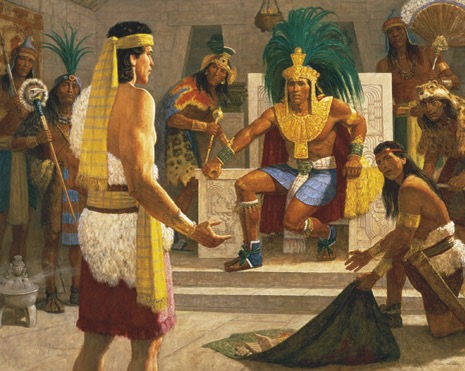
    The story of Ammon is one of my favorites in the Book of Mormon. Ammon went amongst the Lamanites who wanted to kill and murder him to teach them about Jesus Christ. I wrote about a great conversion moment I had from the story of Ammon before. Here I am 4 years later, still being inspired by the story of Ammon.

    This time it was chapter 18 that struck me. Ammon had just performed a miraculous feet, defending the flocks of the king from a group of men trying to scatter them. In defending the sheep, Ammon smote off the arms of so many men that the other servants he was with felt the need to collect them and show them to the king. It is here where King Lamoni, in chapter 18 verse 2 says,

    “Surely, this is more than a man. Behold, is not this the Great Spirit who doth send such great punishmnets upon this people, because of their murders?”

    Ammon was so powerful that the king believed him to be God.

    In verse 18, King Lamoni asks Ammon if he is the Great Spirit.

    Ammon’s simple reply in verse 19 is, “I am not.”

    Their conversation continues and Ammon begins to teach Lamoni about the one true God. Lamoni asks in verse 33, “Art thou sent from God?”

    This is what jumped out to me and made me think. It wasn’t long ago that King Lamoni thought Ammon was actually God. It’s a natural progression, I think, to then ask if he was sent from God. Ammon’s reply is found in verses 34 and 35:

    “I am a man; and man in the beginning was created after the image of God, and I am called by his Holy Spirit to teach these things unto this people, that they may be brought to a knowledge of that which is just and true;

    And a portion of that Spirit dwelleth in me, which giveth me knowledge, and also power according to my faith and desires which are in God.”

    I am called by his Holy Spirit.

    This made me think. Ammon could have simply replied, yes, I am from God. Instead, he chose to use the question as an opportunity to expound and teach about God and our relationship to Him.

    What do missionaries say when a stranger or someone they’re teaching asks the simple question, “Are you sent from God?”

    I hope it is without hesitation that the response comes, a resounding: YES.

    This led me to think even deeper about this. King Lamoni was asking if God guided Ammon there. Ammon replied that God had. But what if Lamoni was asking if Ammon came directly from the presence of God to teach him? That question isn’t that crazy after asking the person if they were God. Ammon could have equally replied to that question: Yes. He came from the presence of God to teach King Lamoni and his people.

    Every missionary serving Jesus Christ came from the presence of God to this earth with the purpose of going on a mission, teaching others about God, and bringing others unto Christ.

    How often do our missionaries think this way? I hope daily. It is a powerful thing to understand that you were sent directly from God for this important mission.

    Neil A Maxwell when speaking of the star that signaled Christ’s birth said,

    “The same God that placed that star in a precise orbit millennia before it appeared over Bethlehem in celebration of the birth of the babe has given at least equal attention to the placement of each of us in precise human orbits so that we may, if we will, illuminate the landscape of our individual lives so that our light might not only lead others but warn them as well.”

    God knows our missionaries. God loves our missionaries. God sent our missionaries, directly from His presence, to shine their lights and illuminate this world. I am so grateful for our missionaries.


  • Little Red Mark

    Little Red Mark

    I have a white church shirt with a little red permanent mark on the left cuff.

    A few years ago, in the Young Single Adult (YSA) Ward of my church, there was a young girl that started coming every so often. She had a family ward she more often went to, but every once in a while, would visit the YSA. She had a young son. He was a toddler, probably two years old.

    I was drawn to this girl. I could imagine how difficult it was for her to bring her young son with her to the YSA ward, a place full of single people with entirely different life situations. I could imagine how she felt judged and out of place. I could relate to how she felt. I’d been her a short year or two before. 

    At the time, I was the Sunday School President. That meant that once a month myself and my counselors led a teacher’s council with all the teachers in our ward to discuss how we could be better teachers, and how we could teach in the Savior’s way. 

    Whenever this young girl came to our ward, I would try to get her to stay for second hour and go to Sunday School. That was my job as Sunday School President, after all. More than that, it was my job as a disciple of Jesus Christ. 

    One Sunday I was inviting this girl to go to one of our Sunday School classes. The difference this week was I wouldn’t be going with her. I had my Teacher’s Council. I could tell that she was going to leave if I wasn’t going to attend the class with her. She was clearly worried about how her young child might be a distraction in class. So, I invited her to my teacher’s council. It took some explaining, letting her know it was open to anyone and she was completely welcome. She came to our council that day.

    I don’t remember anything we taught. I don’t remember an enlightening teaching moment or momentous thing learned on how to be a more Christ-like teacher, though I’m sure some of that occurred. I don’t remember it.

    What I do remember is spending time with that girl’s young son. My counselors were leading most of the discussion so I could spend time with him at the white board with markers, letting him play and keeping him occupied. When I did need to get up front and talk for a bit, I brought him with me. I look back at this moment fondly as a parent now with two daughters I’m constantly bringing to the front with me.

    I didn’t care if he was a distraction to the class. Some things are more important.

    That’s the point, right?

    At one point while watching him, he accidentally marked my white shirt with a red marker. I’ve thought about throwing that shirt out. It’s not a huge or extremely noticeable mark, but it’s there, and it is noticeable. I’ve kept that shirt. I wear it often. I use it as a reminder that some things are more important than a marked shirt.

    I sometimes wonder if someone might see that mark on my shirt and think, “how tacky, throw that shirt out, it has a red mark on it.”  Then I think about that young boy, his mother, and what’s more important, and decide it’s worth wearing that marked shirt.

    Reminder to everyone that we all have little red marks on our shirts. Sometimes they’re self-inflicted and sometimes they’re not. It doesn’t matter. The point is to not judge and to love without bounds.

    I recently got to see a young man that young girl was dating enter the waters of baptism. I hadn’t seen her little son in a few years. It’s crazy how quickly a two-year-old becomes an active, thinking, 5-year-old. I said hi to the now five-year-old boy. He, of course, didn’t remember me. But I showed him that mark on my shirt. It’s probably my imagination, but I saw recognition in those eyes. Like, whether or not he actually remembered making that mark (probably not), somehow, he recognized the significance. I felt like his eyes said, “I made that mark, and you kept it?” I told him I kept the shirt to remember him. He smiled.

    That young girl watched a man she had been dating get baptized. They were civilly married and as soon as they were able to, got sealed in God’s temple. They will be sealed in a temple for time and all eternity. That young boy will be sealed to them. Forever. That’s what it’s really all about, right?

  • What’s in it for Me?

    What’s in it for Me?

    “Ask not what your country can do for you – ask what you can do for your country.”

    John F. Kennedy’s famous quote given in 1961. I think this has become a great weakness of humans today, and society as a whole. There are so few asking, “what can I do for you” and so many asking, “what’s in it for me?”

    There seems to be a great falling away from the Church of Jesus Christ of Latter-day Saints. There is a great falling away from religion in general. I think part of this falling away is based on this “me first” way of thinking. What does a church do for me?

    I believe there might be a plague in the Church of Jesus Christ of this way of thinking. We all know someone who has left the church for whatever reason. All the reasons aside, there’s often a statement included that the church wasn’t doing it for them anymore, the church wasn’t helping them, or they didn’t see the need of the church.

    I would say, ask not what your church can do for you, but what you can do for your church.

    Now, to be clear, the Church of Jesus Christ of Latter-day Saints is the greatest blessing in my life, both temporally and eternally. It saved me from the gutters of this life. It has provided me all that is wonderful and beautiful about life. It has provided me a stable family that loves me. It has provided me a wife and daughters who I love. It has provided me a foundation to hold to in a world that tosses us all around. More than all these blessings here, it has also blessed me eternally with a perspective on why I’m here, where I’m going, and what’s truly important. It has provided me light. It has provided me hope. It has provided me love. It has provided me everything. 

    I say again: the Church of Jesus Christ of Latter-day Saints which is how I know of the Gospel of Jesus Christ and Christ’s love for me is the greatest blessing in my life. Both here and for forever. 

    That said.

    The Church (and gospel) of Jesus Christ is not here on the earth for what it can do for me. It is here for me to learn what I can do for others. The Church of Jesus Christ is not here because of what it can do for you. It’s here to help you learn what you can do for others. The Church is a vehicle by which you can learn to be like Jesus Christ. I wrote about this in my post Do We Really want to be like Jesus.

    I think when we truly understand this, the world changes. It’s no longer, “what do I get out of this?” It becomes “what can I do to help someone else get something out of this?” This is what it’s all about. Love. Fellowship. Support. That’s why the Church is here. Not to bless your life. So you can bless lives.

    I’ll conclude with one last question, I hope you will truly ponder: did Jesus ever ask, “what’s in it for me?”

  • God Loves a Returned Sinner

    God Loves a Returned Sinner

    Luke 15:7 reads:

    “I say unto you, that likewise joy shall be in heaven over one sinner that repenteth, more than over ninety and nine just persons, which need no repentance.”

    Why does heaven rejoice over a returned sinner?

    Why does Christ love a returned sinner? This should be obvious. Christ loves a returned sinner because they’re utilizing His Atonement, the great gift He gave them. He suffered for that gift. Why wouldn’t He rejoice over it being used?

    It’s very important to point out that this doesn’t make the returned sinner any better than the constantly faithful. Do you think God is up there thinking, “you were always upright. Too bad you didn’t sin some more so I could have increased joy”? Of course not. God loves the consistently faithful. I think another important point here is that we’re all sinners. So, by this scripture we can know, that God loves all who repent of sins. We all sin.

    An individual from history who was a clear sinner, making evil choices, even if he didn’t realize it, was Paul. Paul ended up being one of the greatest missionaries ever but started as the greatest persecutor of the church. Paul received a miraculous visit from Jesus Christ. This converted him and he instantly changed his ways. As we read the scriptures, Paul’s change seems instant. But I believe there was a reason he had to travel blind for three days. I believe his change was actually slow and required a lot of humility.

    Paul became an obvious example of Luke 15:7, heaven rejoicing. Paul was such a go-getter of persecution; the Heavens must have been excited to have him on their team once he converted. Imagine how the angels rejoiced when Paul turned to the Lord because they now knew how ferocious he would be for the Lord.

    Peter can be seen as another example of someone who didn’t always make the right choices. Isn’t it amazing to read the New Testament and consider how flawed the individuals were who Christ chose to spread His word and be His ministers? Peter was no exception. You can look to Peter’s three denials of Christ as a great scriptural moment representing needing to learn a lesson, repent, and double down on conversion and commitment.

    Peter made a huge, and life-altering mistake by denying Christ those three times. It was life-altering for how it helped Peter change his life. It could have been life-altering in how it turned Peter away from Christ. He could have gone the other way. Christ knew He wouldn’t. That’s why Christ picked Peter.

    The show “The Chosen” does an interesting job of depicting Peter. What if Peter was kind of a bad guy? Not a bad heart, but did some bad things. A rough guy. A guy that made a lot of mistakes before he met Jesus and fell in as one of his apostles. Then, slowly, over much time around the Master, Peter became His primary apostle. Peter eventually became the president of Christ’s church.

    The student manual for the book of Mark notes:

    “Mark, more than the other Gospel writers, recorded the disciples’ shortcomings (see Mark 4:36-41; 6:52; 8:14-21). The disciples’ weaknesses stand in contrast to their greath faith and successes, which are depicted in the book of Acts, helping us appreciate the transformation brought about by the Resurrection and the outpouring of the Holy Ghost.”

    Never judge a sinner. They can become the most kind, most gentle, most Godly person. We all have Godhood in us. One day our sins will be in great contrast to our faith and successes when we ultimately attain our full potential.

    The Bible Dictionary definition of “conversion” states:

    Denotes changing one’s views, in a conscious acceptance of the will of God (emphasis added, Acts 3:19). If followed by continued faith in the Lord Jesus Christ, repentance, baptism in water for the remission of sins, and the reception of the Holy Ghost by the laying on of hands, conversion will become complete and will change a natural man into a sanctified, born again, purified person-a new creature in Christ Jesus (see 2 Cor. 5:17). Complete conversion comes after many trials and much testing (emphasis added, see Luke 22:32; D&C 112:12-13). To labor for the conversion of one’s self and others is a noble task, as in Ps. 51:13; Dan. 12:3; James 5:19-20; Alma 26; D&C 18:15-16.”

    The part that stood out to me most from that definition was that complete conversion comes after many trials. I know it did for me. I had to experience the bitter to appreciate the sweet. I had to see how dark life could feel to appreciate Christ’s light. I know my testimony is stronger because I had to learn how dark it can be.

    Did Peter experience his change through trials? Did Paul? I think they did. Those who go through the greatest trials and then turn to the Lord become his most devout followers. Paul was blind. That’s quite a trial. But when he saw the light, he never turned away from it again.

    We all don’t receive miraculous visitations from Jesus Christ like Paul did, or get to work with Christ side-by-side like Peter, but we can still feel His presence, serve Him, and feel what it’s like to have Him by our side. Imagine how different your actions would be day-to-day if Christ was with you? Well, He is.

    Sometimes I worry that faithful, day-one-never-wander latter-day saints are missing this. This devotion to the cause. This understanding of how much you need Him. It’s why trials happen. Otherwise, we’d all walk merrily through this life, never understanding the true depth of the Atonement and how desperately we need Him.

    Now, trials come in all shapes and sizes. Just because someone appears to never have gone through “it”, doesn’t mean they’ve never gone through it. We never know the internal struggles, challenges, and difficulties someone faces in their faith. It’s usually not on the outside. But if you see a devoted person to God, you can assume they’ve been through something. It’s those somethings that bring us to Him.

    God loves a returned sinner. Remember that whenever you make a mistake. While we don’t want to make mistakes, we always want to do our best, God will welcome us back with open arms when we make mistakes and repent. It’s a comforting thought whenever we mess up. God knows our heart. Part of making mistakes and repenting is truly regretting it. This doesn’t mean beating yourself up about it or getting too down on yourself, but it does mean truly feeling regret and remorse for mistakes. This can’t be faked. God knows your heart.

    I think we can learn something really neat from examples like Peter and Paul. No matter how far we stray, God has a place for us. God doesn’t look at what we’ve been or what we are, but what we will be. He knows what we will be. He sees that in us. I’d guess it’s His greatest desire that we see in ourselves what He already knows is there.

    Be like Peter and Paul. Be someone Christ can pick.

    God loves a returned sinner.

  • Are Women more Faithful than Men?

    Are Women more Faithful than Men?

    Why are women more faithful than men?

    I’ve often wondered this. Others may disagree, but in my experience, generally, it is true. Why is it that women are more faithful than men?

    There are countless examples of faithful men in the scriptures. There are also examples of faithful women in the scriptures, though less countless. Where the LDS church does have countless examples of women with great faith is in our pioneer stories. There are so many.

    Some of the examples of faithful women in the scriptures include Elizabeth, the mother of John the Baptist, Mary, the mother of Christ, and Mary Magdalene. I think often it is mothers that convert while fathers fight.

    From what I’ve seen today, in modern times, women have more faith than men. Women are more open to spiritual experiences.

    I think this is somewhat due to the “natural man.” In my opinion, man is much more natural than woman.

    I also think it has to do with Christ’s admonition, “be ye as little children” (Matthew 18:3).

    Don’t women possess more of the good qualities of children than most men? Women are generally more humble, meek, kind, caring, and gentle than men. I think few would disagree with this. Women possess more quantities of all the positive attributes of little children that most men lack. It doesn’t make men necessarily bad. I think it does create a gulf between us (males) and God, though.

    If men can learn to be what we are with a positive light, and attain the meekness and humility of little children, we draw closer to God. I think this is what the Priesthood is meant to help us to do. We are to learn to be humble with authority. Learn to be meek with power.

    What was Christ but complete humility with complete power?

    The Priesthood of God can not be wrought with unrighteous dominion (Doctrine and Covenants 121:37).

    We must be as little children. Meek and humble, and let our faith be as the women who surround us, who often far surpass our ability to trust, believe, hope, and have faith.