Tag: god

  • Chosen by God

    Chosen by God

    I had a thought that never occurred to me before while reading Doctrine and Covenants 138, as obvious as this thought is.

    I believe it’s correct that some of the ancient prophets, Adam down to Joseph Smith and beyond, have resurrected bodies and are in heaven teaching. For some reason I’d only ever thought about them teaching those who had already been on earth and died. For the first time it occurred to me that they might also be teaching those who haven’t come to earth yet.

    This seems to be affirmed by the words of modern prophets, from Doctrine and Covenants Student Manuals:

    “President Joseph F. Smith was shown that many choice servants of this dispensation were also among those noble spirits. The Lord held them in the spirit world where they were taught and prepared to come forth and lay the foundations of His latter-day work. The Prophet Joseph Smith once said that “every man who has a calling to minister to the inhabitants of the world was ordained to that very purpose in the Grand Council of heaven before this world was” (Teachings, p 365).

    “President (Joseph F.) Smith also observed that, in addition to these leaders, there were “many others” who “received their first lessons in the world of spirits and were prepared to come forth in the due time of the Lord to labor in his vineyard for the salvation of the souls of men” (D&C 138:56). This refers to the doctrine of foreordination, which teaches that “in the premortal spirit world, God appointed certain spirits to fulfill specific missions during their mortal lives. … Foreordination does not guarantee that individuals will receive certain callings or responsibilities. Such opportunities come in this life as a result of the righteous exercise of agency, just as foreordination came as a result of righteousness in the premortal existence.”

    “President Russell M. Nelson taught: “Your spirit is an eternal entity. … Your Heavenly Father has known you for a very long time. You, as His son or daughter, were chosen by Him to come to earth at this precise time, to be a leader in His great work on earth. You were chosen not for your bodily characteristics but for your spiritual attributes, such as bravery, courage, integrity of heart, a thirst for truth, a hunger for wisdom, and a desire to serve others. You developed some of these attributes premortally. Others you can develop on earth as you persistently seek them.”

    These are things I’ve known, and thought about, but an encouraging and empowering reminder when the world fights back so aggressively against spiritual things.

    We were chosen before we came. We were potentially tutored by the very greatest prophets and teachers the world has ever seen. The tutoring from great prophets pales in comparison to the reminder that we were chosen by God, the eternal Father. God of Heaven and Earth. Creator of all things. When we remember He chose us for a purpose, and we’re on the Earth now for that purpose, the oppositions of the world should seem silly.

    If I was lucky enough to receive training from a great prophet and was chosen by God before coming here, anything is possible.
  • Meaning in Religious Art

    Meaning in Religious Art

    This was an essay I wrote for a meaning of life through art class I took, thus the official format. I feel it was worth sharing.

    Meaning in Religious Art

                It was with difficulty I prepared to hypothesize about the meaning of life when I believe I know the meaning of life. It occurred to me that if I truly believe I know the meaning of life, and I do believe that, that it would be dishonest to write this essay in any other way than to state what I know in my heart to be true. It’s for that reason that I’ve decided to pick three pieces of artwork; a hymn, a mural, and a piece of literature to give a brief explanation on how those pieces portray what I know to be true about the meaning of life. Given my powerful belief of these principles, and the desire I have to share them in my life, it’s with excitement that I write this essay and explore the meaning of life through art.

    Religion

    It’s important to note that a religious individual cannot begin to explore the topic of “the meaning of life” without their ideologies, beliefs, and understandings that come from their religious upbringing having a huge impact on their exploration. I fully acknowledge that many may disagree with my conclusions and interpretations of these pieces of art. That is what makes art beautiful. Art is completely subjective. My viewpoint on the world will color how I view this art. I look to explore how my viewpoint shapes my perspective on these pieces of art and helps me consider the meaning of life.

    Hymn

                I’d like to start by discussing my favorite hymn which is titled “A Child’s Prayer” (MormonTabChoir, 2014). A main focus throughout this essay will be the emotion elicited through this artwork. I believe that art that makes one ponder the meaning of life is likely evoking strong emotions. I cannot listen to this song without strong emotions welling inside me. I feel a change come over me as I listen to the lyrics, likely because it’s this song I focus on when I most question about the meaning of life.

                “A Child’s Prayer” asks a poignant question: “God, are you there?” That’s the portion I ask myself in difficult times. The song unfailingly leads to the important statement: “Pray, he is there, speak, he is listening” (A Child’s Prayer, 1992). This is an important reminder about life and its meaning. The most important line in this song, and the one that most defines the meaning of life on earth is, “You are his child” (A Child’s Prayer, 1992). The meaning of life is to grow and learn and come closer to our Heavenly Father. This hymn is a powerful piece of art that speaks to the soul and reminds one of things often forgotten, but that will forever be true.

    Mural

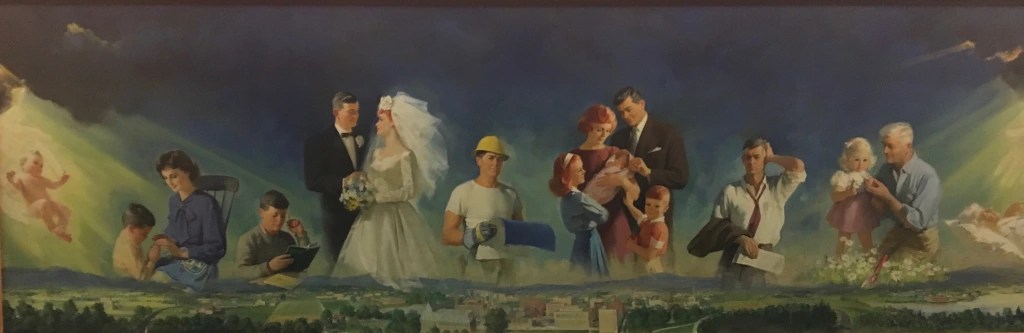
    The second piece of art I’d like to discuss is a mural aptly called, Purpose of Life (Skemp, 1964). Purpose of Life is a simple but compelling representation of the cycles of life and what life is about. Like the hymn, “A Child’s Prayer,” this mural evokes strong feelings within me, and I believe would for anyone who strongly considers its message. 

                The painting starts by showing a child entering the world. There are subtle hands shown coming from the sunlight, appearing to gently lead the child into this life. The depiction follows a young man growing. First, he is at his mother’s side, then reading, and then getting married. These three quick jumps create a feeling inside. As a result, a question develops: is life really that short? The painting continues, showing the boy, now a man, working. The man is shown with his wife and children. The man is shown with graying hair. The man is shown with his grandchild.

                The climax of the painting is the man lying on his deathbed. There is light above him, and the same hands that brought him to earth beckon him home. What could better illustrate the purpose and meaning of life than this painting? The purpose of life is to live, love, grow, learn, and then to come home. As my eyes scroll across the painting, powerful emotions arise. I consider growing up with my family. I consider the family I’ve started. I consider that like everyone before me, my life is heading to the same place, a return trip home. This mural does a fantastic job of illustrating the true meaning of this life.

    Book

    I couldn’t write a paper about the meaning of life without crediting a piece of literature that has given meaning to my life. The Book of Mormon is an entire book that focuses on the question, what is the meaning of life? The Book of Mormon is a piece of literature that literally details the purpose of life (Book of Mormon, 1830). Through my study of it, I have learned many important principles. One of these most important principles that give meaning to my life is that God loves and cares about all people, and that includes me. Others include that God is aware of us and is watching our progress, this life is important and there’s a reason I’m here, and that God keeps His promises. These are the principles that give my life meaning. 

    In a world of chaos and confusion, these basic principles give me hope. They provide light to my world. I simply couldn’t write about the meaning of life without discussing the book that has changed my life, brought me so much comfort, and put me on a path that gives my life meaning and purpose. The Book of Mormon is eloquent in its message and is a powerful work of art that I believe to be from Heaven. I can’t read it without feeling that God is there and being reminded why I’m here. 

    Conclusion

    I am grateful for these pieces of art and the feelings they create inside me. It’s these feelings that tell me there is more to this world than meets the eye and that I’m never alone. Great art provokes thought and emotion. Great art can make one stop and ponder. Great art can make one appreciate beauty and see the world in a different light. As Cooper (2003) says, “art, like philosophy, is the act of bringing truth into being” (p. 109). These three pieces of art, the hymn “A Child’s Prayer, the mural Purpose of Life, and the Book of Mormon, are each art pieces that provide this purpose for me, enlighten my life, and remind me the purpose of being here. I am grateful for art that makes us look beyond ourselves, consider purpose, and even see eternity.

  • What the Theory of Evolution is Missing

    What the Theory of Evolution is Missing

    This is going to go a direction you won’t expect. I’m not going to argue against Darwin’s Theory of Evolution. I’m not nearly smart enough to discuss the theory of evolution in much detail.

    What I will do instead, is propose my own theory.

    Scientists who are proponents of the theory of evolution believe that life is constantly evolving. Over billions of years, a process called natural selection has taken place. Natural selection is basically the idea of survival of the fittest. If you’re the fittest, you survive. If you survive, you procreate. Survival of the fittest. Natural selection.

    The disconnect, for me personally, is when the theory of evolution brings scientists to the conclusion that God doesn’t exist. The omniscient, omnipresent, omnipotent God, creator of Heaven and Earth, couldn’t allow his creations to change?

    Here is where I will diverge from class Christian thinking. The theory of evolution doesn’t go far enough.

    “As man now is, God once was: As God now is, man may be.”

    What is it to attain the fulness of God? (Ephesians 3:19).

    You think fundamentalist Christians hate the theory of evolution already? Imagine their hate for us if we say it hasn’t gone far enough.

    Now, the theory evolution is more than just change. As I noted, it’s about natural selection. Darwin’s theory is that natural selection leads to change. Christ’s theory is He leads to change.

    I’m not saying that Christ is leading plants and animals to change. They have their own process to fulfill the measure of their creation.

    But Christ does lead us to change, or evolve, if you want to use that word.

    Many of both religious and scientific persuasions would scoff at this notion.

    Look again at the theory of evolution. Living creatures are evolving.

    Why would humans not aspire or evolve to something greater then? I’m not talking about from mushrooms or apes. We are God’s children and as His children we have a divine inheritance. Our evolution is much greater. It’s from what we are now, to what Christ is now. This is possible because our Heavenly Father wants to give us “all he hath.”

    What do I change into while here on earth, in a small amount of time? I turn into my parents. I become more and more like my dad every day. What do we evolve or change to eternally? God. He is my Father. It’s the natural order of things.

    Joseph Smith often talked about how scholars, intellectuals, and religionists ridiculed him. Yet all he ever taught was what made sense. What made sense were eternal truths.

    The boy, like to his father grown,

    Has but attained unto his own;

    To grow to sire from state of son,

    Is not ’gainst Nature’s course to run.

    A son of God, like God to be,

    Would not be robbing Deity.

    Lorenzo Snow

    Paul understood this (Philippians 2:5-6) –

    “Let this mind be in you, which was also in Christ Jesus:

    Who, being in the form of God, thought it not robbery to be equal with God”

    So, the scientific-minded, expand your thinking. Religious minded, expand your thinking. Embrace your inheritance and all that the Father has to offer you. Embrace change, embrace the Atonement of Jesus Christ that allows all change. Embrace your evolution. God wants you to aspire to be like Him. It isn’t robbery to Him. What greater joy is there than watching your children grow, develop, and become better? Maybe even become like you.  

    Where does the theory of evolution lead? Where are we headed, what do we become? What is our evolution?

    Our evolution is to become like God, our Father.

  • Plan of Salvation and What Christianity is Missing

    Plan of Salvation and What Christianity is Missing

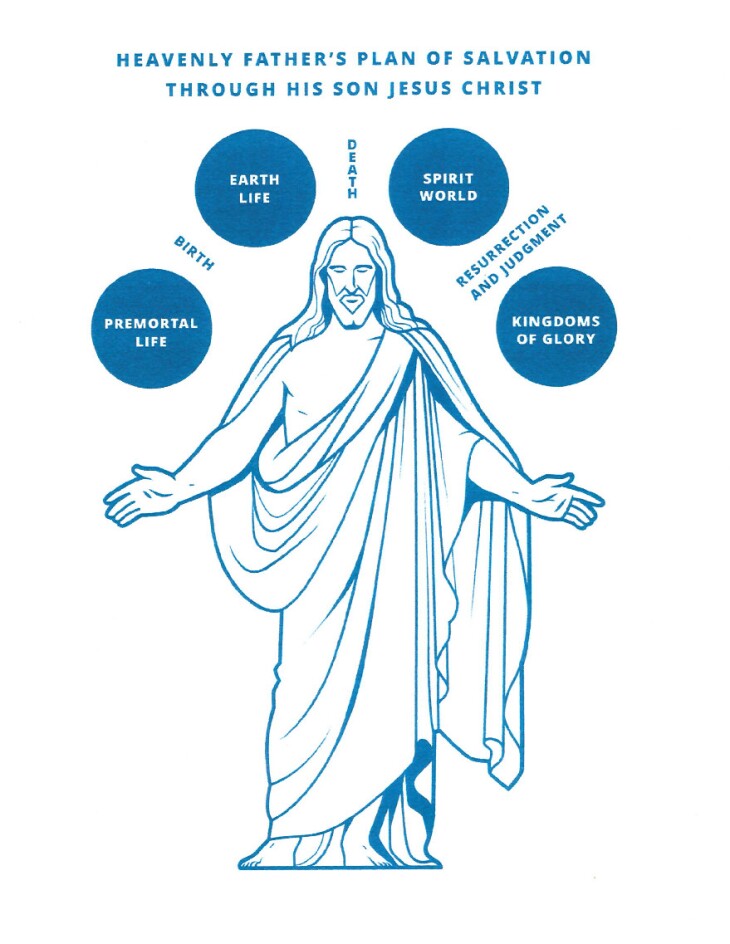
    Outside of the Church of Jesus Christ of Latter-day Saints, what does Christianity believe about the after-life? Generally speaking, Christianity believes that we are born on earth, live our lives, die, are judged, and assigned to either heaven or hell.

    I heard something on an awesome podcast called Unshaken Saints recently that I’d never realized. What the host of the podcast pointed out was that Christianity has it right. Christianity is just missing the beginning and the end.

    As I stated, Christianity believes in life on earth, then judgement, then heaven or hell.

    The truth is that life doesn’t start here on earth. This is the beginning that Christianity is missing. We lived long before we came to earth. There are many truths that stem from our understanding of our premortal existence. One of the most important truths that premortality provides us is an understanding of agency. We chose to come here. This life wasn’t thrust upon us. This is the missing beginning.

    The truth after death (the end) is that we are temporarily assigned to either “spirit prison” or “paradise,” but this isn’t our final resting place. After our temporary assignment to prison or paradise, we receive our final judgement that the scriptures speak of. This is when we come before God and Jesus Christ, Jesus Christ as our advocate to the Father and our judge before God. This is where we either accept Jesus Christ and the mercy He has given us and are reconciled to God, then assigned our glory by the mercy of God and His Son, Jesus Christ; or we reject Jesus Christ and are cast out to outer darkness. We must willfully reject God, Jesus Christ, and the mercy we are given to be cast off. This is the hell that Christianity understands.

    There will be glory assigned to all of God’s children. How can that be? It can be because He loves us that much, so much that He gave His only Begotten Son to save us.

    Christianity thinks the final judgement is immediately after we die. The beauty of the Plan of Salvation is the realization that everyone will have an opportunity to accept Jesus Christ. Everyone will be taught and be given a fair chance. Spirits in “prison” will learn what they missed on earth. No one will be left out. Children are alive in Christ (Moroni 8:12). No one will be lost.

    This is what Christianity misses. The beginning and the end. Premortality and the final judgement. If you cut off the beginning and the end of the Plan of Salvation, you have life on earth and spirit prison or paradise. That’s missing half the picture. We lived before we came here. We were loved by a loving Father in heaven before we came here. At the end, we will be judged for our actions, all we did on earth, our heart’s intent, our good deeds and bad, what we provided in this speck of time that will send us on an eternal trajectory. The beginning and the end. That’s what Christianity misses by rejecting further revelation by God’s prophets.

    What does this do to Christianity?

    Christianity believes we started here on earth. What does that do to our agency? We didn’t choose to come here. We didn’t know God before we came, who is He to us? This is what Joseph Smith spoke of when he talked about the First Vision. He said he learned that God and Jesus Christ knew him by name. For me, that knowledge is so engrained in my soul and being, it’s something I know, that God knows me. The Christianity Joseph Smith knew prior to the First Vision led him to be surprised that God could know him. I’m grateful for the truth God provided Joseph Smith when he appeared to him in a grove.

    Back to what Christianity believes – we come to this earth by no choice of our own, sent by a God we don’t know or understand. We come to this earth to suffer by the sweat of our brow, a fallen world, a cruel world, a challenge we don’t understand, a challenge we didn’t choose. Then God judges us and casts 90% of us off. Most are cast off because they never knew God or Jesus Christ, no fault of their own.

    This is what Christianity believes.

    The podcast provided another analogy that made me think about how this misunderstanding of the Plan of Salvation limits Christianity.

    There are two young men sitting outside of a Bishop’s office. One of the boys doesn’t want to be there. He doesn’t understand why he’s there. All he knows about the Bishop is that he’s a wrathful, unkind, harsh man. This young man fears the Bishop.

    The other young man knows the Bishop. He knows him to be just and kind. He knows the Bishop loves him and only wants what’s best for the him.

    As the first boy waits, he feels like he is in prison. He is dreading the upcoming confrontation with this unkind bishop.

    What does the second young man experience? Is he not in a paradise? He knows he’s soon to meet a friend. That friend is going to give him a treat, congratulate him on how he’s been doing, give him a hug and tell him he loves him. This second young man welcomes the meeting with the Bishop.

    The lack of knowledge in Christianity represents the first young man. Christianity doesn’t know God. By removing the premortal existence, life with a loving Father before life on earth, a Plan to come to earth and progress, a chance to learn of Him after this life, and then to be judged after being given all the necessary information, Christianity only sees a confusing, wrathful God, who has unfairly judged them.

    The Plan of Salvation is a beautiful truth that Christianity is missing. Far from being completely ignorant, Christianity is really close. But this closeness, without the full truth, is extremely limiting.

    ALL of us on earth chose to come to earth. All of us already chose Jesus Christ.

    This is a powerful truth. I wish the rest of Christianity could see, understand, and accept the further light and knowledge that makes this life understandable and worth living.

  • The God You Know

    The God You Know

    When I started writing the post Unity, Peace, and Love, I actually had another point I intended to make. As often happens when I write, my point got sidetracked (I hope by the Spirit) and I ended up going a completely different direction than originally intended. The point I was sidetracked from, I still liked, and think is important, so I decided to write it anyway. Hopefully the Spirit will guide this post as well.

    In Unity, Peace, and Love I talked about a video that shocked me, the video of someone strutting up to a rameumptom to pray. The idea of a follower of God shoving people out of his way to pray was so bizarre to me. I wrote in the aforementioned post what I think ended up being a better point about this. But what really came to mind the first time I watched that video is how corrupt religion can become if people don’t know who they worship.

    In my original post about the rameumpton, I wrote about the God a friend of mine knew. His God was vengeful, exclusive, and selective. This friend believed that I was going to hell despite my best efforts. I assured that friend that I believed he was going to heaven. Do I worship a different God?

    Let me be clear, I believe we’re all trying to worship the same God. I don’t mean to make the same argument that many Christians make against members of the Church of Jesus Christ of Latter-day Saints, that I’m not Christian because I don’t worship the same Jesus Christ. Just because we have different understandings of the person doesn’t completely diminish our worship. My efforts in worshiping Christ, even if others deem it a “different” or “inaccurate” Jesus Christ, is still worship.

    The problem comes when our understanding of who we worship completely alters our understanding and our behavior. The idea that someone could shove someone on their way to prayer was so bizarre to me. But what if the God someone understands has no body, passions, and is unknowable? What if someone thinks God is a selective and vengeful God that needs to be feared?Why not shove someone on their way to prayer? This shoving behavior isn’t as bad as a God who destroys people on a whim, a God who sent us here so 99% of us could be damned to eternal torment. Surely shoving someone isn’t that bad if our example is that God.

    I wrote the above before I finished Alma chapter 21 so I’d forgotten about the next part about the Zoramites, their rameumptom, and their recited prayer.

    Verse 15 of chapter 21, after the depiction of a Zoramite shoving someone out of his way on his way to prayer, reads:

    “Holy, holy God; we believe that thou art God, and we believe that thou art holy, and that thou wast a spirit, and that thou art a spirit, and that thou wilt be a spirit forever.”

    Interesting their beliefs line up with my thinking about how not knowing God corrupts our behaviors not only religiously, but in life. Here we have a recited prayer and the confusion on God’s character destroying a society.

    The culmination of the Zoramites corruption was not in their recited prayers or confusion in God, though. The culmination is found in verse 16 which reads:

    “Holy God, we believe that thou has separated us from our brethren; and we do not believe in the tradition of our brethren, which was handed down to them by the childishness of their fathers; but we believe that thou has elected us to be thy holy children; and also thou has made it known unto us that there shall be no Christ” (emphasis added).

    All their confusion, twisting of doctrine, and beliefs ultimately led to a denial of Christ. We will know the modern religions have truly fallen when they stop believing in He who keeps this all together.

    In an April 2023 General Conference talk, Mark A. Bragg reminded us of the Joseph Smith quote, “If men do not comprehend the character of God, they do not comprehend themselves.”

    This is where modern revelation and especially the Lectures on Faith (See here, here, and especially here for more on those) becomes so important. We must understand the character of perfection and love that Heavenly Father and Jesus Christ possess so that we can aspire to those characteristics. An unknowable God gives us an unknowable standard. Knowing God is perfect love, and we can do our best to be like Him, gives us the ability to do our best to emulate His love.