Tag: holy ghost

  • Lighten Up by Chieko N. Okazki

    Lighten Up by Chieko N. Okazki

    These are the highlights of the book Lighten Up that I read in 2021.

    “…” usually indicates the next part of the quote was later in the paragraph.

    Quotation marks indicate the author is quoting someone else.

    A line starting without a capitalized letter indicates my highlight starts in the middle of a sentence.

    This is a book written for members of the Church of Jesus Christ of Latter-day Saints about going easier on themselves, and lightening up.

    Rejoicing in Diversity (Chapter 1-4)

    Chapter 1 Lighten Up!

    The greatest bridge of all is the culture of the gospel.

    Love is not just a nice feeling about someone. It is the pure and joyful pulse of the universe, and being in tune with it means you are in tune with the forces that bind together the stars on one hand and the atoms on the other.

    According to the measurements we usually use, for the most part Jesus did not make people’s lives physically better.

    We are the rainbow, but it is Christ who is the light.

    Chapter 2 Principles and Practices

    We should never compare ourselves spiritually to someone else.

    Sometimes we think we can’t be united unless we’re all the same – doing the same things, talking the same way, understanding a gospel idea the same way. I think the Apostle Paul has a very different opinion.

    Let us be careful not to snicker at jokes that demean and belittle others because of religious, cultural, racial, national, or gender differences.

    (on 300 families surveyed that were considered “Effective Mormon Families” by their stake presidents) 99 percent of these families always paid their tithing; 93 percent said they always accepted Church callings; nearly all of them were sealed in the temple;…When the interviewers asked if they usually had family prayer, 73 percent of them said yes; 66 percent usually held family home evening; 24 percent went to the temple regularly, and 28 percent had regular family scripture study…lots of leeway on practices. Yet all of these families were, in the opinion of their stake presidents, effective and successful. Isn’t that encouraging?

    (effective families continued) “You don’t have to come from a strong LDS family yourself to have one. Forty-nine percent of the husbands and 39 percent of the wives had not graduated from seminary. Only 21 percent of the husbands had been on missions. Twenty percent of the fathers and 18 percent of the mothers were not baptized at age eight. Between 15 and 18 percent were baptized after the age of twelve.

    “At some point, sometimes before marriage, sometimes as a couple, these people decided that their own children would be raised up in a gospel environment…. [And] they followed it up with action.”

    What’s the principle? Teach your children the gospel.

    Lighten up about yourself – and about other people.

    “Ideals are stars to steer by. They are not a stick to beat yourselves with.”

    If we focus on principles instead of practices, we free ourselves from the unwarranted and unnecessary burden of guilt that often ensues when our practices do not match those of everyone else. We also free ourselves from the even more terrible burden of judging others because their practices don’t match ours.

    “The one great stumbling block to our progress in faith is rule-keeping that does not spring from an honest heart…Jesus Christ never condemned the honest heart. His wrath was kindled against the hypocritically empty rule-keeping of the Pharisees.”

    If I know how you feel about Jesus Christ, I am much less worried with how you feel about many other things.

    Chapter 3 Walk in My Zori

    We cannot replay God for his blessings.

    Whatever your season is, enjoy it. Don’t try to concentrate on the tasks of another season.

    A mission…wisdom of our leaders…it is a full-time assignment that deserves and receives the missionary’s complete concentration. 

    Meet the season of your life wholeheartedly.

    Our marriage was like that – a team effort – and It might not have worked so well if we had spent much time thinking about who the leader was.

    I knew that I must not let this time of physical weakness become a time of spiritual weakness as well.

    (Lessons of the zori) One: Mutual obligation to each other…Two: relishing each season of life in turn without trying to rush through them all…Three: knowing that progress comes by teamwork and by each person in a marriage taking turns…Four: there is a time to bear heavy responsibilities and a time to let those responsibilities shift to someone else.

    My great task in this life is the task the Savior has given all of us: “Learn of me.”

    Chapter 4 Limitations: A Fine Line

    We waste tremendous energy when we fret about our limitations instead of getting on with those portions of our life that are under our control.

    (On consecrating what we have and what we are to the Lord’s work, a woman who said she “took my blackness with me…and that was part of what I consecrated. A woman cried saying she never had the privilege of doing this for a black woman before and she replied) “That’s one of the things I can do for you that no one else in the temple today could do.’”

    Magnifying our callings doesn’t mean multiplying our tasks.

    (The earth is ours. Why? Because we’ve deserved it? Because we’ve earned it?) No, because it is our Father’s delight to give it to us: “And it pleaseth God that he had given all these things unto [you]; for unto this end were they made to be used, with judgement…”

    When we can thank God for trials, tribulations, irritations, and afflictions, something happens to transform them into blessings.

    (Being grateful for fleas, concentration camp where guards let them be so they could read their Bible) “My mind rushed back to our first hour in this place. I remembered Betsie’s bowed head, remembered her thanks to God for creatures I cold see no use for” (The Hiding Place, pp. 2018-9.).

    I could have chosen to feel frightened and let the children and parents feel that.

    “And if [you] come unto me, I will show unto [you your] weakness. I give unto [you] weakness that [you] may be humble; and my grace is sufficient for all who humble themselves before me; for if [you] humble [yourself] before me, and have faith in me, then will I make weak things become strong” (Ether 12:27).

    Defining Ourselves (Chapters 5-9)

    Chapter 5 “For Such a Time as This”

    We, like Esther, have come to our place for such a time as this…”we wrestle not against flesh and blood, but against principalities, against powers, against the rulers of the darkness of this world, against spiritual wickedness in high places”

    (Story of Elizabeth Francis Yeates conversion) “When I had read it all,” she wrote, “I said aloud ‘praise the Lord. I have found the right way at last.’”…”I could see no other way but to repent of my sins and to be baptized. I knew my people would bitterly oppose it when they knew it, and that my former friends would treat me coldly but it was worse than I ever thought.” That one sentence, “It was worse than I ever thought,” contains an agony of heartbreak.

    She did not falter. Her last moment of hesitation had come on the very brink of her baptism when she looked down into the dark river at midnight, December 4, 1855. (The ceremony was performed in secret because of the risk of persecution.) She wrote, “[I] felt as though I could not possibly go in it, but a Voice seemed to say ‘There is no other way.’” In faith, she took that step. “It seemed after that,” she wrote, “that every thing had changed. The scales had fallen from my eyes, and the gospel plan was glorious, and I covenanted with my Heavenly Father that however dark the clouds may be, if friends turned to be foes that by His help I would serve Him.

    “And so I discovered that it is not on our forgiveness any more than on our goodness that the world’s healing hinges, but on His. When He tells us to love our enemies, He gives, along with the command, the love itself (The Hiding Place, p. 239).

    “The Holy Ghost filled me with the awareness that my mother had been handicapped in mortal life. She had an emotional handicap, the source of which remains a secret to me. But she is handicapped no longer. And neither am I” (“Forgiving My Mother,” Ensign, August 1990, p. 49).

    Joy comes from serving others and delighting in our sisterhood – in ministering to rather than administering for each other.

    You, in whatever callings you have throughout your own life, will face many choices between serving the program and serving an individual. I believe that if we truly serve individuals in the Lord’s way, we’ll have less trouble with the program. There’s a wonderful story about President McKay that illustrates the distinction. Irene Bates tells the story, which involved her husband, Bill, the first British president of Manchester Stake in England during the 1960s. (The story goes – It was normal for stake presidents and two bishops to be invited to General Conference with all traveling expenses paid. Instructions came to have all bishops and branch presidents come. A stake president named Bill was sure this was an error, but eventually gave the names of all the bishops and branch presidents in his stake. There was one branch president who was overjoyed for the chance to go to General Conference. He and his wife opened up their home in their little town to have church. The local paper featured a story about the trip. Word came down that it was a mistake. The stake president was distraught. He called the president of the British Mission who provided the prophet, David O. McKay’s, direct number. The stake president “looked at the number for a long moment, then said, ‘I’ve got to do it.’” He phoned President McKay and laid the whole situation before him. His response: “You’re quite right, President Bates. It would be very wrong to do that to that good man. We must have them all come. Please do me a favor and let me call President Tanner.” Bill came out of the office with tears streaming down his face.

    Chapter 6 “A House of Glory”

    Each of us wants to be friends with time,
    Comfortable waiting for toast to pop,

    The trick is to find out
    whether a minute is worth more

    Crammed or empty.
    And, either way, to get on with it.

    Heavenly Father doesn’t save up all his spiritual experiences just for sacrament meeting or the temple.

    And that’s because you’re a temple – a living, breathing, walking temple on two legs with a spirit that’s in motion, seeing the needs of many.

    I know that I am nothing; as to my strength I am weak; therefore I will not boast of myself, but I will boast of my God, for in his strength I can do all things.

    Chapter 7 Motherhood: Less Guilt, More Joy

    How grateful the entire house of Israel could be that Moses’ mother did not insist on being Moses’ only mother.

    Our agency is eternal.

    (speaking of her sons) it was far more important to us that they pay their tithing, attend their meetings, and administer the sacrament worthily than it was for their hair to be a certain length.

    “They have their agency.”

    (her son) instantly identifies and summarily rejects attempts to make him feel guilty about not being married. How foolish I would be to pick up the guilt my son has properly rejected and bind it on my own shoulders, to create a burden where none exists!

    (about mothers) guilt is a burden they need not pick up.

    Chapter 8 Defining Ourselves

    Now, the point I want to make is this: Ed was trying to be the best son, the best son-in-law, and the best Mormon he could be. I was trying to be the best daughter, daughter-in-law, and Mormon I could be. Those were three role definitions apiece we were trying to work out with our families and the Church – not to mention trying to be the best husband and wife to each other we could be. How we succeeded had a large impact on our self-esteem. But there came a point where we had to choose. Ed couldn’t be the best son – in terms of Japanese culture and in terms of what his mother wanted – and also be the best Mormon he could be. I couldn’t be the best daughter-in-law – in terms of what his mother wanted – and still be the best Mormon I could be. Being a good daughter-in-law was important to me, but being a good Mormon was more important. Being a good son was important to Ed, but being a good Mormon was more important. So he had to establish that definition of himself without knowing if his mother would ever come to terms with it. 

    Do you feel that newness? Do you feel that strong connection to Jesus and the love that he has for you? If you do, it makes it easy to choose being a good member of the Church first.

    Minimize the areas of conflict.

    You want your family to see that you’re a better, happier person as a result of belonging to the Church.

    Chapter 9 Three Ideas for a Brighter Life

    But it was the fear of making a mistake that paralyzed him, traumatized him, and made him dissolve in tears…. Does that happen to us sometimes?

    Old proverb – “He who makes no mistakes does not usually make anything.”

    Sin involves two characteristics: knowing the law and willfully breaking the law

    D&C 80:3 “it mattereth not, for ye cannot go amiss.”

    The Japanese word for this self-motivated goodness is kigatsuku.

    Embracing Charity (Chapters 10-13)

    Chapter 10 The Pure Spirit of Charity

    (On teaching and knowing the first day what child would be difficult) I learned that I must go immediately to that child and return to him or her often during the day – to give a hug, to ruffle up his hair, to pat her shoulder. If I would do that, by day’s end, whatever in me sensed a difficult difference about that child had dissolved, and we had created the special bond that had come spontaneously with the others.

    (Her husband while Mission President in Japan, when a woman criticized him for helping to setup a tent) “My title may be president, but that only means that I am the Lord’s servant here in Japan.”

    Chapter 11 Surrounded by Samaritans

    We all know why children behave this way. They want to feel special and important – and Satan’s counterfeit way of achieving that goal, even in little children, is to make someone else feel unimportant, unspecial, wrong.

    (dream told by Jude Inmpey of the Aba area of Nigeria) “He dreamed he was at a major social event where an organ was being played, but the sound from the organ was painful. Upon investigation, he found that the organist was playing only on the white keys. The interpretation came to him sometime later at a Church gathering: ‘The Church has for many years played the white keys on the keyboard,’ he said, ‘and now they’re playing both the white and the black, and the music is much sweeter.’”

    But I think of growing up on a plantation in Mahukona. I think of the Hawaiian women in that tiny Mormon branch who welcomed a Japanese Buddhist girl who edged shyly in the door. They made room for her beside their own children, taught her to sing the hymns, and loved her – not because she was going to be the first counselor in the Relief Society general presidency fifty years later, but because she was there and because they had loving hearts.

    Chapter 12 The Power of Charity

    What I’m suggesting is that our expectations need to communicate confidence and joy, rather than anxiety and pressure.

    (Question she and her husband asked themselves when talking about goals for their sons) “If we continue with these same goals and priorities for Ken, will they help him reach his eternal potential?”

    He (Christ) talks about his Father who, in a parched desert land, sends rain “on the just and on the unjust” and permits his sun “to rise on the evil and on the good.” Then he says, “Be ye therefore perfect, even as your Father…is perfect.”  How is our Father perfect? In not withholding the blessings of this sun and rain – which I think are symbols for his love – for anyone.

    love doesn’t make distinctions about whether someone is evil or good, deserving or not deserving. Love will spill over in blessing, simply because that’s the nature of love.

    We only imperfectly grasp his (God’s) immense patience.

    the need we have to achieve perfection. There is no waste. And there is no haste. We will all have all the time we need. We have a loving Father who makes sure we will receive the experiences we need to achieve perfection. 

    we definitely don’t need to inspect other people.

    The reason “charity never faileth” is because we aren’t in charge of the supply department.

    Chapter 13 “Neither Do I Condemn Thee…”

    Neither do I condemn thee (John 8)

    For I am convinced that neither death nor life, neither angels nor demons, neither the present nor the future, nor any powers, neither height nor depth, no anything else in all creation, will be able to separate us from the love of God that is in Christ Jesus our Lord.” (Romans 8)

    Seeking the Light of Christ (Chapters 14-Epilogue)

    Chapter 14 Opening the Door to Christ

    The gospel is not a system that distrusts or despises the world.

    Illness and adversity are not punishments for being alive; they are natural accompaniments of life.

    If one great constant in the universe is the unfailing love of the Savior, the other great constant is his unfailing respect for human agency.

    He wants to hear real prayers, honest prayers.

    But who are we trying to kid? Jesus has just seen the stove where the spaghetti boiled over, and it was pretty obvious that wasn’t the only thing that had ever boiled over on the stove. He heard what you muttered when you picked up that one sock, just as you’ve been doing for the past eight years. He caught that worry about the dentist bill that flashed across your mind when you were putting toothpaste on your brush. He doesn’t want polite platitudes.  He wants you! All of you! He wants to be the center of your total life – the worried you, the mad you, and the sad you as well as the inspired, happy, obedient, loving you. 

    (From a missionary after saying a no substance prayer and wondering why God wouldn’t help her) “This time, I didn’t say a prayer – I prayed.”

    don’t think anything is too small for the Savior’s loving attention.

    Chapter 15 Spiritual Preparation

    But a life centered in the future is not really the kind of life that makes living today worthwhile.

    the gospel brings peace. Even when it stretches us and makes us work hard, it brings peace.

    (After listing all the “shoulds” in the church, or things we’re told we should do) You should do what works for you.

    many of the good women of the world (in whom there is often such an inner sense of spirituality) will be drawn to the Church in large numbers. – Spencer W. Kimball

    Chapter 16 “Learn of Me”

    There are two things I want us to remember about light: First, light doesn’t compete with darkness. It dispels darkness. And second, Christ’s burden is light.

    For all of us – whether we are converts or were born in the Church – there comes a moment when the gospel becomes real to us in a way that it hasn’t been before. These are moments of a reality beyond realness. They make a light go on permanently, a light that never goes off unless a line goes down or a switch gets turned off somewhere. If that’s the light that we share together when we feast on the scriptures and learn of Christ, then it is a light that dispels the darkness in our lives.

    One of the inevitable effects of true spirituality is light-heartedness, a generosity in happiness. 

    Jesus is our yokemate. When we take his yoke upon us, he’s pulling on the other half of the yoke. There aren’t many loads that are too heavy to pull if Jesus is pulling beside us.

    (Paraphrase of Matthew 7:9-10) “What Relief Society president is there among you, who, if a sister ask for comfort, will give her a lecture? Or, if she ask for more spiritually nourishing lessons, will give her guilt instead?

    To have faith in his identity is only half the principle. To have faith in his ability and in his power to cleanse and to save, that is the other half.

    We must have faith in Christ – not only that he is the Savior, but that he is our Savior.

    Stephen Robinson told another story that impressed me. His seven-year-old daughter Sarah asked for a bicycle. She was the only child on the block without one. Brother Robinson didn’t have enough money to buy her a bicycle at the time, so he sidestepped the issue by telling her, “You save all your pennies, and pretty soon you’ll have enough for a bike.” A couple of weeks later, he saw her do a job for Janet, then add the two pennies she earned to some others in a little jar with a slit in the lid. She showed him the pennies in the bottom and said, “You promised me that if I saved all my pennies, pretty soon I’d have enough for a bike. And, Daddy, I’ve saved every single one of them.”

    “My heart melted,” he says. “She was doing everything in her power to follow my instructions.” She didn’t know – though he did – that she would eventually have enough pennies for a bicycle, but by then she would be in high school.  So he took her shopping and they spent all afternoon looking at bicycles:

    Finally we found it – the perfect bicycle, the one she new in the premortal existence. She got up on that bike, and she was thrilled. She then saw the price tag, reached down, and turned it over. When she saw how much it cost, her face fell and she started to cry. She said, “Oh, Dad, I’ll never have enough for a bicycle.”

    So I said, “Sarah, how much do you have?”

    She answered, “Sixty-one cents.”

    “I’ll tell you what,” I said. “You give me everything you’ve got and a hug and a kiss, and the bike is yours.” Well, she’s never been stupid. She gave me a hug and a kiss. She gave me the sixty-one cents. Then I had to drive home very slowly because she wouldn’t get off the bike. She rode home on the sidewalk, and…I drove along slowly beside her. 

    We all want something desperately – but it isn’t a bicycle. We want the celestial kingdom. We want to be with our Father in Heaven. And no matter how hard we try, we come up short. The Savior proposes, “I’ll tell you what. All right, you’re not perfect. How much do you have? What can you do? Where are you now? Give me all you’ve got, and I’ll pay the rest. Give me a hug and a kiss; that is enter into a personal relationship with me, and I will do what remains undone.”

    There is good news and bad news here. The bad news is that he still requires our best effort. We must try, we must work – we must do all that we can.  But the good news is that having done all we can, it is enough (“Believing Christ,” pp 51-52.)

    Chapter 17 Inviting the Dragon

    Epilogue: Strength in Every Season
  • Repentance

    Repentance

    3 Nephi 11:32 reads: 

    “And this is my doctrine, and it is the doctrine which the Father hath given unto me; and I bear record of the Father, and the Father beareth record of me, and the Holy Ghost beareth record of the Father and me; and I bear record that the Father commandeth all men everywhere to repent and believe in me.” 

    3 Nephi 11:37-38 reads:

    “And again I say unto you, ye must repent, and become as a little child, and be baptized in my name, or ye can in nowise receive these things. 

    And again I say unto you, ye must repent, and be baptized in my name, and become as a little child, or ye can in nowise inherit the kingdom of God.” 

    These were some of the first recorded words Jesus Christ spoke to His other flock in the Americas (John 10:16).

    Hugh Nibley says, 

    “Who is righteous in the Book of Mormon? There’s a very simple definition of righteousness in the Book of Mormon, as in the book of Ezekiel. One is righteous because he is repentant, and a person who is not repenting is a person who is not righteous. That’s all there is to it, because we’re all wicked and we all need to repent all the time. “Say nothing but repentance to this generation” (D&C 6:9). The first word of the Lord to the Nephites was, “This is my doctrine…and I bear record that the Father commandeth all men, everywhere to repent…” (3 Nephi 11:32). You have to do that. And as Ezekiel tells us, if a person has been righteous all his life but he’s not repenting any more, he’s wicked (see Ezekiel 18:20-32). Of course, he may have been wicked all of his life, and if he’s repenting now, he’s righteous. It makes no difference. So, always repent, always keep repenting. “But behold, all nations, kindreds, tongues, and people shall dwell safely in the Holy One of Israel if it so be that they will repent” (1 Nephi 22:28).

    I’ve thought a lot about that Hugh Nibley quote since I read it. 

    Can it be that simple? Is it that black and white? 

    Good person = someone repenting 

    Bad person = someone not repenting 

    Does this mean deathbed confessions are adequate? Does this mean if you confess your sins and repent the day before you die that you are righteous? 

    Yes and no. 

    I believe Hugh Nibley’s point is powerful. Repentance=righteousness. Unrepentance=unrighteousness.  

    There’s another part of this equation. Repentance=change. 

    I think back on the eight years I was inactive from church. One of the most distinct aspects of that time period was not praying. I never prayed. Praying made me feel guilty. Since I was not praying, naturally I was also not repenting. At the time I couldn’t repent. Not only due to the fact that I wasn’t praying, but also because I wasn’t ready. I wasn’t going to stop doing the things I was doing. I couldn’t repent and then go continue to do what I was doing. I hope I’ve never taken for granted the Atonement of Jesus Christ. I know I do. But I try so hard not to. 

    As I’ve been back at church these last 10 years, I haven’t missed a day of repentance. I repent at least once and sometimes two or three or four times a day. My nightly prayers have a consistent feature, no matter what – asking for forgiveness for the mistakes I’ve made. I often try to think back through my day and think of the mistakes I made and the things I could have done better. 

    Repentance causes change. If I repented during the years of my inappropriate behavior, it would have been insincere, or it would have led to change. I wouldn’t have been trying to change. My repentance started when I was ready to change. That isn’t to say I should have waited as long as I did. But I do believe Heavenly Father has an unimaginable amount of patience with us. I think we’ll one day marvel at how much love and patience He possesses.  

    Repentance has a negative connotation. It shouldn’t. Repentance makes us better. As Ivy put it one day when I asked her, “Why do we want to be like Jesus?” 

    “Because He is nice.” Repentance makes us nicer. Repentance makes us better. It isn’t a negative thing at all.  

    Are there nice people that don’t “repent.” Of course. But repentance is bigger than that. It’s a humility. It’s recognizing our faults. It’s recognizing we have nothing without all that God has given us. It is a desire to change and be even better than we were the day before. 

    So are deathbed confessions valid? That’s not for me to decide. I know repentance results in change. Ultimately God will decide. It’s not for us to judge. And that’s the most important point to make. When someone shows up to church for the first time, someone who has made a million mistakes and a million bad life choices; when that person shows up to church, you love them. You love and accept and forgive. Leave the rest for God to decide. A person coming to church and trying to change should be shown as much love as a church congregation can muster.

    The miracle of the Atonement is that it is eternal – backwards and forwards. Forever. Christ is always there waiting for us when we’re ready. When we’re ready to start repenting, then we are ready to start changing, and then we can start to be ready to go see Him again. Hopefully, through so much repentance, we can become like Him. That’s the ultimate goal.  

  • Me and Moses

    Me and Moses

    Before you start reading, I will be comparing my WEAKNESS to Moses’s weakness. Don’t worry, I’m not comparing myself to Moses in a good way.

    I liked that title for this blog post because it gives off a good ‘ole image of Moses and I getting ready to go do some fishin’ or somethin’.

    There is never a moment I feel more like Moses than when I’m asked to speak in public, especially in church.

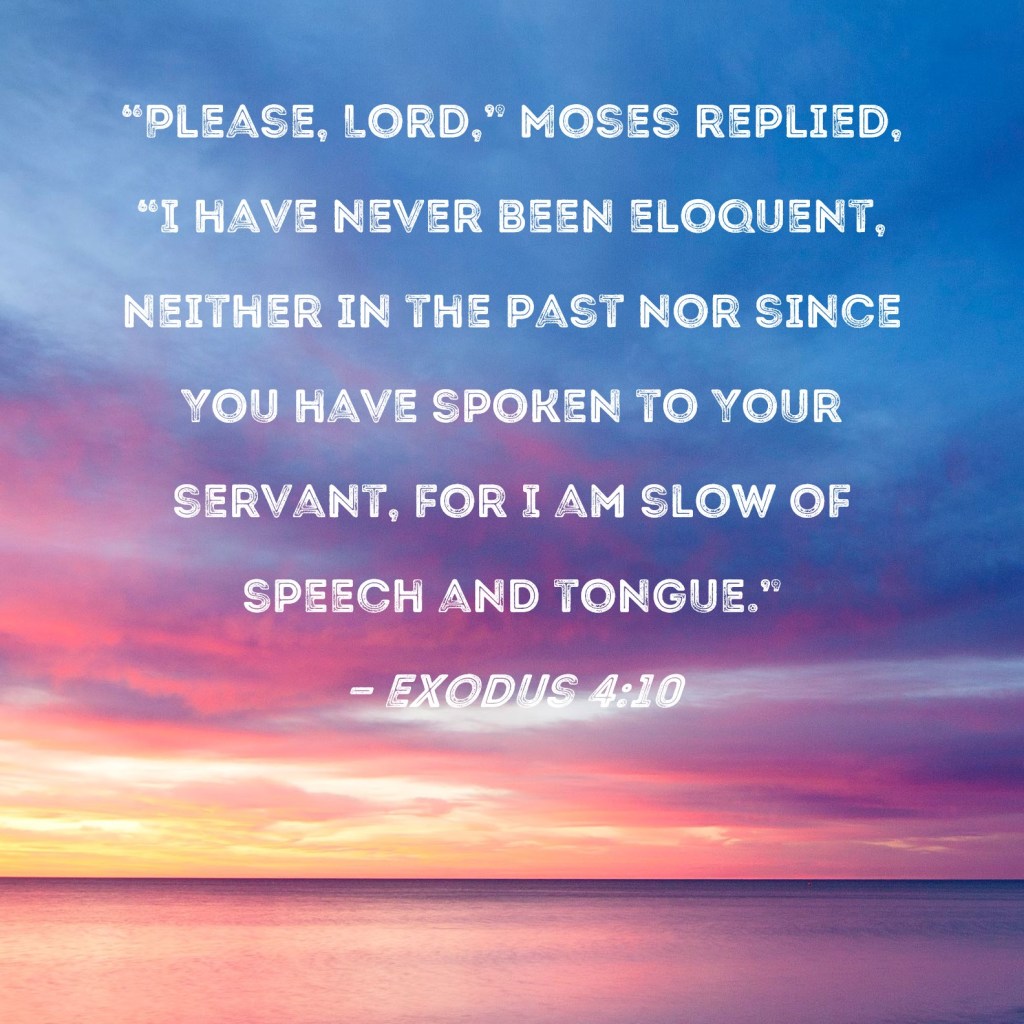
    I’m referring to Exodus 4:10:

    10 And Moses said unto the Lord, O my Lord, I am not eloquent, neither heretofore, nor since thou hast spoken unto thy servant: but I am slow of speech, and of a slow tongue.

    When I first thought about coming back to church in ~2011 there was one overwhelming obstacle in my path: what if I’m asked to speak??? I know to many this seems absurd. But I hope it goes to illustrate how big a fear this was (and still is) for me. I have memories of being a deacon (12–13-year-old) in church and dreading a Sunday School class I learned would be spent reading scripture out loud. It filled my entire body with fear. It made me lock up. It made my throat tight. It made me gulp over and over. It made me sweat. I would start to feel like I might throw up.

    Some of you think you have a fear of public speaking.

    Now do you get how big a fear this was and still is?

    I know others have it worse than me.

    When I did finally come back to church in ~2015, I had to make a decision early on. That decision was that I would not let my fear of speaking hold me back. God had brought me back and I had experiences to share and people to help. Not only that, but I had to learn to lessen the control fear had on my life.

    I decided when I was asked to speak in church, I would accept. That was until that first text came in one morning asking me to give the opening prayer in church that day. I froze. Instead of responding to the text, I called a mentor (I miss you Jessie) and talked it through. He reminded me that if I said no today, when would it stop? By the time I responded to the bishopric member who asked me to give the prayer, he had already reassigned it to someone else. I was off the hook that day, but I promised myself the next time I was asked to speak, I would accept without hesitation, before I could let the fear and excuses set in.

    Little did I know how much that next call would try my faith.

    I was in the middle of studying for a work certification. I’d already failed the test once and this next test was extremely important. I’d been studying for weeks. The test was a couple weeks away when I got the call. I was asked if I could speak in church in two weeks. The excuses flooded my mind: I have this test I’m studying for, I can’t write a talk, and besides, the added stress…! I can’t, I’ll have to accept next time.

    Then I remembered the promise I made myself. 

    “Yes, I will speak.”

    That taught me an important lesson. If we let our fears control us, they will. There are always excuses why NOT to do something that makes us uncomfortable. I spoke two weeks later in church. Beth still talks about that day, hearing me speak, as being the first day I caught her attention.

    From that day forward if I was asked to bless the sacrament, give an announcement in church, say the prayer, teach a lesson, or speak, I always answered yes without hesitation. It petrified me every time. I remember one day I gave someone the Holy Ghost which entailed laying my hands on a friend’s head and giving her a priesthood blessing in front of our entire church. That same day I also blessed the sacrament in front of the whole church, and I gave a talk in front of the whole church.

    Any one of those things in a given day would have given me nightmares.

    Before sacrament, I started to feel sick to my stomach. I thought I was going to be physically ill. I went to an empty classroom, I knelt, and I prayed for help.

    “Please, Heavenly Father, please, just help me get through this. I need you.”

    That may have been the day I solidified my knowledge that I can’t do anything without God, I’m nothing without Him.

    When I gave that blessing to the friend, bestowing the Holy Ghost upon her, I walked up with knees shaking. I thought I was going to, at a minimum fall over, and possibly faint. My throat was dry, and it hurt. I’ll never forget the feeling when I put my hands on her head, with the whole congregation, heads bowed, waiting for me to speak.

    I’ll never forget feeling like a cold bucket of water was poured over my head. From my head down to my toes I felt a tingling. Calm overcame me.

    My grandpa used to say his favorite thing in the world was to give a priesthood blessing because it was the closest he ever felt to God. He said he could feel God in those moments speaking through him.

    That’s what I experienced that day.

    I wrote this on a day that I was speaking in church. I still get kind of sick to my stomach. I still get extremely nervous. I still have to fight back the panic.

    Sometimes people tell me they can’t tell I’m nervous when I speak. I appreciate that, but sometimes I just wish everyone knew. There’s power in putting it out there.

    For others who have this fear, and I know there are many, my biggest advice is to put it out there. Don’t shy away from your fear. When I’m extra nervous, I might just say, “I’m really nervous right now.” Then I feel like I’ve removed the question from those watching and from myself worrying about it. I’ve found this to really help when public speaking.

    I’m grateful for my fear of speaking. It’s assured me, and is a constant reminder, that I can’t do anything without God.

    For those wondering, on the day I wrote this, I did end up speaking and it did go OK. I was supposed to speak for 10 minutes and spoke for 22 due to an excess of time being available. I feel that with practice anything can become more comfortable, and that’s definitely the case with me and public speaking.

    I’ve now taken to challenging myself a little more, to see just how far I can take this reliance on God. The last time I was asked to speak in church I intentionally put zero preparation into my talk. I was asked to speak last minute, a couple days beforehand, due to someone canceling, and the topic was “personal revelation,” so I thought it was a fitting time to try it.

    I got up before the church with little idea of what I was going to share. As I looked around at the congregation, I knew what I wanted to share.

    I’m grateful for the opportunity to speak in church. I’m grateful to be able to share my thoughts and experiences. This fear is a constant reminder that I need God, and I’m grateful for this weakness. Every time I’m asked to speak I’m reminded how weak and silly I am. We can look at all our weaknesses this way, as a reminder of how much we need Him. I know as we do this we come closer to God and better appreciate all He has done and continues to do for us.

  • How did the Trinity come to be? – The Nicene Creed Post 1

    How did the Trinity come to be? – The Nicene Creed Post 1

    Most of my blog posts are personal experiences with little research. They’re mostly just stream-of-thought writing. That’s what I prefer.

    Every once in a while, I want to write about a topic I know nothing about, which results in some (or a lot) of research. My Adam-God Theory post is one that comes to mind.

    I’ve long wanted to write a post about how the Trinity came to be. To prove this, years ago I gave my thoughts on the Trinity in this post.

    And wrote about how I know the Godhead to be true in this post.

    This has been a topic pretty consistently on my mind for a long time.

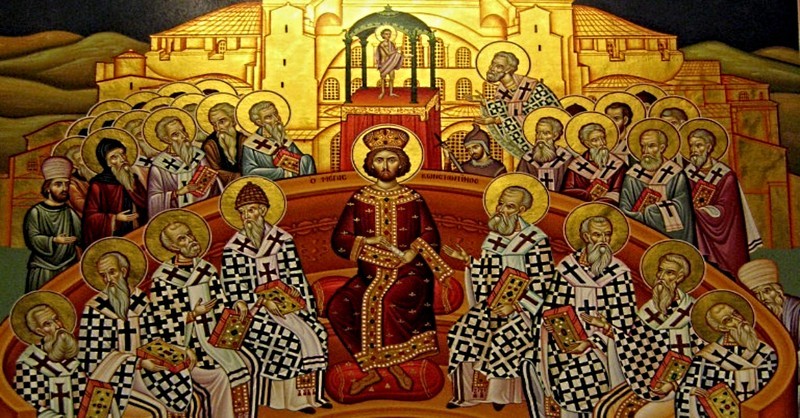
    Quick definition so we can all follow along (because this isn’t going to be an advanced or complicated post), the Trinity refers to the belief that God the Father, Jesus Christ, and the Holy Ghost are all one being. Most of Christianity believes in the Trinity. The Church of Jesus Christ of Latter-day Saints, through the experience of the prophet Joseph Smith, believe in the Godhead. The Godhead is the belief that God the Father, Jesus Christ, and the Holy Ghost are three distinct beings who are one in purpose (John 17:21-23).

    I’ve long wanted to learn more about how the Trinitarian belief came to be. I know it developed from the Nicene Creed. But if this is a falsehood perpetuated throughout history, how did it become so dominant? I’ve wanted to understand this history better. Part of the motivation to understand this better comes from the dominance of the Trinitarian viewpoint. When I’m trying to relate to other Christians, the Trinity vs Godhead question really becomes an issue.

    To know God you must know who He is. When I talk to a Christian, we both believe in Jesus Christ, but who is Jesus Christ? It’s OK to say we both believe in God and go from there, but sometimes not understanding who God is keeps me and other Christians from really being able to progress and learn from each other.

    Personally, I believe this is why this misunderstanding has been so perpetuated throughout history. Satan is cunning. He knows if we don’t know who our Father is, it becomes so much harder to worship Him.

    Is that an unfair statement for me to make? I can hear all the Catholics and Protestants and Lutherans and Baptists in an uproar when I state that a core belief of theirs has been perpetuated by Satan to confuse them. I understand that this is inflammatory. When I’m told by those same groups of people that my belief that God the Father and Jesus Christ are separate and distinct beings is a lie that Satan has deceived me with, it hurts. So I get it.

    This is why I want to understand where the belief in the Trinity comes from.

    When I read the Bible, it’s so abundantly clear to me. It doesn’t make any sense to me that people can read the Bible and conclude that Heavenly Father and Jesus Christ are one person. And yet, I’m in the minority, so clearly, there’s more to it.

    We all have our biases. I have always known Heavenly Father and Jesus Christ to be separate individuals. I have always known Christ to be my advocate with the Father. I have always known Heavenly Father to be my literal Heavenly Father. Seeing it any other way is hard. I get that others have always seen them as the same being. Others have read the scriptures with them being the same entity in mind. I get it.

    Which leads me to my point.

    As I studied this more, trying to understand it, the more confused I got. How this came to be is so confusing. I wanted to write a post simply explaining the history of the Nicene Creed and how the Trinitarian belief came to be and I’m realizing giving a “simple” explanation is going to take a lot more reading to understand.

    Some things stood out as I’ve studied this topic. I have a 62,000+ word document of research, quotes, and other information from my study of this topic.

    What stands out are the words I come across when reading how the Trinitarian belief came into existence.

    “Argument” – 13 times in my notes.

    “Debate” – 7 times in my notes.

    “Power” – 18 times in my notes.

    These are the words I kept coming across as I studied this topic.

    One word stands out that I haven’t come across thus far in all my reading. That word is “revelation.” In all that I’ve read it’s always “debate” and “power” and “trial” and “gain” and “politics.” No revelation

    I would love for a biblical and historical scholar to give me a crash course on the history of the creeds. For now, I continue to read, and study, and try to understand why the Christian world trusts a gospel principle that was handed down by power and politics, with little reference to the God they were trying to understand.

    I conclude this post without a conclusion because I don’t yet have one. It will be the first of many posts about the Nicene Creed and the Trinitarian belief.

  • Goals

    Goals

    I never used to set goals. I’m not exactly sure why. Could have been partly due to the thinking: if you don’t set goals you don’t fail.

    Throughout life, despite not actively setting goals, I think I’ve always had goals, even if those goals are subconscious. I think we all have goals.

    It’s interesting to look back on my life and see how my goals have changed.

    High school – graduate

    College – have as much fun as possible and meet as many people as possible

    After college – have a job to provide for myself

    Over time my goals changed in drastic ways. I went from wanting to have fun to thinking about a family. At some point, I went from only thinking about myself to thinking about others. 

    I’ve never been one to put a whole bunch of stock in goal setting. I always heard the logic: “You can’t accomplish it until you write it down.” I can see how that makes sense, but I just never subscribed to it. That includes New Year’s Resolutions. What’s the point of a whole population of people setting goals due to an arbitrary date? A goal they will stop putting any effort toward after week 3. 

    My Dropbox account has a whole lot of random and miscellaneous items in it. Random word documents, thoughts, quotes, letters, theories, links, notes, etc. When I had been back at church a couple years, I stumbled across something interesting, something I had almost no recollection of writing. I’ll post some of it here. It was a Word document called “2016 Goals.”

    Here is what I wrote in 2016. Through context clues, I can determine it was written either very early in 2016 or even *gasp as New Year’s Resolutions.

    Life

    • Stop swearing
      • Every time I swear out loud, take note of it. At the end of the year, donate $1 for every swear word I said through 2016.
    • Drink less
      • Try to limit drinking to twice per month.
    • Go back to church
      • In January go at least once.
      • February-December go to church at least 2 times per month. If I go less than 2 times in any given month, make up for it in a future month.
    • Go out of my way to do one nice thing for someone else at least once per week.
    • Buy a property.

    High aspirations, right? Try to limit drinking to twice per month, wow… aim for the stars.

    Other than the “Life” category I also had poker, work, and exercise. For the purpose of this post, I’ll focus on the above – Life.

    First of all, I immediately didn’t keep pretty much any of these goals. I never donated $1 for every swear word, though I do remember trying to keep track of my swearing. Drink less – out the window almost instantly. I don’t think I went to church at all January or February, so that’s pretty funny. 

    But here’s the extraordinary part. The year 2016 was the year I accomplished EVERY SINGLE ONE of those goals, with only buying a property bleeding into 2017.

    I stopped swearing in 2016, completely.

    I stopped drinking in 2016, completely.

    I started thinking about others. I don’t know if I did a nice thing for someone every week, but I know I tried.

    I bought my condo in 2017.

    In my opinion, without a doubt, the most important one and the one that enabled me to accomplish all the other goals I set – March 2016 was the month I started going back to church. I laugh at the fact I didn’t go in January or February, but is there any chance I would have gone in March if not for writing down these goals? Probably not.

    Remember, I don’t even remember writing these down. I know that seems strange, but I don’t. That’s how little thought I put into it. Within 2 months I’d completely forgotten about these goals. But, I think, something inside of me didn’t forget about these goals. Call it my subconscious, I’ll call it my soul, somehow, some way, writing these down gave me the power and strength to do things I thought impossible. Note again the goals, swear LESS, drink LESS. I went back to church and that became I don’t want to swear, I don’t want to drink.

    I’d be remiss if I gave all credit to myself for writing these goals down and accomplishing them. These goals that were written down and forgotten, my soul remembered them. I also think they were written and acknowledged somewhere much more important. I believe someone took note of my goals and sent help. That’s the only logical conclusion after all these forgotten goals somehow fell into place in the year 2016.

    After all this, I still don’t set concrete goals. Shame on me after the evidence I’ve seen. When I stumbled upon that “2016 Goals” Word document, I became a believer. Writing down goals is powerful. God sees our goals. Maybe our subconscious kicks in. Maybe good goals cause your spirit to cry out with joy that you’ve set some standards for yourself to try to accomplish.

    What I do know, is that goals are powerful. Writing them down is powerful. I should really try to be better at setting and WRITING DOWN concrete, solid goals. I’ve seen extraordinary things come from that. I think we all can accomplish extraordinary things when we set ourselves on a path.

    I have to conclude by thanking them. God. How could that all have happened without His support? My goals were so lame, and yet He made them something. Jesus Christ. How could I accomplish anything without Him forgiving me for all my wasted time, bad actions, and mistakes? I could only move forward by Him letting me look past my past. The Holy Ghost. There were countless difficult situations, countless times I ALMOST gave in and started drinking again, countless times, countless times. I know he was always there begging me to listen to him. Finally, the countless angels God undoubtedly sent, seen and unseen, to lift me up, help me along, protect, and encourage me. I owe it all to them. I am grateful.