Find yourself a wife that is kind, caring, and good.
Find someone you know will be a good mother not by any one action or by any words but by their being; who they are.
Find someone who will love, uplift, and support you through everything you want to accomplish.
Here’s an important one: find someone that will love you conditionally. The world says to find someone that loves you unconditionally. That’s too easy. Where is the growth and progression in being loved unconditionally? Find someone who wants you to improve and be better as much as you yourself want to improve and be better.
Find someone who also wants to be better.
When two people independently want to be stronger and better, they collectively become stronger and better.
As important as someone who loves you conditionally, find someone who loves the Lord unconditionally. Find someone who has a testimony of what is important in this life. While the world moves and shakes, find someone with a foundation. So that if ever your foundation becomes weak, you have someone whose foundation is strong.
Keep your foundation strong for that person as well, so that they can rely on you when their foundation needs shoring up.
Find someone who wants God to be a part of your life, family, and home. If God is in your home, your home can never fail.
Find someone with faith. Find someone with devotion. Find someone you can trust.
Having a newborn is pretty difficult. Understatement? The challenges are diverse and wide-ranging. I don’t believe this is a coincidence.
As Beth and I were driving to the hospital for her to bring a baby into the world – we prayed.
As we waited to get checked into the hospital – I prayed.
As we sat in our first room and Beth’s pain started to increase – I prayed harder.
As we were moved into the delivery room and the miracle began – I prayed constantly.
As I held my new daughter – I prayed, holding back tears of gratitude.
As we took the new member of our family to our hospital room – I prayed.
As we struggled to stay awake and care for her new needs – I prayed.
As we drove home – I prayed.
As we started the first weeks of no sleep, stress, anxiety, and responsibility. As we tried to feed Sage, as we changed her multiple times throughout the night, as we walked around bleary eyed, as she slept on my chest, as she cried in my arms – I pray constantly for help and strength.
As Beth becomes a zombie from lack of sleep – I pray.
As I fall asleep holding Sage – I pray.
As Ivy adjusts to a new sister, the responsibility, and the change to her little world – I pray for her.
As Beth works to breastfeed every 3 hours and continues not to sleep – I pray for her.
As I go back to work, Beth having extreme trepidation – I pray, and I assure her it will be ok.
We’re being looked after.
As Beth texts me, “You must have said a good prayer for us for today. I can’t believe I feel as good as I do right now.” – I pray with so much gratitude.
I know we’re being looked after.
Having and bringing home a newborn is stressful and a momentous responsibility. I don’t think that is a coincidence. I think it’s meant to remind us how much we need Him. I’m grateful for how difficult it is to bring a new baby home because it brings me closer to my Heavenly Father. I have to rely on Him, because I know my strength is nothing, and I know I can’t do it without Him.
I’m grateful for these challenges because they remind me how much I need Him.
I went on a weeklong river rafting trip. I believe it was the longest time I’d spent away from Ivy. A large portion of that trip, I did not have my cell phone with me.
When I got off the river and started driving back to Las Vegas with my family, I checked my phone and learned that Ivy had not had a good week. Meltdowns, tantrums, refusing to sleep. Apparently, she’d had a very hard time in my absence. I didn’t even recognize the girl being described.
Many theories were tossed around to explain the behavior: teething, out of her routine (they stayed at my in-law’s house), she was sick, her shoes were too tight. I knew the truth. She missed her daddy. I couldn’t wait to get home and comfort her.
I’ve written about missing Ivy before. This was the first time, it seemed, she could really miss me. I just finished a book, What a Difference a Daddy Makes by Dr. Leman that talks all about the importance of a father, especially in a daughter’s life. It talks about how a father reinforces confidence and helps a daughter relate to men as she gets older. It talks about how moms have a tendency to parent and do things one way, and the balance of how a father generally does things is important to a child’s development. This is at least partly why The Family Proclamation says, “Marriage between man and woman is essential to His eternal plan. Children are entitled to birth within the bonds of matrimony, and to be reared by a father and a mother who honor marital vows with complete fidelity.”
I believe I was 16 when I first hung up on my mom while she was talking. I promptly received a call from my dad. The usual mild-mannered, relaxed father I knew was gone. I was told over the phone, in no uncertain terms, that if I EVER hung up on my mother ever again, he would kill me. I believed him. He told me I was to treat my mom with respect. It was an important lesson I needed to learn. It was the last time I ever hung up on my mom.
This is an example of why kids need their dad. Dads, in society, have gotten a ridiculously unfair reputation. Dr. Leman in the aforementioned book noted the unfair representation of fathers on television. Fathers are almost always bumbling blockheads that can’t get anything right. This is unfair and wrong. It has built a belief in society that fathers aren’t needed, or worse, that they cause more harm than good. Fathers are important.
So how was Ivy when I returned home? An angel. The most well-behaved, happy, sleeping babe you ever met. She smiled ear to ear the moment I saw her when I got home. It was such dramatic joy that I almost didn’t believe all the propaganda I’d been hearing about her. She just needed her daddy.
Before I could get too cocky, Beth had a doctor’s appointment during the week. It was Ivy and I for a couple hours. Then I got to witness all the behavior I’d seen.
A growing girl needs her daddy. She also needs her mother. We’ve seen that Ivy is way happier when it’s all of us together. Ivy’s still relatively fresh from heaven. She knows the importance of family and the The Family Proclamation.
I’m grateful to understand the importance of family. I’m grateful to have a small inkling of how important I can be to Ivy’s life. I’m grateful that Beth continues to be such a great mother. I’m grateful to have an amazing family to help me understand these things. I’m grateful that families can be forever.
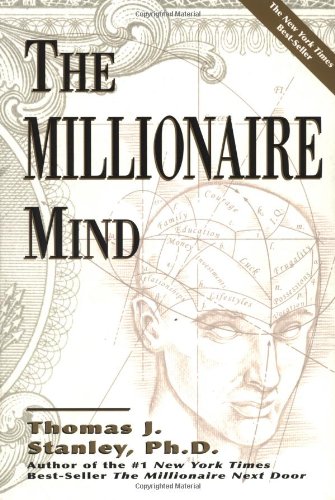
I mentioned in another post the repetitive nature of the book The Millionaire Mind by Thomas J. Stanley. It’s a world-famous, best-selling book written in 2000. Being written 22 years ago makes it slightly outdated (might be the billionaire mind now), yet it is clearly still relevant today. The repetition is undoubtedly intentional as that’s the way humans learn. What were the repeated points made over and over, then? What does this book clearly think are the most important aspects of becoming a millionaire or having a “millionaire mind”?
Before I give the list of things I found repeated in the book, it’s important to point out a distinction made in the book between types of millionaires. In the study of millionaires, the author, Dr. Stanley, was looking for “balance sheet millionaires.” He wanted people with high asset, low debt net worths. For obvious reasons this book was NOT a study of individuals who appear to be living a millionaire lifestyle when in reality they were in huge amounts of debt.
Here are the things I found myself highlighting over and over from that book:
Marriage is conducive to becoming a millionaire, or financially independent. This is for various reasons including but not limited to:
Having a support system and partner
Combining skills and talents (2 is better than 1)
Stability
Generally, millionaires are cautious with how they spend their money. “Cheap” is not a fair characterization, but frugal might be. They are cautious with their money and particular about how they spend it.
The book used the example often that millionaires never bought a car over $41,000 or paid more than $38 for a haircut.
Often, millionaires started their own business. It’s difficult to become a millionaire when you’re being paid by someone else.
I find point 3 very interesting. There’s a guy on YouTube that has gotten popular making one type of video. In these videos he walks around asking people in expensive cars, “what do you do?” Common answers heard are attorney, doctor, and real estate. But the overwhelming majority of the answers are some form of “I started my own company x.”
I think about this often. This was the point stressed over and over, more than any other point made in this book. The dead horse was beaten relentlessly. If you want to get “rich,” start your own business. If you don’t know this, I’m telling you now, so now you know. But I think most of us know this. And yet, so few of us start our own business. Why is that?
Like I said, I think about this a lot. I think there are various reasons more people don’t venture out and start their own thing. They can be boiled down to:
Fear
Doubt in oneself
Laziness
Ignorance
That’s it. I think those are the four things that keep someone from starting their own business. Working for someone else is stable and comfortable, going out on your own is scary (fear). When it’s up to you and you alone to succeed, the excuses go out the door. Relying on yourself for your paycheck requires a lot of confidence in oneself (doubt in oneself). Laziness is probably the greatest detriment to progress in life (laziness). Finally, ignorance in not knowing where to start, or thinking people who start businesses just knew something they didn’t or had some secret (ignorance). Often this is an accepted ignorance. The thinking that others have a secret sauce of success. This ignorance is tied to laziness more than anything.
There is *usually no secret sauce. Usually someone who starts their business had less fear, less doubt in themselves, were the opposite of lazy, and did the research and work. Simple as that. I’m trying to work myself towards a financial freedom goal. It’s slow work and I find myself running into these four hurdles constantly: fear, doubt, laziness, ignorance.
All these things can be defeated, and I think we would benefit ourselves greatly to face these challenges head on and step out of our comfort zones. Of course, that’s easier said than done.
So what’s my conclusion? Why am I writing this post if I myself can’t step out of my fear, doubt, laziness, and ignorance? I don’t know yet. But maybe one day I’ll look back on this post and think, “well I was always thinking about it, and eventually I got there.” That’s the hope.
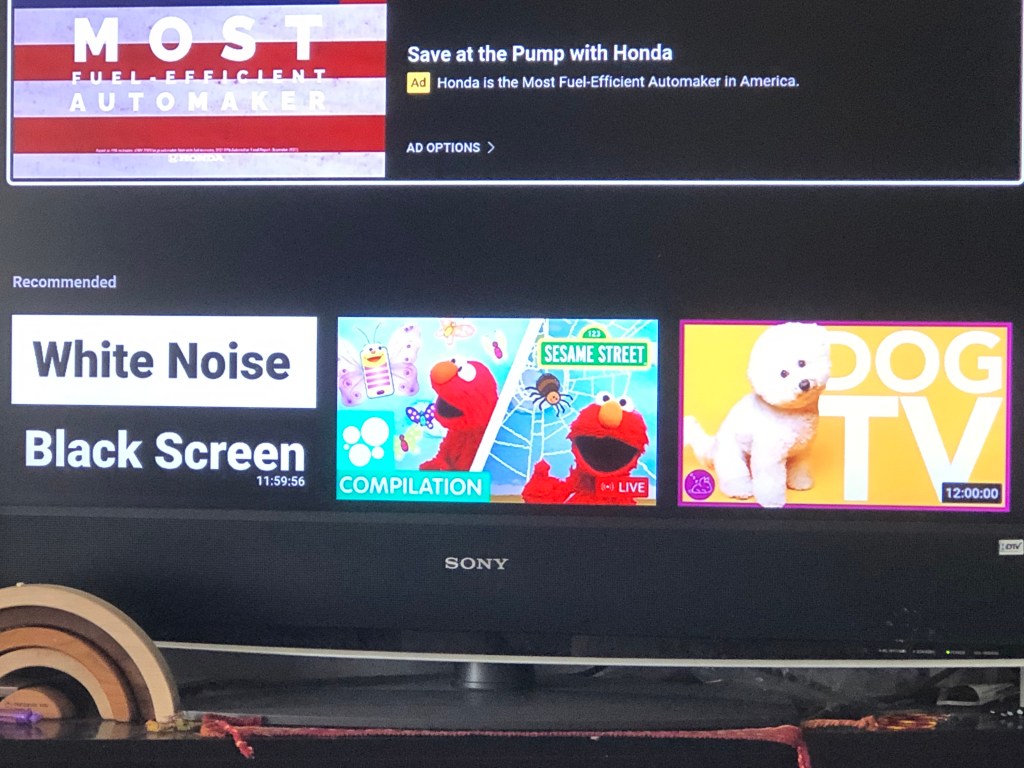
I recently sent this picture to three friends of mine:
I said to them, “How you know when you’re officially an old dad – your recommended videos on YouTube. Just letting you guys know so you can start to see the signs.”
My recommended videos on YouTube are –
12 hours of White Noise Black Screen (so I can sleep)
Live Elmo compilation (so Ivy can be entertained)
12 hours of Dog TV (so Bengie can be entertained)
One of my friends responded, “I’ll keep that in mind if I ever find a partner.”
These three friends are in various relationship statuses, mostly in the bachelor spectrum. That comment from my close friend made me think. I wanted to respond with something semi-productive. I didn’t want to give a normal, mean, insulting, and joking answer.
I responded, “Step 1 – Take steps towards making yourself someone you’d want to date.”
This got me thinking. I tell Beth all the time, if she met me when I was 19-24, she would not have been able to stand me. There’s very little chance she would have had interest in me. She would have thought I was an obnoxious, selfish, immature child. I could easily put some more disparaging adjectives there, but I’ll go easy on myself.
In our lives we always want the best for ourselves. We want a beautiful, intelligent, well-spoken, funny, fun, giving, kind, patient person we can trust and who has their life together. That’s what we want for ourselves. I know that’s what I always wanted. The problem was, that’s the kind of girl from the age of 19-24 I was looking for, meanwhile I was none of those things myself.
How can we expect to find a partner we love and respect for all their great qualities if we haven’t developed those qualities for ourselves?
I’m still working on those qualities, but I hope that my journey back to church helped me to develop some of those qualities a little more. I had to take concrete, real, small steps towards making myself a better person to find a partner I always felt I “deserved,” though lacking the evidence of deserving anything. My behavior for those few years (19-24) was selfish, half-hazardous, and chaotic. No wonder I found myself in selfish, half-hazard, and chaotic relationships.
My point is, we don’t just find a phenomenal partner. We earn a phenomenal partner by being those very qualities we want in a partner. Again, no chance Beth gives me a second glance when I’m 22. But through changing a plethora of bad habits I became a person someone like Beth – a beautiful, intelligent, well-spoken, funny, fun, kind and patient individual with her life together – would give a chance.
Don’t expect to find a great partner if you haven’t developed great qualities in yourself. This doesn’t happen over night. It’s a conscious and effort-filled journey to impvove oneself. Sometimes it’s hard to be introspective and address the qualities in oneself that aren’t the best. I know it was hard for me.
I’m still working every day to be a husband that deserves a wife like Beth. Now I have the added motivation to be a father that raises a daughter with good qualities. It’s my greatest desire for Ivy to be kind, and smart, and confident, and bold.
Start making the steps. Find one habit you can change. Be better tomorrow than you were yesterday. Through small and simple steps great things can, and will, happen.
For more on change, Beth gave a great talk on change that I shared here.
Also, Elder Kevin S. Hamilton gave a talk in last General Conference (eerily similar to Beth’s) on change, which can be read here.